- 256 pages
- English
- ePUB (mobile friendly)
- Available on iOS & Android
eBook - ePub
About this book
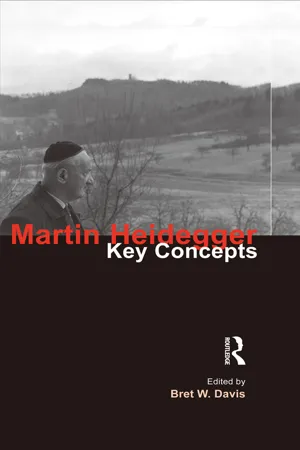
Heidegger's writings are among the most formidable in recent philosophy. The pivotal concepts of his thought are for many the source of both fascination and frustration. Yet any student of philosophy needs to become acquainted with Heidegger's thought. "Martin Heidegger: Key Concepts" is designed to facilitate this. Each chapter introduces and explains a key Heideggerian concept, or a cluster of closely related concepts. Together, the chapters cover the full range of Heidegger's thought in its early, middle, and later phases.
Information
ONE
Hermeneutics of facticity
Theodore Kisiel
Comprehending factical life in its holistic concreteness: through Dilthey to Heidegger
It was Fichte who first coined the abstract term “facticity” (Facticität; later Faktizität) for the philosophical tradition. He was thereby not referring to empirical facts or a collection of them, but to the central “fact” of the tradition of modern thought, which takes its starting-point from Descartes’ famous regress to the “fact of the I-think”, understood as the irreducible limit of reflection behind which one can question no further. It then becomes the ground on which all of modern philosophy takes its stand in order, like Atlas, to move the entire world. The locution of the “fact of the I-think” appears on occasion in Kant’s First Critique, which he supplements with another comprehensive fact early in the Second Critique, when he proclaims the moral law, in its correlation with freedom, to be “the sole fact of pure [practical] reason”. It might accordingly be called a transcendental fact, although Fichte tended to call it “facticity”, especially in his later lecture courses. The posthumous publication of these courses and later works by his theologian son, Immanuel Hermann Fichte, could be considered the most proximate source of the diffusion of the term into the nineteenth-century literature of both philosophy and theology. Nineteenth-century Protestant theology is replete with references to the “facticity” of the events of Christian salvation history, on which the Christian faith takes its original stand. The persistent albeit sporadic use of the term in nineteenth-century writers such as Kierkegaard, Feuerbach, Dilthey and the neo-Kantians is a matter of lexical record (Kisiel 1986–7, 2008).
Dilthey’s occasional use of the term is especially influential on Heidegger. In the context of distinguishing between mythical thought and religious experience, the early Dilthey makes the following observation about the world of early humanity:
[T]his context … grounded in religious experience … is likewise conditioned by the way in which reality is given to human beings in those days. Reality is life and remains life for them; it does not become an intellectual object by way of knowledge. Therefore, it is in all ways will, facticity, history, that is, living original reality. Because it is there for the whole living human being and has not yet been subjected to any kind of intellectual analysis and abstraction (hence dilution), it is therefore itself life. … Life is never exhausted by thought.
(Dilthey 1988: 161 = 1973: 141, emphasis added, trans. mod.)
And yet life is amenable to thinking, when performed without theoretical intrusion, that is, phenomenologically. In his quest for a critique of historical reason, Dilthey gradually renounces the elevated reason of the detached transcendental ego, “in whose veins flows no real blood” (1973: xviii), and calls instead for a return to the “this-side” of life, to the full facticity of unhintergehbares life itself, “behind which [theoretical] thought cannot go”, the vital original reality given to human beings to live before they come to think about it, an irreducible ultimate and irrevocable givenness that human beings cannot but live in and are bound to live out. It is the phenomenological return “to the things themselves”, in this case, back to the transcendental fact of life itself. Starting from the ineradicable givenness of factic life, the phenomenologist must now enter into this life in order to understand it from out of itself, in its own terms. In his philosophy of historical life, Dilthey’s ambition was to develop the “categories” – Heidegger will eventually call them existentials – or basic structures of historical life out of factic life itself, which prior to any thought spontaneously articulates and contextures itself in a manifold of vitally concrete and meaningful basic relations (beginning with I-myself-being-embodied-in-the-world-with-others-among-things) that constitute its immediate lifeworld. In Dilthey’s pregnant phrase, “das Leben selbst legt sich aus”: “life itself lays itself out, interprets itself”, generating its own meaning and senses of direction in the combined shape and thrust of a working context and operative continuity of structure (Wirkungszusammenhang) (Kisiel 1993: 134–5).
In fact, human life is this self-articulating and therefore fundamentally understandable operative continuity of context. Accordingly, phenomenology as the pre-theoretical proto-science of original experience is a “hermeneutics of facticity”, whose initial aim is to make explicit the implicit structures into which historical life has already spontaneously articulated itself, “laid itself out”, prior to any extraneous thought or alien theoretical intrusion. The young Heidegger thus sharply juxtaposes the historically situated I over against any sort of theoretical I or transcendental ego abstracted in Cartesian fashion from its vital context, thereby denuded of its world, dehistoricized and devitalized (ibid.: 45–6; TDP 61–6, 74–7, 174 = GA 56/57: 73–8, 88–91, 206, 208–9).
This historically situated I will soon be ontologically identified with Da-sein as being-in-the-world (see Chapter 3). The language of life now slides into the language of be-ing. Yet, behind the scenes of Dasein as being-in-the-world, the spontaneous hermeneutics of factic life experience continues to operate as a pre-theoretical primal domain of being. Consider the theme of the understanding-of-being. Human being understands being. But this “understanding-of-being” is at first not conceptual in nature; it is rather the more matter-of-fact understanding of what it means to be that comes from simply living a life. To begin with, we do not know what “being” means conceptually, but we are in fact quite familiar with its sense preconceptually in and through the manifold habitual activity of living. If the term “knowledge” still applies to this understanding of life in its being, it is more the immediate “know-how” or “savoir faire” of existence, a knack or feel for what it means to be and how to “go about the business” (umgehen) of being that comes from life experience. We already know how to live, and this pre-understanding of the ways of being is repeatedly elaborated and cultivated in our various forays into the environing world of things and the communal world of being-with-others, both of which intercalate and come to a head in the most comprehensive of meaningful contexts, the self-world of our very own being-in-the-world.
This repeated cultivation and explication of our pre-understanding of being into habitually reinforced articulated contexts of relational meaning is what Heidegger has called a “hermeneutics of facticity”, where the “of” is regarded as a double genitive. That is to say, the facticity of life experience, on the basis of a prior understanding, already spontaneously explicates and interprets itself, repeatedly unfolding into the network of meaningful relations that constitutes the fabric of human concerns that we call our historical world. Historically situated existence in its facticity is thoroughly hermeneutical. Accordingly, any overtly phenomenological hermeneutics of facticity, in its expository interpretation of the multifaceted concerns of the human situation, is but an explicit recapitulation of an implicit pan-hermeneutic process already indigenous to historical life. Facticity is through and through hermeneutical (understandable, intelligible, meaningful).
But there is more. Also related to the hermeneutic situation of factic life is one of Heidegger’s most celebrated “theses”, namely, that Dasein is disclosiveness, the locus of truth as the unconcealment of being (see Chapter 8). This originary mode of truth is already manifest from the tacit dimension of pre-predicative understanding that must be repeatedly explicated out of its precedent latency and concealment, first of all in the persistent exercise of the habit of living, which can then be more overtly explicated by way of deliberative existential and phenomenological exposition. The hermeneutic situation of factic life itself, unfolding itself against the background context of the environing world of tool usage and procurement of products, the interpersonal world of social usage and communal custom in being-with-others, and the self-world of striving-to-be and discovering oneself in one’s unique being, is the proximate disclosive arena of originary truth as unconcealment. Truth is thereby displaced from its traditional locus in judgement and assertion – even seemingly comprehensive assertions such as Cogito ergo sum – to the existentially contextualized expository question, especially when it is poised at the doubled frontier of concealment of the human situation in its mystery and its errancy.
The comprehensive disclosive capability of human existence was in fact recognized quite early by the philosophical tradition. Aristotle, for example, observes that “the human soul is, in a way, all beings”, that is, it is capable of “coming together with” all being by way of cognitive intellection (SZ 14, citing De anima 3, 430a14). But for this tradition, which runs from Parmenides to Husserl, the basic mode of knowing is the total transparency of illuminative seeing, intuition, which in temporal terms means a making-present. In the context of a hermeneutics of facticity, by contrast, the basic mode of knowing is interpretive exposition out of a background of understanding that by and large remains tacit, latent, withdrawn and, at most, only appresent, a tangential presence that shades off into the shadows of being’s concealment. Discovering beings and disclosing the self and its world take place in a temporal “clearing” of unconcealing being that displays an overriding tendency to withdraw into concealment. But this very withdrawal is what draws the enquiring human being to unceasing thought in its questioning pursuit of the temporal sense and mystery of being.
Countering ruinance and formally indicating the facticity of life
The facticity of life was first thematized indicatively and schematically1 in the War Emergency Semester of 1919 under the heading of the pre-theoretical “primal something” (Ur-etwas) of “life in and for itself” (Kisiel 1993: 21–2, 38, 50–55; TDP 186–7, 98 = GA 56/57: 219–20, 116). The semesters that follow make factic life the sole and central matter of a phenomenology defined as the pre-theoretical primal science of original experience.
Heidegger’s most exhaustive phenomenological treatment of factic life itself occurs in Winter Semester 1921–2, replete with an elaborate system of categories in the spirit of Dilthey that trace the complex motions of life in its relations with the world. The transitive movements of life include to live in, live out of, live for, live against, live with, and so on, something. This “something” that sustains these manifold relations of living is called the “world”. The category “world” accordingly names what is lived, what life holds to, the content aimed at by life. Consequently, if life is regarded in its relational sense, the world then characterizes its sense of holdings, its sense of containment. The relational sense of living can be further formally specified as caring. To live is to care. Broadly understood, to live is to care for our privations or needs, for example, “our daily bread”. What we care for and about, what caring adheres to, can be defined as meaningfulness. Meaningfulness is a categorial determination of the contextured world. The world and its objects are present in life in the basic relational sense of caring. “An act of caring encounters them, meets them as it goes its way” (PIA 68 = GA 61: 90). Caring is an experience of objects in their respective mode of encounter, ranging from things and persons to oneself, which respectively occupy the environing world, the shared world and one’s own world, the three specific worlds of care. To be an object here is to be met on the path of care and experienced as meaningful. Meaningfulness is to be taken broadly and not restricted to a particular domain of objects, say, objects of “value”. Meaningfulness is not experienced as such, but can become explicit in the expository interpretation of one’s own life as factic (PIA 70 = GA 61: 93).
The deeper structure of factic life that underlies the intentional correlation between us and the world thus proves to be the correlativity of care and meaningfulness. This deep structure might now be properly identified as its facticity, which as an articulated context of meaning is in no way a brute fact closed in on itself but instead a meaningful context open to further development. One such development – Heidegger here calls it the actualization of a tendency inherent in factic life – is for factic life in its caring to enter into the world to the point of becoming taken by it and never managing to return to itself.
Heidegger’s first detailed phenomenological account of the ways of decadence – in this semester called “ruinance” (Ruinanz) – is presented in an idiosyncratic language and at a level of complexity that will by and large be abandoned in future accounts, as it is in Being and Time, where it is described as a “falling” into “inauthenticity” (see Chapter 4). A sampling of just one of the ways of ruinance developed here may suffice. Life’s tendency to become totally absorbed in the world can reach the point of abolishing the sense of distance from the world as such. Instead, its sense of distance gets shunted into dispersion, being transported from one meaningful arena to another, now seeking distantiation within the meaningful world. The life of care in the shared world is accordingly directed towards rank, success, position, advancement, advantage, superiority (PIA 77, 90 = GA 61: 103, 121). This care for distantiation and distinction finds ever new gratification in the dispersion, which...
Table of contents
- Cover
- Half Title
- Key Concepts
- Title Page
- Copyright Page
- Table of Contents
- Contributors
- Acknowledgements
- Abbreviations
- Introduction: key concepts in Heidegger's thinking of being
- 1. Hermeneutics of facticity
- 2. Phenomenology: Heidegger after Husserl and the Greeks
- 3. Dasein as being-in-the-world
- 4. Care and authenticity
- 5. Being and time
- 6. The turn
- 7. Heidegger, National Socialism and the German People
- 8. Truth as alētheia and the clearing of beyng
- 9. The work of art
- 10. Ereignis: the event of appropriation
- 11. The history of being
- 12. Will and Gelassenheit
- 13. Ge-stell: enframing as the essence of technology
- 14. Language and poetry
- 15. The fourfold
- 16. Ontotheology and the question of god(s)
- 17. Heidegger on Christianity and divinity: a chronological compendium
- Chronology of Heidegger's life
- Bibliography
- Index
Trusted by 375,005 students
Access to over 1.5 million titles for a fair monthly price.
Study more efficiently using our study tools.
Frequently asked questions
Yes, you can cancel anytime from the Subscription tab in your account settings on the Perlego website. Your subscription will stay active until the end of your current billing period. Learn how to cancel your subscription
No, books cannot be downloaded as external files, such as PDFs, for use outside of Perlego. However, you can download books within the Perlego app for offline reading on mobile or tablet. Learn how to download books offline
Perlego offers two plans: Essential and Complete
- Essential is ideal for learners and professionals who enjoy exploring a wide range of subjects. Access the Essential Library with 800,000+ trusted titles and best-sellers across business, personal growth, and the humanities. Includes unlimited reading time and Standard Read Aloud voice.
- Complete: Perfect for advanced learners and researchers needing full, unrestricted access. Unlock 1.5M+ books across hundreds of subjects, including academic and specialized titles. The Complete Plan also includes advanced features like Premium Read Aloud and Research Assistant.
We are an online textbook subscription service, where you can get access to an entire online library for less than the price of a single book per month. With over 1.5 million books across 990+ topics, we’ve got you covered! Learn about our mission
Look out for the read-aloud symbol on your next book to see if you can listen to it. The read-aloud tool reads text aloud for you, highlighting the text as it is being read. You can pause it, speed it up and slow it down. Learn more about Read Aloud
Yes! You can use the Perlego app on both iOS and Android devices to read anytime, anywhere — even offline. Perfect for commutes or when you’re on the go.
Please note we cannot support devices running on iOS 13 and Android 7 or earlier. Learn more about using the app
Please note we cannot support devices running on iOS 13 and Android 7 or earlier. Learn more about using the app
Yes, you can access Martin Heidegger by Bret W. Davis in PDF and/or ePUB format, as well as other popular books in Philosophy & Existentialism in Philosophy. We have over 1.5 million books available in our catalogue for you to explore.