- 220 pages
- English
- ePUB (mobile friendly)
- Available on iOS & Android
eBook - ePub
The Life of Washington
About this book
Weems helped to fabricate the image of Washington that has since dominated the American historical imagination and which in its time, secured Washington's fame. This edition includes documents that provide an insight into the construction of American national identity.
Information
Chapter XI
Washington again on his farm—sketch of his conduct there—suggests the importance of inland navigation—companies forming—urges a reform of the old constitution—appointed president of the United States—great difficulties to encounter—gloriously surmounts them
TO be happy in every situation is an argument of wisdom seldom attained by man. It proves that the heart is set on that which alone can ever completely satisfy it, i.e. the imitation of God in benevolent and useful life. This was the happy case with Washington. To establish in his country the golden reign of liberty was his grand wish. In the accomplishment of this he seeks his happiness. He abhors war; but, if war be necessary, to this end he bravely encounters it. His ruling passion must be obeyed. He beats his ploughshare into a sword, and exchanges the peace and pleasures of his farm for the din and dangers of the camp. Having won the great prize for which he contended, he returns to his plough. His military habits are laid by with the same ease as he would throw off an old coat. The camp, with all its parade and noise, is forgotten. He awakes, in his silent chambers at Mount Vernon, without sighing for the sprightly drums and fifes that used to salute him every morning. Happy among his domestics, he does not regret the shining ranks, that, with ported arms used to pay him homage. The useful citizen is the high character he wishes to act—his sword turned into a ploughshare is his favourite instrument, and his beloved farm his stage. Agriculture had been always his delight. To breathe the pure healthful air of a farm, perfumed with odorous flowers, and enriched with golden harvests, and with numerous flocks and herds, appeared to him a life nearest connected with individual and national happiness. To this great object he turns all his attention, bends all his exertions. He writes to the most skilful farmers, not only in America but in England (for Washington was incapable of bearing malice against a people who had made friends with his country); he writes, I say, to the ablest farmers in America and England, for instructions how best to cultivate and improve his lands—what grains, what grasses, what manures would best suit his soils; what shrubs are fittest for fences, and what animals for labour.
But, to a soul large and benevolent like his, to beautify his own farm, and to enrich his own family, seemed like doing nothing. To see the whole nation engaged in glorious toils, filling themselves with plenty, and inundating the sea-ports with food and raiment for the poor and needy of distant nations—this was his godlike ambition. But, knowing that his beloved countrymen could not long enjoy the honor and advantage of such glorious toils, unless they could easily convey their swelling harvests to their own markets, he hastened to rouse them to a proper sense of the infinite importance of forming canals and cuts between all the fine rivers that run through the United States. To give the greater weight to his counsel, he had first ascended the sources of those great rivers—ascertained the distance between them—the obstacles in the way of navigation—and the probable expense of removing them.
Agreeable to his wishes, two wealthy companies were soon formed to extend the navigation of James River and Potomac, the noblest rivers in Virginia. Struck with the exceeding benefit which both themselves and their country would speedily derive from a plan which he had not only suggested, but had taken such pains and expense to recommend, they pressed him to accept one hundred and fifty shares of the company’s stock, amounting to near 40,000 dollars! But he instantly refused it, saying, “what will the world think if they should hear that I have taken 40,000 dollars for this affair? Will they not be apt to suspect, on my next proposition, that money is my motive? Thus, for the sake of money, which indeed I never coveted from my country, I may lose the power to do her some service, which may be worth more than all money!!”
But, while engaged in this goodly work, he was suddenly alarmed by the appearance of an evil, which threatened to put an end to all his well-meant labours for ever—this was, the beginning dissolution of the federal government!! The framers of that fair but flimsy fabric, having put it together according to the square and compass of equal rights and mutual interests, thought they had done enough. The good sense and virtue of the nation, it was supposed, would form a foundation of rock whereon it would safely rest, in spite of all commotions, foreign or domestic.
“But, alas!” said Washington, “experience has shown that men, unless constrained, will seldom do what is for their own good. With joy I once beheld my country feeling the liveliest sense of her rights, and maintaining them with a spirit apportioned to their worth. With joy I have seen all the wise of Europe looking on her with admiration, and all the good with hope, that her fair example would regenerate the old world, and restore the blessings of equal government to long oppressed HUMANITY. But alas! in place of maintaining this glorious attitude, America is herself rushing into disorder and dissolution. We have powers sufficient for self-defence and glory: but those powers are not exerted. For fear congress should abuse it, the people will not trust their power with congress. Foreigners insult and injure us with impunity, for congress has no power to chastise them.—Ambitious men stir up factions; congress possesses no power to scourge them. Public creditors call for their money; congress has no power to collect it. In short, we cannot long subsist as a nation, without lodging somewhere a power that may command the full energies of the nation for defence from all its enemies, and for supply of all its wants. The people will soon be tired of such a government—they will sigh for a change—and many of them already begin to talk of monarchy, without horror!!”
In this, as in all cases of apprehended danger, his pen knew no rest. The leading characters of the nation were roused; and a CONVENTION was formed of deputies from the several states, to revise and amend the general government. Of this convention Washington was unanimously chosen president.—Their session commenced in Philadelphia, May, 1787, and ended in October. The fruit of their six months labour was the present excellent CONSTITUTION, which was no sooner adopted, than the eyes of the whole nation were fixed on him as the president.
Being now in his 57th year, and wedded to his farm and family, he had no wish to come forward again to the cares and dangers of public life. Ease was now become almost as necessary as dear to him. His reputation was already at the highest; and as to money, in the service of his country he had always refused it. These things considered, together with his acknowledged modesty and disinterestedness, we can hardly doubt the correctness of the declaration he made, when he said, that, “the call to the magistracy was the most unwelcome he had ever heard.”
However, as soon as it was officially notified to him, in the spring of 1789, that he was unanimously elected president of the United States, and that congress, then sitting in New-York, was impatient to see him in the chair, he set out for that city. Then all along the roads where he passed, were seen the most charming proofs of that enthusiasm with which the hearts of all delighted to honour him. If it was only said, “General Washington is coming,” it was enough. The inhabitants all hastened from their houses to the highways, to get a sight of their great countryman; while the people of the towns, hearing of his approach, sallied out, horse and foot, to meet him. In eager throngs, men, women, and children pressed upon his steps, as waves in crowding ridges pursue the course of a ship through the ocean. And as a new succession of waves is ever ready to take the place of those which had just ended their chase in playful foam, so it was with the ever-gathering crowds that followed their Washington.
“On reaching the western banks of Schuylkill,” said a gentleman who was present, “I was astonished at the concourse of people that overspread the country, apparently from Gray’s ferry to the city. Indeed one would have thought that the whole population of Philadelphia was come out to meet him. And to see so many thousands of people on foot, on horseback, and in coaches, all voluntarily waiting upon and moving along with one man, struck me with strangely agreeable sensations. Surely, thought I, there must be a divinity in goodness, that mankind should thus delight to honour it.”
His reception at Trenton was more than flattering. It was planned, they said, by the ladies, and indeed bore marks that it could have been done only by them. The reader must remember, that it was near this place that the fair sex in ’76 suffered such cruel indignities from the enemy; and also that it was here that Providence in the same year enabled Washington so severely to chastise them for it. The women are not apt to forget their benefactors. Hearing that Washington was on his way to Trenton, they instantly held a caucus among themselves, to devise ways and means to display their gratitude to him. Under their direction, the bridge over the Sanpink (a narrow creek running through Trenton, from whose opposite banks Washington and the British once fought) was decorated with a triumphal arch, with this inscription in large figures:
DECEMBER 26, 1776.
THE HERO WHO DEFENDED THE MOTHERS, WILL ALSO PROTECT THE DAUGHTERS.
He approached the bridge on its south side, amidst the heartiest shouts of congratulating thousands, while on the north side were drawn up several hundreds of little girls, dressed in snow-white robes, with temples adorned with garlands, and baskets of flowers on their arms. Just behind them stood long rows of young virgins, whose fair faces, of sweetest red, and white, highly animated by the occasion, looked quite angelic—and, back of them, in crowds stood their venerable mothers. As Washington slowly drove off the bridge, the female voices all began, sweet as the first wakings of the Eolian harp, and thus they rolled the song:
Welcome, mighty chief! once more
Welcome to this grateful shore
Now no mercenary foe
Aims again the fatal blow,
Aims at thee the fatal blow.
Virgins fair, and matrons grave,
(These thy conquering arm did save!)
Build for thee triumphal bowers.
Strew, ye fair, his way with flowers;
Strew your hero’s way with flowers.
While singing the last lines, they strewed the way with flowers before him.
Some have said that they could see in his altered looks, that he remembered the far different scenes of ’76; for that they saw him wipe a tear. No doubt ’twas the sweet tear of gratitude to him who had brought him to see this happy day.
At New-York the behaviour of the citizens was equally expressive of the general veneration and esteem. The ships in the harbour were all dressed in their flags and streamers; and the wharves where he landed richly decorated. At the water’s edge he was received by an immense concourse of the joyful citizens, and amidst the mingled thunder of guns and acclamations, was conducted to his lodgings. Such honours would have intoxicated most men; but to a mind, like his, habitually conversant with the far sublimer subjects of the Christian philosophy, they must have looked quite puerile. Indeed, it appears from a note made in his Journal that very evening, that he regarded all these marks of public favour rather as calls to humility than pride. “The display of boats on this occasion,” says he, “with vocal and instrumental music on board, the decorations of the ships, the roar of cannon, and the loud acclamations of the people, as I passed along the wharves, gave me as much pain as pleasure, contemplating the probable reverse of this scene after all my endeavours to [do] good.”
It was on the 23d of April, 1789, that he arrived in New-York: and on the 30th, after taking the oath, as president of the United States, to preserve, protect and defend the constitution, he entered upon the duties of his office.
As things then stood, even his bitterest enemies, if he had any, might have said “happy man be his dole!” for he came to the helm in a perilous and fearful season. Like, chaos, “in the olden time,” our government was “without form and void, and darkness dwelt upon the face of the deep.” Enemies innumerable threatened the country, both from within and without, abroad and at home—the people of three continents at daggers drawn with the young republic of America!
The pirates of Morocco laying their uncircumcised hands on our rich commerce in the Mediterranean!
The British grumbling and threatening war.
The Spaniards shutting up the Mississippi!
The Kentuckians in great wrath! threatening to break the union, and join the Spaniards!
The Indian nations, from Canada to Georgia, unburying the tomahawk!
North-Carolina and Rhode-Island blowing on the confederacy! strong parties in other states against it!—and an alarming insurrection in Massachusetts! While, to combat all these enemies, the United-States had but 600 regular troops!! and, though eighty millions of dollars in debt, they had not once cent in the treasury!!! Here, certainly, if ever, was the time to try a man’s soul. But Washington despaired not. Glowing with the love of his country, and persuaded that his country still enjoyed an opportunity to be great and happy, he resolved, whatever it might cost him, that nothing should be wanting on his part to fill up the measure of her glory. But first of all, in his inaugural speech, he called upon Congress and his countrymen, to look up to God for his blessing; next as to themselves, to be most industrious, honourable, and united, as became men responsible to ages yet unborn, for all the blessings of a republican government, now, and perhaps for the last time, at stake on their wisdom and virtue;—then as to himself. “Ifeel,” said he, “my incompetency of political skill and abilities. Integrity and firmness are all I can promise. These, I know will never forsake me, although I may be deserted, by all men: and of the consolations to be derived from these, under no circumstances can the world ever deprive me.”—And last of all, as in a crazy ship at sea, tost by furious winds, no pilot can save without the aid of able seamen, Washington prudently rallied around him the wisest of all his countrymen.
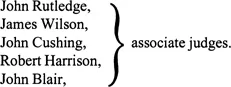
Mr. Jefferson, secretary of foreign affairs.
Col. Hamilton, secretary of the treasury.
General Knox, secretary of war.
Edmund Randolph, attorney-general.
John Jay, chief justice.
These judicious preparations being made for the storm, (Heaven’s blessing invoked and the ablest pilots embarked with him,) Washington then seized the helm, with a gallant hard-a-lee, luffed up his ship at once to the gale, hoping yet to shoot the hideous gulphs that threatened all around.
His first attention was turned to the call of Humanity, i.e. to satisfy and make peace with the Indians. This was soon done; partly by presents, and by establishing in their country, houses of fair trade, which, by preventing frauds, prevent those grudges that lead to private murders, and thence to public disturbances and wars. Some of the Indian tribes, despising these friendly efforts of Washington, were obliged to be drubbed into peace, which service was done for them by General Wayne, in 1794—but not until many lives had been lost in preceding defeats; owing chiefly, it was said, to the very intemperate passions and potations of some of their officers. However, after the first shock, the loss of these poor souls was not much lamented. Tall young fellows, who could easily get their half dollar a day at the healthful and glorious labours of the plough, to go and enlist and rust among the lice and itch of a camp, for four dollars a month, were certainly not worth their country’s crying about.
Washington’s friendly overtures to Spain were equally fortunate...
Table of contents
- Cover
- Half Title
- Title Page
- Title Page
- Copyright Page
- Table of Contents
- Foreword by Paul Finkelman
- Introduction by Peter S. Onuf
- I Introductory
- II Birth and Education
- III George's Father Dies—His Education Continued by His Mother—His Behaviour under School-master Williams
- IV George Leaves School—Is Appointed a Private Surveyor to Lord Fairfax, of the Northern Neck—Wishes to Enter on Board of a British Man of War—Providentially Prevented by His Mother—The First Lightnings of His Soul to War
- V French Encroachments on the Ohio—Washington Volunteers His Services to Governor Dinwiddie—His Hazardous Embassy to the French and Indians—Miraculous Escapes—Account of His Journal—Anecdote of His Modesty
- VI The French and Indian War Begins—Washington Goes Forth to Meet the Dangers of His Country—Aims a Blow at Fort Du Quesne—Fails—Gallant Defence of Fort Necessity—Retires from the Service in Disgust—Pressed into it Again by General Braddock—Defeat and Death of Braddock, and Dreadful Slaughter of His Army
- VII Fateful Effects of Braddock's Defeat—Washington Wishes to Carry the War into Indian Country—Government Refuses—Defensive War Preferred—The Frontiers Desolated
- VIII Washington's Mother Has a Very Curious Dream—It Points to Great Coming Troubles—A Cloud Rising in England—The Causes of the Revolutionary War
- IX Battle of Bunker's-hill—Of Sullivan's Island-Declaration of Independence—Defeat of the Americans on Long-Island—Howe Looks Big—Times Squally
- X Lord North, Coming to His Senses, Sends Commissioners to America—Clinton Evacuates Philadelphia—Washington Pursues Him—Battle of Monmouth—Arnold's Apostacy—André Apprehended—Executed—His Character
- XI Washington Again on His Farm—Sketch of His Conduct There—Suggests the Importance of Inland Navigation—Companies Forming—Urges a Reform of the Old Constitution—Appointed President of the United States—Great Difficulties to Encounter—Gloriously Surmounts Them
- XII The Death of Washington
- XIII Character of Washington
- XIV Washington's Character Continued—His Benevolence
- XV Washington' s Character Continued—His Industry
- XVI Washington's Character Continued—His Patriotism—Conclusion—Washington's Will
- Related Documents
- About the Editor
Trusted by 375,005 students
Access to over 1.5 million titles for a fair monthly price.
Study more efficiently using our study tools.
Frequently asked questions
Yes, you can cancel anytime from the Subscription tab in your account settings on the Perlego website. Your subscription will stay active until the end of your current billing period. Learn how to cancel your subscription
No, books cannot be downloaded as external files, such as PDFs, for use outside of Perlego. However, you can download books within the Perlego app for offline reading on mobile or tablet. Learn how to download books offline
Perlego offers two plans: Essential and Complete
- Essential is ideal for learners and professionals who enjoy exploring a wide range of subjects. Access the Essential Library with 800,000+ trusted titles and best-sellers across business, personal growth, and the humanities. Includes unlimited reading time and Standard Read Aloud voice.
- Complete: Perfect for advanced learners and researchers needing full, unrestricted access. Unlock 1.5M+ books across hundreds of subjects, including academic and specialized titles. The Complete Plan also includes advanced features like Premium Read Aloud and Research Assistant.
We are an online textbook subscription service, where you can get access to an entire online library for less than the price of a single book per month. With over 1.5 million books across 990+ topics, we’ve got you covered! Learn about our mission
Look out for the read-aloud symbol on your next book to see if you can listen to it. The read-aloud tool reads text aloud for you, highlighting the text as it is being read. You can pause it, speed it up and slow it down. Learn more about Read Aloud
Yes! You can use the Perlego app on both iOS and Android devices to read anytime, anywhere — even offline. Perfect for commutes or when you’re on the go.
Please note we cannot support devices running on iOS 13 and Android 7 or earlier. Learn more about using the app
Please note we cannot support devices running on iOS 13 and Android 7 or earlier. Learn more about using the app
Yes, you can access The Life of Washington by Mason L. Weems in PDF and/or ePUB format, as well as other popular books in Politics & International Relations & Political Biographies. We have over 1.5 million books available in our catalogue for you to explore.