- 224 pages
- English
- ePUB (mobile friendly)
- Available on iOS & Android
eBook - ePub
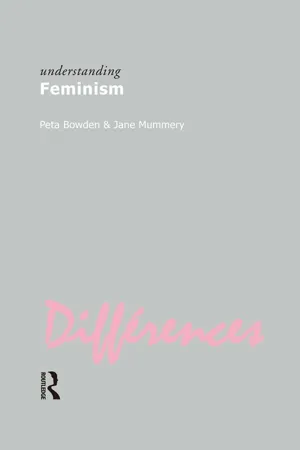
Understanding Feminism
About this book
"Understanding Feminism" provides an accessible guide to one of the most important and contested movements in progressive modern thought. Presenting feminism as a dynamic, multi-faceted and adaptive movement that has evolved in response to the changing practical and theoretical problems faced by women, the authors take a problem-oriented approach that maps the complex strands of feminist thinking in relation to women's struggles for equal recognition and rights, and freedom from oppressive constraints of sex, self-expression and autonomy. Each chapter focuses on a different cluster of concerns, demonstrating key moves in second-wave feminist thought, as well as some of the diversity in response-strategies that encompass both socio-economic and cultural-symbolic concerns. This approach not only shows how central feminist insights, theories and strategies emerge and re-emerge across different contexts, but makes clear that far from being 'over', feminism remains a vital response to the diverse issues that women (and men) find pressing and socially important.
Information
one
Oppression
“The problem that has no name”
In 1963 American writer Betty Friedan published a book entitled The Feminine Mystique, which aimed to highlight what she termed “the problem that has no name”. This book was to go on to be popularly credited with launching the second wave of the feminist movement. What was this problem that inspired women and men to new social insight and activism, and that spawned the new wave of thought that has developed into contemporary feminism? A white college-educated suburban housewife, Friedan claimed to identify a deep malaise among her female peers, a problem she diagnosed as based in the discrepancy between women’s own sense of their needs and potential in life, and the feminine roles of wife and mother to which their society – husbands, doctors, experts, schools, churches, politics and professions – consigned them. Under the terms of the “feminine mystique”, Friedan contended, women were living a lie, embracing a life that constrained and distorted their full potential. Subsequent thinkers have named the problems at the heart of feminism in different ways: oppression, exploitation, subordination, discrimination, inequality and exclusion, sexism, misogyny, chauvinism, patriarchy and phallism. Yet all of these terms circle around a common terrain: that of the restrictions associated with women’s social opportunities. Some thinkers put these restrictions down to prevailing dispositions and attitudes, and others to social arrangements; some suggest they are the result of specific constraints, others more systematic problems. Perhaps it is better to understand the “problem that has no name” as a cluster of problems with many names.
In this chapter, we will map some of the key landmarks in feminist understandings of the nature and sources of the problem of women’s limited social opportunities. This is a tall order as it requires taking on feminist analyses of not only the material conditions of women’s oppression in both the public and private spheres, but also the impact of biases in the norms and ideals of knowledge, and in linguistic practices, on women’s social situations. Alongside these critical analyses, we shall trace key feminist strategies for challenging these problematics, including those concerned with women’s struggle for equitable recognition and participation in both the public and private spheres, and some of the revisionings of feminist understandings of knowledge and linguistic structures. In this process, we will also introduce what will be an ongoing thread of feminist discussion: the difficulties produced by the tendencies to pursue either an “equality” or a “difference” response strategy (strategies that assume either that women, having the same basic needs and interests as men, should be recognized as equal to men, or, being essentially different from men, should be recognized as having different needs and interests). As we shall see, both here and in later chapters, the contest between these strategies has not only shaped much of the work of second-wave feminists but itself presents a problematic that later thinkers have struggled to overcome or deconstruct.
Countering social oppression in the public and private spheres
In the Introduction we discussed how the work of eighteenth-and nineteenth-century thinkers such as Wollstonecraft and Mill challenged some of the social strictures on middle-class western women in their times. Friedan’s twentieth-century articulation of the “problem with no name” echoed similar concerns. Friedan and her peers had greater educational opportunities than women of earlier times (and perhaps this accounts at least in part for the broader impact of Friedan’s writings) but their frustration with their destinies as suburban housewives was diagnosed as the result of being excluded from developing their full potential through participation in the careers and decision-making of the mainstream public world (of men). Society, in other words, should allow women to have equal opportunity and independence to that enjoyed by men. Friedan also argued that women’s engagement in public sphere activities of paid work and politics would allow them to see that the “feminine mystique” – with its requirements for sexual passivity, submission to male domination, and fulfilment in homemaking and motherhood – is no more than a giant ruse that prevents them from achieving freedom of choice, self-determination and dignity in an equal partnership with men.
Betty Friedan (1921–2006)
Born Betty Naomi Goldstein, American activist and writer Betty Friedan, through the publication of The Feminine Mystique (1963), has been credited with activating the second-wave feminist movement, and has more generally been seen as central to the reshaping of attitudes towards women’s lives and rights in the west. As one of the founders of the US-based National Organization for Women (NOW) in 1966 and its first president from 1966 to 1970, Friedan was instrumental in NOW’s development into an influential organization able to lobby effectively for legislative and social change that would give women now-taken-for-granted equal rights in employment, education, childcare, political participation and abortion rights. Friedan was steadfastly opposed to feminist positions based on structural analyses of inequality between the sexes, such as challenges to the public-private split, seeing them as raising unnecessary tensions between women and men. Instead she embraced the view that the solution to women’s social disem-powerment was their full participation in public sphere activities. Friedan’s later writings include it Changed My Life (1976), The Second Stage (1981), The Fountain of Age (1993), Beyond Gender (1997) and her autobiography, Life So Far (2000). Although her works have been lambasted by many feminists – bell hooks being a prime example – for their narrow representation of women (white, middle-class, heterosexual) and for their subsequent limitations with regard to political action, they mark a pioneering attempt to turn women’s personal experiences into political issues.
A view like Friedan’s, however, is seriously impaired by the limits of the experience of the particular women and men on which it draws. As a result, Friedan’s analysis does not take account of the subordinate status of all those working-class women who were already engaged in arduous and often dispiriting labours in the public sphere; nor does it recognize that the self-directed life held up as the ideal for women was available only to a select group of men, or that there are racial and cultural differences when it comes to understanding the social situations of women. Nonetheless, its resonance for the dominant social class at a time of progressive challenges to the status quo in western societies ensured its popular uptake as exemplary for what feminism and women’s liberation is all about. In understanding feminism, it is therefore important to understand how this particular version of feminism has developed and the problems and responses it has generated within its own (and the dominant strand of feminism’s) white, middle-class terms. However, as we shall see in later chapters (especially Chapter 4), while views such as Friedan’s have been influential in increasing the publicity and attention given to feminist ideas, the problems associated with their failure to recognize the differences in different women’s social situations have forced feminists to rethink significantly their analyses and response strategies.
Friedan’s diagnosis of women’s situation and the means of its change is a version of what is known as “equality feminism”. It demands that the freedoms of men’s lives should be equally available to women, and that both men and women should have equal rights and responsibilities in all significant aspects of social life. At first sight this seems eminently plausible, at least if one keeps the lives of successful men in mind. In order to liberate themselves from oppression and exploitation, women need simply to refuse the conventions of female difference and fight for the right to live by the patterns forged for men. In such a view, a life comprising commitment to housekeeping, marriage and motherhood is inherently a second-class choice.
This position, that women should have the opportunity to fulfil the dominant ideal for (certain) male lives (taking that ideal as universal for all human beings), is also described as “liberal feminism”. This is because feminists committed to this conception of equality tacitly endorse the liberal theory of politics with its accent on respect for individual choice and self-determination, its endorsement of capitalist economics and the sociopolitical distinction between public and private life. The question, however, is whether such equality or liberal feminisms are in fact effective responses to women’s oppression. For a start, aside from the failure to take account of class and race differences in people’s opportunities (a very big aside, as we have noted), a major problem readily becomes evident: who does the family work while women are in the marketplace? After all, the pursuit of a career is not simply a matter of putting on a business suit and getting out and about; it depends on someone taking care of both the family and those who are out and about. There is, in other words, a clash between participation in the public sphere and in family life, one that became obvious to many of the women who took Friedan’s advice and ended up juggling paid employment and work for their families, or choosing one over the other.
The response of some feminists has been to jockey around the clash, encouraging women to fit their jobs into the periods when their children are at school, or after they have left home. (Of course, this can mean that women might struggle to meet the demands of some time-intensive professional careers.) For women who cannot afford this option, and when the demands of their work in the public sphere exceed the flexibility of family life, feminists demand rights to part-time and flexi-time jobs, maternity leave and reproductive control, and subsidized child-and elder-care provision. However, as more women enter the workforce and public life (whether through the impetus of feminism, or the breakdown of full male employment and the family wage), the stopgap nature of these claims becomes more apparent. Work-life balance, how to juggle employment and family responsibilities, is one of the most pressing contemporary issues for women.
Other feminists have responded to this clash more critically, noting that access to public life has not put an end to women’s unequal social position. The experiences of women in marginalized socioeconomic and racial groups provide powerful evidence here. As African-American feminist bell hooks explains in Feminist Theory (1984), many of these women have always worked but this has not reduced their inequality or increased their opportunities for freedom of choice. For middle-class feminists in the west, too, terms such as “pink ghetto”, “mummy track” and “glass ceiling” show how women’s public sphere participation is still largely a second-rate affair. According to these analyses, while increasing numbers of women may achieve their dreams in education and employment, most are confined to the lower rungs of the marketplace and “pink collar” positions of caring and subservience to the needs of others. Such work, after all, holds the promise that it can be more easily fitted around family and household responsibilities, although conversely it often has little or no long-term security. For many women, participation in paid work and public life has also simply meant the addition of a “second shift” (see Hochschild 1989), where there is no reduction in household responsibilities to compensate for their additional obligations to employers (see also Summers 2003). Additionally, underemployment, increasing casualization and lack of affordable care services have all added to the difficulties of a growing number of women who struggle to support themselves and their families.
Challenging the structure of society
These difficulties suggest that the issues of equality of opportunity and freedom of choice are far more complex than as envisaged by equality-on-men’s-terms versions of feminism. While there are varied responses, most liberal feminists agree that challenging women’s material oppression depends on challenging the relationship between the public and the private spheres. British political theorist Carole Pateman in “Feminist Critiques of the Public/Private Dichotomy” (1989), for instance, shows how the two spheres do not simply distinguish different, but equally valued, realms of activity. Rather, women’s and men’s differential location in these spheres, allied with the emphases common to liberal theory, express “the patriarchal reality of a social structure of inequality and the domination of women by men” (ibid.: 120). Pateman’s point is that the split between public and private in liberal societies is a hierarchical division that understands the private as subordinate and sometimes even irrelevant to the public. The dominant liberal social ideology holds that activities in the public sphere, the realm of economic production and political decision-making, are more significant and valuable than those of the private sphere of family nurturance and personal life. The accompanying designation of the public sphere as the location of men and their activities, and the private sphere as that of women, enshrines men’s dominance in social life.
It is this rule of men over women that Pateman describes as “patriarchal”. Although, strictly speaking, this term refers to the rule of fathers over their families, here it symbolizes the distinctive character of a sexual inequality that “rests on the appeal to nature and the claim that women’s natural function in child-bearing prescribes their domestic and subordinate place in the order of things” (ibid.: 124). From here the idea that nature also underwrites a gendered division of labour (at least among the white middle classes) is only a short step away. Maternal and wifely work – caring for and nurturing the interests of others – then, is women’s work and inferior, while the activities of economic production and political decision-making are men’s work and superior. Along with these differences, of course, go those familiar ideals of femininity (nurturance, vulnerability, passivity, weakness) and masculinity (competitiveness, invulnerability, activity, strength) that are frequently used to measure and value women and men.
In other words, the liberal feminist argument here is that contemporary understandings of the public and private spheres rest on a gender ideology that naturalizes male domination and women’s oppression. In addition, early attempts by middle-class women to cross the divide show that the two spheres are interrelated functionally. Far from being irrelevant to the public realm, it has become increasingly clear that women’s domestic activities are vital to sustaining the operation of public life. After all, no one comes into the world ready to participate in the public sphere and, for everyone, the achievement of their full potential and independence depends on the provision of personal care and nurturance.
Later analyses thus demand “that if women are to participate fully, as equals in social life, men have to share equally in child-rearing and other domestic tasks. While women are identified with this ‘private’ work, their public status is always undermined” (ibid.: 135). This, however, would necessarily involve the structural reform of both families and workplaces so that work in each sphere dovetails with work in the other. Such a change would also require cultural changes in current understandings of women’s and men’s life possibilities and responsibilities. In this vein, American feminist Susan Moller Okin has argued that under what she calls “humanist liberalism” (1989a), equality presupposes changes for both men and women, including equal public sphere participation and equal sharing in child-rearing, care for the vulnerable and frail, and household duties. In this, as she contends elsewhere, justice and equity in the household are crucial, encompassing equal legal entitlement of partners to all earnings coming into the household and the same standard of living for both in post-divorce households (1989b). Indeed, it is fair to say that by prescribing a more androgynous model of life for all, Okin argues against the relevance of gender to social structures and practices.
It is important to note, however, that such analyses do not deny that there are at least two different dimensions to social engagement, or that women are naturally (biologically) bound to childbearing in a way that men are not. What they do reject is the sexual division of labour, the hierarchical opposition of public and private activities, and males’ domination over females. All in all, this focus on the interrelationship of domestic and public sphere life reminds us that simply demanding women’s participation in the public sphere will not allow for equality unless it occurs in terms that undo some of these hierarchies. Changes to the organization and norms of both spheres are necessary in order for women’s participation in the public sphere to have any real impact on overcoming the problems of oppression and exploitation. Hence, while early liberal feminists such as Friedan suggested that feminists utilize existing social structures and standards of opportunity, respect and freedom of choice (initially developed in the interests of men) for their arguments for equality, later feminists have argued for new understandings of equality on the basis of their analyses of the public-private dichotomy, the gendered division of labour, and sexual, class and racial relations of domination and subordination.
Maybe men and women have different potentials and values
For some feminists, however, the emphasis on equality has seriously underestimated the significance of the very different values, interests and practices expressed by women in their private sphere, caregiving responsibilities. After all, while the dominant liberal capitalist tradition in contemporary western societies identifies and respects independence and self-determination in public sphere participation, it seems clear that these values are not appropriate in all of our activities. (For instance, while it is important to encourage independence and self-determination in our children, values of attachment, care and concern for others are also essential.) These thinkers also suggest that giving preference to public sphere values misses the very real differences between women’s and men’s lives, and the importance of private sphere virtues and activities as a locus for fulfilment and community-building. Additionally, such preference overlooks the aspirations of those for whom paid work is simply the means to support family and community life. According to this view, the real source of women’s oppression is not their excl...
Table of contents
- Cover
- Half Title
- Understanding Movements in Modern Thought
- Title Page
- Copyright Page
- Table of Contents
- Acknowledgements
- Introduction
- 1 Oppression
- 2 Embodiment
- 3 Sexuality and desire
- 4 Differences among and within women
- 5 Agency
- 6 Responsibility
- Questions for discussion and revision
- Further reading
- References
- Index
Trusted by 375,005 students
Access to over 1.5 million titles for a fair monthly price.
Study more efficiently using our study tools.
Frequently asked questions
Yes, you can cancel anytime from the Subscription tab in your account settings on the Perlego website. Your subscription will stay active until the end of your current billing period. Learn how to cancel your subscription
No, books cannot be downloaded as external files, such as PDFs, for use outside of Perlego. However, you can download books within the Perlego app for offline reading on mobile or tablet. Learn how to download books offline
Perlego offers two plans: Essential and Complete
- Essential is ideal for learners and professionals who enjoy exploring a wide range of subjects. Access the Essential Library with 800,000+ trusted titles and best-sellers across business, personal growth, and the humanities. Includes unlimited reading time and Standard Read Aloud voice.
- Complete: Perfect for advanced learners and researchers needing full, unrestricted access. Unlock 1.5M+ books across hundreds of subjects, including academic and specialized titles. The Complete Plan also includes advanced features like Premium Read Aloud and Research Assistant.
We are an online textbook subscription service, where you can get access to an entire online library for less than the price of a single book per month. With over 1.5 million books across 990+ topics, we’ve got you covered! Learn about our mission
Look out for the read-aloud symbol on your next book to see if you can listen to it. The read-aloud tool reads text aloud for you, highlighting the text as it is being read. You can pause it, speed it up and slow it down. Learn more about Read Aloud
Yes! You can use the Perlego app on both iOS and Android devices to read anytime, anywhere — even offline. Perfect for commutes or when you’re on the go.
Please note we cannot support devices running on iOS 13 and Android 7 or earlier. Learn more about using the app
Please note we cannot support devices running on iOS 13 and Android 7 or earlier. Learn more about using the app
Yes, you can access Understanding Feminism by Peta Bowden,Jane Mummery in PDF and/or ePUB format, as well as other popular books in Social Sciences & Philosophy History & Theory. We have over 1.5 million books available in our catalogue for you to explore.