This practical resource takes a holistic view of the learning and development of children with autism, taking into account the nature of their social-emotional learning and the transactional nature of difficulty. Using an interdisciplinary approach, this accessible and practical text invites practitioners, pupils and parents to reflect on their understandings, beliefs and values and to make appropriate adjustments in their practice. Split into five chapters, this book covers some of the main issues involved in observation-based teaching and learning, including:
educational assessment for pupils with special educational needs and disability
points to consider when observing autistic pupils
methods for listening within inclusive autism education
learning outcomes for autistic pupils in relation to well-being, social participation and communication
compiling pupil profiles that are suitable for autistic pupils
Aligning research with practice, this sociocultural perspective on autism is of interest to teachers, learning support assistants and SENCos, as well as professionals working in an advisory capacity. Observation, Assessment and Planning in Inclusive Autism Education will also be of interest to students on courses that cover autism as well as anyone who wants to develop their practice and find new ways of supporting children and young people.
1 Taking an educational perspective on the autistic pupil
10.4324/9781315731827-2
Focus of this chapter:
current understandings about the autism spectrum
good practice in relation to autism education and the central importance of assessment to teaching and learning
two models of disability, the medical model of disability and the social model of disability, and their implications for education
educational assessment for pupils with special educational needs and disability, with special reference to autistic pupils.
Introduction
UK and European guidance on the education of pupils with special educational needs and disability recommends that ordinary methods of assessment are applied within inclusive education (EADSNE, 2009; Wilkinson and Twist, 2010). These methods, which include observation, listening to children and teacher reflection, are suited to gaining an insight into how children and young people make sense of the world and participate in learning. They enable school practitioners to reflect too on their own knowledge, understanding and practice as a way of providing effective support for learning. Knowledge, understanding and reflection are key aspects of autism education, and the aim of this book is to outline a reflective approach to observation, assessment and planning that is useable within inclusive autism education.
At present, theory and practice in relation to the education of pupils with autism take a strongly medicalized approach. This focuses on the individual child and their impairment and promotes a skills development model of learning. This book describes an alternative approach to autism education based in observation-based pedagogy that provides a better ‘fit’ with ordinary educational practice and makes more sense given the socially contextualized nature of social-emotional learning and development. A holistic and naturalistic perspective on children’s learning is offered, and clear guidance is provided on how to view the autistic child within everyday contexts that are rich, interactive and involve other children’s and adult’s interests, understandings and responses. Ordinary methods in observation, listening to children and adults, recording and reflecting on information, and identifying next steps in learning are outlined, together with explanations of the adjustments and special considerations that need to be made in the case of autism.
Autism education is concerned with children’s early capacities in communication and social sharing that are the basis of human development. It has a strong focus on children’s social-emotional learning and on their experiences of interactions, roles and relationships. It could be argued that autism education is most aligned with practice found in the early years and in reflective teaching, which also takes an interest in children’s interactional and communicative experiences and the ways in which they make sense of these. Early years practice and reflective teaching promote observation-based pedagogy as a way of seeing the whole child within ordinary contexts, and listening to children as a way of gaining insight into their perspectives. These methods help us to understand how children’s actions relate to their understandings and patterns of thought, and know how to provide support for learning appropriately, naturalistically and at the child’s level. Observation, assessment and reflective practice are very ordinary aspects of teaching and learning, yet are mostly neglected in the literature on autism education. This book explores the rich possibilities these methods offer in terms of enabling educational practitioners to gain knowledge and understanding and so support the learning and development of pupils with autism.
Current understandings about the autism spectrum
There can be no doubt that our understanding of autism has changed significantly in the last few decades. Not only has there been a remarkable rise in the number of reported cases of autism, but also there have been important changes in what we know about autism and how it affects people’s lives.
Prevalence rates
Perhaps the most dramatic development in our understanding of autism is the rapid rise in diagnosed cases. Autism was once thought of as a rare disorder, but this can no longer be said to be the case. Prevalence has increased steeply, from 1 in 5,000 of the population being on the autism spectrum in the 1970s to 1 per 1,000 in the 1980s, and more than 1 per 100 of the population in 2009 (Baron-Cohen et al., 2009). The most recent estimate in the US provided by the Centers for Disease Control (CDC) puts the figure at 1 out of every 68 children, or 14.7 cases per 1,000 of the population (CDC, 2015).
The increase in people being diagnosed with autism is partly explained by the wider use of the diagnosis, the earlier age of diagnosis and inclusion of milder cases, but the cause of autism is still not fully understood. We know that autism has a genetic base, but there are also thought to be risk factors involved, such as parental age and diabetes in pregnancy. It is probable that the numbers of cases will continue to rise, though current figures are largely gained from Western high-income countries with little evidence currently about prevalence around the world.
Diagnostic criteria
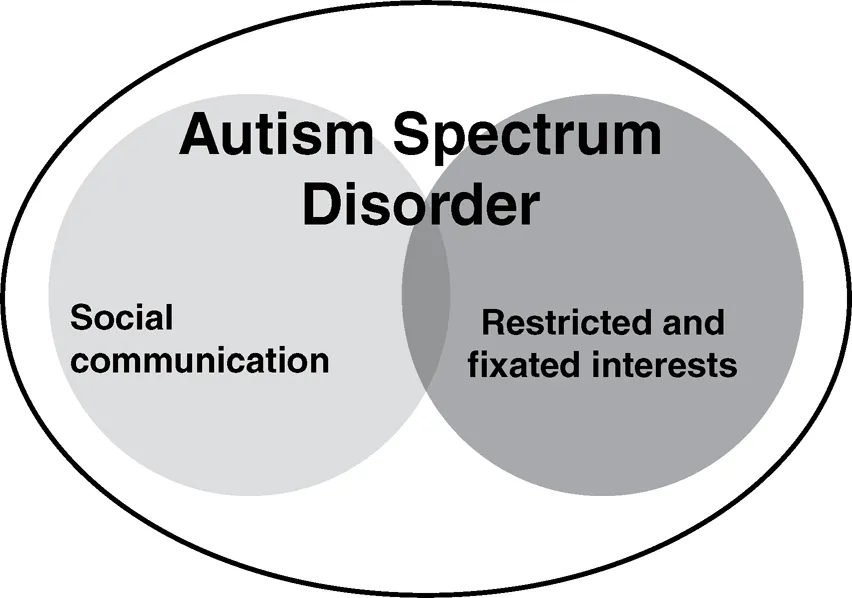
The fifth revision of the American Psychiatric Association’s Diagnostic and Statistical Manual of Mental Disorders (APA, 2013), known as DSM-V, has rationalized our understanding of the autism spectrum by proposing that the separate diagnoses of autistic disorder, Asperger’s syndrome, childhood disintegrative disorder, PDD-NOS and Rett syndrome should come under one diagnostic category: autism spectrum disorder. Figure 1.1 illustrates the new definition of autism spectrum disorder put forward in DSM-V. This recognizes the highly integrated nature of ‘social interaction’, ‘communication’ and ‘imaginative play’, and describes the difficulties associated with autism as being within a single domain of functioning, that of social communication. DSM-V proposes that autism is more simply defined as difficulties in social communication together with the existence of stereotyped or repetitive behaviours and interests, which includes sensory behaviours.
Figure1.1 New definition of the autism spectrum proposed in Diagnostic and Statistical Manual of Mental Disorders, 5th edition (DSM-V) (APA, 2013)
Autism is now understood to be a subset of an ‘autism phenotype’ which describes people who may not be diagnosed with the condition, but who nevertheless have autistic traits, such as poor eye contact or poor awareness of other people’s feelings. The ‘autism spectrum’, therefore, should be thought of as a dimensional difference and on a continuum with the general population.
Relationship to gender
Autism is something that is known to occur in boys more than girls, but it is becoming increasingly apparent that more girls are affected than was previously thought. Most recent estimates suggest that autism is likely to occur about four times more often in boys compared to girls (Newschaffer et al., 2007). However, the incidence of autism in girls is far from clear since it is apparent that there are different factors operating where girls are concerned (Nichols et al., 2009). Girls with autism appear to be better at masking the condition. They display more behaviours that appear to be social – for example, copying other peers in a group – and have special interests that are more socially oriented – for example, an interest in people’s hair or the sensory details of clothing. It is the case too that different social expectations exist in relation to girls. The expectation that girls are quieter than boys, for example, has an impact on a process of diagnosis that is based on one person identifying characteristic behaviours in another. A girl who is socially withdrawn may be more likely to be perceived as depressed rather than having social communication difficulty, whilst associated eating difficulties in autism may result in a girl being diagnosed as having an eating disorder.
Population variation
Wider use of the diagnosis has also underpinned a shift in our understanding about how autism manifests itself in people’s lives. We understand now that, though autism is characterized by differences in social interaction, verbal and non-verbal communication, sensory processing, and by restricted interests and behaviour, there is significant variability in how these differences are experienced by people with autism. Research into the experiences of play, interaction and friendship for children and young people with autism necessitates a rethink of the classic image of the autistic child: of a child in a world of their own, who does not seek out interaction, does not play and has no friends. Research evidence shows children and young people with autism are at least partly socially engaged, though differences exist in the form their engagement takes compared to children without autism. Autistic children do play, though they have particular play preferences, they tend to have at least one friend, though that friend may have also have some sort of additional need, and it is likely that development in social communication will occur, though this may require more in the way of support than is the case for other children (Bauminger and Shulman, 2003; Chamberlain et al., 2007; Jarrold and Conn, 2011). There is great variation in all these areas of functioning, with some individuals existing outside of any kind of social relations, whilst others are centrally involved within social networks and cultural contexts.
Educational provision for pupils with autism
The wider use of the diagnosis of autism has meant a change in the profile of an autistic person. More people who might once have been described as having ‘mild autism’ are being diagnosed, and there is less association now with learning disabilities, though this remains a feature of autism for many people. This together with the introduction of the inclusion agenda in special education has meant a rise in the number of pupils with autism being educated fully or partly in mainstream classrooms. In the UK, it is estimated that around two-thirds of autistic pupils are currently included within mainstream schools (DfE, 2014).
Educational provision for children and young people with autism is more widely understood to require an ‘eclectic approach’ that involves a range of practices and support mechanisms (Kasari and Smith, 2013). Autistic pupils are conceived of as being able to participate and learn to some degree within ordinary contexts that are suitably adapted. However, they are also seen as needing to learn to compensate for development that does not take place in ordinary ways and that requires aspects of specialized provisi...
Table of contents
Cover Page
Half Title Page
Title Page
Copyright Page
Table of Contents
List of figures
List of tables
Preface
1 Taking an educational perspective on the autistic pupil
2 Making observations
3 Listening to children
4 Assessment and planning
5 Compiling pupil profiles and evaluating practice
References
Index
Trusted by 375,005 students
Access to over 1.5 million titles for a fair monthly price.
Study more efficiently using our study tools.
Frequently asked questions
Yes, you can cancel anytime from the Subscription tab in your account settings on the Perlego website. Your subscription will stay active until the end of your current billing period. Learn how to cancel your subscription
No, books cannot be downloaded as external files, such as PDFs, for use outside of Perlego. However, you can download books within the Perlego app for offline reading on mobile or tablet. Learn how to download books offline
Perlego offers two plans: Essential and Complete
Essential is ideal for learners and professionals who enjoy exploring a wide range of subjects. Access the Essential Library with 800,000+ trusted titles and best-sellers across business, personal growth, and the humanities. Includes unlimited reading time and Standard Read Aloud voice.
Complete: Perfect for advanced learners and researchers needing full, unrestricted access. Unlock 1.5M+ books across hundreds of subjects, including academic and specialized titles. The Complete Plan also includes advanced features like Premium Read Aloud and Research Assistant.
Both plans are available with monthly, semester, or annual billing cycles.
We are an online textbook subscription service, where you can get access to an entire online library for less than the price of a single book per month. With over 1.5 million books across 990+ topics, we’ve got you covered! Learn about our mission
Look out for the read-aloud symbol on your next book to see if you can listen to it. The read-aloud tool reads text aloud for you, highlighting the text as it is being read. You can pause it, speed it up and slow it down. Learn more about Read Aloud
Yes! You can use the Perlego app on both iOS and Android devices to read anytime, anywhere — even offline. Perfect for commutes or when you’re on the go. Please note we cannot support devices running on iOS 13 and Android 7 or earlier. Learn more about using the app
Yes, you can access Observation, Assessment and Planning in Inclusive Autism Education by Carmel Conn in PDF and/or ePUB format, as well as other popular books in Education & Education General. We have over 1.5 million books available in our catalogue for you to explore.