Boosting Learning in the Primary Classroom
eBook - ePub

Boosting Learning in the Primary Classroom

Occupational therapy strategies that really work with pupils

  1. 110 pages
  2. English
  3. ePUB (mobile friendly)
  4. Available on iOS & Android
eBook - ePub

Boosting Learning in the Primary Classroom

Occupational therapy strategies that really work with pupils

About this book

Boosting Learning in the Primary Classroom is your one-stop practical guide to understanding the physical development of children and how this affects their ability to learn. Not only does it explain the reasons behind the theories but provides over 75 practical tips that really work in the classroom.

The book is based on a successful five-step approach to help children acquire the skills needed to manage at school and daily life. It works by being able to pinpoint a problem, assists others in recognising the impact that difficulty is having to the child and then provides strategies to develop that child's specific skills. Using the latest medical research and established occupational therapy techniques to obtain great results, this approach provides teachers with the tools to use different knowledge and strategies to engage children in the learning process.

  • Key ideas explored include:
  • Exploring the reasons for poor handwriting
  • Increasing Disability Awareness
  • The link between body posture and concentration
  • Dyspraxia in a school setting
  • Play develops learning
  • Understanding sensory behaviour

By providing teachers with an understanding of physical child development and the impact this has in the classroom, this book demonstrates how teachers can use this knowledge to boost the learning of their primary-aged children. It encourages teachers to identify improvements in the child's progress of not just educational learning targets but also in physical motor development, using real life case studies, latest theory and tried & tested occupational therapy methods to help every child improve.

Frequently asked questions

Yes, you can cancel anytime from the Subscription tab in your account settings on the Perlego website. Your subscription will stay active until the end of your current billing period. Learn how to cancel your subscription.
No, books cannot be downloaded as external files, such as PDFs, for use outside of Perlego. However, you can download books within the Perlego app for offline reading on mobile or tablet. Learn more here.
Perlego offers two plans: Essential and Complete
  • Essential is ideal for learners and professionals who enjoy exploring a wide range of subjects. Access the Essential Library with 800,000+ trusted titles and best-sellers across business, personal growth, and the humanities. Includes unlimited reading time and Standard Read Aloud voice.
  • Complete: Perfect for advanced learners and researchers needing full, unrestricted access. Unlock 1.4M+ books across hundreds of subjects, including academic and specialized titles. The Complete Plan also includes advanced features like Premium Read Aloud and Research Assistant.
Both plans are available with monthly, semester, or annual billing cycles.
We are an online textbook subscription service, where you can get access to an entire online library for less than the price of a single book per month. With over 1 million books across 1000+ topics, we’ve got you covered! Learn more here.
Look out for the read-aloud symbol on your next book to see if you can listen to it. The read-aloud tool reads text aloud for you, highlighting the text as it is being read. You can pause it, speed it up and slow it down. Learn more here.
Yes! You can use the Perlego app on both iOS or Android devices to read anytime, anywhere — even offline. Perfect for commutes or when you’re on the go.
Please note we cannot support devices running on iOS 13 and Android 7 or earlier. Learn more about using the app.
Yes, you can access Boosting Learning in the Primary Classroom by Sheilagh Blyth in PDF and/or ePUB format, as well as other popular books in Education & Education General. We have over one million books available in our catalogue for you to explore.

Information

Publisher
Routledge
Year
2015
eBook ISBN
9781317575412
Edition
1

CHAPTER 1 Exploring the reasons for poor handwriting

DOI: 10.4324/9781315739007-1
Writing, to me, is simply thinking through my fingers.
Isaac Asimov
HANDWRITING IS A complex life skill and an essential requirement for school.
Teaching the skill of turning scribbles into stories can be difficult. Many children need extra time to transform what they can see or read into the written word. Sometimes common handwriting errors or habits are missed. Avoidance techniques develop and frustration appears. If not successfully taught children risk being put in the lowest set regardless of their intellectual knowledge.
Every few years new advice on how to develop handwriting skills appears. Teaching staff are left feeling further confused on how to teach this subject.
In the UK children start school according to their age rather than their academic ability. However, in other parts of Europe children don’t start school until they are six or seven. If you were born in Spain you’d start school at six years old and if you lived in Sweden you’d start school at seven. According to research by Gharp into European school starting ages, the UK school age limit was not based on developmental or educational reasons but on child welfare purposes dating back to the 1870 Education Act. By starting school in the UK so early not all children have acquired the hand skills needed to hold a pencil. So it is highly likely that children in the UK schooling system will have handwriting difficulties at some point in their school life.
To help you uncover and change children’s handwriting difficulties this chapter has been broken down into five sections: identification, the effects on learning, usual development, why we need this skill and practical tips. It will give you the skills and understanding to help a child to form legible words.
We will start with how to spot a problem: how children physically try to show you they have a handwriting issue. Next we will look at how handwriting difficulties affect learning. Here there is an opportunity to read a case study of a child who swapped hands when writing and understand how common handwriting problems are in the UK. The third section will give you understanding of how handwriting skills develop. Followed by two pieces written by Imogen McCall, aged eight, and Corey Birrell, aged 10, who both explain in their own words the impact struggling to write had on their lives. Lastly, you will learn 13 different practical tips that you can apply immediately in any classroom setting.
By the end of this chapter you will have gained greater understanding from both a medical and a child’s perspective of this problem. You will have many different practical tips building upon your own repertoire of skills. By applying what you know you will be helping a child with a handwriting problem achieve future exam grades and career choices. To help you, definitions of important terms immediately follow.
Before we start here are some definitions of essential terminology used in this chapter.
  • Tripod grip is the pencil grip where three fingers are placed near the nib of a pencil. Both the thumb and index (first) finger are placed on top of the pencil shaft and the middle (second) finger has the pencil resting on top of it.
  • Handwriting problem is when a child struggles to write. It could relate to pencil grip, letter legibility, writing speed, hand skills including hand dominance, visual skills or sitting posture.

How to identify a handwriting problem

Often the first indication of a handwriting problem is when the work produced is below the expected standard. This section explains how to identify a handwriting difficulty in a primary school child. It will discuss why noticing a problem is essential and analyses what to look for when thinking a child may have a handwriting problem. There is a checklist on how to spot a child with a handwriting difficulty in your classroom.
The impact of handwriting difficulties is more than not being able to keep up academically with peers or experiencing physical pain. Such difficulties can cause low self-esteem. Children can become frustrated and lack the confidence to complete homework or school projects. Over time they may even try to avoid doing handwriting activities.
Handwriting provides an indication to how a child is both physically and cognitively developing. The ability to write is not solely linked to the acquisition of one skill and often children struggle due to its complexity.
Writing requires the combination of correct body posture, visual motor skills, motor planning, cognition, appropriate behaviour, tactile and perceptual skills. By adulthood the use of these seven skills becomes so automatic that sometimes it is easy to forget the intricacies involved for a child to learn this essential activity.
In the primary classroom, handwriting remains a core activity for most subjects. The ability to write influences reading, language and critical thinking skills. Handwriting problems can cause a reduction in the amount of work produced and physical pain in the hand. It can result in pupils struggling to remember letters. They might copy letters and spell words incorrectly. Alternatively they can struggle to extract meaning from words, phrases or topic books.
Writing requires more physical energy if it is a problem area. Research has also shown that when writing the brain gets its energy from oxygen that is transferred into glucose. The glucose acts as fuel to help the brain. However, if a child is struggling to write they use more oxygen meaning the body has to work harder to create the resources to think. This is why body posture can alter from sitting up straight in a chair to appearing to be slumped over a desk as the child no longer has the energy to remain sitting upright.
In the long term a handwriting problem can negatively affect exam grades. Studies have concluded that examiners allocate lower marks to students whose work was poorly written. Sweedler-Brown concluded this was regardless of the quality of the content. In turn poor exam results impact on career choices.
Handwriting problems need to be identified to reduce the impact upon all lessons, body fatigue and exam grades. A recent study published by Cermak and Bissell in 2014 identified that although children may correctly identify that they have a handwriting problem, they are unaware of the extent and severity of their problem. These children need their teachers to help them identify that an existing handwriting problem needs to be addressed.
Being able to recognise a handwriting difficulty is essential. There is no one encompassing test to state if a child is ready to write or if they have a handwriting difficulty. One of the first words ever written by a child is their name and this is the start of a child gathering meaning to letter formations. Asking a child to write a familiar word and a non-familiar word will help you notice differences between practised letter formations.
When looking for a handwriting issue often both teachers and parents assess in terms of neatness, size and pencil grip. There are two methods to analysing handwriting: either whilst it is being completed or after it has been written. The latter is more difficult for identifying a specific problem: observation is necessary.
If you are analysing any handwriting whilst it is being produced look at the child’s sitting posture. They may appear to slump forward and round their shoulders when writing due to reduced muscle stability in their trunk. Check the wrist position. Does their wrist turn inwards towards the centre of the body as if hooking back on its self? This occurs when a child is trying to see what they are writing but their current pencil grip restricts vision. It should be avoided as it affects letter legibility and can cause physical pain in the wrist. To learn more about the impact of poor sitting posture read Chapter 3.
Another area to look at is the pencil grip. Often children who hold the pencil too tightly do so because they do not write using a three-fingered tripod grip. An awkward pencil grip causes children to press too heavily when writing. To relieve any tension in the hand and return the blood supply to the finger tips children will shake their hand, wiggle their fingers or say their hand hurts. This particularly occurs if the thumb is tucked straight over the pencil shaft causing there to be no web space between the thumb and the first (index) finger. A thumb web space is crucial for easy formation of rounded letter shapes.
Neatness is only achieved once letter formation and size has been mastered. When looking at any letter formations, check to see if the letters are clearly formed or reversed. Letter reversals are common for younger children. This is due to them developing visual motor and perceptual skills at the same time as learning to write. Letter size with clear ascender and descender letters appears when a visual skill called spatial relationship is fine tuned. This is when spaces around two-dimensional and three-dimensional shapes are noticed. Observe word spaces and letter alignment when considering general neatness of the work.
If you are analysing writing after the work has been produced then you will only be able to analyse neatness. Look to see if the letters are at the correct height. The straight letters may look crooked and apart. There may be limited or no spaces between words and on turning the paper over you can feel bumps on the page whe...
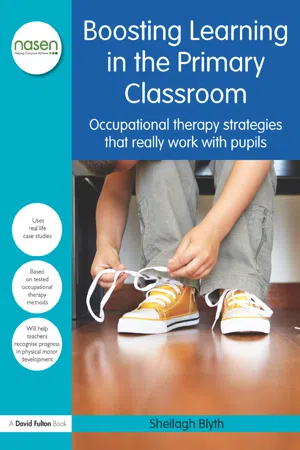
Table of contents

  1. Cover Page
  2. Half-Title Page
  3. Title Page
  4. Copyright Page
  5. Table of Contents
  6. About the author
  7. Foreword
  8. Acknowledgements
  9. Introduction: how to get the most out of this book without it gathering dust on your shelf
  10. 1 Exploring the reasons for poor handwriting
  11. 2 Increasing disability awareness
  12. 3 The link between body posture and concentration
  13. 4 Dyspraxia in a school setting
  14. 5 How play develops learning
  15. 6 Understanding sensory behaviour
  16. Conclusion
  17. Index