eBook - ePub
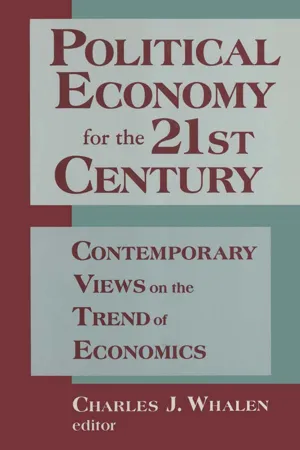
Political Economy for the 21st Century
Contemporary Views on the Trend of Economics
- 304 pages
- English
- ePUB (mobile friendly)
- Available on iOS & Android
eBook - ePub
Political Economy for the 21st Century
Contemporary Views on the Trend of Economics
About this book
This text provides an alternative to conventional economics, drawing on the neoclassical and non-neoclassical insights of Lester Thurow, Robert Heilbroner, Alice Amsden, Barry Bluestone and 11 other prominent economists from America and England. It is intended to provide productive analyses of several contemporary economic problems.
Information
Part I
Introduction
1
Beyond Neoclassical Thought: Political Economy for the Twenty-first Century
Charles J. Whalen
This volume brings together economists from a range of non-neoclassical traditions. All agree that mainstream economic theory is incapable of adequately addressing the real-world challenges of the late 1990s and early twenty-first century. The alternative they provide unites institutionalism, post-Keynesianism, social economics, and other perspectives. This forward-looking collaboration points toward construction of a coherent and broadly defined political economy.1
Concerns similar to the one that has produced this book are certainly not new. John Kenneth Galbraith, for example, noted more than two decades ago that neoclassical economics has “a decisive flaw” in that it “offers no useful handle for grasping the economic problems that now beset the modern society.”2 In fact, this volume follows in the tradition of a collection of essays published early in the century as The Trend of Economics (The Trend)?3 What is new today, however, is the pace and extent of structural economic change—change that is transforming not only firms and industries but also individual nations and the entire global economy.
During this century, members of the economics profession produced many developments in the realm of theory. But the neoclassical theories now dominant in English-speaking nations have retained key methodological elements from the distant past. Those elements place severe constraints on both theory and policy—and continue to restrict the ability of economics to offer practical insights. In the course of seeking to provide a more secure foundation for policy, the alternative outlined in this volume breaks free from these constraints.
Economics in the Twentieth Century
From Confusion to Contentment
Advanced capitalist nations experienced severe macroeconomic fluctuations in the early decades of the twentieth century. Moreover, the boom-and-bust cycles were complicated and exacerbated by persistent distributional problems and occasional structural adjustments. As real-world problems mounted, economics in the 1930s found itself in what Joan Robinson described as a “pitiful state of confusion.”4 The most pressing problems of the era were resolved only after the adoption of numerous recommendations not grounded in traditional economic analysis.5
Despite policy achievements, individuals with a non-neoclassical outlook were unable to dislodge conventional economic theorists from their position of dominance in academia. This is explained in part by the fact that many non-neoclassicals failed to develop theoretical foundations for their work. Academic economists influenced by the University of Wisconsin’s John R. Commons, for example, were often content to seek resolution of practical problems without any regard for theory. Many other innovative thinkers left academia entirely and devoted their careers to government service. But the resilience of economic orthodoxy is also explained by the ability of mainstream economists to reconcile countercyclical policies with standard theory through construction of the “neoclassical synthesis.”6
The development of economics in the twentieth century has also been influenced by the increased use of quantitative methods. While contributors to The Trend stressed the need for a more empirical economics, they also warned readers to avoid becoming blind to economic reality through the relentless pursuit of rigor.7 Unfortunately, conventional economics—which has long sought to model itself after the “hard” sciences—found the attraction to mathematical techniques and modes of expression irresistible. In a discipline where formalism is not a secondary feature but often “a central programmatic aim,” we should not be surprised to find neoclassicalism in a dominant position—for there is no question that this approach permits a high degree of mathematization.8
The fact that economics has sacrificed relevance for rigor received much attention during the 1970s as conventional policies proved ineffective in the face of rising inflation and unemployment.9 But after citizens became accustomed to higher levels of unemployment (a development accompanied by upward revisions of the notion of the “natural” rate of unemployment), and conservative public policies and international developments kept inflation in check, English-speaking economists were able to return again to their world of “splendid isolation” and “scholarly contentment.”10 In fact, one of the most prestigious mainstream developments of the past few decades has been the rise of the “new classical economics”—a body of analyses (by Robert Lucas, for example) that offer an equilibrium account of business cycles and an elegant rationalization of monetarism.11
Disenchantment Returns
The contributors to this volume believe the present era demands more than conventional economics provides—indeed, more than economic orthodoxy is capable of providing. In the 1992 U.S. presidential election, for example, citizens expressed their frustration with an economy weakened by cyclical, structural, and distributional ills. In the agenda-setting Little Rock conference that followed, however, economists devoted most of their attention to rehashing debates regarding the appropriateness of deficit reduction and stimulative fiscal action.
Even those touted as being among the most progressive and innovative within the neoclassical camp seem out of touch. Consider the work of Paul Krugman as an example. The United States has faced serious competitiveness problems and a “silent” depression (involving slow productivity growth and stagnant earnings) during the past two decades.12 Krugman, meanwhile, considers competitiveness “a largely meaningless concept” and “a dangerous obsession.”13 His latest book devotes some critical attention to Lucas and other conservatives, but the volume and a related article unleash a much more vicious attack on problem-oriented supporters of “strategic” trade.14 In contrast, Krugman explains that his own “new international economics” leads to “a sadder but wiser argument for free trade.”15
Perhaps the most disturbing of all recent evidence regarding the detached nature of economics comes from a 1991 report by the American Economic Association’s Commission on Graduate Education in Economics (COGEE). The commission noted that many top students from the nation’s best liberal-arts colleges either decide against graduate economics programs or drop out during their first year because “the abstract, technical nature” of the curriculum “is not economics as they know it.”16 COGEE also expressed the fear “that graduate programs may be turning out a generation with too many idiot savants, skilled in technique but innocent of real economic issues.”17 On the matter of technique versus substance, the commission concluded, “We feel that the balance is not quite right at present.”18
Will the neoclassical wing of the U.S. economics profession change in response to these recent findings? Probably not in any meaningful way. COGEE recommends that professors devote more course attention to applying economic theory to real-world matters. But that practice will not be enough—for the narrow vision of our prevailing paradigm is itself part of the problem. Moreover, economics has long operated under a scoring system that rewards technical wizardry and discourages investigations of real economic issues.19 COGEE offers no recommendations that would alter this arrangement.
Conventional economics is likely to persist, but so too will citizen disenchantment with both economists and real-world economic performance—unless economists outside the thrall of neoclassicalism join forces and both offer and build support for an alternative. Kevin Phillips argued in 1993 that how officials address the public’s widespread uneasiness regarding economic security is the key to the politics of the 1990s.20 Contributors to this volume understand that addressing the sources of such uneasiness is one important task of any economic alternative that seeks to provide a more secure policy foundation for the years ahead.
An Overview of the Present Volume
Redefining Economics
The perspective presented in this volume does not involve a complete rejection of neoclassical insights. Conventional concepts such as “marginal utility” and “opportunity cost” are indeed valuable. In addition, orthodox theories provide important insights into the impact of scarcity on market allocation—the interaction of supply and demand as described in standard theory does indeed contribute to understanding real-world economic activity. Nevertheless, neoclassicalism offers a weak methodological foundation, an incomplete picture of reality, and equilibrium requirements that are satisfied only in unreal, idealized cases.
In light of the narrowness of economic orthodoxy, we begin this effort to improve the discipline by redefining it. A shift from the perspective of neoclassical orthodoxy to that of our “political economy” involves defining economics not as the study of market allocation under the constraint of scarcity but instead as the study of the much broader terrain of “social provisioning.” This permits economists to shape theory to reality rather than the reverse. It also permits them to infuse their work with greater attention to both the moral dimension of human behavior and the economic significance of gender and marginality. Chapters by William M. Dugger, Charles K. Wilber, and Ann Mari May (in a section entitled “Provisioning, Ethics, and Gender”) underscore the elements of such a redefinition.
The wider scope of this political economy authorizes explorations of more questions than are permissible within neoclassicalism. For example, the perspective allows researchers to investigate the impact of culture on individual desires. It also permits questions of allocation and distribution—matters central to orthodoxy—to be considered from a more expansive viewpoint. Markets are important contemporary provisioning mechanisms, but market activity is neither independent of other social spheres nor the only realm in which provisioning occurs. Thus, our alternative encourages a study of the entire social landscape (including, for example, institutions and practices involving the workplace, state, and family) rather than analyses of just markets alone.
This more expansive outlook enables economists to consider provisioning influences other than scarcity, and to explore motives or objectives beyond short-run self-interest. In particular, political economists recognize the economic significance of not only additional influences such as custom and power but also altruism and morally grounded behavior. Indeed, Wilber’s chapter suggests that the latter is a prerequisite to achieving allocative efficiency even in the conventional sense.
The shift from neoclassical orthodoxy to political economy offers even more than a broader focus—it also provides a foundation that is fundamentally different from the one supporting traditional economics. In particular, this political economy offers a foundation that:
• rejects the idea of “value-neutral” economics and instead acknowledges both the influence that an economist’s “world view” has on professional research and the fact that economics seeks ultimately to guide public policy;
• focuses on actual events, not hypothetical ones—and wants to explain as well as predict;
• emphasizes historical processes and institutional adjustment;21
• does not ignore harmony and contentment, but—unlike orthodoxy—puts issues of conflict and disorder at the center of its attention; and
• acknowledges the inseparability of the market and the state.
This foundation is firmly rooted, as Dugger’s chapter indicates, in the tradition of institutional economics. But Dugger also explains that the approach shares important elements with the work of Karl Marx and cont...
Table of contents
- Cover Page
- Half-Title Page
- Title Page
- Copyright Page
- Dedication
- Contents
- Contributors
- Foreword
- Preface
- Part I: Introduction
- Part II: Provisioning, Ethics, and Gender
- Part III: Firms, Human Resources, and Money
- Part IV: Macroeconomics, Structural Change, and Distribution
- Part V: Competitiveness, Trade, and Development
- Part V: Conclusion
- Index
Trusted by 375,005 students
Access to over 1.5 million titles for a fair monthly price.
Study more efficiently using our study tools.
Frequently asked questions
Yes, you can cancel anytime from the Subscription tab in your account settings on the Perlego website. Your subscription will stay active until the end of your current billing period. Learn how to cancel your subscription
No, books cannot be downloaded as external files, such as PDFs, for use outside of Perlego. However, you can download books within the Perlego app for offline reading on mobile or tablet. Learn how to download books offline
We are an online textbook subscription service, where you can get access to an entire online library for less than the price of a single book per month. With over 1.5 million books across 990+ topics, we’ve got you covered! Learn about our mission
Look out for the read-aloud symbol on your next book to see if you can listen to it. The read-aloud tool reads text aloud for you, highlighting the text as it is being read. You can pause it, speed it up and slow it down. Learn more about Read Aloud
Yes! You can use the Perlego app on both iOS and Android devices to read anytime, anywhere — even offline. Perfect for commutes or when you’re on the go.
Please note we cannot support devices running on iOS 13 and Android 7 or earlier. Learn more about using the app
Please note we cannot support devices running on iOS 13 and Android 7 or earlier. Learn more about using the app
Yes, you can access Political Economy for the 21st Century by Charles J. Whalen,Hyman P. Minsky in PDF and/or ePUB format, as well as other popular books in Economia & Teoria economica. We have over 1.5 million books available in our catalogue for you to explore.