- 256 pages
- English
- ePUB (mobile friendly)
- Available on iOS & Android
eBook - ePub
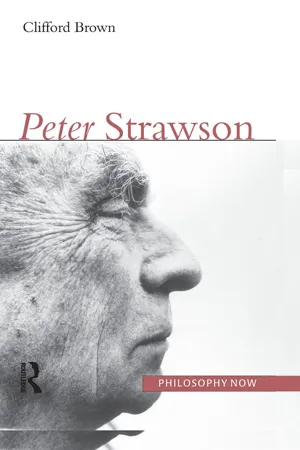
Peter Strawson
About this book
The British philosopher, Peter Strawson, has helped shape the development of philosophy for over fifty years. His work has radically altered the philosophical concept of analysis, returned metaphysics to centre stage in Anglo-American philosophy, and has transformed the framework for subsequent interpretations of Kantian philosophy. In this, the first, introduction to Strawson's ideas, Clifford Brown focuses on a selection of Strawson's most important texts and close and detailed examination of the arguments, and contributions to debates (with, for example, Russell, Quine and Austin), which have done the most to establish Strawson's formidable reputation. Each chapter provides clear exposition of a central work and explores the ways in which other philosophers have responded to Strawson's initiatives. Brown shows how Strawson's philosophical approach has been to seek better understanding of particular concepts or concept-groups and to draw out an awareness of parallels and connections among them that sheds new light over an apparently familiar landscape. The central thoughts in logic and language with which Strawson began his career are shown to have remained constant throughout while manifesting their applications across an even broader range of philosophical topics.
Information
Chapter 1
"On Referring" and Introduction to Logical Theory: The basic questions
Looking back at the course of his career in philosophy, Strawson believed in 1998 that the work by which he continues to be best known remains his first, the article “On Referring”. That judgement is probably correct. It is certainly true that “On Referring” is the root of the whole wide spectrum of developments in his later writings. The article is concerned with one particular aspect of the relation between our ordinary language and formal logic, and the concern with that relation is then broadened in his subsequent first book, Introduction to Logical Theory. The two works are therefore appropriately considered together as foundational.
"On Referring"
We commonly use expressions of a certain kind to refer to some individual person, object or event. We use singular demonstrative pronouns (“this” and “that”), proper names (“Peter Strawson”), singular pronouns (“I”, “you”, “it”), and we use the definite article followed by a noun in the singular (“the table”, “the king of France”). The members of the last of those four classes are called definite descriptions, and they constitute the source of a number of questions that are simultaneously grammatical, logical and ontological. Those questions have a long history, going back at least to Aristotle, and contemporary efforts to deal with them are a major source and a continuing central concern among contemporary Anglophone philosophers.
Russell’s theory of definite descriptions (Russell 1905) is still widely held among logicians to be a correct account. In “On Referring”,1 however, Strawson wants to show that Russell’s theory contains some fundamental mistakes. In his effort to set the account straight, we find the prime source of all that was to follow in Strawson’s career as a philosopher, with consequences that were to involve the most fundamental questions not only in the relation between ordinary language and logic, but ever more widely with perennial questions in epistemology and metaphysics.
We may begin by asking what question or questions Russell’s theory of definite descriptions attempts to answer. Consider someone at present uttering the sentence “The king of France is wise”. The sentence thus uttered certainly seems to be significant, but then the question arises of just how this can be so if there is no present king of France. One apparent answer would be this argument. Let the sentence as a whole be S, and let “the king of France” be D. Then:
- If S is significant, then it is either true or false.
- S is true if D is wise, false if D is not wise.
- But S and not-S are alike true only if there is D in some sense.
- Since S is significant, D must exist in some sense.
That is evidently a bad argument, one that Russell rejects. For him, the mistake in the argument comes from thinking that D as the grammatical subject of S is therefore also its logical subject. But D is not the logical subject of S. Indeed, S is not logically a subject–predicate sentence at all; it is instead a complex kind of existential proposition. To exhibit the true logical form of S, we should rewrite it:
- There is a king of France.
- There is not more than one king of France.
- There is nothing that is the king of France and is not wise.
Thus, on Russell’s analysis, anyone uttering S today would be saying something significant but false. And thus for Russell we must distinguish definite descriptions such as “the king of France” from logically proper names. The latter (a) can alone be the subjects of sentences of a genuine subject–predicate form, and (b) have some single object for which they stand. Strawson thinks that Russell is wrong in this. For Strawson, sentences 1–3 above do indeed describe circumstances that are necessary conditions for making a true assertion when uttering the sentence. But that does not mean that Russell has given us an account of those sentences that is either completely or even partially correct.
In order both to show the error of Russell’s way and to provide an alternative correct account, Strawson begins by drawing a distinction among
- a sentence
- a use of a sentence
- an utterance of a sentence.
The sentence “The king of France is wise” can be uttered at various times, and it has various uses. It is critically important to recognize that we cannot say that the sentence in itself is either true or false; we can only say that the sentence may be used to make a true or false assertion or to express a true or false proposition.
In line with this analysis of the sentence S, we can make an analogous although not identical analysis of a uniquely referring expression such as “the king of France”. The analysis is not identical, since no use of such an expression can ever be either true or false. But there is an effective analogy, and this is at the heart of Strawson’s position. Referring is not something that an expression such as “the king of France” does. Referring is instead characteristic of the use of an expression, just as truth-or-falsity is characteristic of the use of a sentence.
In sum, let “type” stand for “sentence” or “expression”. Strawson then is not saying that there are types, and uses of types and utterances of types, in the sense in which there are ships, and shoes and sealing wax. He is instead saying that we cannot say the same things about types, the uses of types and the utterances of types.
We are apt to fancy that we are talking about sentences and expressions when we are talking about the uses of sentences and expressions …. This is what Russell does. Generally, as against Russell, I shall say this. Meaning (in at least one important sense) is a function of the sentence or expression; mentioning and referring and truth or falsity, are functions of the use of the sentence or expression.
(OR: 9)
Meanings do give general directions for the ways in which a type may be used, but they do not give directions for any particular use. Thus the question of whether a sentence is significant or not has nothing to do with the truth or falsity of a particular occasion of its use. Russell confuses meaning with mentioning, and that is the source of his mistake. For Strawson, the absurdity of asking whether a particular sentence is true or false is not relieved by Russell’s contention that it must be one or the other on the grounds that the sentence is significant. A sentence in itself is no more true or false than it is about some particular subject. The correct question on whether a sentence is significant or not is the question of whether there are language habits, conventions or rules such that the sentence could be used to talk about something.
Russell’s claim is that anyone now uttering the sentence “The king of France is wise” would (a) be making either a true or a false statement, and (b) be asserting that there exists at present one and only one king of France. Strawson finds Russell wrong on both counts. For Strawson, the sentence is certainly significant, because it could be used to say something true or false, and it could be used to refer to a particular person. But that does not mean that any particular use of it must be either true or false. Suppose someone were at present to utter “The king of France is wise”, and were to ask me whether what he just said is true or false. I would be likely to reply that it was neither, since the question simply does not arise.
There are, of course, “secondary” uses of sentences and expressions, as in the cases of sophisticated fictions. If I at present say that the king of France is wise, and that he lives in a golden castle with one hundred wives, no one would suppose either that I was referring to an existing person, or that my utterance was false. Such secondary uses do not compromise the primary one. Someone using “the king of France” in a primary way is not asserting that there is a king of France, nor does that use entail a proposition of a uniquely existential sort. One of the ordinary functions of the definite article is to signal that some unique reference is being made, but which particular individual is being referred to is a function of the contextual features such as the time and the place of a sentence’s utterance. There is thus a critical distinction between (a) using a sentence to make a unique reference, and (b) asserting that there is one and only one individual that has certain characteristics. To refer is not to assert. Russell fails to make that distinction, and is thus led to “the logically disastrous theory of names developed in the Enquiry into Meaning and Truth and in Human Knowledge” (OR: 16).
It is Strawson’s claim that in the correct account we use expressions to make unique references, but that it is only in the rules governing those uses along with the context of those uses that we actually secure a particular use. There is thus a need to distinguish between rules for referring and rules for ascribing and attributing. Once that distinction is recognized, we are well on the way to resolving a number of ancient logical and metaphysical puzzles. We approach those puzzles with the recognition that when we state a fact about a particular, we have two tasks, the referring and the attributing. That distinction roughly and approximately corresponds to the grammatical distinction between subject and predicate. There are, of course, other methods. An example would be a game in which no expression is used in a uniquely referring way, but there are instead a series of uniquely existential sentences leading ultimately to the identification of a particular through an accumulation of relative clauses. The parlour game Twenty Questions might serve as an example. But the fact that this is a game is a sufficient indication that this is not the ordinary use we have for existential sentences.
To make a unique reference requires some device for showing both that a unique reference is made, and what unique reference it is. To do this, the context of utterance is of the greatest importance:
The requirement for the correct application of an expression in its ascriptive use to a certain thing is simply that the thing should be of a certain kind, have certain characteristics. The requirement for the correct application of an expression in its referring use to a certain thing is something over and above any requirement derived from such ascriptive meaning as the expression may have; it is, namely, the requirement that the thing should be in a certain relation to the speaker and to the context of utterance. Let me call this the contextual requirement.
(OR: 19)
For Strawson, this irreducible distinction between ascribing use and referring use has been blurred by logicians in their neglect or misinterpretation of the conventions for referring. This is because most logicians are preoccupied with definitions, and some of them are preoccupied with formal systems. The distinctive features of referring use are ones that they seek to reduce or eliminate altogether. For Strawson, a prime instance of the folly of that attempt is made by Leibniz in his effort to establish individual identity through “complete plete individual concepts” done in exclusively general terms. We shall see in Strawson’s subsequent Individuals (1959) a detailed account of just how Leibniz is judged to go wrong. Strawson thinks that Russell similarly strives desperately in his own way to make logic in a narrow sense adequate for referring to individuals.
It is important to remember that while Strawson’s fundamental distinction is between referring and ascribing uses, there are expressions that can play either role, and those expressions that refer can do so in a variety of ways:
- Such expressions may differ in their degree of context- dependence, with “I” and its maximum dependence at one end of the scale and “the author of Waverley” at the other.
- They may also differ in their degree of descriptive meaning. “Horace” may be the name of a cat, a dog or a motorcycle. Such pure names have no descriptive meaning at all, although they may acquire such a meaning as a result of one of their uses. In contrast, a substantial phrase such as “the round table” has a maximum descriptive meaning.
- They may differ on whether or not they are governed by some general referring-cum-ascriptive conventions. For pronouns, having the least descriptive meaning, there are such conventions. Usually for proper names there are no such conventions, only conventions that are ad hoc for each particular case.
Common nouns are naturally and commonly used to refer; adjectives are not. We expect common nouns to show what unique reference is being made, and to mirror the salient characteristics of things. Strawson finds the difference between nouns and adjectives to be mirrored quaintly by John Locke in the claim that substances are collections of simple ideas.
“Substance” is the troublesome tribu...
Table of contents
- Cover
- Half Title
- Title
- Copyright
- Contents
- Abbreviations
- Introduction
- 1. "On Referring" and Introduction to Logical Theory: The basic questions
- 2. Individuals: An Essay in Descriptive Metaphysics: Towards a basic ontology
- 3. The Bounds of Sense: Kant's first Critique under analysis
- 4. Skepticism and Naturalism: Hume revisited
- 5. Analysis and Metaphysics: Summing up
- Notes
- Bibliography
- Index
Trusted by 375,005 students
Access to over 1.5 million titles for a fair monthly price.
Study more efficiently using our study tools.
Frequently asked questions
Yes, you can cancel anytime from the Subscription tab in your account settings on the Perlego website. Your subscription will stay active until the end of your current billing period. Learn how to cancel your subscription
No, books cannot be downloaded as external files, such as PDFs, for use outside of Perlego. However, you can download books within the Perlego app for offline reading on mobile or tablet. Learn how to download books offline
Perlego offers two plans: Essential and Complete
- Essential is ideal for learners and professionals who enjoy exploring a wide range of subjects. Access the Essential Library with 800,000+ trusted titles and best-sellers across business, personal growth, and the humanities. Includes unlimited reading time and Standard Read Aloud voice.
- Complete: Perfect for advanced learners and researchers needing full, unrestricted access. Unlock 1.5M+ books across hundreds of subjects, including academic and specialized titles. The Complete Plan also includes advanced features like Premium Read Aloud and Research Assistant.
We are an online textbook subscription service, where you can get access to an entire online library for less than the price of a single book per month. With over 1.5 million books across 990+ topics, we’ve got you covered! Learn about our mission
Look out for the read-aloud symbol on your next book to see if you can listen to it. The read-aloud tool reads text aloud for you, highlighting the text as it is being read. You can pause it, speed it up and slow it down. Learn more about Read Aloud
Yes! You can use the Perlego app on both iOS and Android devices to read anytime, anywhere — even offline. Perfect for commutes or when you’re on the go.
Please note we cannot support devices running on iOS 13 and Android 7 or earlier. Learn more about using the app
Please note we cannot support devices running on iOS 13 and Android 7 or earlier. Learn more about using the app
Yes, you can access Peter Strawson by Clifford A. Brown in PDF and/or ePUB format, as well as other popular books in Philosophy & Language in Philosophy. We have over 1.5 million books available in our catalogue for you to explore.