The Routledge International Handbook of Sandplay Therapy
eBook - ePub

The Routledge International Handbook of Sandplay Therapy

  1. 350 pages
  2. English
  3. ePUB (mobile friendly)
  4. Available on iOS & Android
eBook - ePub

The Routledge International Handbook of Sandplay Therapy

About this book

The Routledge International Handbook of Sandplay Therapy provides a comprehensive overview of this therapeutic method, developed to provide a means of helping clients of all ages with mental suffering. The contributors, from a range of therapeutic and cultural backgrounds, demonstrate core theory and practice, and explore the implications of current neuroscientific research. The chapters illustrate the effectiveness of this seemingly simple psychotherapeutic tool in its contemporary applications. Split into six parts, this handbook considers:

  • Sandplay therapy in medicine
  • Sandplay with special populations
  • Sandplay in analysis and general practice
  • Adaptions of the Sandplay method in education
  • Sandplay and the spirit
  • Non-Jungian uses of the sand tray in therapeutic applications

Unique in scope and breadth, this handbook will appeal to academics and students of Jungian psychotherapy, as well as occupational therapists, art and play therapists, and all clinicians using Sandplay therapy as part of their professional practice.

Frequently asked questions

Yes, you can cancel anytime from the Subscription tab in your account settings on the Perlego website. Your subscription will stay active until the end of your current billing period. Learn how to cancel your subscription.
No, books cannot be downloaded as external files, such as PDFs, for use outside of Perlego. However, you can download books within the Perlego app for offline reading on mobile or tablet. Learn more here.
Perlego offers two plans: Essential and Complete
  • Essential is ideal for learners and professionals who enjoy exploring a wide range of subjects. Access the Essential Library with 800,000+ trusted titles and best-sellers across business, personal growth, and the humanities. Includes unlimited reading time and Standard Read Aloud voice.
  • Complete: Perfect for advanced learners and researchers needing full, unrestricted access. Unlock 1.4M+ books across hundreds of subjects, including academic and specialized titles. The Complete Plan also includes advanced features like Premium Read Aloud and Research Assistant.
Both plans are available with monthly, semester, or annual billing cycles.
We are an online textbook subscription service, where you can get access to an entire online library for less than the price of a single book per month. With over 1 million books across 1000+ topics, we’ve got you covered! Learn more here.
Look out for the read-aloud symbol on your next book to see if you can listen to it. The read-aloud tool reads text aloud for you, highlighting the text as it is being read. You can pause it, speed it up and slow it down. Learn more here.
Yes! You can use the Perlego app on both iOS or Android devices to read anytime, anywhere — even offline. Perfect for commutes or when you’re on the go.
Please note we cannot support devices running on iOS 13 and Android 7 or earlier. Learn more about using the app.
Yes, you can access The Routledge International Handbook of Sandplay Therapy by Barbara Turner, Barbara A. Turner in PDF and/or ePUB format, as well as other popular books in Psychology & Mental Health in Psychology. We have over one million books available in our catalogue for you to explore.

Information

1
INTRODUCTION

What is Sandplay therapy?
Barbara A. Turner
Sandplay therapy is a therapeutic method developed to provide a means of helping children with mental suffering. It is a non-verbal play therapy that intentionally creates a space for the unconscious to manifest. Although originally developed as a way to do Jungian analysis with children, Sandplay is now used with adult clients as well. The Sandplay method consists of the psychotherapy client’s creation of a three-dimensional picture using miniature figures in a tray of sand. This is done in the protective presence of a well-trained therapist.
The interior measurements of the sand tray are 28.5 inches long, 19.5 inches wide, and 3 inches deep. The sides and the bottom of the tray are a light, sky blue color. By shaping and moving the sand the client is able to make rivers, lakes, designs, and so on, by revealing the blue color below. On shelves nearby there is a wide variety of miniature figures and simple building materials that represent all forms of life and fantasy. The Sandplay therapist encourages the client to make whatever he or she wants in the tray, and sits quietly by as a witness to the work. While the client works in the tray the therapist draws a small map of the client’s construction in the tray and makes notes of any observations or things the client might say or do during the process.
fig1_1
Figure 1.1Sandplay collection and sand trays
The Sandplay method allows the client to go beyond the limits of his or her current state of consciousness, creating a space for the unconscious to guide and facilitate the healing and development of the psyche. The Sandplay material is not interpreted to the client, allowing the healing process to continue at its own pace, and to be integrated into consciousness at a later time. We will discuss these concepts in greater depth in the material that lies ahead.

The history of Sandplay therapy

Margaret Lowenfeld

The early roots of Sandplay began with pediatrician, Margaret Lowenfeld, in early twentieth century London. Dr. Lowenfeld had suffered an unhappy, although financially privileged childhood, coming from an upper class family of both Polish and English heritage. Lowenfeld returned to Poland following the First World War and was profoundly moved by the trauma and suffering the children had experienced (Mitchell & Friedman, 1992). From that moment on she was determined to find a way to work with children that would allow her to understand their thinking processes. She also wanted a method that she could record for later study.
In the course of pondering how she might accomplish these goals, Lowenfeld happened to recall a book by well-known social critic and writer, H. G. Wells, called Floor Games (Turner, 2004). This delightful little book is Wells’ account of his young sons’ imaginative play on the nursery floor, which involved a variety of wooden blocks, miniature figures, and objects found around the house and garden. Through the course of each week, the boys built islands, cities, and countries, and had great fun playing with them. Lowenfeld thought that this might be a good approach to working with the children at the clinic, so she gathered small toys and miniature figures together in a large box, calling it the Wonder Box. Lowenfeld noticed that the children in the clinic took the figures from the Wonder Box and put them in the sand box to build their worlds. She thus made a small sand tray where the children would have a private place to build their worlds when working with the therapist. What the children did with the Wonder Box was inspired and this was the birth of Lowenfeld’s World Technique. It is not an exaggeration to say that it was the children who invented Sandplay (Lowenfeld, 1979).
Margaret Lowenfeld was a true pioneer in child psychotherapy who is not given much mention in the annals of psychology. A contemporary of Melanie Klein and Anna Freud, Lowenfeld was the first clinician to treat children through the medium of free play. She had a deep understanding of children and realized that attempting to help children by talking with them would not work. Lowenfeld sat with each child respectfully and asked them to “make a picture of your world” in the sand tray. She sketched the child’s creation and spoke with them about it. Her intention was to understand how children think.

Dora M. Kalff

Dora Kalff, the founder of what we now know as Sandplay, came from a prosperous family. Her father, August Gattiker was a highly respected Army Colonel and politician. He manufactured textiles and had a deep interest in religion. Dora Kalff had a rich education in the humanities. In 1923 she graduated from the prestigious Boarding School Hochalpines Institut Ftan, located in the beautiful Engadin region of the southern Alps. After this she attended Westfield College, London, where she studied philosophy. In Paris she studied piano with renowned pianist Robert Casadesus, receiving a Concert Certificate. Dora Kalff studied Greek, Sanskrit, and Chinese, and was fluent in German, Dutch, Italian, English, and French. It was during her Chinese studies that she discovered a great interest in Eastern religions.
In 1933, Dora Kalff married Dutch banker, Leopold Ernst August Kalff, and moved to Holland. She had two sons, Peter Bedouin and Martin Kalff. The late 1940s proved to be a difficult time for Kalff. The Nazis had invaded Holland and occupied her house. She returned to Switzerland and lived with her sons in a small mountain village called Parpan (Punnett, 2013). Also during this time, Kalff’s father died. Dora Kalff soon realized that she could not support herself and her children and would need to earn an income.
As it worked out, Gret Baumann, Carl and Emma Jung’s youngest daughter, took her holidays in Parpan (Punnett, 2013). Baumann recognized that her own children were always calm and happy when they returned from playing at Kalff’s house, so she decided she should meet this neighbor. Soon Kalff and Baumann became friends and Dora Kalff told her about her financial difficulty and her need to find a career. Baumann suggested that psychology might be good for her, as she was so good with children.
Baumann then introduced Kalff to her parents, Carl and Emma Jung. Kalff did her analysis with Emma Jung, and studied Jung’s psychology for many years, after which Carl Jung suggested that she develop a way to do Jungian analysis with children.
In the 1950s Kalff attended a presentation of Lowenfeld’s World Technique at a psychological congress in Zurich. Being familiar with Lowenfeld’s method, Carl Jung encouraged Kalff to go to London to study with her (Mitchell & Friedman, 1992). While in London, Kalff also studied with D. W. Winnicott and consulted with child analyst, Michael Fordham (Kalff, 1980/2003). As she witnessed the worlds that the children were making in Lowenfeld’s clinic, Kalff recognized what Jung called the process of individuation spontaneously occurring over the course of several worlds. Individuation is the psyche’s process of integrating new material from the unconscious with the conscious personality, for the purpose of self-discovery grounded in the wholeness, or the truth of oneself. As Lowenfeld traditionally discussed the sand worlds with the children, Kalff was greatly concerned that this would force too much conscious awareness on the tray’s content and would interfere with the individuation process. Kalff recognized that it was critical that the therapist not interpret the world, or sand tray construction with the client. Kalff knew that the therapist’s ability to understand and hold, to provide silent support, the client’s work provided the necessary safety the newly developing psychic material needed to come into its maturity. She did say that a verbal discussion of the work could be beneficial, after sufficient time has passed for it to integrate into consciousness (Kalff, 1991). In 1957, Kalff discussed her concerns with Lowenfeld and they agreed to have two separate methods. Lowenfeld’s would continue to be called the World Technique and Kalff’s would be known as Sandplay.
A great influence in Dora Kalff’s life and work was her meetings with several Eastern spiritual teachers (Kalff, 1980/2003). Among these included Daisetz Suzuki, Trichang Rinpoche, the teacher of the Dalai Lama, and the Dalai Lama. Kalff’s understanding of the depth and meaning inherent in all beings and events matured and flourished during this time. In the principles of the Eastern traditions, Kalff recognized what Carl Jung described psychologically as the rectification of the conscious mind, or ego, to the central truth of the personality, the Self. Although Kalff did her analysis with Emma Jung and studied at the Jung Institute of Zurich for six years, she was denied certification as a Jungian Analyst for not having a tradition university education (Mitchell & Friedman, 1994). This surprising rejection was a great disappointment, but Kalff, nonetheless, carried forward with her work. Both Emma and Carl Jung attempted to intervene on her behalf, but to no avail. Much later she was accepted as a full Analytic member of the Jung Institute for having made such a great contribution to the field.
In 1966, Dora Kalff wrote what we know in English as Sandplay: A Psychotherapeutic Approach to the Psyche (2003). Following her death in early 1990, Dora Kalff’s Sandplay method continues to grow. In addition, several clinicians have developed alternative ways of working therapeutically with the sand tray and miniature figures for a variety of purposes. We will explore some of these methods in this volume. Although Sandplay is not a panacea and is often used in conjunction with other treatments, particularly in cases of complex trauma, I can say unequivocally that Kalff’s Sandplay method is a very profound and far-reaching form of psychotherapy. We are indebted to this wise and courageous teacher for the gift that she continues to give to thousands of children and adults.
The psychology of Carl G. Jung

Sandplay is based on the personality theory of Carl G. Jung, renowned Swiss psychiatrist and psychotherapist, who lived and practiced outside Zurich in a small suburb known as Küsnacht, on Lake Zurich. Born in 1875, Jung’s early work was with psychotic patients in a hospital setting. He was also a student and colleague of Sigmund Freud’s.
The customary treatment of psychotic patients at that time was in its early stages, consisting of cold baths and various forms of lobotomy. Rather than dismissing the seemingly senseless ramblings of his patients, Jung listened to them carefully. Over time, he began to realize that the images and voices his clients experienced actually constituted another form of thinking, or mental process, that differed from our ordinary rational, conscious thinking. With careful study, Jung began to see that the psychotic process was image and affect based, and that it had its own form of reasoning, or logic. It was an undirected form of mental process that operated with symbols and myth and it was just as valid as the customary perceptions of how humans think. It was out of this work that Jung ended his work with Freud and eventually developed his theory of the unconscious.
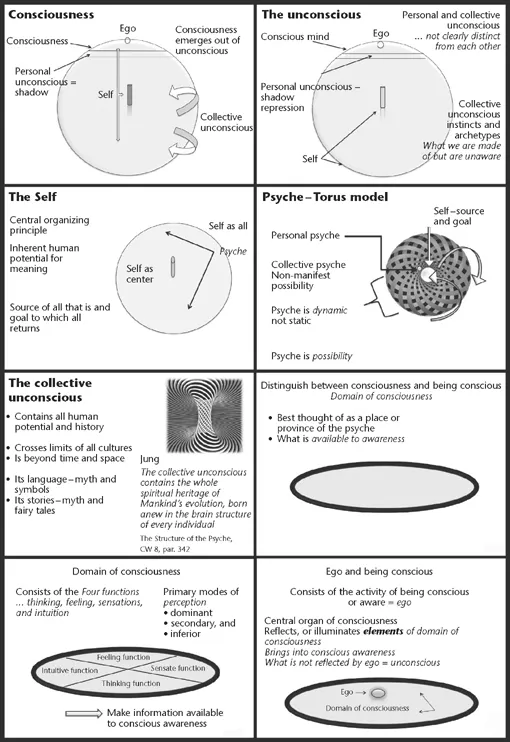
Jung’s early research showed that this unconscious form of thought underlies all other forms of conscious thought, and that it was out of the unconscious that all new learning and personality development emerged. He recognized that the language of the unconscious is images and symbols, and that the stories that they tell are mythic. The language of the conscious mind, on the other hand, is words and rational reasoning. What is conscious has emerged out of the unconscious. In fact, Jung averred that consciousness is minute in comparison with the unconscious. Jung also observed that, given the proper conditions, the human psyche has a natural tendency to heal and grow. This propensity is an aspect of what Jung called the Self, the central archetype of the psyche. Jung theorized that the human psyche consists of template-like patterns that configure human existence. For example, there is a mother archetype that functions to organize the individual’s experiences of mothering. I suspect that what Jung saw as archetypes are the aspects of the human genome that work together to make us human.
As the center of the psyche, the Self is the source from which all facets of the human experience emerge. The Self functions in each individual, but extends to all of manifest reality. It is the organizing principle that makes order out of chaos. It is the center point that gives all of life its meaning and coherence. The Self is also the goal to which everything returns. The Self is the purpose for being. It is not difficult to see how what Jung described is the core principle of all major religious traditions. The Self is what we call the divine principle, God, Buddha, Muhammad, and so on. Jung recognized that the Self functions as the unifying principle of the human psyche. Having a center point to which everything can be referred gives meaning to life. We see this reflected in religious traditions across cultures. The Western Bible, for example, says, “For this God is our God for ever and ever; he will be our guide even to the end” (Psalms 48:14 New International Version Bible). In the Tao Te Ching from the Chinese tradition, Lao Tzu said, “The ten thousand things rise and fall while the Self watches their return. They grow and flourish and then return to the source” (16, English, Feng, & Lippe). In the Quran we read, “Unto Allah belong the East and the West, and whithersoever ye turn, there is Allah’s Countenance. Lo! Allah is All-Embracing, All-Knowing” (2:115, Pickthall). We might envision the Self as a torus that turns in on itself at a miniscule center point. Thus as the torus rotates, new material emanates from the center, and returns to the center after a complete rotation.
fig1_2
Figure 1.2The unconscious and the conscious psyche
Jung observed that the purpose of life was to incorporate more and more of the Self into consciousness. The ego, the conscious position, must surrender its autonomy and become a servant of the Self. So we say, the ego aligns with the Self. Taken over the course of a lifetime, this is what Jung called the individuation process. This is, however, not an easy undertaking. The ego, ...

Table of contents

  1. Cover
  2. Half Title
  3. Title Page
  4. Copyright Page
  5. Table of Contents
  6. List of figures
  7. List of tables
  8. Notes on contributors
  9. 1 Introduction: what is Sandplay therapy?
  10. Part I Sandplay therapy in medicine
  11. Part II Sandplay with special populations
  12. Part III Sandplay in analysis and general practice
  13. Part IV Adaptations of the Sandplay method in education
  14. Part V Sandplay and the spirit
  15. Part VI Non-Jungian uses of the sand tray in therapeutic applications
  16. Index