In this first comprehensive overview of the intersection of immigration law and the First Amendment, a lawyer and historian traces ideological exclusion and deportation in the United States from the Alien Friends Act of 1798 to the evolving policies of the Trump administration.
Beginning with the Alien Friends Act of 1798, the United States passed laws in the name of national security to bar or expel foreigners based on their beliefs and associations—although these laws sometimes conflict with First Amendment protections of freedom of speech and association or contradict America's self-image as a nation of immigrants. The government has continually used ideological exclusions and deportations of noncitizens to suppress dissent and radicalism throughout the twentieth and twenty-first centuries, from the War on Anarchy to the Cold War to the War on Terror.
In Threat of Dissent—the first social, political, and legal history of ideological exclusion and deportation in the United States—Julia Rose Kraut delves into the intricacies of major court decisions and legislation without losing sight of the people involved. We follow the cases of immigrants and foreign-born visitors, including activists, scholars, and artists such as Emma Goldman, Ernest Mandel, Carlos Fuentes, Charlie Chaplin, and John Lennon. Kraut also highlights lawyers, including Clarence Darrow and Carol Weiss King, as well as organizations, like the ACLU and PEN America, who challenged the constitutionality of ideological exclusions and deportations under the First Amendment. The Supreme Court, however, frequently interpreted restrictions under immigration law and upheld the government's authority.
By reminding us of the legal vulnerability foreigners face on the basis of their beliefs, expressions, and associations, Kraut calls our attention to the ways that ideological exclusion and deportation reflect fears of subversion and serve as tools of political repression in the United States.
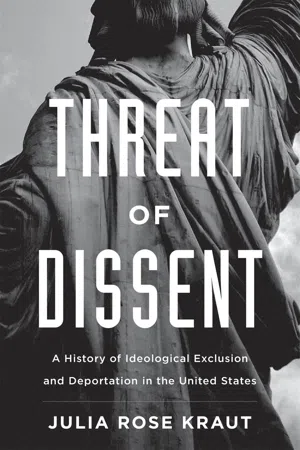
eBook - ePub
Threat of Dissent
A History of Ideological Exclusion and Deportation in the United States
- 344 pages
- English
- ePUB (mobile friendly)
- Available on iOS & Android
eBook - ePub
Threat of Dissent
A History of Ideological Exclusion and Deportation in the United States
About this book
Information
Topic
DirittoSubtopic
Storia nordamericana1
Sovereignty and Self-Preservation
IN HIS 1796 FAREWELL ADDRESS, President George Washington spoke to the American people as their “fellow-citizen” and an “old and affectionate friend.” Washington warned about the dangers of foreign influence, as well as political factions and divisions within the nation, for they “are likely, in the course of time and things, to become potent engines, by which cunning, ambitious, and unprincipled men will be enabled to subvert the power of the people and to usurp for themselves the reins of government.”
Turning to foreign affairs, the departing president advised the young country not to have “excessive partiality for one foreign nation and excessive dislike of another,” which he argued “gives to ambitious, corrupted, or deluded citizens (who devote themselves to the favorite nation), facility to betray or sacrifice the interests of their own country, without odium, sometimes even with popularity.” Washington spoke of “the insidious wiles of foreign influence,” and that “a free people ought to be constantly awake, since history and experience prove that foreign influence is one of the most baneful foes of republican government.”
Washington cautioned against one political faction dominating and controlling the government, claiming this could lead to a “more formal and permanent despotism” and would result in a gradual inclination by men to seek revenge and security through absolute power. He emphasized the importance of the separation of powers within the federal government and the need to guard against the “spirit of encroachment” and too much power held by one department without a check by others. Washington called for unity and for a focus on a shared story of fighting for liberty and forging a new nation together.1
The nation that Washington addressed was a deeply divided one. The arguments over the ratification of the Constitution in 1787 had extended into the 1790s, reflecting a fundamental, perpetual disagreement over the role of the federal government and of the states in the new democratic republic. The Federalists, led by Washington, John Adams, and Alexander Hamilton, favored a strong central government, which encouraged business and trade. The Democratic-Republicans, led by Thomas Jefferson and James Madison, opposed a strong central government, favored independent farmers, and were concerned that the new Constitution had given too much power to the federal government, which could infringe upon the states’ autonomy and power.2
Washington’s warning about factions reflected his apprehension regarding the rise of Democratic-Republican societies, where people gathered to discuss politics and their opposition to his administration. These societies viewed themselves as preserving the “legacy of the Revolution,” which they argued Washington’s administration undermined with its financial policies and foreign relations with Great Britain. They considered open challenges to Washington’s decision-making as a patriotic check on federal power, and they believed sovereignty was held by the people and the individual states, and not by the federal government. The Federalists viewed these Democratic-Republican societies as subversive, undermining the interests of the people and the government by expressing dissent and criticism in their own circles, and not through the electoral process and political petitions to Congress.3
The United States faced crisis not only at home, but also abroad. Internationally, the United States was caught in the middle of tensions between Great Britain and France following the French Revolution. In the 1790s, the Federalists were pro-British, while the Democratic-Republicans were sympathetic to France.4 When France declared war on Great Britain in 1793, Washington issued a Proclamation of Neutrality, but in 1795, Washington signed the Jay Treaty with Great Britain. The treaty granted the United States “most favored nation status” and sent compensation for prerevolutionary debts and British seizure of American ships into arbitration.5 It exacerbated tensions with France, which considered the Jay Treaty a step away from neutrality and a step toward the United States’ open alliance with Great Britain.6 Because of this perceived partiality toward Great Britain and a step away from France, the Jay Treaty was also incredibly unpopular with Democratic-Republicans and was denounced by Jefferson.7
Both the Federalists and the Democratic-Republicans shared Washington’s concerns about foreign influence, but this consensus also served to contribute to the political chasm and increasing enmity within the United States. Desperate to distinguish the United States from Europe and to increase partisan political gains, the Federalists and the Democratic-Republicans accused each other of changing the nature of the United States through its alliances and partiality. The Democratic-Republicans charged the Federalists with bringing elements of British aristocracy to the United States, thus corrupting the new nation’s experiment in democracy. The Federalists charged the Democratic-Republicans with bringing terror and chaos to the United States with their support of the French Revolution and referred to Democratic-Republicans as American “Jacobins.”8
By 1798, the Federalists controlled Congress and, with the election of John Adams, the presidency as well. The nation’s division had grown even sharper and more contentious, and the United States was in a quasi-war with France. The infamous “XYZ Affair” was primarily responsible for Adams’s decision that the nation would enter this “virtual state of undeclared war.”9 This diplomatic scandal involved three French agents (referred to as “X, Y, Z”) who demanded enormous concessions as a condition for continuing bilateral peace negotiations, including a $10 million loan and a $250,000 personal bribe to French foreign minister Charles Maurice de Talleyrand. The American delegates sent to France rejected these demands, replying “No. Not a sixpence.”10 When this news broke, the Federalists urged war with France, while the Democratic-Republicans supported maintaining neutrality and openly denounced Adams.11
On the brink of open war with France, the Federalists passed legislation that conflated foreigners with dissent and subversion, and they abused their political power in the executive and legislative branches to exploit the vulnerability of foreign noncitizens. In addition to changing naturalization requirements and criminalizing criticism of Adams, Congress, and the quasi-war, the Federalists also passed the Alien Friends Act in 1798, the first implicit ideological deportation law. This act gave the president absolute power and discretion to deport any foreigner he deemed “dangerous to the peace and safety of the United States.” One of the legal justifications for the Alien Friends Act’s passage—Congress’s power to regulate commerce with foreign nations—was later used to support and strengthen federal power and regulation throughout the nineteenth century. Other justifications, including national sovereignty and the inherent right of self-preservation, served as the basis for Congress’s plenary (absolute) power and the plenary power doctrine to uphold the constitutionality of federal immigration restriction.
The Four Acts Passed in 1798
Before the American Revolution, individual colonies restricted their borders and expelled undesirable foreign newcomers.12 After the Revolution, these colonies-turned-states continued their practice of exclusion and ejection. Thus, individual states, and not the federal government, were responsible for the restrictions on foreigners coming to and residing in the United States.
By the late 1790s, the United States had become a haven for various refugees, including French radicals and aristocrats, French planters escaping the Haitian Revolution, and persecuted Irish fleeing British rule.13 Approximately, 80,000 had emigrated from Great Britain, 60,000 had arrived from Ireland, and 30,000 French immigrants were living in the United States, many of them residing in Philadelphia.14
The Democratic-Republicans worried that the Haitian planters would bring their sympathies for monarchy and fear of revolution to the United States and support the Federalists. They were also concerned that the free black Haitian émigrés would import radicalism and insurrection to the slave-holding states.15 Meanwhile, the Federalists focused on the anti-British, antimonarchical Irish, who they feared would become Democratic-Republicans.16 Irish immigrants who had been members of the United Irishmen, a secret organization fighting against British rule and for Irish independence, established similar societies in the United States and voted Democratic-Republican.17 The Federalists worried the Irish and French immigrants would unite and work together to bring rebellion against the United States and its government.18
The Federalists in Congress and members of the Adams administration had also become increasingly angered by the verbal and published attacks hurled at them by the Democratic-Republicans.19 In the 1790s, newspapers and their circulation increased, as did their partisanship and use by Hamilton and Jefferson as organs of the Federalists and the Democratic-Republicans, respectively.20 Encouraged by Jefferson, Benjamin Franklin Bache (Benjamin Franklin’s grandson), the editor of the Aurora, the leading Democratic-Republican newspaper published in Philadelphia, explicitly and forcefully opposed the Jay Treaty. Bache turned the paper into an organizing vehicle for the Democratic-Republicans and their support for Jefferson.21 He denounced the Federalists and described the president as “old, querulous, Bald, blind, crippled, Toothless Adams.”22
As war with France loomed, the Federalists seized the opportunity to curb the Democratic-Republicans’ vitriol by turning them into the enemy. They characterized the Democratic-Republicans as “foreign” and attacked their patriotism by casting them as disloyal and subversive. Jefferson was the Federalists’ main target. The Porcupine’s Gazette, Philadelphia’s Federalist newspaper and rival to Bache’s Aurora, described Jefferson, as “the head of the democratic frenchified faction in this country.” At a Federalist rally to celebrate the Fourth of July, all raised their glasses to Adams: “May he, like Samson, slay thousands of Frenchmen with the jawbone of Jefferson.”23 The Federalists declared that an American who opposed the Adams administration was a “traitor.” Another Federalist newspaper, the Gazette of the United States, coined the political slogan: “He that is not for us, is against us.”24
The Federalists’ turn toward federal legislation as a tool to suppress the threat of dissent began with naturalization. Under Article I of the Constitution, Congress held the power to “establish an uniform rule of Nationalization,” and in 1790, it passed the first Naturalization Act. Attempting to encourage immigration to the new nation and increase citizenry, the act granted citizenship to “free white persons” of “good moral character” who had resided for two years in the United States.25 Fears of foreign influence and foreigners’ political participation and support for the Democratic-Republicans led Congress, which was then controlled by the Federalists, to revise the Naturalization Act in 1795, lengthening the time to become a US citizen by increasing the US residency requirement to five years.26
Now, on the brink of war, Federalists sought to more than double the residency requirement. On June 18, 1798, Congress passed a new Naturalization Act, which increased the residency requirement to fourteen years. The act also included a requirement for all foreigners over the age of twenty-one to register with a clerk at the nearest US distri...
Table of contents
- Cover
- Title Page
- Copyright
- Dedication
- Contents
- Introduction
- 1. Sovereignty and Self-Preservation
- 2. War on Anarchy
- 3. Making Democracy Safe in America
- 4. Denaturalization, Detention, Deportation, and Discretion
- 5. An Iron Curtain of the West
- 6. The Return of McCarranism
- 7. One Door Closes, Another Opens
- 8. War on Terror
- Conclusion
- Abbreviations
- Notes
- Acknowledgments
- Index
Trusted by 375,005 students
Access to over 1.5 million titles for a fair monthly price.
Study more efficiently using our study tools.
Frequently asked questions
Yes, you can cancel anytime from the Subscription tab in your account settings on the Perlego website. Your subscription will stay active until the end of your current billing period. Learn how to cancel your subscription
No, books cannot be downloaded as external files, such as PDFs, for use outside of Perlego. However, you can download books within the Perlego app for offline reading on mobile or tablet. Learn how to download books offline
We are an online textbook subscription service, where you can get access to an entire online library for less than the price of a single book per month. With over 1.5 million books across 990+ topics, we’ve got you covered! Learn about our mission
Look out for the read-aloud symbol on your next book to see if you can listen to it. The read-aloud tool reads text aloud for you, highlighting the text as it is being read. You can pause it, speed it up and slow it down. Learn more about Read Aloud
Yes! You can use the Perlego app on both iOS and Android devices to read anytime, anywhere — even offline. Perfect for commutes or when you’re on the go.
Please note we cannot support devices running on iOS 13 and Android 7 or earlier. Learn more about using the app
Please note we cannot support devices running on iOS 13 and Android 7 or earlier. Learn more about using the app
Yes, you can access Threat of Dissent by Julia Rose Kraut in PDF and/or ePUB format, as well as other popular books in Diritto & Storia nordamericana. We have over 1.5 million books available in our catalogue for you to explore.