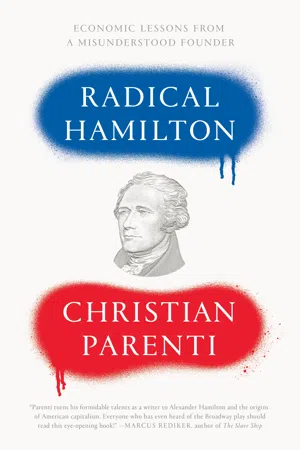
In retelling the story of the Radical Alexander Hamilton, Parenti rewrites the history early America and global economic history writ large. For much of the twentieth century, Hamilton - sometimes seen as the bad boy of the founding fathers or portrayed as the patron saint of bankers- was out of fashion. In contrast his rival Thomas Jefferson, the patrician democrat and slave owner who feared government overreach, was claimed by all. But more recently, Hamilton has become a subject of serious interest again.
He was a contradictory mix: a tough soldier, austere workaholic, exacting bureaucrat, yet also a sexual libertine, and a glory-obsessed romantic with suicidal tendencies. As Parenti argues, we have yet to fully appreciate Hamilton as the primary architect of American capitalism and the developmental state. In exploring his life and work, Parenti rediscovers this gadfly as a path breaking political thinker and institution builder. In this vivid historical portrait, Hamilton emerges as a singularly important historical figure: a thinker and politico who laid the foundation for America's ascent to global supremacy - for better or worse.
- 304 pages
- English
- ePUB (mobile friendly)
- Available on iOS & Android
eBook - ePub
About this book
Information
1
Do We Know Hamilton?
The modern United States has a strange relationship with Alexander Hamilton. Sometimes he is seen as the bad boy of the founding fathers, because of his authoritarian political tendencies. He is portrayed as the patron saint of bankers, because he saw the importance of banks and created our financial system. As a person he was a contradictory mix: a tough soldier, austere workaholic, exacting bureaucrat, yet also a sexual libertine who probably had at least one male lover, and a glory-obsessed romantic with pronounced suicidal tendencies. For much of the twentieth century, Hamilton was out of fashion, while his rival Thomas Jefferson, the patrician democrat and slave owner who feared government overreach, was claimed by all. But more recently, Hamilton has become hip.
Yet Americans still ignore Hamilton’s dirigiste economic theory. We take our Hamilton à la carte. We recognize him as the architect of our financial system, but we ignore what he wrote about the real economy in which goods and services are actually produced and consumed. We recognize him as a key author of the American Constitution and thus of the modern American state, but we never connect his theory of state to his full theory of economic development.
In particular, Hamilton’s magnum opus, his 1791 Report on the Subject of Manufactures, a central focus of this book, is almost totally ignored by economists, historians, development specialists, and biographers. Hamilton’s statist political economy is all there in print, yet most recent literature on Hamilton shies away from addressing his profoundly statist economic ideas. The Report is occasionally name-checked but almost never read, taught in college courses, or publicly discussed in any detail.
In his otherwise highly readable biography of Hamilton, Ron Chernow devotes only four pages to the Report. Chernow’s lines feel correct to the modern ear: “In the best of all possible worlds, Hamilton preferred free trade, open markets, and Adam Smith’s ‘invisible hand.’” Hamilton was, he says, “reluctant to tinker with markets.” But that is not correct.
In reality, Hamilton sought to create a national market from thirteen semi-integrated pieces and then transition that national economy from a lopsided dependence on export agriculture to a balanced and diversified economy centered on manufacturing. In the Report Hamilton lists, in meticulous detail, exactly how government should not merely “tinker with” but fundamentally overhaul, and create from the ground up, whole markets. His set of tools was labeled with a phrase that should be famous: “the Means proper.” These included carefully targeted state subsidies; protective tariffs; strategic exemptions from the same tariffs; selective export bans of strategic raw materials; quality-control standards and inspections; public investment in infrastructure; research and development; recruitment of skilled labor, and other measures that are detailed later. Hamilton’s means proper were the tools of economic planning, and their presentation in the Report on Manufactures was not merely a list, but also a blueprint for the orchestration and execution of a grand national plan aimed at nothing less than fundamental economic transformation. Asserting, as many do, that Hamilton was deep down a free marketeer serves to elide the progressive and immediately useful elements in Hamilton’s thinking.1
Similarly, Richard Brookshire, an editor at National Review, in his recent Hamilton biography spends only six pages on the Report, during which he mostly ignores Hamilton’s advocacy of government intervention. Instead, he focuses on those portions of the Report that defend manufacturing as more productive than agriculture.2 The PBS American Experience documentary on Hamilton devotes one line, or about six seconds out of an hour and a half, to Hamilton’s statist and developmentalist policies. Even then the documentary dismisses as sinister and strange Hamilton’s flirtation with the idea of public ownership.
One of the most famous books on American economic history, Douglas C. North’s The Economic Growth of the United States, 1790–1860, mentions Hamilton once in a footnote and then again briefly in the text to name him as the person who created the nation’s financial system. North says nothing about the Report and Hamilton’s role in fostering manufacturing, nor anything about Hamilton’s statist ideas in revolutionizing transportation, even though transportation costs are central to North’s argument.3 More recently, Andrew Shankman, who is typically a careful and precise historian, bizarrely minimizes and misrepresents the Report. Shankman casts Hamilton as hostile to protective taxes on imports, claiming that Hamilton only “gave protective tariffs 126 words” out of the Report’s total of about 40,000.4 In reality, Hamilton did not use the word “tariff” in the Report but did write extensively of “taxes” and “protecting duties” and devoted almost half the Report to an explicit and at times painfully detailed discussion of exactly which sorts of duties should be laid on all manner of imports, ranging from iron, lead, and copper to coal, wood, cotton, and grain; to flax and hemp; to printed books; to alcohol, refined sugar, chocolate, and more. By my count, the Report uses the word “duty” or “duties” a total of 89 times. Shankman also interprets Hamilton as relatively ignorant of, and hostile to, manufacturing. All this, it would seem, is part of an admirable effort to draw our attention to class struggle and the forgotten interests of the artisans and small farmers.5
A few older histories do address the Report in a serious fashion, most notably John C. Miller’s very fine biography.6 But that book, published in the 1950s, is fading into the rear view. A smattering of scholars writing in other disciplines have also given a place of honor to Hamilton’s dirigiste ideas. The development economist Ha-Joon Chang traces his critique of laissez-faire economics through the experience of South Korean industrialization back to Hamiltonian origins in U.S. history.7 The economic sociologist Fred Block, who has done stellar work documenting and theorizing America’s actually existing, though never named, developmentalist state, also gives Hamilton and the Report proper recognition. However, being focused on current political economy, both their discussions of the Report are necessarily limited.8
The reason for the more general elision of the Report is simple. Hamilton’s economic ideas contradict, and directly attack, the prevailing orthodoxy of extreme laissez-faire, the market-über-alles fundamentalism that is the leitmotif of Wall Street, big business, politicians, academia, and the vast majority of America’s center-right pundits. The Report on the Subject of Manufactures is ignored because, by today’s narrow standards, it is heretical. Its real message, served up in dense, convoluted, and tedious prose, is ignored and thus misunderstood.
The Report’s opening paragraphs smash holes in Adam Smith’s core argument about the supposedly self-regulating market. Further in, the Report outlines a set of policy tools for government intervention in the economy—Hamilton called these “the Means proper.” They include: tariffs, subsidies, public investment, and even imply a legitimate place for public ownership. America’s real political economy, our real economic history, has been built around these tools, yet we remain in denial. Many years ago the economist Michael Hudson, researching the intellectual history of American protectionism—which is to say the history of those who followed in Hamilton’s footsteps—found that: “Not even ostensibly encyclopedic studies of American economic thought paid much attention to [economic nationalists], treating them patronizingly as anomalies rather than the men who designed the nation’s rise to industrial supremacy.”9
Even if we do not acknowledge the role of protectionism and planning in our intellectual histories, their impacts have been central to the history of America’s actual economic development.
Impacts and Reverberations
Hamilton’s ideas would be called the “American School.” Then, in the 1820s under the leadership of the Kentuckian Henry Clay, they came to be known as the “American System.” Taken up by Friedrich List and brought to Germany, they morphed into the “National System.” These ideas—the “means proper” of 1791—helped shape the late-nineteenth-century industrialization of Germany and then Japan, and a century later the industrialization of South Korea, Hong Kong, and Taiwan. Today, these ideas guide the world-transforming rise of China. Indeed, the Report is the basic policy blueprint followed by most other successfully industrialized countries.
Hamilton’s defensive developmentalism, though in no way socialist, nonetheless had an anti-imperialist or at least postcolonial tinge, and in that regard anticipated some of the challenges later faced by the socialist experiments in the twentieth century. A more symmetrical comparison can be drawn between Hamilton’s project and that of Simón Bolívar. Like Hamilton, Bolívar was a liberal nationalist with a political vision of continental scale, rooted in the quest for development, sovereignty, and a strong central government.10 As Joshua Simon put it “Bolívar’s constitutional thought, especially his views on the separation of powers and on the role of the executive in a republic … compare well with those of the early American republic’s High Federalists, especially Alexander Hamilton.”11 Bolívar’s project fragmented, and in Latin America economic development was delayed and distorted by outside powers.
There is a perception, a latent, often unspoken assumption, that the United States was inevitably bound for high standards of living and political stability, while the states of Latin America were always and only destined for instability and underdevelopment. That perception not only smacks of racism, it is wrong on both counts. There was nothing inevitable about the formation of the United States. The pessimistic warnings of The Federalist Papers could have become reality.
This book treats the modern state and capitalism as historically contingent and politically produced. My aim in this book is not to “side with” Hamilton, but rather to explore parts of his life and context so as to unpack early American state formation and economic development. The book examines the context in which Alexander Hamilton arrived at his ideas about the role of government in economic development.
Hamilton’s dirigiste economic theories emerge first from his experiences in the Revolutionary War. As part of Washington’s staff Hamilton got a bird’s-eye view of the new nation’s poverty, corruption, and near-catastrophic disorganization. Then during the “Critical Period,” the postwar economic slump and political crisis of the 1780s, Hamilton saw the new nation sliding toward civil war, fragmentation, foreign invasion, and re-colonization. In telling this story, I draw on parts of Hamilton’s writing that address the nature of state power.
Relative Autonomy
What drove Hamilton? Charles Beard’s 1913 classic, An Economic Interpretation of the Constitution, detailed the financial interests of all the framers and the ways in which each of them directly benefited from or was directly assisted by the document. Importantly, Beard exempts Hamilton from such charges: “That Hamilton himself made any money in stocks which he held personally has never been proved by reference to any authentic evidence.” And Beard calls “highly improbable” the idea that Hamilton had “ever held any considerable sum in securities.”12 Instead of chasing personal benefit directly, Hamilton did it indirectly. As a man of the state—soldier, politician, then bureaucrat—he was materially bound to it and thus worked to create a political structure that tied various economic interests to the new government. His fortune was linked to that of the state: call him homo publicus. National survival was his desideratum.
Hamilton’s ultimate allegiance was to the project of state formation. In this regard he embodies what later social scientists would refer to as “the relative autonomy of the state.”13 For Hamilton, a secure future depended on a strong and activist government, powerful military, and robust, nationally integrated economy based on manufacturing. In place of Smith’s “invisible hand,” Hamilton saw the hand of government. The economy would not, in fact, develop all on its own “as if guided by an invisible hand.” Rather, it had to be actually and deliberately guided.
The tripartite circuitry of Hamilton’s nationalism cast sovereignty as dependent on national defense. National defense was dependent on the capacities of a professional standing army, which was, in turn, dependent on the wealth and technological sophistication of a manufacturing-based national economy. And that sort of economy, which did not yet exist in 1790, could only be created with the active guidance and support of a powerful central state. Thus, the state was both means and ends. A weak state, in this logic, is the path toward economic underdevelopment and permanent dependence.
Or as Hamilton put it in Federalist 11: “If we continue united, we may counteract a policy so unfriendly to our prosperity in a variety of ways. By prohibitory regulations, extending, at the same time, throughout the States, we may oblige foreign countries to bid against each other, for the privileges of our markets.” Here, Hamilton illustrates the essence of economic nationalism: the state does not merely react to economic conditions; it creates them. Hamilton’s political economy was a defense against European imperialism, a form of postcolonial pragmatism. The young nation’s choice was to either build a strong manufacturing-based economy or face disintegration. The mission was, in short, development or death.
Climate Hamilton?
American history is not merely interesting; it is also useful. Although our current world bears little resemblance to the eighteenth century, some parallels exist. After the Revolution the new nation slipped into a dangerous, multifaceted crisis. Political and economic collapse seemed imminent. Yet the framers managed to produce significant political and economic transformations that stabilized the situation, and the early republic avoided social breakdown, political fragmentation, and foreign domination. The society produced by the U.S. Constitution and the developmentalist state it empowered was never fair, or just, or ideal. But it was relatively stable and capable. If its mission was expansionist, racist, exploitative, its methods were at least functional and effective in their own terms. Many states are born of hierarchical and bigoted agendas. But not all succeed.14
Like that first generation of Americans, we contemporary Americans also face crisis. Ours takes the form of anthropogenic climate change and the inability of laissez-faire ideology to address it. Modern civilization must mitigate the causes of global warming and adapt to its effects. Failure to face this reality will mean almost certain violent social breakdown. Addressing climate change hinges upon, among other things, a total transforma...
Table of contents
- Cover Page
- Halftitle Page
- Title Page
- Copyright Page
- Dedication
- Contents
- 1. Do We Know Hamilton?
- 2. Cometh the Hour, Cometh the Man
- 3. The Supply Effort, from Grand Forage to Manufacturing
- 4. “The Badness of the Money”: Inflation and War
- 5. Military Mutiny and the Critical Period
- 6. Postwar Depression
- 7. Challenging the Weak State: Frontier Secessionists, Maroons, and Native Americans
- 8. Shays’s Rebellion: Culmination of Crisis
- 9. The Constitution as Reaction to Crisis
- 10. A Dirigiste Interpretation of the Constitution
- 11. Public Debt as Central Power
- 12. The Bank Uniting Sword and Purse
- 13. The Report
- 14. Small-Government Apocalypse: Tax Cuts, Austerity, and Enemy Invasion
- 15. The Report’s Long Impact
- Acknowledgements
- Notes
- Index
Trusted by 375,005 students
Access to over 1.5 million titles for a fair monthly price.
Study more efficiently using our study tools.
Frequently asked questions
Yes, you can cancel anytime from the Subscription tab in your account settings on the Perlego website. Your subscription will stay active until the end of your current billing period. Learn how to cancel your subscription
No, books cannot be downloaded as external files, such as PDFs, for use outside of Perlego. However, you can download books within the Perlego app for offline reading on mobile or tablet. Learn how to download books offline
Perlego offers two plans: Essential and Complete
- Essential is ideal for learners and professionals who enjoy exploring a wide range of subjects. Access the Essential Library with 800,000+ trusted titles and best-sellers across business, personal growth, and the humanities. Includes unlimited reading time and Standard Read Aloud voice.
- Complete: Perfect for advanced learners and researchers needing full, unrestricted access. Unlock 1.5M+ books across hundreds of subjects, including academic and specialized titles. The Complete Plan also includes advanced features like Premium Read Aloud and Research Assistant.
We are an online textbook subscription service, where you can get access to an entire online library for less than the price of a single book per month. With over 1.5 million books across 990+ topics, we’ve got you covered! Learn about our mission
Look out for the read-aloud symbol on your next book to see if you can listen to it. The read-aloud tool reads text aloud for you, highlighting the text as it is being read. You can pause it, speed it up and slow it down. Learn more about Read Aloud
Yes! You can use the Perlego app on both iOS and Android devices to read anytime, anywhere — even offline. Perfect for commutes or when you’re on the go.
Please note we cannot support devices running on iOS 13 and Android 7 or earlier. Learn more about using the app
Please note we cannot support devices running on iOS 13 and Android 7 or earlier. Learn more about using the app
Yes, you can access Radical Hamilton by Christian Parenti in PDF and/or ePUB format, as well as other popular books in Economics & Political Economy. We have over 1.5 million books available in our catalogue for you to explore.