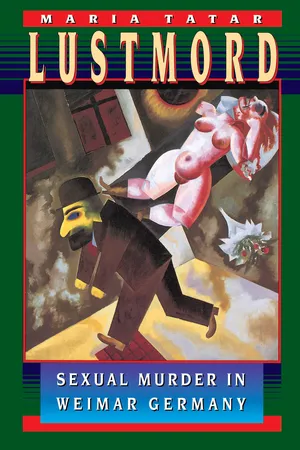
In a book that confronts our society's obsession with sexual violence, Maria Tatar seeks the meaning behind one of the most disturbing images of twentieth-century Western culture: the violated female corpse. This image is so prevalent in painting, literature, film, and, most recently, in mass media, that we rarely question what is at stake in its representation. Tatar, however, challenges us to consider what is taking place--both artistically and socially--in the construction and circulation of scenes depicting sexual murder. In examining images of sexual murder (Lustmord), she produces a riveting study of how art and murder have intersected in the sexual politics of culture from Weimar Germany to the present.
Tatar focuses attention on the politically turbulent Weimar Republic, often viewed as the birthplace of a transgressive avant-garde modernism, where representations of female sexual mutilation abound. Here a revealing episode in the gender politics of cultural production unfolds as male artists and writers, working in a society consumed by fear of outside threats, envision women as enemies that can be contained and mastered through transcendent artistic expression. Not only does Tatar show that male artists openly identified with real-life sexual murderers--George Grosz posed as Jack the Ripper in a photograph where his model and future wife was the target of his knife--but she also reveals the ways in which victims were disavowed and erased.
Tatar first analyzes actual cases of sexual murder that aroused wide public interest in Weimar Germany. She then considers how the representation of murdered women in visual and literary works functions as a strategy for managing social and sexual anxieties, and shows how violence against women can be linked to the war trauma, to urban pathologies, and to the politics of cultural production and biological reproduction.
In exploring the complex relationship between victim and agent in cases of sexual murder, Tatar explains how the roles came to be destabilized and reversed, turning the perpetrator of criminal deeds into a defenseless victim of seductive evil. Throughout the West today, the creation of similar ideological constructions still occurs in societies that have only recently begun to validate the voices of its victims. Maria Tatar's book opens up an important discussion for readers seeking to understand the forces behind sexual violence and its portrayal in the cultural media throughout this century.
- English
- ePUB (mobile friendly)
- Available on iOS & Android
eBook - ePub
About this book
Information
Publisher
Princeton University PressYear
2020Print ISBN
9780691015903
9780691043388
eBook ISBN
9780691216218

Sexual Murder: Weimar Germany
and Its Cultural Legacy
and Its Cultural Legacy

Morbid Curiosity:
Why Lustmord?
Why Lustmord?
I don't particularly want to chop up women but it seems to work.
Brian De Palma
This book represents the long answer to a question that seemed trivial when it first arose, but that haunted me with a curious insistence. Who was that man named Haarmann in verses that I had heard sung by Germans—both in real life and in movies?
Just you wait 'til it's your time,
Haarmann will come after you,
With his chopper, oh so fine,
He’ll make mincemeat out of you.1
In Fritz Lang’s film M, which opens in a subtly unnerving manner when the innocent voice of a child chants this grisly rhyme, the words “black man” are substituted for Haarmann.2 But most variants (and the one still widely known in Germany today) identify the cleaver-wielding fiend of these verses as “Haarmann.” While the name Haarmann, as I quickly discovered, does not appear in the standard cultural histories of Weimar Germany, it can be found with astonishing frequency in newspapers of the time ranging from the liberal Frankfurt Times (Frankfurter Zeitung) to the Communist Red Flag (Rote Fahne) and in acclaimed novels such as Yvan Goll’s Sodom Berlin and Alfred Döblin’s Berlin Alexanderplatz.3 When Lang released his film in 1931 and Döblin published his novel in 1929, both could count on general familiarity with the case of Fritz Haarmann, a serial murderer executed in 1925. They could also assume that their audiences were familiar with a range of other notorious cases—the Vampire of Düsseldorf or the Silesian Bluebeard—involving what a “medical man” in Hitchcock’s Frenzy calls “criminal sexual psvchopaths.”4 It was Fritz Haarmann who tipped me off to those cases and to the way in which they were a conspicuous presence, yet also a closely guarded secret, in Weimar's artistic, cinematic, and literary production.
Much as collective cultural memory has excluded Fritz Haarmann from the historical record and preserved his deeds in the popular imagination as something closer to lore than to fact, it was impossible to eradicate his real-life existence entirely Of late, the Haarmann case has attracted a certain amount of notoriety, but, in one instance at least, the effort to remember turned into what was perceived to be a scandalous attempt to commemorate his deeds. In Haarmann's native city of Hanover, Alfred Hrdlicka proposed erecting a monument to Haarmann—a statue that would be a provocation to be sure—but with the hope of provoking thought. It goes without saying that the plan was never approved, but Hrdlicka still had the chance to articulate what it was that made Haarmann worthy of memorialization. Haarmann's offenses lay at the heart of “the enigmas of a nation,” Hrdlicka declared. “Haarmann the mass murderer . . . was not only a lightning flash revealing the state-sanctioned mass murders that were to come; his antisocial preoccupations and drives were, above all, what made him a prototype of his time.”5 Hrdlicka may be loading the person of Haarmann with more cultural and social baggage than a single pathological case deserves, but his refusal to erase Haarmann from the historical record and his determination to investigate his deeds as symptomatic of something larger than the murderer himself guided me in my investigations.
What next caught my attention, after learning more about Haarmann, were the murder victims—not just Haarmann's, but those who began to appear as a virtually ubiquitous presence in Weimar's artistic production. The sheer number of canvases from the 1920s with the title Lustmord (Sexual Murder) ought to have been a source of wonder for Weimar's cultural historians long before now. But more startling than the way in which real-life murderers and their victims enter the referential codes of works of art from Weimar Germany is the way in which the producers of those works become personally implicated in what they put into words and images, so deeply implicated that it is tempting to give some credence to Degas's belief that a painting demands as much cunning, malice, and vice as does a crime.6 George Grosz, who painted more than his share of what he called "ladykillers'' (in the literal sense of the term) and of their mutilated victims, once had himself photographed in the pose of Jack the Ripper (fig. 1). Menacing his victim with a knife pointed at her genitals, he transforms himself from the creative artist who frames, contains, and appropriates the seductive appeal of his model into a murderer prepared to destroy the source of male heterosexual desire and of artistic inspiration. The female model—absorbed in the contemplation of her own image (note the redundant presence of both a hand mirror and a near full-length mirror)—puts herself on display in a gesture of serene self-sufficiency. She has, in a sense, made the artist superfluous by creating herself as a work of art, as the target of the male connoisseur's gaze. And that reason alone may be sufficient to account for the artist's impersonation of a man prepared to assault, disfigure, and mutilate the body before him.

1. George Grosz as Jack the Ripper, Self-Portrait with Eva Peter in the Artist’s Studio (1918). As Eva Peter admires herself in a hand mirror, George Grosz emerges from behind a larger mirror in which she is reflected to stage a mock assault on the woman who was to become his wife two years later.
But the photograph of Grosz does not give us the real thing. In fact, it emphasizes its own "unreality” in the proliferation of simulacra ranging from mirror images and photographs through masks and dolls. The photograph appears to represent nothing more than a witty charade, with the artist merely masquerading as murderer. Still, murder—even when it is “just” staged, as in this snapshot—is never entirely innocent. That Grosz not only drew and painted mutilated female corpses but also felt compelled to act out the role of murderer seems telling, particularly when we consider that there was a real erotic tie between the Grosz in the photograph and his model. (Eva Peter, the woman on display, was to become his wife two years later.) What was it that drove Grosz to open the boundaries between art and life—first, to depict killers on his canvases, then, to impersonate them in photographs? That he was engaged in mimetic practices that were violent from both an aesthetic and a somatic point of view becomes evident from descriptions of his working methods. One critic points out that he turned his canvases into "scenes of crimes,” applying the knife to them and spraying them with red paint.7 Was this part of the same syndrome that led Frank Wedekind to enact on stage the role of Jack the Ripper in a play that he had written and that had starred his wife as Jack's victim? Or that motivated Otto Dix to paint a self-portrait entitled Sex Murderer and to smear it with his red handprints—just as if he wanted to be caught red-handed? That real-life murderers and their victims have a habit of turning up in plays and novels or making appearances in paintings and films even as artists construct their own identities as murderous assailants suggests a strange bond between murder and art, one to which Thomas De Quincey referred in his meditations "On Murder Considered as One of the Fine Arts” (1827).8 This book on Lustmord tries to define the nature of that connection and to identify how it expresses itself in a variety of ways, some self-evident and straightforward, others surreptitious and complex.
In recent years, scholars from a variety of disciplines have trained our attention on the gender politics of cultural production in Germany during the prewar era through the war years into the 1920s.9 Their efforts have made it possible to discern the outlines of a modernist project that aestheticizes violence and turns the mutilated female body into an object of fascination and dread, riveting in its display of disfiguring violence yet also repugnant in the detail of its morbid carnality Whether studying Rudolf Schlichter's painting Sexual Murder, exploring the "Sex Murderer Grotto” in Kurt Schwitters's Cathedral of Sexual Misery, or observing how Alfred Döblin reconstructs the psychic life of Rosa Luxemburg and sexualizes her political assassination, it becomes evident that the representation of murdered women must function as an aesthetic strategy for managing certain kinds of sexual, social, and political anxieties and for constituting an artistic and social identity.
Developing arguments about the positioning of sexual murder in the 1920s requires a close look not only at Weimar Germany's cultural understanding of the killers, but also our own ways of explaining what is at stake in cases of serial murder. This issue is addressed in the next chapter by attending to definitions and to the way in which they are shaped by the identity, deeds, and accounts of historical murderers. Our fascination with sexual murder stems in part from its mystification as a deed that, in its perversion of love into hate, could be committed only by a savage beast or deranged monster rather than a human being. Yet time and again, these murderers are constructed as sons seeking revenge against women—against mothers as agents of sexual prohibition or against women in general as icons of licentious sexuality. Similarly, those who commit murder on canvases, pages, or screens are, as I try to demonstrate, competing with the reproductive powers of women or aiming to transcend the laws of biological procreation affiliated with women's bodies. I dwell in detail on Hitchcock's representation of sexual murder, in part because it was shaped so powerfully by German cinematic portrayals, in part because it so clearly captures Western notions of what drives men to murder women. These reflections are followed by a chapter that describes actual cases of sexual murder in Weimar Germany and looks at the ways in which those cases were reported by the press, investigated by the police, and overseen by the judicial system.
The second part of this book presents case studies of works by artists, writers, and filmmakers. Looking at representations in a variety of media requires an interdisciplinary approach that turns the once closely patrolled boundaries between literature, the visual arts, and cinema into permeable borders. I examine what Louis Montrose has called the “synchronic text of a cultural system," trying to establish a kind of cultural intertextuality in which case studies illuminate artistic production even as fictional accounts broaden our understanding of social realities. If we reflect on the way in which Jack the Ripper has been featured in so many films, plays, and novels that he is now as much literary construct as cultural case history or consider the way in which Norman Bates has found his way into legal arguments and psychiatric studies, it becomes clear that the study of sexual murder requires an approach that recognizes the controversial “textuality of history and historicity of texts"10 without, however, dissolving the line between historical fact and imaginative construct.
This study analyzes verbal and visual representations of sexual murder, or more specificially what the German language calls Lustmord. (I shall use that term interchangeably with the English “sexual murder," though the German term Lust—which implies desire and pleasure along with sexual gain—captures more precisely the multiple dimensions of the motives driving this type of killing.) It also considers the sociocultural field that shaped those images and produced, in many cases, a surprising ideological consonance among male artists who prided themselves on their highly differentiated and personalized political beliefs. Where the consonance exists, I emphasize it. But I have also resisted homogenizing constructions that would turn energetic messiness into falsely stable and stabilizing arguments about the paintings, texts, and films discussed. I have tried not to configure the material in each chapter into completely tidy, but oversimplified and inaccurate, categories—with the result that disjunctions and discontinuities emerge in the case studies. They are there because disruptive anomalies are also a part of what constitutes the work of individual artists and writers and because the anomalies are often more revealing than the signatures of a particular style.
For decades, images of the victims of Lustmord were suppressed in our investigations of what has come to be known as Weimar Culture—in part because of their disturbing content, in part because of their unsettling effect on our attempts to produce stabilizing definitions of modernist aesthetics by emphasizing manner over matter. Elisabeth Bronfen has stressed the degree to which overkill has also desensitized us to the image of female corpses in books, on the screen, or on canvases: “Because they are so familiar, so evident, we are culturally blind to the ubiquity of representations of feminine death."11
That cultural blindness often takes the symptomatic form of naturalizing rape and murder directed at women. The filmmaker Brian De Palma has insisted that "using women in situations where they are killed or sexually attacked” is nothing more than a "genre convention . . . like using violins when people look at each other.”12 To argue that images of sexual and homicidal assault are culturally innocent is to take an almost willfully naive position about the role of ideology in artistic productions. What makes woman's position as victim, either in cinema or in real life, ""natural?” The violent scenes De Palma puts on screen are anything but routine, workaday images devoid of substance. They figure as arresting moments that shock us and challenge us to reflect on the complex interlocking of gender roles, sexuality, and violence.
Yet even once we agree to problematize images of sexual violence, our interpretive habits can prevent us from facing the full implications of what is represented. As twentieth-century readers and spectators, we have been trained to view violence as an aesthetic strategy funded by a powerful transgressive energy that is the mark of the avant-garde. It is seen as nothing more than a pretext for practicing the modernist art of fragmentation and disfigurement. The referential matter of modernist art is relentlessly subordinated to and effaced by its spiritualizing manner. Thus Picasso's Demoiselles d’Avignon, which has been characterized as depicting a “tidal wave of female aggression" and “savage, disfiguring sexual menace," has been reframed to become a modernist icon of the viewer's “collision with art" or the “emancipation of form from content."13 Focusing exclusively on formal features and insisting on disfigurement as a purely aesthetic principle can distract from facing the ful...
Table of contents
- Cover Page
- Title Page
- Copyright Page
- Contents
- List of Illustrations
- Acknowledgments
- Part One: Sexual Murder: Weimar Germany and Its Cultural Legacy
- Part Two: Case Studies
- Notes
- Index
Trusted by 375,005 students
Access to over 1.5 million titles for a fair monthly price.
Study more efficiently using our study tools.
Frequently asked questions
Yes, you can cancel anytime from the Subscription tab in your account settings on the Perlego website. Your subscription will stay active until the end of your current billing period. Learn how to cancel your subscription
No, books cannot be downloaded as external files, such as PDFs, for use outside of Perlego. However, you can download books within the Perlego app for offline reading on mobile or tablet. Learn how to download books offline
Perlego offers two plans: Essential and Complete
- Essential is ideal for learners and professionals who enjoy exploring a wide range of subjects. Access the Essential Library with 800,000+ trusted titles and best-sellers across business, personal growth, and the humanities. Includes unlimited reading time and Standard Read Aloud voice.
- Complete: Perfect for advanced learners and researchers needing full, unrestricted access. Unlock 1.5M+ books across hundreds of subjects, including academic and specialized titles. The Complete Plan also includes advanced features like Premium Read Aloud and Research Assistant.
We are an online textbook subscription service, where you can get access to an entire online library for less than the price of a single book per month. With over 1.5 million books across 990+ topics, we’ve got you covered! Learn about our mission
Look out for the read-aloud symbol on your next book to see if you can listen to it. The read-aloud tool reads text aloud for you, highlighting the text as it is being read. You can pause it, speed it up and slow it down. Learn more about Read Aloud
Yes! You can use the Perlego app on both iOS and Android devices to read anytime, anywhere — even offline. Perfect for commutes or when you’re on the go.
Please note we cannot support devices running on iOS 13 and Android 7 or earlier. Learn more about using the app
Please note we cannot support devices running on iOS 13 and Android 7 or earlier. Learn more about using the app
Yes, you can access Lustmord by Maria Tatar,Maria M. Tatar in PDF and/or ePUB format, as well as other popular books in Literature & German Literary Criticism. We have over 1.5 million books available in our catalogue for you to explore.