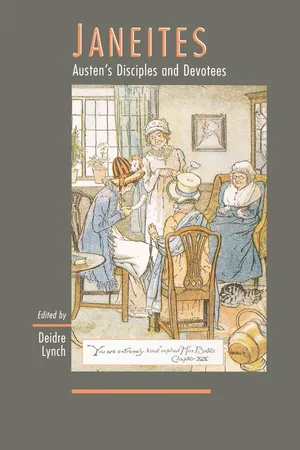
Over the last decade, as Jane Austen has moved center-stage in our culture, onto best-seller lists and into movie houses, another figure has slipped into the spotlight alongside her. This is the "Janeite," the zealous reader and fan whose devotion to the novels has been frequently invoked and often derided by the critical establishment. Jane Austen has long been considered part of a great literary tradition, even legitimizing the academic study of novels. However, the Janeite phenomenon has not until now aroused the curiosity of scholars interested in the politics of culture. Rather than lament the fact that Austen today shares the headlines with her readers, the contributors to this collection inquire into why this is the case, ask what Janeites do, and explore the myriad appropriations of Austen--adaptations, reviews, rewritings, and appreciations--that have been produced since her lifetime.
The articles move from the nineteenth-century lending library to the modern cineplex and discuss how novelists as diverse as Cooper, Woolf, James, and Kipling have claimed or repudiated their Austenian inheritance. As case studies in reception history, they pose new questions of long-loved novels--as well as new questions about Austen's relation to Englishness, about the boundaries between elite and popular cultures and amateur and professional readerships, and about the cultural work performed by the realist novel and the marriage plot.
The contributors are Barbara M. Benedict, Mary A. Favret, Susan Fraiman, William Galperin, Claudia L. Johnson, Deidre Lynch, Mary Ann O'Farrell, Roger Sales, Katie Trumpener, and Clara Tuite.
- English
- ePUB (mobile friendly)
- Available on iOS & Android
eBook - ePub
About this book
Information
Publisher
Princeton University PressYear
2020Print ISBN
9780691050065
9780691050058
eBook ISBN
9780691216089
1
The Divine Miss Jane: Jane Austen, Janeites, and the Discipline of Novel Studies
CLAUDIA L. JOHNSON
On the level of common sense it is not hard to wish Mr. Kimball well in his war [against “tenured radicals”]. Even when his examples of academic idiocy are funny, they are also hair-raising. ... A proponent of feminist studies argues that “gynophobia is structured like a language.” Sessions of the annual meeting of the Modern Language Association are devoted to “Jane Austen and the Masturbating Girl” and to “Desublimating the Male Sublime: Autoerotics, Anal Erotics and Corporeal Violence in Melville and William Burroughs.”
(Roger Rosenblatt, “The Universities: A Bitter Attack” [review of Roger Kimball, Tenured Radicals], New York Times Book Review, 22 April 1990)
If we now turn to the significance of the macho-style for gay men, it would, I think, be accurate to say that this style gives rise to two reactions, both of which indicate a profound respect for machismo itself. One is the classic put-down: the butch number swaggering into a bar in a leather get-up opens his mouth and sounds like a pansy, takes you home, where the first thing you notice is the complete works of Jane Austen, gets you into bed, and—well, you know the rest. In short, the mockery of gay machismo is almost exclusively an internal affair, and it is based on the dark suspicion that you may not be getting the real article. The other reaction is, quite simply, sexual excitement.
(Leo Bersani, “Is the Rectum a Grave,” in AIDS: Cultural Analysis, Cultural Activism)
JANE AUSTEN always seems to inspire radically contradictory appeals to self-evidence. For Roger Rosenblatt, as for Roger Kimball, “common sense” dictates that Austen is obviously straitlaced and straight, and would have seemed off-limits to the nonsense of sex and gender analysis if tenured radicals had not turned the world, the obviously prim Miss Austen included, upside down. Pressing fantasies about the serenity of Regency England into the service of heterosexual presumption, Kimball and Rosenblatt place Austen before the advent of such ills as industrialization, dubiety, feminism, homosexuality, masturbation, the unconscious. In her novels, men are gentlemen, women are ladies, and the desires of gentlemen and ladies for each other are intelligible, complementary, mutually fulfilling, and, above all, inevitable. Not that such assumptions are articulated. The whole point is not that they do not have to be but that they must never be; as David Halperin has suggested, heterosexuality is the love that dares not speak its name, and argument would denaturalize and out it.1 Recoiling from this possibility as from apocalypse itself, Rosenblatt describes Eve Kosofsky Sedgwick’s paper on Sense and Sensibility as one of the many “horror stories” that make Kimball seem like a bearded prophet of old: the world may indeed be coming to an end; even Jane Austen is not safe.2
For Leo Bersani, the case is different, testifying inadvertently as he does to Austen’s status among gay men. His anecdote comes to us as an old and disappointing story. Like Rosenblatt, he relies on “common” knowledge and on an audience that similarly will recognize his anecdote as a classic, a story you—which is to say, “we gay boys”—all know and that for this reason will require no elaboration. Calling attention to the ambivalences about effeminacy and macho within the gay community itself, Bersani’s anecdote shows that homosexuality and the Oxford Illustrated Jane Austen are not strange bedfellows. Even as we speak, some leather-clad “butch number” may be “swaggering” up to a not-so-unsuspecting boy in a bar, his mind full of the ball at Netherfield and hot sex. Sure, he is, as Bersani puts it, a “pansy”: “you” may pretend “you” had no inkling of this until later, but “you” knew it as soon as he “open[ed] his mouth,” and obviously liked it well enough to go home with him in the first place. But his passion for Austen, recognized later, makes him doubly so, guaranteeing that he will be a bottom: “well, you know the rest.” Bersani’s complex and rather Austenian mockery aside, Austen’s novels appear often to have facilitated rather than dampened conversation between men. In 1899, when he was a student at Cambridge, E. M. Forster was whisked to a fellow’s room expressly to examine a new deluxe edition of Austen’s novels;3 and Montague Summers remembers “hotly championing the cause of Jane Austen” to the “charming” poet Robert Nichols, a man “distractingly violent. . . but most attractive in his flaming zeal and pale vehemence.”4 The precise nature of these Austenian encounters we do not know. This much is clear, however: the real joke in Bersani’s story is not the “complete works of Jane Austen” but the “leather get-up,” and their simultaneously denied and desired conjunction.
A comparable clash of assumptions over what Austen is like and what kind of converse her novels promote reerupted in 1995 in the London Review of Books, when Terry Castle discussed Austen’s intense attachment to her sister Cassandra and claimed that sister-sister relations are just as important as marriage in the novels, if not more so. The editors of the LRB sought controversy: why else entitle the review “Was Jane Austen Gay?” without Castle’s say-so? But no one expected the vehemence that followed, as scores of people rushed to rescue Austen from the charge of “sister-love”: one reader, assuming that “Terry” was a man, damned the “drip-drip” smuttiness of “his” discussions of women’s familiarity; some swore up and down that marriages in Austen’s novels were perfectly felicitous without requiring the supplemental pleasures of sororal love; others insisted testily, if inanely, that since sisters commonly shared beds in those days, it is anachronistic to imply that their intimacy meant anything “more.” Austen scholar B. C. Southam entered the fray: does Austen describe women’s bodies with “homophilic fascination,” as Castle suggested? Not to worry: Austen was an amateur seamstress and thus had a perfectly innocent reason for attending to how gowns hugged the persons of her female acquaintance. The outcry, extensively covered in the British media, even reached Newsweek and Time, where one reader grumbled, “So Jane Austen may have been a lesbian. . . . Who cares?” only to continue by complaining about the “questionable practices” of psychoanalyzing historical subjects unable to speak for themselves and of reading too much into the “love language of women.” Vainly did Castle plead that she had never asserted the existence of an incestuously lesbian relationship between Austen and her sister: the words homophilic and homoerotic provoked readers to announce that the limits of tolerance had been reached. Castle had “polluted the shrine,” and this would not be suffered.5
The heteronormativity of Austen seems as obvious to Rosenblatt, Kimball, and outraged readers of the LRB as her queerness does to Castle, Bersani, and the men in his anecdote. How can we account for this anomaly, and why should we bother? In attempting to answer this, I make no claims to neutrality. I cast my lot with the queer Austen and believe that the question of Austen’s reception and readerships merits substantial consideration. Such is the enormity of Austen’s status as a cultural institution, however, and such is her centrality to the canon of British literature in general, that the issues surrounding these controversies are really much larger. What if Austen were “gay” (as the LRB put it)? I hope to show that modern Austen criticism labored to occlude this possibility when a middle-class professorate wrested Austen from upper-class Janeites, and when the disciplined study of the novel was being founded. Central to this undertaking, then, is a consideration of different traditions, motives, and modes of valuation regarding Austen.6 While I will begin by tracing the sexual politics of Austenian valuations and how these get appropriated by constituencies of different class and sexual positions, I will go on to uncover the terms on which Austen’s place in the founding of the disciplined study of the novel was established. Although my principal aim will be to illuminate the history of Austenian reception as it sheds light on the institution of novel studies,7 at the same time, by considering the phenomenon of “Janeiteism,” I also hope to genealogize the perceived queerness of many of her readers, as this queerness has been played out euphemistically in (sometimes overlapping) oppositions between macho and “effeminate” standards of masculinity, and between academic and belletristic models of novel criticism.

To listen to the readers who attacked Sedgwick and Castle, we might imagine that no one had ever doubted Austen’s normativity before. This is so far from the case that the wonder is rather that Austen’s normality itself now appears beyond question to so many. “Is she queer?—Is she prudish?” (230). So asks the rakish Henry Crawford of Mansfield Park as he wonders about Austen’s nerdiest heroine, Fanny Price. For some reason, the erotic charm that makes married and unmarried women in that novel yield to Henry’s desire fails to make a dent on this mousy, inhibited, and intense girl. Stymied by Fanny’s resistance to his allure, Henry tries to determine Fanny’s “character” (230). Is something wrong with her (is she odd, out of sorts, cold, and thus peculiarly resistant to normal heterosexual seduction)? Or is something “wrong” with him (do his multiple and serial flirtations deserve the censure this unusually, but not abnormally, moral young lady levels against them?)? Fanny decides in favor of the severity of rectitude, but the novel refuses to settle between propriety and pathology, and insists on their confusion.
Henry’s reading of Fanny as either queer or prudish describes two traditions of Austenian reception.8 Ever since Archbishop Whately claimed in 1821 that Austen was “evidently a Christian writer,”9 many readers have been either pleased or infuriated to find that her novels are given over to orthodox morality, conservative politics, and strenuous propriety. This view is hardly the handiwork of the academic right wing, much less of heterosexist readers. Such are the asymmetries of the sex-gender system brilliantly elucidated by Judith Butler, among others, that it is not hard to find critics working within the camps of feminism, deconstruction, and queer studies who view Austen as Rosenblatt and Kimball might wish. D. A. Miller, for example, who has done so much for the study of “gay fabulation,” reads Austen much as Allan Bloom does: what Bloom admires as wholesomely instructive and disciplinary in Austen’s style and narrative structures, Miller can describe as violently hygienic and correctional. Different valuation: same Austen.10
Even though Kimball and Rosenblatt cast themselves as righteous amateurs opposing the lunacy rampant in the academy, the Jane Austen prevailing in the British and American academies today actually belongs to this normative tradition. It is only recently, however, that this Austen became the only widely visible one. Starting in the mid-nineteenth century, an antinormative tradition developed. Ever since Mrs. Oliphant praised the “feminine cynicism” and “quiet jeering” of her fiction,11 another set of readers has been either pleased or infuriated to find that Austen is not committed to the values of her neighborhood or to any values qua values at all, that she is disengaged from dominant moral and political norms, particularly as these are underwritten by the institutions of heterosexuality and marriage.
Because Austen’s heterosexuality was not guaranteed by marriage, doubts about her sexuality have been played out in different historical moments as asexuality, as frigidity, and as lesbianism. This “queerness,” as we might now term it, has been used to account for her fiction from the get-go. Charlotte Bronte linked the formal perfection of Austen’s novels—her attention to “the surface of the lives of genteel English people”—to her indifference to “what throbs fast and full, though hidden, what the blood rushes through.”12 Lionel Trilling attributed many readers’ “feral” hostility to Austen to “man’s panic fear at a fictional world in which the masculine principle, although represented as admirable and necessary, is prescribed and controlled by a female mind.”13 His explanation, however, misrepresents such animosity as a conflict between the sexes, when it is a conflict about sexuality. It is not because she is a woman that D. H. Lawrence and Bronte deplore her, but because she is a woman whose fiction does not reverence the love of virile men. Thus Lawrence decried “this old maid” for typifying “the sharp knowing in apartness” rather than the “blood connection” between the sexes; and George Sampson complained, “In her world there is neither marrying nor giving in marriage, but just the make-believe mating of dolls. . . . Jane Austen is abnormal. . . because [her characters] have no sex at all.”14
The history of Austen criticism has often been darkened by the scorn Austen-haters express for novels in which men and women are more absorbed in village tittle-tattle than in each other. For this reason, male admirers of Austen have had much to endure at the hands of a world that frowns upon their love. H. W. Garrod’s famous “Jane Austen: A Depreciation,” an address delivered to the Royal Society of Literature in 1928, attacks the whole notion of Austen’s greatness on sexual grounds. Austen is an “irredeemably humdrum” writer precisely because she holds herself aloof from sexual passion for men, and so “was as incapable of having a story as of writing one—by a story I mean a sequence of happenings, either romantic or uncommon.” Garrod’s misogynist “Depreciation” is aimed just as much at male Janeites in the audience as at Austen herself: “There is a time to be bo...
Table of contents
- Cover Page
- Title Page
- Copyright Page
- Contents
- Acknowledgments
- A Note to the Reader
- Introduction: Sharing with Our Neighbors
- Chapter 1: The Divine Miss Jane: Jane Austen, Janeites, and the Discipline of Novel Studies
- Chapter 2: Jane Austen’s Friendship
- Chapter 3: Sensibility by the Numbers: Austen’s Work as Regency Popular Fiction
- Chapter 4: Austen’s Earliest Readers and the Rise of the Janeites
- Chapter 5: Decadent Austen Entails: Forster, James, Firbank, and the “Queer Taste” of Sanditon (comp. 1817, publ. 1925)
- Chapter 6: The Virago Jane Austen
- Chapter 7: Free and Happy: Jane Austen in America
- Chapter 8: In Face of All the Servants: Spectators and Spies in Austen
- Chapter 9: Jane Austen and Edward Said: Gender, Culture, and Imperialism
- Notes on Contributors
- Index
Trusted by 375,005 students
Access to over 1.5 million titles for a fair monthly price.
Study more efficiently using our study tools.
Frequently asked questions
Yes, you can cancel anytime from the Subscription tab in your account settings on the Perlego website. Your subscription will stay active until the end of your current billing period. Learn how to cancel your subscription
No, books cannot be downloaded as external files, such as PDFs, for use outside of Perlego. However, you can download books within the Perlego app for offline reading on mobile or tablet. Learn how to download books offline
Perlego offers two plans: Essential and Complete
- Essential is ideal for learners and professionals who enjoy exploring a wide range of subjects. Access the Essential Library with 800,000+ trusted titles and best-sellers across business, personal growth, and the humanities. Includes unlimited reading time and Standard Read Aloud voice.
- Complete: Perfect for advanced learners and researchers needing full, unrestricted access. Unlock 1.5M+ books across hundreds of subjects, including academic and specialized titles. The Complete Plan also includes advanced features like Premium Read Aloud and Research Assistant.
We are an online textbook subscription service, where you can get access to an entire online library for less than the price of a single book per month. With over 1.5 million books across 990+ topics, we’ve got you covered! Learn about our mission
Look out for the read-aloud symbol on your next book to see if you can listen to it. The read-aloud tool reads text aloud for you, highlighting the text as it is being read. You can pause it, speed it up and slow it down. Learn more about Read Aloud
Yes! You can use the Perlego app on both iOS and Android devices to read anytime, anywhere — even offline. Perfect for commutes or when you’re on the go.
Please note we cannot support devices running on iOS 13 and Android 7 or earlier. Learn more about using the app
Please note we cannot support devices running on iOS 13 and Android 7 or earlier. Learn more about using the app
Yes, you can access Janeites by Deidre Lynch in PDF and/or ePUB format, as well as other popular books in Literature & English Literary Criticism. We have over 1.5 million books available in our catalogue for you to explore.