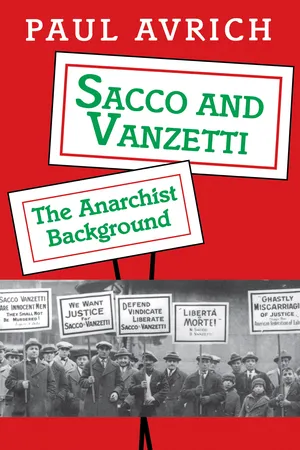
The Sacco-Vanzetti affair is the most famous and controversial case in American legal history. It divided the nation in the 1920s, and it has continued to arouse deep emotions, giving rise to an enormous literature. Few writers, however, have consulted anarchist sources for the wealth of information available there about the movement of which the defendants were a part. Now Paul Avrich, the preeminent American scholar of anarchism, looks at the case from this new and valuable perspective. This book treats a dramatic and hitherto neglected aspect of the cause célèbre that raised, according to Edmund Wilson, "almost every fundamental question of our political and social system."
- English
- ePUB (mobile friendly)
- Available on iOS & Android
eBook - ePub
About this book
Information
Publisher
Princeton University PressYear
2020Print ISBN
9780691026046
9780691047898
eBook ISBN
9780691216201
Topic
GeschichteSubtopic
Nordamerikanische GeschichtePART ONE
Immigrants
CHAPTER ONE
Italian Childhoods
IN 1908 MORE than 130,000 Italians emigrated to the United States. Among them were Nicola Sacco and Bartolomeo Vanzetti. They came from opposite ends of Italy and did not meet until 1917. After that, however, their fates were inseparably linked.
Sacco and Vanzetti hardly seemed destined for immortality when they arrived on America’s shores. In most respects they differed little from the millions of their fellow Italians who entered the country during the early years of the century, when immigration was at flood tide. Both, typically, were single young men of adventurous spirit in search of wider opportunities. Both came from peasant families, deeply rooted in the Italian soil. Though Sacco was from the south and Vanzetti from the north, both had grown up in small, remote towns, largely sheltered from the outside world. On reaching America, both abandoned their agrarian heritage for the career of an urban worker. Their lives, moreover, were compounded of the usual struggles, disappointments, and successes that fell to every new arrival.
In all this their experiences were unexceptional. What distinguished them from the ordinary lot of Italian immigrants was that both became militant anarchists who followed a course of clandestine insurgency. More than that, they became the defendants in one of the most celebrated trials in American history.
• • •
Sacco began life in Torremaggiore, a quiet southern town in the foothills of the Apennines, inland from the Adriatic spur of Italy’s boot. Remote from urban civilization, Torremaggiore was more than an hour’s journey to the nearest city, the provincial capital of Foggia, a bustling market for the wool, wheat, vegetables, olives, and grapes of the Puglia region, of which the province of Foggia forms a part. Torremaggiore, surrounded by vineyards and olive groves, took its name from the ancient castle, long since transformed into a tenement, that surmounted the hill on which the town was perched. Below the castle ran a maze of narrow streets with two-story mud-and-stone houses, whitewashed to shield them from the sun. Wide doorways, garlanded with vegetables and fruits, led directly into the living quarters or opened into courtyards cluttered with farm implements, chickens, and goats.1
In such a house, on April 22, 1891, Nicola Sacco was born, the third son in a family of seventeen children. Nicola was not his original name; he was baptized Ferdinando. Not until 1917, the year in which he met Vanzetti, did he adopt the first name by which he became generally known. To his family, however, he remained Ferdinando, or simply Nando, the nickname of his youth.
Nando grew up in comfortable circumstances, at least by the standards of a southern Italian community at the turn of the century. Though Puglia was a region in which rural destitution was endemic,2 there were no extremes of wealth and poverty in Torremaggiore, and the Saccos, while far from being affluent, were among the more prosperous of the town’s ten thousand inhabitants. The father, Michele, thirty years old at the time of Ferdinando’s birth, was a substantial peasant who had married Angela Mosmacotelli, the daughter of an olive oil merchant. Shortly after the wedding, Michele took charge of the business, which prospered under his supervision. Outside the town, in addition, he owned a plot of land for the cultivation of fruit and vegetables, as well as an extensive vineyard, one of the largest in Torremaggiore, from which he produced and sold wine. This enterprise, too, flourished under his direction, so that he hired a number of laborers to assist him.3
As property owners and employers, firmly rooted in the local soil, the Saccos were a respected family who played a role in public affairs. Ferdinando’s older brother Sabino later became the mayor of Torremaggiore, and several uncles served on the town council. At home, Nando grew up in a happy environment, surrounded by affection and love. Years later, when his life took a darker turn, he recalled with nostalgia his “sweet youth” in Torremaggiore, secure within the bosom of his family.4 Though devoted to his father, a model of sobriety and good sense, Nando was especially attached to his mother, to whom he bore a striking physical resemblance. A woman of kindly and generous temper, it was to her that he invariably turned when feeling ill or out of sorts, and she always lent a sympathetic ear.5
Happily such moments were rare. For Nando was blessed with excellent health and with a buoyant and genial disposition. He was less given to moping than many boys his age, and illness or moodiness seldom intruded. To be cheerful, he afterwards noted, “is my nature, because I remember my dear and poor mother when she use to say that not matter if you work hard the smile shining always on your face.”6
And work hard he did, even in his tender years. A child of nature, who loved the outdoor life, he did not take eagerly to classroom learning. Alert and intelligent though he was, he never liked school, as he later confessed, judging himself a “little thick.”7 According to some accounts, he received no formal education at all and was unable to read and write when he came to America. Sacco himself, testifying at his trial, claimed to have attended school for seven years, quitting at the age of fourteen. The truth, however, lies in between, namely that he completed the third grade; and it can be shown that he was literate in Italian when he arrived in the United States.8
Dropping out of school at the age of nine, Ferdinando went to work in his father’s vineyard, a twenty-minute walk from the town. There he performed a variety of chores, from weeding and hoeing to planting and picking. Another of his duties was to see that animals pasturing on adjacent land did not wander into the vineyard. To accomplish this, he often remained overnight, sleeping on a hayrick he had built with his father and brothers. Rising before dawn, he watered the vegetables, flowers, and fruit trees grown by the Saccos alongside their vineyard. The sun would be coming up when Ferdinando completed this work. Returning to the center of the vineyard, he would jump up on a wall surrounding the well and survey the “enchanted scene.” “If I was a poet,” he wrote from prison in 1924, “probably I could discribe the red rays of the loving sun shining and the bright blue sky and the perfume of my garden and flowers, the smell of the violet that was comes from the vast verdant prairies, and the singing of the birds, that was almost the joy of deliriany.” After such interludes Nando would return to his chores, singing a favorite song. In the evening, just after dusk, he would return to the garden. If going home for the night, he would fetch the baskets of fruit and vegetables that he had gathered for his mother during the day, along with “a bunch of flowers that I used make a lovely bouquet.”9
Throughout these years in Torremaggiore, Ferdinando’s closest companion was his brother Sabino, seven years his senior. Despite the difference in their ages, the pair were steadfast friends. They worked together, played together, and shared each other’s innermost dreams. In 1904, however, Sabino, now twenty, was conscripted into the army, obliged to serve for three years. This left Ferdinando, at thirteen, the oldest son remaining at home. (Nicola, the first Sacco son, had already married, set up house, and begun a family. Ferdinando would later assume his name.)
A trustworthy boy, mature for his years, Nando began to take on new responsibilities. Sometimes his father sent him around in a mule-drawn cart to pay the hired hands or buy supplies. These were enjoyable interludes, a break from the usual routine. More than anything else, however, Nando was fascinated by machines. In summer-time, when there was nothing that needed tending in the vineyard, he liked to stoke the big steam-powered machine that threshed all the wheat of the district. Better than farming or helping his father, Nando liked working around engines; and in the fall of 1907, after the harvest was in, he quit the vineyard and went back to town to learn to be a mechanic.10
He did not remain long at this trade. By now Sabino had returned from military service, burning with new ambitions and ideas. Army life, narrow though it was, had broadened his horizons. Politically he had moved to the left. In contrast to his father, a Mazzinian republican of long standing, he had come to consider himself a socialist. Soon after his return he began to frequent the socialist club in town. Whether any of this rubbed off on Ferdinando—barely sixteen when Sabino came home—it is difficult to say, but probably not a great deal. If the youth had any political sympathies at this time, they leaned towards the republicanism of his father rather than the socialism of his brother.11
Ferdinando was enthralled, however, by quite another of his brother’s preoccupations. Since his return from the army, Sabino had talked incessantly of going to America, the shining land across the sea. Not that he felt driven by economic necessity, as there was ample place in his father’s business for both him and his younger brother. But now twenty-three, a veteran of military service, he longed for a wider world than that of the backwater in which he had been reared. Nor was this feeling unique; the same quest for a new life was driving millions of young men across the Atlantic. America, for Sabino, was the land of freedom, opportunity, and adventure. It was all that was modern and enlightened in the world.
Ferdinando shared his brother’s excitement. No less than Sabino he yearned to go to America, the country “that was always in my dreams.”12 Given his love of machines, it offered him boundless possibilities and aroused his most thrilling expectations. He was “always a dreamer,” his father later recalled, “though he worked hard, too. I can see him among the vines there on the hillside, a robust youngster, and good-hearted.” But it was also the promise of freedom that lured the youngster to America. “I was crazy to come to this country,” he declared at his trial, “because I was liked a free country, call a free country,” the country on which he fastened his hopes.13
Michele Sacco, who loved his sons dearly, had counted on their remaining in Torremaggiore and joining him in his business. But, unable to dissuade them, he wrote to an old friend, Antonio Calzone, from the nearby town of Casalvecchio, who had several years before emigrated to the United States, settling in Milford, Massachusetts. Calzone replied with enthusiasm, urging the boys to come as soon as possible. So it was that, in April 1908, Sabino and Ferdinando Sacco left their father’s house and set out to realize their dream. From the vineyards and olive groves friends and neighbors came to the road to embrace them in farewell. There were tears in many eyes. Two more young Italians were off to America.14
• • •
Two months later, in June 1908, yet another young Italian, Bartolomeo Vanzetti, started on his journey to America. Three years older than Ferdinando Sacco, he had been born, the son of a farmer, in the picturesque town of Villafalletto, high in the hills of Piedmont in the northwestern corner of the country. Some twenty miles to the south lay the provincial capital of Cuneo, a market for chestnuts, silk, and grain. Turin, to the north, was the principal city of the region, a center of industry and trade. The nearest port was Genoa, half a day’s journey to the east, from which the products of Piedmont and adjacent regions were shipped all over the world.
Villafalletto, nestled in the Alpine foothills, sat on the right bank of the Maira River, amid orchards, woods, and fields rising gently towards the mountains on the horizon. The houses, adorned with pastel colors and red tile roofs, formed a chain of connected dwellings with interior courtyards. A piazza, decorated with a fountain, stood at the center of the town, dominated by the campanile of a church. From the hills above the town there were magnificent views of the river, meandering through the valley below.15
Villafalletto gained its livelihood primarily from agriculture, raising hay, wheat, beans, clover, and silkworms (mulberry trees lined a corner of every field). In the surrounding hills grew a variety of fruits—apples and cherries, pears and grapes, peaches and plums—in addition to berries, mushrooms, and nuts. Dairy products, too, were an important part of the economy. The larger farms boasted as many as three hundred cows, to say nothing of chickens and hogs, and a factory in town produced several tons of cheese every week.16
The principal crop, however, was hay, which grew in such abundance that seasonal labor had to be hired to harvest it. Every May a legion of mountaineers, equipped with sacks and scythes, descended into Villafalletto in mule-drawn carts to carry out the task. As they entered the town they would begin to sing, “throatfull, with stentorean voices their rough songs.”17 Hal...
Table of contents
- Cover Page
- Title Page
- Copyright Page
- Contents
- Illustrations
- Acknowledgments
- Introduction
- Part One: Immigrants
- Part Two: Red Scare
- Part Three: Repression
- Notes
- Bibliography
- Index
Trusted by 375,005 students
Access to over 1.5 million titles for a fair monthly price.
Study more efficiently using our study tools.
Frequently asked questions
Yes, you can cancel anytime from the Subscription tab in your account settings on the Perlego website. Your subscription will stay active until the end of your current billing period. Learn how to cancel your subscription
No, books cannot be downloaded as external files, such as PDFs, for use outside of Perlego. However, you can download books within the Perlego app for offline reading on mobile or tablet. Learn how to download books offline
Perlego offers two plans: Essential and Complete
- Essential is ideal for learners and professionals who enjoy exploring a wide range of subjects. Access the Essential Library with 800,000+ trusted titles and best-sellers across business, personal growth, and the humanities. Includes unlimited reading time and Standard Read Aloud voice.
- Complete: Perfect for advanced learners and researchers needing full, unrestricted access. Unlock 1.5M+ books across hundreds of subjects, including academic and specialized titles. The Complete Plan also includes advanced features like Premium Read Aloud and Research Assistant.
We are an online textbook subscription service, where you can get access to an entire online library for less than the price of a single book per month. With over 1.5 million books across 990+ topics, we’ve got you covered! Learn about our mission
Look out for the read-aloud symbol on your next book to see if you can listen to it. The read-aloud tool reads text aloud for you, highlighting the text as it is being read. You can pause it, speed it up and slow it down. Learn more about Read Aloud
Yes! You can use the Perlego app on both iOS and Android devices to read anytime, anywhere — even offline. Perfect for commutes or when you’re on the go.
Please note we cannot support devices running on iOS 13 and Android 7 or earlier. Learn more about using the app
Please note we cannot support devices running on iOS 13 and Android 7 or earlier. Learn more about using the app
Yes, you can access Sacco and Vanzetti by Paul Avrich in PDF and/or ePUB format, as well as other popular books in Geschichte & Nordamerikanische Geschichte. We have over 1.5 million books available in our catalogue for you to explore.