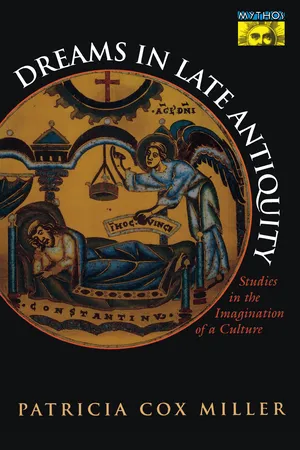
Dream interpretation was a prominent feature of the intellectual and imaginative world of late antiquity, for martyrs and magicians, philosophers and theologians, polytheists and monotheists alike. Finding it difficult to account for the prevalence of dream-divination, modern scholarship has often condemned it as a cultural weakness, a mass lapse into mere superstition. In this book, Patricia Cox Miller draws on pagan, Jewish, and Christian sources and modern semiotic theory to demonstrate the integral importance of dreams in late-antique thought and life. She argues that Graeco-Roman dream literature functioned as a language of signs that formed a personal and cultural pattern of imagination and gave tangible substance to ideas such as time, cosmic history, and the self.
Miller first discusses late-antique theories of dreaming, with emphasis on theological, philosophical, and hermeneutical methods of deciphering dreams as well as the practical uses of dreams, especially in magic and the cult of Asclepius. She then considers the cases of six Graeco-Roman dreamers: Hermas, Perpetua, Aelius Aristides, Jerome, Gregory of Nyssa, and Gregory of Nazianus. Her detailed readings illuminate the ways in which dreams provided solutions to ethical and religious problems, allowed for the reconfiguration of gender and identity, provided occasions for the articulation of ethical ideas, and altogether served as a means of making sense and order of the world.
- English
- ePUB (mobile friendly)
- Available on iOS & Android
eBook - ePub
About this book
Trusted by 375,005 students
Access to over 1.5 million titles for a fair monthly price.
Study more efficiently using our study tools.
Information
Publisher
Princeton University PressYear
2020Print ISBN
9780691058351
9780691074221
eBook ISBN
9780691215853
________________ Part I _________________
IMAGES AND CONCEPTS OF
DREAMING
DREAMING
________________ Introduction ________________
TRADITION has it that Socrates dreamed on the night before he met Plato that a young swan settled in his lap and, developing at once into a full-fledged bird, it flew forth into the open sky uttering a song that charmed all hearers.1 A Hellenistic parody of this dream plays tradition another way: Socrates dreamed that Plato became a crow, jumped onto his head, and began to peck at his bald spot and to croak.2 Historians of philosophy may want to decide between the heroic Plato who transformed his master’s words into charming songs, on the one hand, and the comic Plato who croaked as he pecked on the teacher’s bald head, on the other. What interests me, however, is the use of dreams as a way of portraying a philosophical relationship. With their vivid concatenation of images, these dreams lend tangibility and concreteness to the intangible, abstract idea of philosophical influence. This, I will argue, was one of the major functions of dreams in late antiquity: as one of the modes of the production of meaning, dreams formed a distinctive pattern of imagination which brought visual presence and tangibility to such abstract concepts as time, cosmic history, the soul, and the identity of one’s self. Dreams were tropes that allowed the world—including the world of human character and relationship—to be represented.
It seems strange to suggest that dreams bestowed tangibility. Is it not paradoxical to say that the material is conveyed by the ephemeral? Perhaps, but Graeco-Roman dream literature shows that there was a late-antique predilection to confound apparently discrete categories, and it was in this predilection that dreams found their proper signifying ground. It is important to note immediately the difficulty of speaking about the relation between such categories as “dream” and “reality” or the “tangible” and the “intangible” without reifying or essentializing them and so missing a striking feature of the late-antique imagination. In another cultural context, Wendy Doniger O’Flaherty has explored the conceptual twists and turns that talk of dreams provokes, and because her observations are pertinent to this discussion, I turn briefly to her recent book, Dreams, Illusion, and Other Realities.
One of the intriguing observations in O’Flaherty’s book shows that it is possible to falsify the hypothesis that one is dreaming—by waking up; but it is not possible to verify that one is awake by falling asleep. The thought that one cannot verify the fact that one is awake but can only falsify the fact the one is asleep (by waking up) delivers something of a jolt to Western “common sense,” which typically takes for granted the distinctness of such categories as “real” and “unreal,” “conscious” and “unconscious,” “dream” and “waking life.” Yet, as O’Flaherty points out, we know that we cannot see ourselves seeing an illusion, just as we cannot verify the “reality” of ourselves in the moment when we are engaged in testing our reality.3
Although the kinds of dichotomous structures just mentioned (real and unreal, and so forth) may be epistemologically useful, they are ontologically suspect, and when the lines of demarcation that support such structures are probed deeply enough, they tend to wobble, if not to disappear altogether. This is especially the case when one is considering the relationship between dreams and waking life, where, as Socrates says in the Theaetetus, “there is plenty of room for doubt.”4 Indeed, across the centuries there has been so much room for doubt that, as O’Flaherty shows so well, people have insisted on tantalizing themselves with the thought that dreams are real and the “real” world is a dream: the line not only wobbles, the categories change places.
In the company of such thoughts, we are in a kind of twilight zone where, to borrow a phrase from Marianne Moore, there are imaginary gardens—with real toads in them.5 We cannot escape this twilight zone by dismissing it as the product of O’Flaherty’s exotic Hindus immersed in māyā; the Western tradition has its own frogs, and nowhere are they livelier than in late antiquity. Perpetua, after all, awoke from her dream of eating paradisal cheese with the taste of something sweet in her mouth, and Macrobius thought that a vision of the entire cosmos lay encoded in a dream: monotheist and polytheist, martyr and philosopher alike subscribed to the figurative world of dreams.6
Socrates can help again in exploring the particular kind of “imaginary garden” that was the ancient dream world. As though echoing what he had said in the Theaetetus about our perceptual uncertainty when pressed to say whether we are awake or dreaming that we are awake, Socrates remarks in the Symposium that his “understanding is a shadowy thing at best, as equivocal as a dream.”7 This is a statement of the kind of wisdom that belongs to dreams. It involves a mode of discourse that is shadowed and equivocal, speaking with more than one voice, as in the following poem:
In a dream I meet
my dead friend. He has,
I know, gone long and far,
and yet he is the same
for the dead are changeless.
They grow no older.
It is I who have changed,
grown strange to what I was.
Yet I, the changed one,
ask: “How you been?”
He grins and looks at me.
“I been eating peaches
off some mighty fine trees.”8
In this poem, the “I” in the dream meets a dream figure, a friend, who is dead, “gone long and far.” The friend in the dream is dead (even though he grins, looks, and speaks), while the dream “I” is convinced of his own status as not-dead because he is conscious (although he is dreaming) that he has changed. Yet it is the dreamer who feels that he has “grown strange” to himself, while the dead man is the one who calls up the sensuous imagery of a world that is alive, “eating peaches off some mighty fine trees.” Who is “really” alive, and who is dead?
I think that ancient readers would have liked this poem, because it gives expression to a dimension of dream-reality that runs fairly consistently through the classical and late-antique traditions: that is, that the dream is the site where apparently unquestioned, and unquestionable, realities like life and death meet, qualify each other, even change places. A particularly striking representation of the equivocal qualities of the dreamworld forms part of Ovid’s Metamorphoses. It will take us more squarely into the imagistic world of the late-antique oneiric imagination.
Part of Book 11 of the Metamorphoses tells the story of King Ceyx, who dies in a torrential storm at sea.9 Meanwhile, his wife Alcyone, knowing nothing of her husband’s death, continues to burn incense at the altar of Juno as petition for his safe return. Juno, irked by the touch of Alcyone’s unconsciously mourning hands, summons Iris to go to “the drowsy house of Sleep,” “to tell that god to send Alcyone a dream of Ceyx, to tell the truth about him.” So Iris goes to the kingdom of Sleep, a place of “dusky twilight shadows” where she delivers her plea to Sleep: “O mildest of the gods, most gentle Sleep, Rest of all things, the spirit’s comforter, Router of care, O soother and restorer, Juno sends orders: counterfeit a dream to go in the image of King Ceyx to Trachis, to make Alcyone see her shipwrecked husband.” Sleep wakes up Morpheus, who is the best of all his sons at imitating humans, “their garb, their gait, their speech, rhythm, and gesture.”
Morpheus flies to Alcyone’s bedside and stands there with the face, form, pallor, and nakedness of the dead Ceyx: “His beard was wet, and water streamed from his sodden hair, and tears ran down as he bent over her: ‘O wretched wife, do you recognize your husband? Have I changed too much in death? Look at me! You will know me, your husband’s ghost, no more your living husband. I am dead, Alcyone.’” Still asleep, Alcyone knows that “the voice of Morpheus was that of Ceyx; how could she help but know it? The tears were real, and even the hands went moving the way his used to.” She weeps and tries to touch this dream figure, crying for him to wait for her. But her own voice wakes her, and she screams: “The queen Alcyone is nothing, nothing, dead with Ceyx.’”
Ovid’s portrait of the dreamworld insists on its equivocality. In a twilight realm, Sleep, called the “mildest of gods” and “the spirit’s comforter,” sends as his soothing message a counterfeit, his shape-shifting son, living phantasm of the dead Ceyx. Morpheus, unsubstantial yet somehow alive as the drenched ghost of the king, speaks, as Alcyone’s dream, what no living person could ever say literally: “I am dead.” Yet Alcyone knows in her sleep, conscious as she lies unconscious, that the tears are real, though the dream cannot be seen in the lamplight when she opens her eyes. What is unreal is real—the unsubstantial figment of the imagination (the “phantasm”) conveys the essential message. What is counterfeit is true, what is alive is dead, what is divine is human—and also the reverse. Th...
Table of contents
- Cover Page
- Title Page
- Copyright Page
- Dedication
- Contents
- Acknowledgments
- Abbreviations
- Part I: Images and Concepts of Dreaming
- Part II: Dreamers
- Conclusion
- Bibliography
- Index
Frequently asked questions
Yes, you can cancel anytime from the Subscription tab in your account settings on the Perlego website. Your subscription will stay active until the end of your current billing period. Learn how to cancel your subscription
No, books cannot be downloaded as external files, such as PDFs, for use outside of Perlego. However, you can download books within the Perlego app for offline reading on mobile or tablet. Learn how to download books offline
Perlego offers two plans: Essential and Complete
- Essential is ideal for learners and professionals who enjoy exploring a wide range of subjects. Access the Essential Library with 800,000+ trusted titles and best-sellers across business, personal growth, and the humanities. Includes unlimited reading time and Standard Read Aloud voice.
- Complete: Perfect for advanced learners and researchers needing full, unrestricted access. Unlock 1.5M+ books across hundreds of subjects, including academic and specialized titles. The Complete Plan also includes advanced features like Premium Read Aloud and Research Assistant.
We are an online textbook subscription service, where you can get access to an entire online library for less than the price of a single book per month. With over 1.5 million books across 990+ topics, we’ve got you covered! Learn about our mission
Look out for the read-aloud symbol on your next book to see if you can listen to it. The read-aloud tool reads text aloud for you, highlighting the text as it is being read. You can pause it, speed it up and slow it down. Learn more about Read Aloud
Yes! You can use the Perlego app on both iOS and Android devices to read anytime, anywhere — even offline. Perfect for commutes or when you’re on the go.
Please note we cannot support devices running on iOS 13 and Android 7 or earlier. Learn more about using the app
Please note we cannot support devices running on iOS 13 and Android 7 or earlier. Learn more about using the app
Yes, you can access Dreams in Late Antiquity by Patricia Cox Miller in PDF and/or ePUB format, as well as other popular books in History & Ancient History. We have over 1.5 million books available in our catalogue for you to explore.