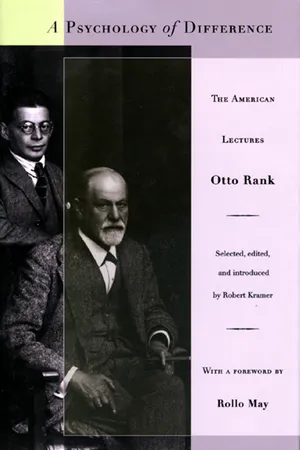
A leading disciple and confidant of Freud, Otto Rank revolutionized the field of psychoanalytic theory in The Trauma of Birth (1924). In this book, Rank proposed that the child's pre-Oedipal relationship to the mother was the prototype of the therapeutic relationship between analyst and patient. Although Rank is now widely acknowledged as the most important precursor of humanistic and existential psychotherapy--influencing such well-known writers as Carl Rogers, Rollo May, and Ernest Becker--Rank's knotty prose has long frustrated readers. In this volume of Rank's lectures, Robert Kramer has brought together for the first time the innovator's clearest explanations of his most influential theories.
The lectures were delivered in English to receptive audiences of social workers, therapists, and clinical psychologists throughout the United States from 1924 to 1938, the year before Rank's untimely death. The topics covered include separation and individuation, projection and identification, love and will, relationship therapy, and neurosis as a failure in creativity. The lectures reveal that Rank, much maligned by orthodox analysts, invented the modern object-relations approach to psychotherapy in the 1920s. In his introduction, based on private correspondence between Rank, Freud, and others in the inner circle, Robert Kramer tells the full story of why Rank parted ways with Freud. The collection of lectures constitutes a "readable Rank," filled with insights still relevant today, for those interested in the humanistic, existential, or object- relational aspects of psychotherapy, or in the development of the psychoanalytic movement.
- English
- ePUB (mobile friendly)
- Available on iOS & Android
eBook - ePub
About this book
Information
PART ONE
THE TRAUMA OF BIRTH:
“A MUCH STRONGER REPRESSION THAN EVEN
INFANTILE SEXUALITY”
1
PSYCHOANALYSIS AS GENERAL PSYCHOLOGY (1924)
LADIES AND GENTLEMEN, I take it for granted that you have already heard of psychoanalysis, and I assume that what you wish to know is whether you are thinking about it in the right way. I can, of course, tell you only what I think about it. To begin with, I do not know how you came to know of it, from what angle each of you has looked at it, or in what sense you have taken it—I mean whether you think of it as a therapy for treatment of nervous suffering, a method of investigation of unconscious life, or a psychological theory.
In any case, my purpose is to present psychoanalysis to you from a general point of view and from its purely practical side. In other words, I want to show you what we today can take from psychoanalytical knowledge, how it is possible to apply this knowledge in various spheres of practical life, and what advantages we can gain thereby.
As far as possible, I will not dwell upon the mere historical development of psychoanalysis and will also try to avoid discussing it as a theoretical system. Both these phases of the subject have been satisfactorily handled in psychoanalytical literature, and I could give you nothing more about them than you can get from that literature. First of all, I want to dispose of a number of obsolete ideas about psychoanalysis that I think are rather in the nature of misunderstandings than actual deficiencies in your knowledge of it. Then I propose showing you how psychoanalysis appears to me today, what in a certain sense it has accomplished, especially what practical contributions to life it has made and has still to make. If we once realize the significance of psychoanalysis for our present social life, we shall at the same time get some idea of the important part it has to play in the near future.
But I must at least give you briefly the most important facts from the past of psychoanalysis, so that you may know whence it comes and what it purposes. Psychoanalysis was born in the year 1881. Its father was the late physician, Dr. Josef Breuer, who for nearly ten years kept secret the birth of this illegitimate child.1 Dr. Breuer then abandoned the child because it might appear a bastard of scientific medicine, of which he himself was a representative, and of psychotherapy, which is still under suspicion at the present time. It was then that it found a tender and loving foster mother in the person of Sigmund Freud. He reared the neglected and misunderstood being and developed it into what we know today as psychoanalysis. It is now full grown and self-reliant. It leaves behind it a very interesting past and has gone through many adventures that Freud himself has recounted up to the year 1914 in his History of the Psycho-Analytic Movement [S.E., 14: 7—66] and since brought up-to-date in some of his later encyclopedia articles [“Two Encyclopedia Articles” (1923a) S.E., 18:235-59].
In order to be able to understand psychoanalysis fully, as it is today, we must—according to a fundamental principle of psychoanalysis itself—grasp the determining phases of its childhood. Breuer’s discovery was of a purely practical nature. It had, so to say, been made at the bedside of a patient and was the result of a compelling necessity to give therapeutic help. At that time, it could not be called psychoanalysis. The name psychoanalysis was introduced many years later by Freud himself and definitely given to the method of investigation and treatment that he himself had developed. The story of Breuer’s first case has already been related so often that it will be enough here to recall just its essential points. It was to this case that he owed his surprising discovery, and also his method of therapeutically influencing the patient. This patient was a young girl who had suffered from a number of hysterical symptoms since she had nursed her father in a severe illness. Breuer, under certain conditions that he later called hypnoid, was able to bring back to her consciousness certain forgotten memories. The content of these memories gave meaning to the symptoms—that is, the symptoms were revealed to be substitutions for the memory of a painful incident that, because it was painful, had been forgotten. The symptoms thus dominated the patient’s consciousness in place of the forgotten incident. She called the relief that she obtained in her hypnoid states from remembering forgotten facts the “talking cure” or, jokingly, “chimney sweeping.” This related also to the fact that she remembered, so to speak, “repressed” English, which she had not spoken since she was a child and which she now spoke exclusively. This unburdening of soul became the basis of Breuer’s cathartic method, and it was this that Freud later developed into psychoanalytic therapy. The surprising fact was that the symptoms apparently disappeared as soon as the forgotten impressions were brought into consciousness or remembered. This problematical state of affairs formed the starting point for a number of investigations that finally led to analytic psychology.
Starting with Breuer’s first case, let us disregard the therapeutic factor and follow the development of the psychoanalytic psychology formulated by Freud, which has become the first normal psychology, in spite of the fact that it was developed from pathologic material. For this purpose, we must give a little further consideration to Breuer’s catharsis, as the affect-toned remembrance of forgotten impressions was called.
You remember that the symptoms proved to be substitutions for forgotten experiences—that they disappeared as soon as the original impressions had been brought again to the patient’s consciousness. Thus the therapeutic task seemed quite easy. It looked as if one had only to consider how to find out those recollections that had expressed themselves so inappropriately as symptoms. This was possible only by bringing the forgotten experiences to the remembrance of the patient, and the easiest way to do this seemed by direct questioning in hypnosis. The patient herself was the stimulus for development of this method. She sometimes fell quite spontaneously into hypnoid states, in which she was able to recall forgotten memories. Breuer tried later to induce this state artificially by hypnosis in other patients who did not produce the same symptom of hypnoid states. As a matter of fact, hypnosis led to practically the same result. And it is to be regretted that Breuer did not make full use of his discovery in this direction, although probably in that case we should have missed the discovery of the real psychoanalysis by Freud.
The story of why Breuer did not continue his investigation, which promised such success, is more than a mere anecdote; it is a specially interesting fragment of the history of the science. We know that he was able to show an undoubted success in the treatment of his first patient; the symptoms disappeared, apparently, with the explanation of their origin.
But something else not noticed and not understood by Breuer appeared in the patient in place of symptoms. This was appreciated by Freud only much later and was the foundation stone of his psychoanalytic therapy as well as of an understanding of neuroses. The story is this. As Breuer one day revisited his patient, at that time almost recovered, he found her again in bed, in a state of excitement accompanied by violent convulsions whose meaning he had not long to look for. His patient cried out to him that she was now bringing forth the child begotten by him. This was enough to horrify any respectable doctor. Consequently he, so to speak, suddenly forgot his cue, took the matter personally, declared the patient insane, and arranged for her to be put into a mental hospital. There, after some time, this acute condition died away of its own accord.
Do not let us reproach Dr. Breuer for not realizing immediately that this curious behavior on the part of his patient was only a newly formed symptom in place of her neurosis, which, like her earlier symptoms, could be made to disappear by bringing into consciousness the real unconscious meaning of her reaction. I think the doctors among you would have treated the case just as he did before Freud recognized in such behavior something typical, which he later, according to his dynamic conception, called by the name of transference. So you see Breuer did literally run away from psychoanalysis as from an unwelcome illegitimate child. And perhaps you can understand how even today, in spite of a complete psychological understanding of this phenomenon as transference, psychoanalysis has won a certain sexual notoriety, which has deterred some of Freud’s fellow workers since Breuer from further occupation with the subject. But hypnosis, not understanding transference, was the starting point of Freud’s own method. He soon found that hypnosis was not appropriate for every patient. Besides, it had in its influence something vague, inexplicable, and mystical, so he finally dropped it. He wanted to know, on the one hand, what occurs in the patient, and, on the other hand—also from practical motives—how one can help the patient without being dependent on the unreliable method of hypnosis. This second question could be answered only by learning more about the processes that go on in the patient, the mechanism of mental life. And so a plan of inquiry was necessary, as also a series of investigations to answer the following questions:
1. How can one bring the forgotten pathological impressions back to the memory of the patient in his normal condition?
2. Why does he remember these impressions with such difficulty?
3. How is it that the symptoms disappear when he has remembered the repressed experiences?
The first question leads directly into the field of general psychology, involving as it does an investigation of the normal psychical state. This is accomplished by the real psychoanalytic method, based on free associations and their interpretation according to a quite determined unconscious aim. The second question—why it is that the patient remembers the impressions with such difficulty—leads from the phenomena of forgetting and remembering to the kernel of dynamic psychology—namely, the concept of repression. The third question—how is it that the symptoms disappear when their causation is remembered—leads finally to the doctrine of the unconscious and its predominating psychical mechanisms.
The real birth hour of psychoanalysis was that moment, nearly a generation ago, when Freud went beyond questioning the patient in hypnosis and began to investigate psychical mechanisms in the normal state. Then for the first time he got at an understanding of normal unconscious processes, which finally led, through a special method of inquiry and investigation, to psychoanalytic psychology.
Here, first of all, I must explain the manner and character of the psychoanalytic method. There are, properly speaking, two methods, according to their essence quite different, from which Freud, having dropped the hypnotic therapy, built up the psychoanalytic method of investigation: (1) the method of free association, which has as its presupposition the strict determinism2 of all psychic occurrences; (2) the method of interpretation that has so often been accused of being purely arbitrary. The first method, or free association, is actually a purely scientific principle, which can be experimentally demonstrated by the association test, wherein also the determinism of psychical occurrences is incontestably manifested. With the greatest possible elimination of conscious attention and self-criticism—which generally tests and sifts all ideas—these freely occurring associations betray a more or less conscious relation to a definite complex. The discovery of the unconscious site of the complex was in the beginning very difficult and accompanied by the usual uncertainties. One arrived at the hidden unconscious meaning alluded to in these associations really through a kind of intuitive guesswork, in which one naturally would sometimes go wrong, but in which quite definite rules gradually crystallized into the so-called technique of interpretation. This interpretation appeared subjective and arbitrary3 only so long as one did not apply to it also the same law of the strict determinism of all psychical life.
By frequent experience we have gradually learned to trace the chain of associations further, link by link, into the preconscious and the unconscious, and so to recognize the psychical meaning of the entire process. This technique of, so to speak, translating was soon formulated into definite rules that for the most part have been since confirmed not only by numerous clinical experiences of many analysts, but in part also by experiment. I think, then, that the interpretations of psychoanalysts have been justified theoretically as subordinate to the law of determinism and have been practically confirmed from various outside sources, such as mythology, folklore, art, and so forth. For instance, symbolism has been demonstrated indisputably to have the same meaning in different spheres of human psychical life. So the whole technique of interpretation, like the method of association, was only a method of investigation used to ascertain the content and meaning of the unconscious psychical life, which you now know under the names of various complexes, as, for instance, the Oedipus.
But knowledge of all these unconscious complexes makes it superfluous for the analyst today to take the same difficult route in every individual case. That would be just as if every doctor had to make chemical experiments at the patient’s bedside to work out the necessary preparation or medicine, which he can quite easily buy at the druggist’s. Today we are in a position to convert directly into practical use the results of a decade’s laborious work in analysis. We can apply this knowledge not only to the therapy of neuroses, the field in which psychoanalysis started, but also just as well to various fields of general psychology. Until recently the general psychological knowledge that we owe to the psychoanalytic method of investigation alone was still too limited to serve as a basis for satisfactory therapeutic results. On this account the enormous and as yet incomplete work of investigation was necessary. But now, armed with our enriched knowledge, we can set out in our struggle against neuroses; and not only against disease itself, for we can use our knowledge as a prophylactic by applying it to the betterment of child education and of our social and sexual relations through the psychoanalytic understanding of our own natures and characters. And the development of psychoanalysis has led to this spontaneously, without the drawing up of a program, because in its nature it is practical, real, and humane.
From this it should not surprise you that I have placed psychoanalysis as a general psychology in the foreground and have put into the background its therapeutic function, which yet was the starting point of the entire work and to many appears still to be its essential feature. The disinclination of human beings to recognize the universal nature of the unconscious impulses brought to light by analysis—which it has become impossible any longer to ignore—has led to a conception that unfortunately has marred the image of psychoanalysis. Finally, the objection has been made: “All these immoral, egotistic, sexual tendencies may be found by analysis in the unconscious of neurotics, and may be answerable for their illness. But one ought not to generalize this fact and extend to it the psychology of the normal.” Such an objection seems to me like the answer of most children when they learn something of the facts of sexual life. The child usually reacts thus: “That may be all right for so and so’s parents or for animals, but for my parents, certainly not!”
Such is the objection to psychoanalysis! But such an objection, while characteristic and intelligible as a defense, is as a matter of fact—one might almost say unfortunately—false, for all the unconscious material brought to light by analysis in treatment of neurotic patients, and recognized in their psychical mechanism, proves on closer inspection to be a common possession of mankind. I said “unfortunately,” not because I sympathize with the moral resistances criticized above, but from scientific regret that we have been unable to isolate any specifically pathologic factors, and thus to simplify the problem of therapy. Our experience has been that it is a matter of quantity only; the neurotic becomes ill from the same conflicts that the so-called normal succeeds in mastering.
But we need not regret too much this failure to find something that could be easily understood, easily got at, and so easily cured. Instead, psychoanalysis has found something more valuable—a new understanding of normal psychic life, based upon knowledge of general psychological unconscious contents. These contents had not been recognized before, because no method existed by which one could trace and bring them up into the light of consciousness, which one is obliged to do in psychoanalytical treatment of neurotics, if one really makes an effort to help them. What Freud has formulated in his Interpretation of Dreams [S.E. 4 and 5], his The Psychopathology of Everyday Life [S.E., 6], his sexual theory, his studies of civilization, ethnology, and aesthetics, is nothing but a normal psychology.
The kernel of this psychology is the doctrine of repression, which represents a psychical protection and defense mechanism of the ego against something incompatible with it. Let me illustrate the mechanism of repression further by a simple comparison that remains within the range of psychoanalysis. In repression, the ego acts toward a wish impulse arising from within exactly as Dr. Breuer behaved toward the unwelcome message from without, which announced to him a child. The ego wishes to know nothing about it and attempts to turn aside from the idea by depreciating or denying it. If this is not successful, one must at least confine it for a time in the unconscious, as Breuer did with his patient when he put her into an asylum. There in the unconscious the unwelcome wish impulse may be left after a while to its own resources without special supervision. This example illustrates the most favorable aspect of repression. But if by any chance one continually has to use a part of one’s psychic energy to restrain or keep guard over this unwelcome impulse or idea, or if the idea is strong enough and permanently rebels, then there is nothing left to do but call for help.
This illustration may give you at the same time an idea of the double consciousness that dominates our inner life and that becomes manifest only in severe cases of neuroses or psychoses. From the fact of repression, the dynamic point of view follows quite naturally to the assumption of something repressed, which strives against the repressive forces of the ego. But this division within the psychic personality need not throughout occur between conscious forces and ...
Table of contents
- Cover Page
- Title Page
- Copyright Page
- Dedication
- Contents
- Foreword, by Rollo May
- Chronology of Rank’s Life (1884-1939)
- Editor’s Notes to the Reader
- Introduction: Insight and Blindness: Visions of Rank by Robert Kramer
- Part One: The Trauma of Birth: “A much Stronger Repression than even Infantile Sexuality”
- Part Two: Exploring the Dark Continent of Maternal Power: “The ‘Bad Mother’ Freud has never seen”
- Part Three: From Projection and Identification to Self-Determination: “Emotions are the Center and Real Sphere of Psychology”
- Part Four: Toward a Theory of Relationship and Relativity: “I am no Longer trying to prove Freud was Wrong and i Right”
- Prior Publication of Lectures
- References
- Index
Trusted by 375,005 students
Access to over 1.5 million titles for a fair monthly price.
Study more efficiently using our study tools.
Frequently asked questions
Yes, you can cancel anytime from the Subscription tab in your account settings on the Perlego website. Your subscription will stay active until the end of your current billing period. Learn how to cancel your subscription
No, books cannot be downloaded as external files, such as PDFs, for use outside of Perlego. However, you can download books within the Perlego app for offline reading on mobile or tablet. Learn how to download books offline
Perlego offers two plans: Essential and Complete
- Essential is ideal for learners and professionals who enjoy exploring a wide range of subjects. Access the Essential Library with 800,000+ trusted titles and best-sellers across business, personal growth, and the humanities. Includes unlimited reading time and Standard Read Aloud voice.
- Complete: Perfect for advanced learners and researchers needing full, unrestricted access. Unlock 1.5M+ books across hundreds of subjects, including academic and specialized titles. The Complete Plan also includes advanced features like Premium Read Aloud and Research Assistant.
We are an online textbook subscription service, where you can get access to an entire online library for less than the price of a single book per month. With over 1.5 million books across 990+ topics, we’ve got you covered! Learn about our mission
Look out for the read-aloud symbol on your next book to see if you can listen to it. The read-aloud tool reads text aloud for you, highlighting the text as it is being read. You can pause it, speed it up and slow it down. Learn more about Read Aloud
Yes! You can use the Perlego app on both iOS and Android devices to read anytime, anywhere — even offline. Perfect for commutes or when you’re on the go.
Please note we cannot support devices running on iOS 13 and Android 7 or earlier. Learn more about using the app
Please note we cannot support devices running on iOS 13 and Android 7 or earlier. Learn more about using the app
Yes, you can access A Psychology of Difference by Otto Rank, Robert Kramer in PDF and/or ePUB format, as well as other popular books in Psychology & History & Theory in Psychology. We have over 1.5 million books available in our catalogue for you to explore.