At the turn of the last century, as industrialists and workers made Chicago the hardworking City of Big Shoulders celebrated by Carl Sandburg, Chicago women articulated an alternative City of Homes in which the welfare of residents would be the municipal government's principal purpose. Seeing With Their Hearts traces the formation of this vision from the relief efforts following the Chicago fire of 1871 through the many political battles of the Gilded Age and Progressive Era. In the process, it presses a new understanding of the roles of women in public life and writes a new history of urban America.
Heeding the call of activist Louise de Koven Bowen to become third-class passengers on the train of life, thousands of women "put their shoulders to the wheel and their whole hearts into the work" of fighting for better education, worker protections, clean air and water, building safety, health care, and women's suffrage. Though several well-known activists appeared frequently in these initiatives, Maureen Flanagan offers compelling evidence that women established a broad and durable solidarity that spanned differences of race, class, and political experience. She also shows that these women--emphasizing their common identity as women seeking a city amenable to the needs of women, children, families, and homes--pursued a vision and goals distinct from the reform agenda of Progressive male activists. They fought hard and sometimes successfully in a variety of public places and sites of power, winning victories from increased political clout and prenatal care to municipal garbage collection and pasteurized milk.
While telling the fascinating and in some cases previously untold stories of women activists during Chicago's formative period, this book fundamentally recasts urban social and political history.
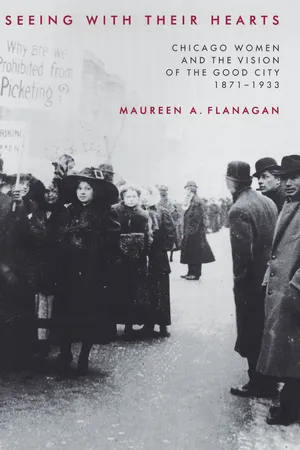
eBook - ePub
Seeing with Their Hearts
Chicago Women and the Vision of the Good City, 1871-1933
- English
- ePUB (mobile friendly)
- Available on iOS & Android
eBook - ePub
Seeing with Their Hearts
Chicago Women and the Vision of the Good City, 1871-1933
About this book
Trusted by 375,005 students
Access to over 1.5 million titles for a fair monthly price.
Study more efficiently using our study tools.
Information
Topic
StoriaSubtopic
Storia nordamericanaPart One
CRAFTING THE VISION
One
“The Whole Work Has Been Committed to the Hands of Women”: Women Respond to the Fire of 1871
ON THE evening of October 8, 1871, a wind-driven fire blazed a destructive path across Chicago, ravaging a three and a half square mile area by the time it spent itself the following evening. The city’s entire commercial and governmental district had burned to the ground along with the bulk of the city’s housing. The Great Chicago Fire caused almost two hundred million dollars worth of property damage and destroyed fifteen thousand buildings, leaving one hundred thousand people—one-third of the population—homeless. It was the worst fire in a major U.S. city in the country’s history.1 Providing relief for thousands of homeless, injured, and hungry city residents became the city’s top priority, but the municipal government doubted that it had the authority to undertake such a massive relief effort. At that time, city governments still were generally confined to deciding on public works projects and questions of tax revenues; conducting a major relief effort was beyond anything Chicago’s government had ever before done.2 Rather than direct fire relief himself, Mayor Roswell Mason turned to the Chicago Relief and Aid Society, a private organization founded in 1857 run by a collection of Chicago’s most eminent professional and business men.3 In doing so, Mason surrendered to the Society all control of the relief monies, which would total nearly five million dollars. This money began pouring into the city from across the country and around the world even as the fire still blazed.4
The mayor’s decision was not uncontested, and the fire of 1871 and the questions of who should and how to provide fire relief gave prominent Chicago women a totally new urban experience. It produced their first significant encounter with a massive municipal problem and connected them in ways they had never before known to the larger arena of their city and its problems. In the coming months they would organize, direct their own activities, learn to forge alliances with one another, and work more openly in public view than ever before. The fire experience would also force women to articulate the principles upon which they based their actions. In doing so, they would espouse principles of public actions that brought them into public conflict with men of their same status.

Figure 3. Map of Chicago, 1871. Showing settled area, burned district, city limits, and Chicago Relief and Aid Society Headquarters and First Congregational Church (Drawn by Dennis McClendon, Chicago CartoGraphics)
When the directors of the Relief and Aid Society had petitioned the mayor to give them the responsibility for fire relief, they were following a course traditional to nineteenth-century charitable endeavors in which private citizens, not public government, managed such affairs. But the Society’s leaders had more at stake than a desire to manage charity. They believed that the fire relief effort had to be carefully directed to facilitate the rebuilding of the city in ways most useful to businessmen such as themselves, and also to keep control of the thousands of now homeless and jobless workers in the city.5 The Society’s initial actions, which placed stringent requirements on receiving relief, bear out their intentions. The day after Mayor Mason turned over the relief funds to the Society, it quickly stopped issuing “able bodied men” free railroad passes to leave the city. The rule was enforced by a Society committee, headed by railroad entrepreneur George Pullman, that routinely rejected applications from these so-called “able bodied men” and even boys, sending them instead to a Society employment committee where they would be assigned a job.6
The Society followed these measures with a decree that “not a single dollar [was to] be expended for persons able to provide for themselves. . . . [A]ny man, single woman, or boy, able to work, and unemployed at this time, is so from choice and not necessity.” It also prepared application forms to be completed in writing and accompanied by the testimony of “well-known” citizens that the applicant was totally destitute and thus worthy to receive outdoor relief, or that the applicant had suffered a tangible loss of property that entitled him or her to shelter.7 These principles were strictly enforced. By mid-January, the Society’s shelter committee had received 9,272 requests for housing, of which it rejected 2,853. Among the surviving applications is one from a woman with an injured husband and five children, all of whom had been burned out of their previous dwelling and were now being evicted from their current dwelling by her landlord. She petitioned the Society for lumber to build a shanty—the approximate cost of which was $115. The Society rejected her application for lumber because “this family had two months rent paid [previously by the Society]—had one stove, one [unreadable], one table, four chairs, and some bedding.”8 Until it declared the relief effort closed in early 1874, the Relief and Aid Society never budged from its strict position that only those residents who could prove themselves utterly destitute, or who had lost tangible property, were qualified to receive relief.
As the men of the Relief and Aid Society went about their work, so too did many Chicago women, who, after taking care of their own families, turned to relieve suffering throughout the city. At first, women responded as individuals, providing whatever aid they could to others in need. Harriet Hubbard Ayer (who lost her own baby in the fire) recalled “sewing for the destitute” in the days immediately following the fire while her mother-in-law “was in charge of a center that provided clothes for the penniless; each day she handed out not only warm clothing but soup and milk.”9 Mrs. Hudlun, an African American woman whose house had survived the blaze, dispatched family members out into the streets to bring the homeless and injured they encountered back to her home.10
Other women joined the Ladies’ Relief and Aid Society, organized as an auxiliary to the men’s group, to help with fire relief. Four of the six officers of the Ladies’ group were married to directors of the men’s Society. Some women volunteered to help at Society headquarters. Katharine Medill, wife of the part-owner of the Chicago Tribune, the man who would be elected mayor in early November 1871, joined this group.11 In very short time, however, Chicago women dramatically expanded their relief efforts and removed themselves from the control of the Relief and Aid Society. Two weeks after the fire, for example, Aurelia King, who was married to Society director Henry W. King, wrote privately to her friends that if they wished to make their contributions directly to the general relief fund they could of course do so, but that if they would instead send them “directly to me, I will distribute to the needy that I know personally.” She told her correspondents that she had “already received money and other things from different places which I divide and apportion exactly as I see most pressing need.”12
Katharine Medill quickly grew disenchanted with her work at the Relief and Aid Society and quit. But rather than quit relief work altogether, she readily accepted her friend Annie McClure Hitchcock’s offer to solicit donations so that she could direct a relief effort out of her own home. Hitchcock wrote to a friend in Boston explaining the desperate needs of Chicago’s fire victims and the way that she and Medill wanted to help. Medill, wrote Hitchcock, had tried working with the Relief and Aid Society but had chafed under the regulations that made it difficult for many people to secure any relief. Rather than continue to follow the Society’s dictates, Hitchcock continued, Medill had told her [Hitchcock] that “it would be a great satisfaction to be able to supply the wants I hear of every day of people who are in every way worthy and get beyond the Aid Society’s Rules.” After explaining the situation, Hitchcock then asked her friend if she and other Boston women could send donations of clothing directly to her. “These general rules [of the Relief and Aid Society] are so hard to follow,” she wrote. “It would be such a comfort if some Boston ladies felt like sending some boxes of clothing to be distributed in violation of all general rules.”13
The two rules that Hitchcock and Medill proposed to violate were essential to the Society’s control over the dispersal of relief. After receiving its mandate from Mayor Mason, the Society divided the city into districts and ordered that all locations supplying relief would henceforth “be subject to the control of the [Relief and Aid Society] Superintendent of the district and those in charge of the same will give out no more supplies except on his order.”14 To control further the distribution of relief, the Society also decreed that any donations sent into the city had to be distributed within the district of the city to which they were sent, and distributed only by the Society’s appointed representative in that district. By setting up a distribution center in her home, Katharine Medill was violating the first decree. Annie Hitchcock not only conspired with Medill but also intended to violate the second decree. Hitchcock lived on the south side of the city, in the Hyde Park area that was not burned in the fire. According to the Society’s rules, anything sent to her had to be distributed in Hyde Park. But Hitchcock wanted to distribute clothing in the desperately needy areas of the city’s burned-out west side, and she had no intention of obeying the Society’s rule. By contrast, those Chicago men who were engaged in relief activities seemed inclined to let the Society take over directing the work of relief. In an open letter to the Relief and Aid Society that appeared in Chicago’s newpapers, Mr. C. T. Hitchcock assured the Society that his ad hoc relief group, which had been distributing relief since immediately after the fire, would comply with the Society’s order and no longer distribute relief except under the Society’s supervision.15
Medill and Hitchcock were not the only women running relief efforts in violation of the Society’s orders. A number of women’s groups headed by prominent Chicago women also began relief work soon after the fire. Historians have missed the significance of their work, both for the women themselves and for their place in Chicago history, because they rely too heavily on male sources to describe the relief work of women. The most important primary source for studying Chicago’s fire relief—the records of the Relief and Aid Society—details an organization run by men who always regarded women as under their control. They spoke of women in this way in the reports and thereby conveyed the message that women were subservient to men in fire relief.16 Most other primary sources—all of which were written by men—concentrate on the work of men: Newspapers heralded the activities of the Relief and Aid Society but relegated those of women to small paragraphs on inside pages; contemporary accounts of fire relief paid scant attention to women’s activities; and the collections of biographies of leading men of the city—and there are many for Chicago— include little mention of their wives and none at all on these women’s fire relief activities.17 That women did not explicitly publicize their actions, rarely talked about themselves (except to one another), and formed organizations without paid staff to compile accounts of their actions, contributes to the relative paucity of primary material. When the Society’s explanations are accepted at face value, and because, as a legacy of the earlier nineteenth century, many women’s organizations were still headed by boards of male advisors, historians assume that the Society’s organizational framework controlled women’s response to relief.18 But if instead of seeing women and their work through the eyes of men, one looks at what women’s organizations actually did and how they presented themselves, their work and their activities assume quite a different character.19
In the manuscript collection of the United Charities of Chicago—the successor organization to the Relief and Aid Society—survive some circulars and letters that testify to the work of various women’s relief groups. According to these documents, the Ladies’ Christian Union, the Ladies of the First Congregational Church of Chicago (located at the corner of Washington and Ann streets), and the Ladies’ Industrial Aid Society of St. John’s church, for example, distributed circulars throughout the city and contacted women’s organization in other cities asking for contributions of money, household utensils, crockery, and hospital supplies— specifically soliciting supplies donated directly to themselves and not the Society.20 Even the Ladies’ Relief and Aid Society, which was supposedly controlled by the male Relief and Aid Society, and the Ladies’ Christian Union, which had a board of male advisors, went around the Society to get the supplies that they wanted.21 Ten days after the fire, the Ladies’ Christian Union held a public meeting for the purpose of organizing its own “system of relief for the multitudes of women and children rendered destitute” by the fire.22 Although several of these groups were organized from churches, these women do not speak of religious motivations for their activities. While we can be certain that they were religious, so too were the men of the Relief and Aid Society, and both genders were undoubtedly influenced by their religion. Yet men’s and women’s differing responses to the suffering after the fire seem much more in line with Barbara Berg’s observations that a developing sense of women’s shared common experiences and need...
Table of contents
- Cover Page
- Title Page
- Copyright Page
- Dedication
- Contents
- List of Figures
- List of Acronyms
- Acknowledgments
- Introduction: City of Big Shoulders or City of Homes? Re-envisioning Urban History
- Part One: Crafting the Vision
- Part Two: Expanding the Vision
- Part Three: Campaigning for the Vision
- Conclusion: Chicago Remains the City of Big Shoulders
- Appendixes
- Notes
- Bibliography
- Index
Frequently asked questions
Yes, you can cancel anytime from the Subscription tab in your account settings on the Perlego website. Your subscription will stay active until the end of your current billing period. Learn how to cancel your subscription
No, books cannot be downloaded as external files, such as PDFs, for use outside of Perlego. However, you can download books within the Perlego app for offline reading on mobile or tablet. Learn how to download books offline
Perlego offers two plans: Essential and Complete
- Essential is ideal for learners and professionals who enjoy exploring a wide range of subjects. Access the Essential Library with 800,000+ trusted titles and best-sellers across business, personal growth, and the humanities. Includes unlimited reading time and Standard Read Aloud voice.
- Complete: Perfect for advanced learners and researchers needing full, unrestricted access. Unlock 1.5M+ books across hundreds of subjects, including academic and specialized titles. The Complete Plan also includes advanced features like Premium Read Aloud and Research Assistant.
We are an online textbook subscription service, where you can get access to an entire online library for less than the price of a single book per month. With over 1.5 million books across 990+ topics, we’ve got you covered! Learn about our mission
Look out for the read-aloud symbol on your next book to see if you can listen to it. The read-aloud tool reads text aloud for you, highlighting the text as it is being read. You can pause it, speed it up and slow it down. Learn more about Read Aloud
Yes! You can use the Perlego app on both iOS and Android devices to read anytime, anywhere — even offline. Perfect for commutes or when you’re on the go.
Please note we cannot support devices running on iOS 13 and Android 7 or earlier. Learn more about using the app
Please note we cannot support devices running on iOS 13 and Android 7 or earlier. Learn more about using the app
Yes, you can access Seeing with Their Hearts by Maureen A. Flanagan in PDF and/or ePUB format, as well as other popular books in Storia & Storia nordamericana. We have over 1.5 million books available in our catalogue for you to explore.