Students of comparative politics have long faced a vexing dilemma: how can social scientists draw broad, applicable principles of political order from specific historical examples? In Analytic Narratives, five senior scholars offer a new and ambitious methodological response to this important question. By employing rational-choice and game theory, the authors propose a way of extracting empirically testable, general hypotheses from particular cases. The result is both a methodological manifesto and an applied handbook that political scientists, economic historians, sociologists, and students of political economy will find essential.
In their jointly written introduction, the authors frame their approach to the origins and evolution of political institutions. The individual essays that follow demonstrate the concept of the analytic narrative--a rational-choice approach to explain political outcomes--in case studies. Avner Greif traces the institutional foundations of commercial expansion in twelfth-century Genoa. Jean-Laurent Rosenthal analyzes how divergent fiscal policies affected absolutist European governments, while Margaret Levi examines the transformation of nineteenth-century conscription laws in France, the United States, and Prussia. Robert Bates explores the emergence of a regulatory organization in the international coffee market. Finally, Barry Weingast studies the institutional foundations of democracy in the antebellum United States and its breakdown in the Civil War. In the process, these studies highlight the economic role of political organizations, the rise and deterioration of political communities, and the role of coercion, especially warfare, in political life. The results are both empirically relevant and theoretically sophisticated.
Analytic Narratives is an innovative and provocative work that bridges the gap between the game-theoretic and empirically driven approaches in political economy. Political historians will find the use of rational-choice models novel; theorists will discover arguments more robust and nuanced than those derived from abstract models. The book improves on earlier studies by advocating--and applying--a cross-disciplinary approach to explain strategic decision making in history.
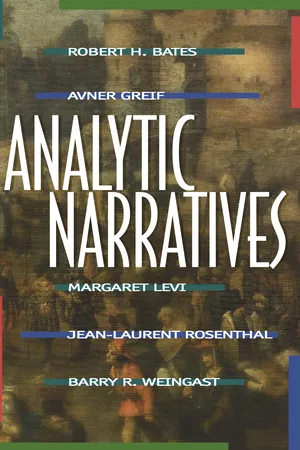
eBook - ePub
Analytic Narratives
- English
- ePUB (mobile friendly)
- Available on iOS & Android
eBook - ePub
Analytic Narratives
About this book
Trusted by 375,005 students
Access to over 1.5 million titles for a fair monthly price.
Study more efficiently using our study tools.
Information
Publisher
Princeton University PressYear
2020Print ISBN
9780691001296
9780691001289
eBook ISBN
9780691216232
Table of contents
- Cover Page
- Title Page
- Copyright Page
- Dedication
- Contents
- Acknowledgments
- Introduction
- Chapter One: Self-Enforcing Political Systems and Economic Growth: Late Medieval Genoa: Avner Greif
- Chapter Two: The Political Economy of Absolutism Reconsidered: Jean-Laurent Rosenthal
- Chapter Three: Conscription: The Price of Citizenship: Margaret Levi
- Chapter Four: Political Stability and Civil War: Institutions, Commitment, and American Democracy: Barry R. Weingast
- Chapter Five: The International Coffee Organization: An International Institution: Robert H. Bates
- Conclusion
- Appendix
- Index
- About the authors
Frequently asked questions
Yes, you can cancel anytime from the Subscription tab in your account settings on the Perlego website. Your subscription will stay active until the end of your current billing period. Learn how to cancel your subscription
No, books cannot be downloaded as external files, such as PDFs, for use outside of Perlego. However, you can download books within the Perlego app for offline reading on mobile or tablet. Learn how to download books offline
Perlego offers two plans: Essential and Complete
- Essential is ideal for learners and professionals who enjoy exploring a wide range of subjects. Access the Essential Library with 800,000+ trusted titles and best-sellers across business, personal growth, and the humanities. Includes unlimited reading time and Standard Read Aloud voice.
- Complete: Perfect for advanced learners and researchers needing full, unrestricted access. Unlock 1.5M+ books across hundreds of subjects, including academic and specialized titles. The Complete Plan also includes advanced features like Premium Read Aloud and Research Assistant.
We are an online textbook subscription service, where you can get access to an entire online library for less than the price of a single book per month. With over 1.5 million books across 990+ topics, we’ve got you covered! Learn about our mission
Look out for the read-aloud symbol on your next book to see if you can listen to it. The read-aloud tool reads text aloud for you, highlighting the text as it is being read. You can pause it, speed it up and slow it down. Learn more about Read Aloud
Yes! You can use the Perlego app on both iOS and Android devices to read anytime, anywhere — even offline. Perfect for commutes or when you’re on the go.
Please note we cannot support devices running on iOS 13 and Android 7 or earlier. Learn more about using the app
Please note we cannot support devices running on iOS 13 and Android 7 or earlier. Learn more about using the app
Yes, you can access Analytic Narratives by Robert H. Bates,Avner Greif,Margaret Levi,Jean-Laurent Rosenthal,Barry R. Weingast in PDF and/or ePUB format, as well as other popular books in Social Sciences & Social Science Research & Methodology. We have over 1.5 million books available in our catalogue for you to explore.