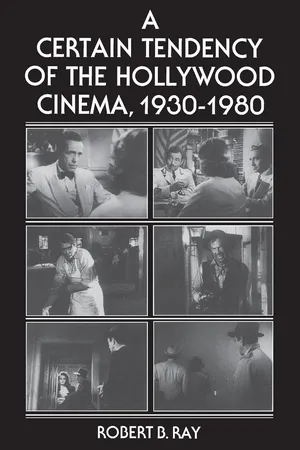
Robert B. Ray examines the ideology of the most enduringly popular cinema in the world--the Hollywood movie. Aided by 364 frame enlargements, he describes the development of that historically overdetermined form, giving close readings of five typical instances: Casablanca, It's a Wonderful Life, The Man Who Shot Liberty Valance, The Godfather, and Taxi Driver. Like the heroes of these movies, American filmmaking has avoided commitment, in both plot and technique. Instead of choosing left or right, avant-garde or tradition, American cinema tries to have it both ways.
Although Hollywood's commercial success has led the world audience to equate the American cinema with film itself, Hollywood filmmaking is a particular strategy designed to respond to specific historical situations. As an art restricted in theoretical scope but rich in individual variations, the American cinema poses the most interesting question of popular culture: Do dissident forms have any chance of remaining free of a mass medium seeking to co-opt them?
- 424 pages
- English
- PDF
- Available on iOS & Android
eBook - PDF
A Certain Tendency of the Hollywood Cinema, 1930-1980
About this book
Information
Publisher
Princeton University PressYear
2020Print ISBN
9780691101743
9780691047270
eBook ISBN
9780691216164
Subtopic
Film History & CriticismPart
One.
Classic
Hollywood
(1930-1945)
Table of contents
- Cover Page
- Half-title Page
- Title Page
- Copyright Page
- Dedication Page
- Contents
- Acknowledgments
- Introduction
- Part One : Classic Hollywood (1930-1945)
- Part Two : The Postwar Period (1946-1966)
- Part Three : The Contemporary Period (1967-1980)
- Conclusion
- Notes
- Bibliography
- Index
Trusted by 375,005 students
Access to over 1.5 million titles for a fair monthly price.
Study more efficiently using our study tools.
Frequently asked questions
Yes, you can cancel anytime from the Subscription tab in your account settings on the Perlego website. Your subscription will stay active until the end of your current billing period. Learn how to cancel your subscription
No, books cannot be downloaded as external files, such as PDFs, for use outside of Perlego. However, you can download books within the Perlego app for offline reading on mobile or tablet. Learn how to download books offline
Perlego offers two plans: Essential and Complete
- Essential is ideal for learners and professionals who enjoy exploring a wide range of subjects. Access the Essential Library with 800,000+ trusted titles and best-sellers across business, personal growth, and the humanities. Includes unlimited reading time and Standard Read Aloud voice.
- Complete: Perfect for advanced learners and researchers needing full, unrestricted access. Unlock 1.5M+ books across hundreds of subjects, including academic and specialized titles. The Complete Plan also includes advanced features like Premium Read Aloud and Research Assistant.
We are an online textbook subscription service, where you can get access to an entire online library for less than the price of a single book per month. With over 1.5 million books across 990+ topics, we’ve got you covered! Learn about our mission
Look out for the read-aloud symbol on your next book to see if you can listen to it. The read-aloud tool reads text aloud for you, highlighting the text as it is being read. You can pause it, speed it up and slow it down. Learn more about Read Aloud
Yes! You can use the Perlego app on both iOS and Android devices to read anytime, anywhere — even offline. Perfect for commutes or when you’re on the go.
Please note we cannot support devices running on iOS 13 and Android 7 or earlier. Learn more about using the app
Please note we cannot support devices running on iOS 13 and Android 7 or earlier. Learn more about using the app
Yes, you can access A Certain Tendency of the Hollywood Cinema, 1930-1980 by Robert B. Ray in PDF and/or ePUB format, as well as other popular books in Media & Performing Arts & Film History & Criticism. We have over 1.5 million books available in our catalogue for you to explore.