- 382 pages
- English
- ePUB (mobile friendly)
- Available on iOS & Android
eBook - ePub
About this book
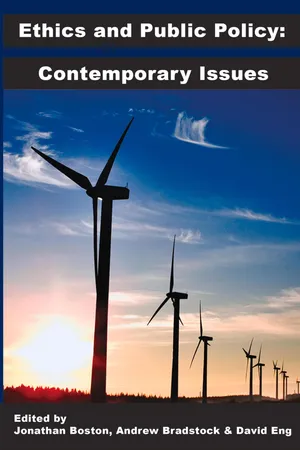
Exploring the ethical frameworks and principles upon which governments can and should base their policies, this study draws on papers from the 2009 Ethical Foundations of Public Policy conference held in Wellington, covering topics such as ethics in decision making and advice giving, sustainability, equality and justice, and measuring progress. The examination contends that interplay between ethical considerations and policy creation is often complex, controversial, and challenging but that the careful management of this interplay is vital to the effective functioning of liberal, democratic government. Demonstrating the inextricable link between ethics and public policy, this is essential reading for policymakers, students, and those interested in the policy process.
Information
1
Introduction: Ethical dimensions of public policy
Jonathan Boston, Andrew Bradstock
& David Eng
& David Eng
As the title of this book indicates, the essays included here explore the inter-relationship between ethics and public policy. While the perspectives of the contributors vary considerably, each starts from an assumption that there are creative questions to be asked about, not simply what governments do, but the principles that guide the decisions they take. If we assume a simple definition of ethics – that it is about what people or institutions ought or ought not to do – it is clear that ethical questions lie at the very core of public policy, from the task of defining a problem and assessing available options, through to the adoption and implementation of policies to deal with it, and their evaluation. An underlying conviction of all who have contributed to this volume is that ethical inquiry is not confined merely to the decisions and actions of individuals but relates to those taken by groups, even as large as individual nations and what we now refer to as the international community. Ethics is as relevant to the public realm as it is to the private, to the work of those who act on behalf of the public as to individual members of the public themselves.
Bringing ethical questions to bear on the sphere of public policy enables fruitful questions to be explored, as the chapters here make clear. What purpose might government action seek to fulfil? What ends should governments strive to achieve? What is government policy for? And, moving beyond these questions, what are the appropriate means of achieving agreed ends? How can means and ends be reconciled? Is it important that they are? Responses to these questions will vary enormously, and the contributions to this volume inevitably reflect the wide range of perspectives advanced in recent decades by scholars, practitioners and commentators. Should the end of public policy be the building of a ‘good society’ and, if so, what do we mean by ‘good’? Should it be the realisation of the ‘common good’? Or should the emphasis be on the pursuit of ‘justice’? Further, should values such as happiness, well-being, prosperity or equality inform policy making and, if so, how might they be prioritised?
These are far from straightforward issues, yet one thing is clear: no state can avoid exercising an ethical judgment concerning its policies. As Michael Sandel (2009) points out in Justice: What’s the right thing to do? there are some issues – for instance, abortion and stem cell research – that simply cannot be resolved without taking a stand on the underlying moral and religious factors. For example, the standard liberal position with respect to abortion is that the state should not take sides in the complex moral and theological debate over when life begins and simply allow women to decide for themselves whether to have an abortion. But, Sandel argues, this argument does not succeed, for if it is the case that the developing foetus is morally equivalent to a child, then abortion is morally equivalent to infanticide, and few people would argue that governments should let parents decide for themselves whether to kill their children. The ‘pro-choice’ position in the abortion debate is therefore not really neutral on the underlying moral and theological question, Sandel suggests, but rests implicitly on the assumption that the Catholic Church’s teaching on the moral status of the foetus – that it is a person from the moment of conception – is false.
To acknowledge this assumption is not to argue for banning abortion per se, simply to note that neutrality and freedom of choice are not sufficient grounds for affirming a right to abortion. Similarly with stem-cell research, if the early embryo is morally equivalent to a person, then opponents of research that uses embryonic stem cells have a point, since even highly promising medical research would not justify dismembering a human person. As with the question of abortion, therefore, neutrality is impossible because the issue is whether the practice in question involves taking the life of a human being. As Sandel and the contributors to this book make clear, the interplay between ethical considerations and policy making is complex and challenging; but it is also essential to the effective functioning of liberal, democratic government.
Part One: Ethical foundations
The first group of essays examines some foundational issues and broad ethical frameworks, including this question of individual sovereignty. Part One commences with reflections by Morris Altman on human motivation and behaviour, including the contrasting behavioural assumptions made by different schools of economic thought and their ethical implications. In particular, Altman outlines and assesses three distinct approaches: conventional or neoclassical economics (as articulated by numerous economists over the past century or so); contemporary behavioural economics (as exemplified by the views of Daniel Kahneman and Amos Tversky); and an alternative approach to behavioural economics that draws on the work of scholars as diverse as Herbert Simon, John Harsanyi and Martha Nussbaum.
A basic premise of neoclassical economics is that human beings are self-interested, rational, utility maximisers. It is further assumed that individuals are the best judges of their own interests. Given such assumptions, it is argued that individuals’ preferences and choices ought to be respected; otherwise their welfare will be reduced. Accordingly, governmental interference is only ethically justified where the choices individuals make are likely to harm third parties or the environment. Contemporary behavioural economics, by contrast, assumes that individuals are strongly prone to irrationality, errors, external manipulation and biases. For such reasons, they are not always the best judges of their own interests and frequently lack the capacity to exercise genuinely free choice. Their behaviour, therefore, may deviate significantly from that deemed to be welfare-maximising under neoclassical assumptions. From this standpoint, governments are ethically justified, or so it is claimed, in reconfiguring individuals’ choice environments and ‘nudging’ them to make welfare-enhancing choices (for example, by constraining or eliminating certain choices or ‘reframing’ the context within which choices occur). But, as Altman highlights, such interventions are necessarily paternalistic in nature, and even ‘soft’ (or libertarian) paternalism raises important philosophical and ethical issues. Altman explores some of these issues, drawing on the work of notable philosophers and economists, most notably John Stuart Mill, Isaiah Berlin and Fredrick von Hayek.
In Altman’s view, there are good reasons to question not only the key assumptions underpinning neoclassical economics but also some of the claims and policy recommendations of contemporary behavioural economics. In the latter part of his chapter, therefore, he outlines an alternative approach to understanding human behaviour. This view incorporates sociological and institutional variables, acknowledges certain physiological limitations and recognises the tendency for humans to develop certain heuristics or experience-based decision-making short-cuts. According to Altman, such heuristics are not necessarily irrational or error-prone, even though they do not sit comfortably with assumed neoclassical behaviour. From this perspective, individual choice needs to be respected and the case for ‘nudging’ is questioned. At the same time, sound ethical arguments can be advanced that governments should seek to improve the context in which individuals make decisions through a range of institutional, informational and educational strategies.
The next chapter is also concerned with human motivation and behaviour, but from a rather different angle. In his reflection on the famous biblical story of the Good Samaritan, Chris Marshall explores how the imperative with which the parable ends, ‘go and do thou likewise’, might inform public policy making. Marshall considers the contrast between the challenge Jesus lays down in relating this story, to exercise practical concern and care for our ‘neighbour’, and the assumption of contemporary liberal thought that what is most to be prized and guaranteed is the right of private citizens to do as they wish so long as they do not violate the freedom of others. He then asks what the law might look like if, instead of being ‘viewed solely as an instrument for preventing harm’, it were to serve ‘as an engine for promoting good or for facilitating human transformation’. As Marshall points out, there is no legal requirement on a passerby to save a person from drowning or even to warn others of dangerous currents in a river: indeed, it is only when a bystander does choose to intervene that civil liability may arise! As Marshall concludes, an examination of this powerful and challenging narrative in the light of contemporary practice can be instructive in showing the ‘value-commitments and ideological presuppositions underpinning social and political policy, and in particular the supreme value we place on individual autonomy’.
Margaret Bedggood also explores the question ‘who is my neighbour?’, in this case with respect to the relationship which might be said to exist between the wider international community and countries where the majority of people live in poverty. Taking as an example the issue of health care in Malawi, which is ranked 164th out of 177 countries on the Human Development Index and has one of the highest infant and maternal mortality rates in the world, Bedggood raises the question of how far our obligations, as individual states and an international community, extend to other human beings, and whether such moral obligations can be transferred into legal ones. Bedggood notes that ‘the question of the nature and extent of a state’s obligations when it is acting as a donor … is still developing’. Even more problematic is the broader question of how, if the international community does have an obligation to provide assistance at the request of an impoverished state, that is to be sheeted home. Bedggood considers whether committing 0.7% of gross domestic product to overseas aid should be an obligation for rich countries, concluding that the most that can probably be asserted is that these countries should have an obligation to take a step towards such a target. However, some recent developments in international human rights law could strengthen the case for the recognition of such an obligation in the future.
In her contribution Karen Baehler argues that core ideas of justice found throughout New Zealand history support a modified version of the ‘capability’ approach to social justice pioneered by Amartya Sen and Martha Nussbaum. Baehler explores the experience of early European settlers in New Zealand, who travelled, not in the expectation that their new government would make success happen for them, or guarantee them a certain income, but that they would experience capability and genuine opportunity. She notes that, while the particular circumstances that gave rise to the Kiwi tradition of egalitarianism are unlikely to be repeated, New Zealand’s ‘sustained attention’ to the question of equality and inequality was not entirely accidental either. Surveying the New Zealand scene from first European settlement to the social dislocations of the 1980s and early 1990s, she points to a modified version of the capability approach, in which: a social contract is recognised that requires society to support individual capabilities, while citizens are expected to reciprocate with productive functioning; equal opportunity is expanded to require full employment; limits are placed on material inequalities, to protect mutual respect among citizens; collective capabilities, especially those associated with easing inter-group tensions, are nurtured alongside individual capabilities; and the impulse to restrict egalitarian practices to members of an in-group is thoroughly rejected and actively resisted. As Baehler says, New Zealanders have long taken pride in their country’s international reputation as perhaps the most egalitarian of the world’s English-speaking countries, and that reputation makes New Zealand a particularly fitting object of study from the perspective of justice. Baehler’s chapter is part of a larger project that seeks to test and refine the capability approach based on comparison with a real, but imperfectly realised and continually evolving model of justice found in an actual society as observed over time.
In their chapter, Frieder Lempp, Lucas Kengmana and Jonathan Boston present an alternative to traditional foundationalist and coherentist approaches to ethical theories. According to a foundationalist approach – one might include here deontological and consequentialist theories – non-basic ethical theorems or principles are derived from basic moral principles. In contrast, on a coherentist approach, such as Rawls’ reflective equilibrium account, ethical principles are justified by virtue of cohering with other principles within the theory. Both of these approaches, according to this chapter, face significant problems. A key problem for foundationalists is that their approach provides no guidance on how to resolve conflicts between competing foundationalist accounts. This means that in practical policy settings, such as the current international climate change negotiations, the approach offers no way of resolving disputes between countries that adopt different foundational theories. The problem for coherentists is that their approach makes it difficult to rule out ethical principles even if they are strikingly counter-intuitive or based on very weak principles.
The foundherentist approach that Lempp, Kengmana and Boston defend picks the more plausible features of both approaches. Their approach embraces the foundationalist idea that more basic principles are given a greater initial degree of justification than non-basic principles. At the same time, their approach embraces the coherentist idea that less basic principles can justify to some extent more basic principles. Using climate change as an example, they illustrate how this kind of mixed approach can avoid the main problems facing foundationalism and coherentism. More specifically, they show that non-basic ethical principles, such as equality, need, and capacity, are more strongly justified than other principles, because they cohere with a greater number of competing basic theories, such as egalitarianism, utilitarianism and libertarianism.
Part Two: Ethics and policy making
The chapters in Part Two examine the ethical issues that arise in public policy making. There is no doubt that ethics and ethical considerations are relevant and important to such activity. Indeed, as we have noted, ethics and ethical considerations interact in all sorts of ways with public policy, from taking ethical values into account in decision making, to weighing harms and benefits that accrue to the public, to identifying and preserving the rights of individuals, and to developing policies that can most fairly and justly serve the public. Of course, what makes these ethical questions especially difficult for policy makers are the severe constraints on public resources and funding. Given the limited resources available, how do policy makers balance and prioritise the competing needs of various public groups?
Although it is clear that policy making raises ethical issues and considerations, it is less obvious how ethics can usefully inform policy decisions. From the perspective of politicians and policy makers, the challenge is to determine how the theoretical debates that dominate academic discussions of ethics are relevant to the practical decisions and dilemmas with which policy makers grapple. It is often quite difficult to see how the debates among various foundational and theoretical approaches – utilitarian, deontological, rights-based, or virtue-based – can help in practical terms. Most of the chapters in Part Two address this concern by linking the ethical challenges that often arise in real public policy contexts with more theoretical debates.
In the first chapter of Part Two, Scholes identifies a number of important ethical issues that arise when we explore more deeply the nature of the policy-making process. The most obvious, and perhaps most important, ethical issue for policy makers is to determine what are the most fair and just policies. Beyond this, Scholes argues that there are four other important kinds of ethical issues that arise when thinking about policy roles and decision making.
The first concerns determining an ethically acceptable process of decision making, in light of the fact that the processes involved are those where the overall ethical agency is spread across multiple people. Here, Scholes highlights the fact that public policies are typically enacted through a structured hierarchical process, and decisions are made under tight time pressures. Second, she questions how the public itself should be defined, and how their interests should be understood. Here she explores the uncertainties relating to future generations, foreign publics, dead persons, and non-human animals. Third, Scholes considers the point that if ethics is about how people are treated, then a person in a policy role ought to consider how they are treating themselves or allowing themselves to be treated through their role. Fourth and finally, she discusses how public policy accountability, whether to the public or to other agents in the policy process, also requires an ethical focus.
It is fair to say that the dominant ethical approach in policy making is a utilitarian or cost–benefit analysis (CBA) approach. In the second chapter in Part Two, Wilkinson highlights the key problems facing a utilitarian/CBA approach when discussing government interventions (for example, adding folate to bread or fluoride to water) that are not very targeted. With a utilitarian/CBA approach, interventions in general are assessed in terms of their costs and benefits. The ethically right intervention is the one that has the greatest net benefits compared to other interventions.
Drawing on examples from the public health sector, Wilkinson effectively highlights how traditional utilitarian/CBA approaches often ignore important ethical issues such as: 1) the need to give priority to the worse off; 2) asymmetries in how harms and benefits are valued; 3) the rights of individuals; and 4) issues of responsibility and fairness.
For many, the problems that Wilkinson raises for a utilitarian/CBA approach constitute sufficient reason for either developing a more sophisticated utilitarian account or rejecting this kind of approach and considering alternative options, such as a prioritarian view. However, given the extent to which a utilitarian/CBA approach is engrained in how policy makers assess policies and interventions, Wilkinson presents these issues as a toolkit of considerations to take into account when assessing interventions. This toolkit includes paying special attention to: 1) whether the agents who are harmed and benefited are those who are worse off; 2) whether the intervention prevents some people harming others or whether the intervention itself harms some people; 3) whether an intervention infringes people’s rights (for example, mandatory screening which may infringe a person’s right to bodily integrity); and 4) whether people are morally responsible for the gains and losses they would suffer without the intervention.
Perhaps the most challenging ethical issue facing most public policy makers is how to balance and prioritise the needs of various groups when budgets and resources do not allow everyone’s needs to be met. Given the rising costs of health care and, certainly in recent years, shrinking public sector budgets, the health sector perhaps faces the most difficult of these kinds of challenges. How do policy makers decide which treatments should be funded and therefore whose lives should be put at risk?
In the third chapter in Part Two, Fenton discusses the controversial decision by PHARMAC (the New Zealand government’s pharmaceutical agency) to limit funding for the use of Herceptin – a drug used for early breast cancer treatment – to nine weeks rather than the recommended twelve months. Although the PHARMAC decision placed New Zealand outside the international norm on funding for Herceptin, Fenton argues that PHARMAC’s decision was justified and that it can sometimes be morally justifiable and fair for a health system to limit its funding of expensive treatments for very serious illnesses, such as cancer.
Many will undoubtedly find Fenton’s conclusion and argument controversial. At the heart of her defense of PHARMAC’s decision are two key claims. The first is that the need to fund expensive medical treatments for serious illnesses should be balanced against the need to use resources efficiently to meet as many needs as possible. This is the case even if a prioritarian position (that is, where some degree ...
Table of contents
- Front Cover
- Title Page
- Copyright
- Tables, Figures and Boxes
- Preface
- Acknowledgements
- Contributors
- 1. Introduction: Ethical dimensions of public policy
- Part One Ethical Foundations
- Part Two Ethics and Policy Making
- Part Three Sustainability and Progress
- Appendix: 1994 United Nations Fundamental Principles of Official Statistics
- Back Cover
Trusted by 375,005 students
Access to over 1.5 million titles for a fair monthly price.
Study more efficiently using our study tools.
Frequently asked questions
Yes, you can cancel anytime from the Subscription tab in your account settings on the Perlego website. Your subscription will stay active until the end of your current billing period. Learn how to cancel your subscription
No, books cannot be downloaded as external files, such as PDFs, for use outside of Perlego. However, you can download books within the Perlego app for offline reading on mobile or tablet. Learn how to download books offline
Perlego offers two plans: Essential and Complete
- Essential is ideal for learners and professionals who enjoy exploring a wide range of subjects. Access the Essential Library with 800,000+ trusted titles and best-sellers across business, personal growth, and the humanities. Includes unlimited reading time and Standard Read Aloud voice.
- Complete: Perfect for advanced learners and researchers needing full, unrestricted access. Unlock 1.5M+ books across hundreds of subjects, including academic and specialized titles. The Complete Plan also includes advanced features like Premium Read Aloud and Research Assistant.
We are an online textbook subscription service, where you can get access to an entire online library for less than the price of a single book per month. With over 1.5 million books across 990+ topics, we’ve got you covered! Learn about our mission
Look out for the read-aloud symbol on your next book to see if you can listen to it. The read-aloud tool reads text aloud for you, highlighting the text as it is being read. You can pause it, speed it up and slow it down. Learn more about Read Aloud
Yes! You can use the Perlego app on both iOS and Android devices to read anytime, anywhere — even offline. Perfect for commutes or when you’re on the go.
Please note we cannot support devices running on iOS 13 and Android 7 or earlier. Learn more about using the app
Please note we cannot support devices running on iOS 13 and Android 7 or earlier. Learn more about using the app
Yes, you can access Ethics and Public Policy by Andrew Bradstock,David Eng, Jonathan Boston in PDF and/or ePUB format, as well as other popular books in Politics & International Relations & Ethics & Moral Philosophy. We have over 1.5 million books available in our catalogue for you to explore.