- 20,012 pages
- English
- ePUB (mobile friendly)
- Available on iOS & Android
eBook - ePub
About this book
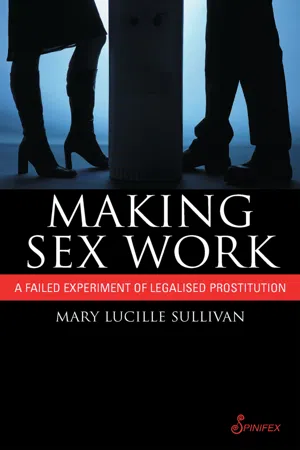
Backing up theory and critical literature with hard evidence, this book refutes the idea that legalization of prostitution can be anything but a harmful contributor to the commodification of women. It explores the fallacy of the "cottage industry," the role of financial institutions in supporting prostitution, the myth of exit programs, the conflation of legal and illegal sex industries, the problem of applying occupational health and safety standards to prostitution, and the specter of sex trafficking.
Information
CHAPTER ONE
Setting the Framework: Prostitution in the 21st Century
Every movement and community for social justice does or should have an interest in recognizing and combating sexual exploitation. Systems of prostitution draw strength from the economic, social and physical vulnerability of girls and women, and reinforce the belief that girls and women are sexual objects … Sexual exploitation exists because people are willing to exploit or use others, and because societies allow it to happen.
STANDING AGAINST GLOBAL EXPLOITATION (SAGE 2005) – A PROSTITUTION SURVIVOR-CENTRED HUMAN RIGHTS ORGANISATION.
In 1984 the Australian State of Victoria legalised prostitution, the first of four Australian states and territories to legitimise sex as work.1 A decade later, the Victorian Government was acclaiming its success in creating a ‘highly regulated, profitable, professional and incredibly well patronised sex industry’ (Victoria 1997a, p. 1147). Today this commodification of women and girls for sex, and profit, continues to escalate.2 At the beginning of the twenty-first century, prostitution is no longer simply a legally accepted industry in Victoria. ‘Sexual services’ ranks highest of all personal service industries in terms of revenue (reaching as high as 80 per cent), and drives the overall growth of this economic sector in general. Further, sex-based industries in Australia are the financial equals of the 50 top-ranking publicly traded companies, with the industry growing at 5.2 percent annually between 1999/2000 and 2004/2005, and as high as 7.4 percent between 2003/2004 and 2004/2005.This is significantly higher than the Gross Domestic Product.3
1. The Australian Federal Government does not implement prostitution industry legislation on a national level. Each state and territory develops its own legislation. The Australian Capital Territory (ACT) legalised prostitution in 1992, the State of New South Wales (NSW) in 1995 and the State of Queensland (QLD) in 1999. The Federal Government has authority over international relations, which takes in sex trafficking.
2. I use the term women and girls as they represent over 90 per cent of victims of prostitution and sex trafficking. However, throughout my book my analysis relates equally to all those entrapped in systems of sexual exploitation.
What underpins a government’s decision to institutionalise prostitution as work? What impact does this have on women and girls in prostitution? And how do we, as a society committed to women’s right to equality and safety, come to terms with a culture where the prostitution industry is influential, pervasive and most of all, considered acceptable? In Making Sex Work, I address these questions. I begin by situating Victoria’s experience of legalised prostitution as part of the rising global trend to legitimise prostitution as work. I expose the Victorian Government’s endorsement of the sex trade as a failed social experiment that harms women and girls in prostitution and ultimately affects the civil status of all women. This book’s dominant theme is that the normalisation of prostitution as work gravely undermines women’s workplace equality and contradicts other avowed government policies designed to protect the human rights of women. Victoria’s legalised prostitution system assists in maintaining male dominance, the sexual objectification of women, and the cultural approval of violence against women.
3. The Australian and New Zealand Standard Industrial Classification (ANZSIC) lists ‘sexual services’ as ‘personal services’ similar to businesses such as domestic services, babysitting services and weight reduction services. I based my statistical data on information provided by IBISWorld Pty Ltd reports, Personal Services in Australia (1998–October 2005); Sexual Services in Australia (May 2006) and ABS (2006) Gross Domestic Product, ABS CAT NO: 52060, June 2006, 2.3GDP. See also Victoria (1999), pp. 963 and 967.
In the first sections of this book, I map out the social forces and ideologies that underline Victoria’s shift from treating prostitution as a deviant and illegal practice, to recognising it as a ‘sexual service’ and a legitimate commercial activity. I then move on to examine the implications of this conversion in thinking and practice, for the State, for the pimps and buyers who now have a ‘lawful’ supply of women for their sexual use, and for the increasing number of individuals who have become highly saleable commodities in the marketplace. I outline the evolution of legalisation with its initial emphasis on containment and tolerance. Next I focus on more recent justifications – sexual liberalism and the rationale that prostitution is ‘just a job’. This latter view fits easily with a neo-liberal vision of a laissez-faire economic system and the freeing up of the market place where women and girls are just another sought-after consumer good.
As I discuss further in this chapter, feminists have been divided in their approach to prostitution. At one end of the spectrum are liberal feminists who argue that prostitution should be normalised as work. This thinking differs significantly from the radical perspective that analyses prostitution through an anti-violence lens and locates it along a continuum that includes rape, sexual harassment, violence perpetrated by intimate partners, incest and child sexual abuse. The feminist perspectives that were particularly influential in the Victorian debates on legalisation reflected a libertarian outlook which assimilated with the views of the alleged prostitutes’ rights movement and with the economic and political priorities of the State. These liberal feminist discourses equate the right to be prostituted with concepts of women’s rights to self-determination, economic power and sexual autonomy – a woman’s body, a woman’s right. That the health and well-being of women oppressed in a system of prostitution was never a central concern for these feminists, nor of the State’s legislators or of pro-prostitution advocates, becomes clearly apparent as Victoria progresses along its path towards making sex work.
From the outset, the liberalisation of the State’s prostitution laws was based on a harm minimisation approach, a position which accepts the inevitability of prostitution. The Victorian Government hoped that making the trade in women and girls a regulated sector of the mainstream workforce would contain the highly visible and expanding massage parlour industry as well as street prostitution. Equally critical was the desire to eliminate the industry’s criminal elements. Among prostitutes’ rights activists there was also some belief that legalising prostitution would alleviate most of the worst abuses within the industry.
But legalisation not only does not control prostitution’s harms, it produces many of its own making. State endorsement intensifies the commodification of women’s bodies and greatly expands the illegal, as well as legal, sectors of the industry. Other consequences of legalisation include the encroachment of prostitution on public life, its integration into state tourism and the growing role of Australian financial institutions in supporting the industry.
The later sections of this book in particular dispel many of the myths associated with legalisation and its purported benefits for women. I shed light on the fallacy of legalisation as promoting self-employment for women, allowing for a cottage-type industry and the lack of exit programs for women who want to leave prostitution. A further fiction that I challenge is that the prostitution industry can be neatly categorised into a well-regulated business that operates similar to other legitimate commercial activities, and clandestine operations which law enforcers now have the capability to deal with. Criminal behaviour and involvement is a feature of both sectors. Sex exploiters indiscriminately traffic women for commercial sexual exploitation, into both legal and illegal brothels, the former often a safe entrepôt for the illicit trade. The increased tolerance of prostitution in Victoria, in effect, requires a steady flow of women and girls to meet the demands of the vastly expanded and lucrative market. And sex business entrepreneurs devise numerous ways to sexually exploit women to make profits and meet consumer demands. The Government must continually introduce catch-up legislation in an attempt to deal with the myriad of unforeseen problems that stem from the State’s liberalised prostitution regime. Lastly, street prostitution, despite its continued illegality, increases commensurate with the industry as a whole.
One of the more compelling claims for treating prostitution as work is the theory that this will protect those within the industry from exploitation and violence. Victoria’s legal prostitution system notionally provides the most optimal conditions for creating a safe place and system of work. The State, in fact, purports to be at the forefront of implementing occupational health and safety standards (OHS) for the prostitution industry. However these OHS measures, when applied to the everyday reality of women in prostitution, show the unworkability of this proposition. Far from alleviating its harms, any government’s attempts to treat prostitution businesses as similar to other mainstream workplaces obscure the intrinsic violence of prostitution – violence that is entrenched in everyday ‘work’ practices and the ‘work’ environment. Sexual harassment and rape are indistinguishable from the sex the buyers purchase. That legalisation might make the pathologies of prostitution worse has been asserted in theoretical and critical literature. In Making Sex Work, my intention is to make this case with evidence.
Prostitution as ‘work’ in a global context: an overview
The shift towards viewing prostitution as work materialised in the context of the global industrialisation of what is now a multibillion-dollar sex industry. From the 1980s onwards, we have seen the emergence of commercial sex on an extensive and unprecedented scale. This immense commodity production entails the proliferation of prostitution and prostitution-like activities that include organised prostitution in brothels, massage parlours and escort services, street prostitution, internet prostitution, strip clubs, telephone sex and sex trade shows. It services military forces, sex tourism, a mass pornography trade and marriage bureaus. The media, airlines, hotel chains, tourist industries, international communication and banks all play a part in facilitating its business operations.4
An intrinsic component of this new world sex market is the trafficking of millions of people, mainly women and girls, for commercial sexual exploitation. Most countries are involved or affected. While profit estimates vary because trafficking is an illegal and cross-border issue, the US Government has intimated that after drug dealing, trafficking of humans is becoming tied with arms dealing as the second largest criminal industry in the world, and is the fastest growing (US Department of Health and Human Services 2006). In its report Forced Labor and Human Trafficking: Estimating the Profits, the International Labor Organisation (ILO), the principal human rights instrument that deals with workers’ rights and labour regulations, suggests that global profits made specifically from trafficking for commercial sexual exploitation are worth US $27.8 billion. This figure takes into account intra-country trafficking. Almost half of the profits are derived from trafficking into or within industrialised countries (Belsar, 2005 p. 15).5
4. For more information on global prostitution see The Coalition Against Trafficking in Women. http://catwinternational.org
Sex trafficking generally involves movement from poorer countries with struggling economies to relatively richer ones, or domestically, from impoverished regions to major industrial centres. It affects almost all countries and reaps enormous profits for agents who provide transport or cross borders, and for brothel owners and pimps who exploit victims in the place of destination. Trafficking thus has a strong race and class component as it involves a big demand and a steady supply of women who are made vulnerable to sex traffickers through inequalities, lack of employment opportunities, violence, abuse, discrimination and poverty (Economic and Social Commission for Asia and the Pacific 2005). However Janice Raymond, feminist theorist and co-executive director of the international organisation the Coalition Against Trafficking in Women (CATW), makes the critical point that, while human trafficking itself is not new, ‘What is new is the global sophistication, complexity and control of how women and children are trafficked from/to/in all parts of the globe’ (Raymond 2003, p. 1). Trafficking is a huge, organised and largely international industry. The number of women and children trafficked between countries for commercial sexual exploitation is estimated to be between 700,000 and two million each year (2003, p. 1). However as Raymond argues, these estimates are preliminary.6 The USA’s 2006 Trafficking in Persons Report found that ‘approximately 80 per cent of trafficked victims are women and girls, and up to 50 percent are minors’ (Office to Monitor and Combat Trafficking in Persons 2006, p. 1). A further finding is that the majority are trafficked into commercial sexual exploitation. However the report stressed that ‘With a focus on transnational trafficking in persons … these numbers do not include millions of victims around the world who are trafficked within their own borders’ (Office to Monitor and Combat Trafficking in Persons 2006, p. 1).
5. It is important to realise that these estimates only account for sex trafficked victims where some form of overt coercion was present that is ‘forced’ sexual exploitation. I discuss the serious limitations in making any distinction between forced and free sexual exploitation further in this chapter.
6. In Chapter Six, I explain how differing definitions of sex trafficking lead to differences in researchers’ estimates of the phenomenon as well as differences between official statistics and non-government organisations.
Most international strategies to eliminate sex trafficking have been shaped by contemporary dialogue around prostitution and by the legal approa...
Table of contents
- Contents
- Acknowledgements
- CHAPTER ONE Setting the Framework: Prostitution in the 21st Century
- CHAPTER TWO Institutionalising Men’s Rights to Women’s Bodies: Legalisation (1982–1997)
- CHAPTER THREE From Prostitutes’ Rights to Sex Industry Advocates: The History of the Prostitutes’ Collective of Victoria
- CHAPTER FOUR Living Off the Earnings of Prostitution: Sex Industry Expansion and Its Beneficiaries
- CHAPTER FIVE Unregulated and Illegal: Clandestine Prostitution Under Victoria’s ‘Model Legislation’
- CHAPTER SIX Victoria’s ‘Safe Sex Agenda’: Occupational Health and Safety for the Sex Industry
- CHAPTER SEVEN Rape and Violence as Occupational Hazards
- CHAPTER EIGHT Making Men’s Demand Visible
- Glossary
- Abbreviations
- Table of Legislation
- Bibliography
- Index
Trusted by 375,005 students
Access to over 1.5 million titles for a fair monthly price.
Study more efficiently using our study tools.
Frequently asked questions
Yes, you can cancel anytime from the Subscription tab in your account settings on the Perlego website. Your subscription will stay active until the end of your current billing period. Learn how to cancel your subscription
No, books cannot be downloaded as external files, such as PDFs, for use outside of Perlego. However, you can download books within the Perlego app for offline reading on mobile or tablet. Learn how to download books offline
Perlego offers two plans: Essential and Complete
- Essential is ideal for learners and professionals who enjoy exploring a wide range of subjects. Access the Essential Library with 800,000+ trusted titles and best-sellers across business, personal growth, and the humanities. Includes unlimited reading time and Standard Read Aloud voice.
- Complete: Perfect for advanced learners and researchers needing full, unrestricted access. Unlock 1.5M+ books across hundreds of subjects, including academic and specialized titles. The Complete Plan also includes advanced features like Premium Read Aloud and Research Assistant.
We are an online textbook subscription service, where you can get access to an entire online library for less than the price of a single book per month. With over 1.5 million books across 990+ topics, we’ve got you covered! Learn about our mission
Look out for the read-aloud symbol on your next book to see if you can listen to it. The read-aloud tool reads text aloud for you, highlighting the text as it is being read. You can pause it, speed it up and slow it down. Learn more about Read Aloud
Yes! You can use the Perlego app on both iOS and Android devices to read anytime, anywhere — even offline. Perfect for commutes or when you’re on the go.
Please note we cannot support devices running on iOS 13 and Android 7 or earlier. Learn more about using the app
Please note we cannot support devices running on iOS 13 and Android 7 or earlier. Learn more about using the app
Yes, you can access Making Sex Work by Mary Lucille Sullivan in PDF and/or ePUB format, as well as other popular books in Social Sciences & Gender Studies. We have over 1.5 million books available in our catalogue for you to explore.