- 200,113 pages
- English
- ePUB (mobile friendly)
- Available on iOS & Android
eBook - ePub
About this book
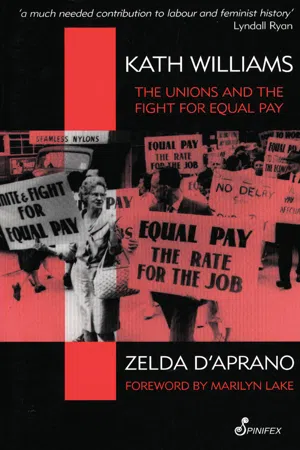
One of Australia's most important activists for women's rights, Kath Williams was a trade unionist and a communist before taking on the mantle of feminist after World War II. With a trade unionist ex-husband who was elected to Federal Politics opposing her left wing campaigns, Kath emerged as a feisty and quietly determined woman. Her campaign of conviction was the major force behind the country's achievement of equal pay for women.
Information
Topic
HistoireSubtopic
Biographies historiques1
Cath the housewife/mother becomes Kath the activist
Catherine Mary Isabel Chambers (Cath) commenced her teacher training for the Domestic Arts in 1913.1 We do not know what dreams or ambitions she may have had during adolescence but, with the pervading culture inculcating domesticity for girls and opposing participation of women in the workforce, the demand for teachers qualified in Domestic Arts created opportunities for young women to obtain a profession. Choices for women were few, and perhaps Cath recognised the potential this training would give her for a career, the means of a livelihood as well as providing skills and knowledge befitting her for marriage.
Cath was born on April 23 1895 at Lara, a tiny settlement south-west of Melbourne, in StoneLea Cottage, the home of her maternal grandparents, built by her stonemason grandfather William Harding. By the 1890s Lara, with its population of 250, had developed the charming air of an English village. Even its railway station, according to the Werribee Express, had the rural cottage home cosiness which might be seen on country branch lines in England.
Cath was the second-born of five children, four daughters and the youngest being a son. While little is known of Cath’s parents or about her childhood, her father, Edward, was the foundation Secretary of the Victorian Clerks Union.2 Her parents were able to live a comfortable existence and had the financial means to provide their children with advanced education. Lois Williams, an early pupil of Melbourne University High School, recalls seeing Cath’s name heading the list on the old school’s Honour Roll.3
Early in the twentieth century tertiary education was a luxury few could afford, and, of the five Chambers’ children, Cath attended The College of Domestic Economy situated in Lonsdale Street, the precursor to Emily McPherson College, and obtained her Diploma to teach Domestic Arts in December 1915.4
Eileen, the eldest daughter, was said to have been a Magistrate in the Children’s Court; Bobbie was a librarian; and Connie came down with tuberculosis, a disease rampant at the time, especially among young women. Ted, unlike his sisters, found schooling difficult, worked in numerous unskilled and semi-skilled jobs and spent several years humping his swag during the depression years.
Having obtained her qualifications to teach, Cath being classified as a temporary assistant, was placed by the Education Department in various schools from Collingwood to Daylesford.5 World War 1 was in progress and what money was available went for the war effort, not education. Cath’s teaching report after completing her first year of teaching, described her as ‘A teacher, bright in appearance, prepares and presents a good lesson, demonstrates and questions well, but needs experience in methods. Is an energetic and willing worker and should with experience become a very good teacher. Good 84.’6
It was through her father’s involvement with the trade union movement that Cath first met her husband-to-be, Percy James Clarey. When visiting the Chambers’ home to see Edward on union business, Percy met Cath, and expressed words of interest to Edward about his attractive daughter. At a later visit to the Chambers’ home, Percy and Cath spent some time conversing and Cath accepted his invitation to visit him at his union office at Unity Hall at the Spencer Street end of Bourke Street. This was the beginning of their relationship.
‘This morning, girls, we are going to make spotted dick.’
So wrote Kathy Skelton in her account of her experiences as a student in Form two at a domestic school during the 1950s. She describes how the girls were allowed to clean the flat at the end of the Domestic arts wing, make pasties, lemon sago, Irish stew, baked custard, rice pudding and jam roly-poly. They never made spotted dick and nor were they ever asked to open their Education Department Recipe Book at page forty-two, although longing for the teacher to direct them there and pronounce the forbidden words.
Cath Chambers during her teaching career was responsible for adhering to the curriculum established by the Education Department and, as a domestic arts teacher, was responsible for preparing girls for their housewife/mother role.
The curriculum Kathy Skelton describes was the sort Cath was required to teach.
Drawn from Michele Lonsdale, Liberating Women:
The Changing Lives of Australian Women since the 1950s, p. 19
Percy was born in 1890 at Bairnsdale, Victoria. When he was a child, the family moved to Melbourne where he was educated at South Yarra State School and later at the Working Men’s College. Crippled in his youth by rheumatoid arthritis, he was dependent on crutches all his life. Percy spent some years in hospital because of his affliction and, with plenty of time on his hands, he was able to use this period of incapacitation to continue his education and indulge himself in reading, a pastime he loved. On leaving hospital, he attended the Royal Melbourne Institute of Technology where he studied gold and assaying.
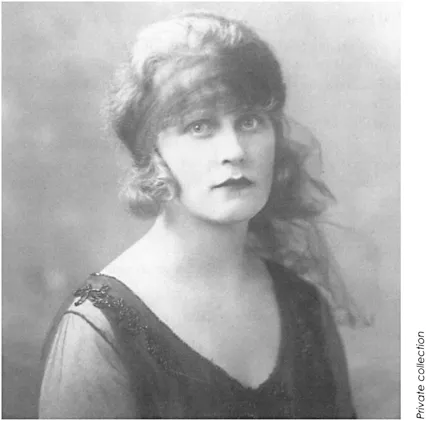
Cath in her early twenties
Percy was employed as a clerk at George Pizzey and Son, leather merchants, Percy became involved in trade unionism and politics. He was an ambitious young man and at the early age of twenty-four became the Victorian President of the Federated Clerks’ Union of Australia and Federal President three years later. He was to become an organiser of the Amalgamated Food Preservers’ Union of Australia and of the Federated Storemen and Packers’ Union of Australia. He served as Federal President of both organisations and maintained a close relationship with them throughout his long industrial career.7
At a time when most young men were away at the war, it is easy to understand the impression Percy, a successful young man who had already attained a position of power and respect, made upon Cath. Shortly after their relationship began, Cath spoke to her mother of her love for Percy and of his proposal of marriage.
In 1990, when interviewed by Cath’s granddaughter Lynda, Agnes Doig, long-time friend and comrade of Cath’s, said ‘[Cath’s] mother disapproved of the relationship on the grounds that “she would be foolish to marry a cripple”’. In time, Cath wondered if her mother’s strong reaction to the prospect of her marriage made her more determined at the age of twenty-two to make her own decisions and assert her right to live her own life. Many years later and in hindsight, ‘she wondered whether she would have married so soon, having known Percy for two months only, or at all, if her mother had not made her feel sorry for him and his disability’.8
With the forthcoming marriage in sight, Cath was forced to resign from her teaching position due to Education Department regulations at the time which stipulated that ‘No married woman shall be eligible for appointment to any office in the public service. Every woman employed in the public service who marries after the passing of this Act shall immediately upon her marriage retire from the public service.’9
Cath would have been fully aware of Departmental policy regarding married women teachers and although she may have resented it, like most women of her time, she accepted the housewife/mother role and was prepared to sacrifice her career. The Education Department waived the penalty when she broke her bond: the bond being an undertaking that she would teach at government schools for a specific number of years after qualifying.
Cath and Percy were married on 31 March 1917. The marriage was conducted at the Chambers’ family home at Box Hill and Mr. J.L.Mudford, minister of the evangelist Church of Christ officiated. The newspaper advertisement of her nuptials is attached to Cath’s Education Department Record.10
Taking a great interest in helping her husband in his political ambitions, Cath made great efforts in the home, socially and politically, in support of his aspirations. Her training in the domestic arts equipped her with the necessary skills for being a competent housewife and she was noted for her splendid cooking. She was always well groomed and was considered to be a good wife and mother, qualities which were deemed to be of the utmost importance. Cath was pleased when their first child, Bruce, was born in 1918, just prior to the end of World War 1. She didn’t want her child born while the war was in progress.11
Cath and Percy lived in Inkerman Road, Caulfield, a well-established ‘middle-class’12 suburb, and Cath was more than satisfied in assisting Percy along the road to political success. Whilst doing this, Cath herself was becoming more learned and aware of politics and of the hardship and suffering the working class endured. Cath had been brought up in a family in which the labour movement and politics were broadly discussed, and was a keen reader and incisive thinker. Although being ‘gentle’, she was not shy about discussing her ideas or opinions and could be quite forthright in doing so. She believed strongly in trade unionism and the Labor Party, believing it to be a true party, dedicated to bettering the lot of working-class Australians.
Cath’s committment to the Australian Labor Party (ALP) was profound. She was to become prominent in the labour movement, attaining a position on the Victorian Executive of the ALP.13 Being an extremely competent woman, she was able to manage her home and devote much of her time to Labor Party activities. It was twelve years before Cath gave birth to her second son. This delay was caused by problems associated with her first confinement and, wanting another child, she underwent surgery to enable her to be a mother for the second time. Raymond was her last child.14
One can only speculate as to why, after all these years, Cath decided to have another child. To have undergone surgery as she did indicated her genuine desire to have another child. However, in view of what was to transpire, perhaps she thought another child would hold the marriage together.
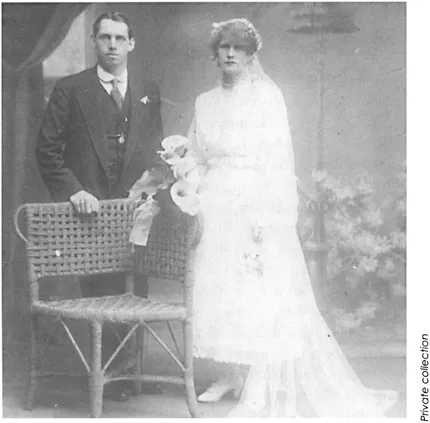
Cath and Percy’s wedding
The economic crash in 1929 ushered in a lengthy period of deprivation, poverty and hardship which, for many people, endured until the beginning of World War 2 in 1939. During these years when the economic depression was at its worst, Cath was often distressed when meeting people who came knocking on their front door asking for handouts, mainly food, money or clothing. It was during these bad years that ‘Percy would on occasions bring home a box of fruit, a bottle of expensive alcohol or some other luxury item. When first asking Percy how he came by the “gift”, she was told it came from a mate in return for a ‘favour’.15
Cath, after giving several years of devoted service to the ALP, eventually became President of the ALP Women’s Organising Committee. Her observations and experiences of the poverty all about her, and seeing no end in sight or improvement in the economic situation, caused her to develop doubts about the policies and practices of the ALP and its ability to deliver the promises made to working-class Australians. She believed the Liberal and Labor parties had different platforms and represented different people: the Liberals looking after the interests of the moneyed class while the Labor Party looked after the working-class, and they both had different visions for Australia. She initially believed in the parliamentary system, a democratic political system—representing all Australians—and that it would in time create a fair and equal Australia; but with one-third of the workforce unemployed during the worst years of the depression, Cath gradually came to believe that the parliamentary process was far removed from the reality of ordinary workers’ lives. She questioned the adequacy of the Labor and Liberal party structures to meet the needs of the desperate people who were turning up on her doorstep and began a serious analysis of her own political beliefs and those of her husband.
By 1933 when Hitler came to power in Germany, people who understood capitalism and how it functioned were rapidly becoming alarmed by the threats of Hitler’s policies, and Cath developed an interest and involvement in causes and activities more radical than Percy preferred. The Movement against War and Fascism was one of these causes and, knowing the threat fascism posed to the world, Cath became one of the Movement’s foremost speakers, proving to be quite capable of holding her own among the male speakers.16 It was on one of these occasions, when addressing an overflow audience of over 1000 people at Unity Hall in 1934, that Flo Russell, who was to join and become an organiser for the Communist Party of Australia (CPA), first heard Cath speak. She was most impressed by Cath’s ‘clear, thoughtful and powerful address’.
With the passage of time, Cath and Percy’s marriage developed problems, political differences being a major issue. Agnes Doig felt that Cath had eventually become ‘more interested in assisting Percy to overcome prejudice towards his disability and achieve his goals than feeling any love for him’.17 Percy was determined to enter Parliament and having a wife like Cath, who was averse to hiding her growing rad...
Table of contents
- Other books by Zelda D’Aprano Zelda (1995)
- Contents
- Acknowledgements
- Foreword
- Abbreviations
- Preface
- Editorial note
- 1 Cath the housewife/mother becomes Kath the activist
- 2 An early history of women and unionism
- 3 Women’s postwar moves on equal pay and the ACTU
- 4 Decisions on equal pay, 1891 to 1955
- 5 The fight for equal pay, 1956 to 1959
- 6 1960 to 1962, the fight escalates
- 7 Kath resigns from the Communist Party of Australia
- 8 1963 to 1964, the ACTU and equal pay
- 9 1965 to 1967: the ACTU gears up for action as Kath begins to retire
- 10 The ACTU changes policy: from urging legislation to preparing a claim for equal pay
- 11 The equal pay case of 1969
- 12 Equal pay for work of equal value
- 13 Kath and male structures
- 14 Women, work and the fight for pay justice
- Appendix 1 Noteworthy decisions on pay
- Appendix 2 The Victorian Working Women’s Centre
- Interviews
- Notes
- Bibliography
- Index
Trusted by 375,005 students
Access to over 1.5 million titles for a fair monthly price.
Study more efficiently using our study tools.
Frequently asked questions
Yes, you can cancel anytime from the Subscription tab in your account settings on the Perlego website. Your subscription will stay active until the end of your current billing period. Learn how to cancel your subscription
No, books cannot be downloaded as external files, such as PDFs, for use outside of Perlego. However, you can download books within the Perlego app for offline reading on mobile or tablet. Learn how to download books offline
Perlego offers two plans: Essential and Complete
- Essential is ideal for learners and professionals who enjoy exploring a wide range of subjects. Access the Essential Library with 800,000+ trusted titles and best-sellers across business, personal growth, and the humanities. Includes unlimited reading time and Standard Read Aloud voice.
- Complete: Perfect for advanced learners and researchers needing full, unrestricted access. Unlock 1.5M+ books across hundreds of subjects, including academic and specialized titles. The Complete Plan also includes advanced features like Premium Read Aloud and Research Assistant.
We are an online textbook subscription service, where you can get access to an entire online library for less than the price of a single book per month. With over 1.5 million books across 990+ topics, we’ve got you covered! Learn about our mission
Look out for the read-aloud symbol on your next book to see if you can listen to it. The read-aloud tool reads text aloud for you, highlighting the text as it is being read. You can pause it, speed it up and slow it down. Learn more about Read Aloud
Yes! You can use the Perlego app on both iOS and Android devices to read anytime, anywhere — even offline. Perfect for commutes or when you’re on the go.
Please note we cannot support devices running on iOS 13 and Android 7 or earlier. Learn more about using the app
Please note we cannot support devices running on iOS 13 and Android 7 or earlier. Learn more about using the app
Yes, you can access Kath Williams by Zelda D'Aprano in PDF and/or ePUB format, as well as other popular books in Histoire & Biographies historiques. We have over 1.5 million books available in our catalogue for you to explore.