Lévi-Strauss tried to convince women that we are spoken, exchanged like words; Lacan tried to teach women we can't speak, because the phallus is the original signifier; and then Derrida says that it doesn't matter, it's just talk.
Foucault, Derrida, Lacan, Nietzsche: the chant resonates through universities around the world. Have you ever tried to untangle the words of postmodernist theorists? How to find your way through the labyrinth to sense and clarity? If so, this is the book for you.
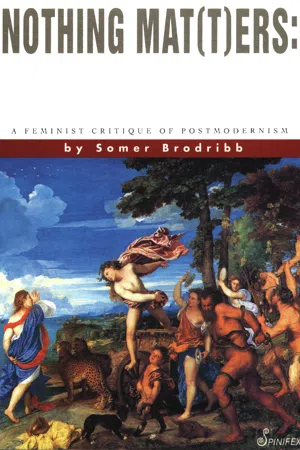
- 178 pages
- English
- ePUB (mobile friendly)
- Available on iOS & Android
eBook - ePub
About this book
Information
1
A SPACE ODYSSEY
What women need to do, to put it in the simplest way, is to be able to demonstrate that male dominant culture and the male-stream thought which buttresses and justifies it are both, in some sense, prejudiced by the very fact that they are masculine.
One way of doing this, or at least of starting to do it, is to consider male philosophy as an ideology of male supremacy. (O’Brien: 1981, p. 5)
Postmodernists view de Beauvoir’s work as hopelessly foundationalist (grounded in a theory of human nature) and transcended by Lacanian psychoanalysis. Nevertheless, she had her own views on the “new” postmodern writing of Robbe-Grillet and others. The violently individualist, amoral, apathetic and misogynist nouveau roman was the literary event of the ‘60s. Hubert Aquin and Alain Robbe-Grillet are two of the better known authors in this genre. In her discussion of Klossowski, de Sade, Bataille and phallic fantasy/ideology, Dardigna cites the following interview with Robbe-Grillet:
There is in all my novels an attack on the body, at the same time the social body, the body of the text and the body of woman, all three stacked together. It is certain that, in the male fantastic, the body of woman is the privileged target. In no way am I ashamed of my sado-erotic fantasies; I give them a major role: the life of the fantastic is what the human being must claim most strongly (Dardigna: 1981, p. 21).
These thriller detective novels of the “God is Dead and I’m okay” period typify a certain masculinity, which professes not heroes, but anti-heroes. Simone de Beauvoir discusses her distress with the nouveau roman. “It is a dead world they are building, these disciples of the new school” (1968, p. 637). She charges that in their regressive, schizophrenic, metaphysical work,
the justifications and the discoveries coincide: the Revolution has failed, the future is slipping from our grasp, the country is sinking into political apathy, man’s [sic] progress has come to a halt; if he is written about, it will be as an object; or we may even follow the example of the economists and technocrats who put objects in his place; in any event, he will be stripped of his historical dimension (1968, p. 636).
These are the common characteristics of the new school which “confuses truth and psychology.refuses to admit interiority.reduces exteriority to appearances” (1968, p. 636). De Beauvoir captures the superficiality and contra-mundane aspect of the post-1945, postmodern ideology: “appearances are everything, it is forbidden to go beyond them.the world of enterprises, struggles, need, work, the whole real world, disappears into thin air” (1968, p. 636). She charges that “with the intention of saying nothing, they mask the absence of content with formal convolutions.” (1968, p. 636). De Beauvoir links this “escape into fantasies about the absolute” and “defeatism” (1968, p. 637) to the degraded situation of France and the rise of fascism there.
Those who have stood at the door of the Masters’ House of science and subjectivity, of class and state power, have been struck by what O’Brien calls “an ironic sense in which the understanding of how hegemony works might well be clarified in an ethnography of Marxist intellectuals” (1989, p. 233). Maria-Antonietta Macciocchi, a former student of Louis Althusser, looks back at the men of her generation and recalls life among the men of science and subjectivity, class and state power. She chronicles their disappearance as the ending of an era:
Nikos Poulantzas committed suicide on October 3, 1979. Lacan dissolved his school on March 16, 1980. Sartre died on April 15, 1980. Barthes, victim of an automobile accident on February 18, 1980, died in the month of April in the same year. Althusser strangled his wife on November 17, 1980. Lacan died on September 19, 1981 (1983, p. 487).
Certainly, their works influenced, engaged and denounced one another in many ways. Althusser reread Marx and Lacan, Lacan reinterpreted Freud, Barthes’ Mythologies was indebted to Levi-Strauss’s Mythologiques, Sartre influenced Foucault, and Poulantzas tried to write the methodological micro-histories called for by Althusser. Foucault said: “Open Althusser’s books” (Bellour: 1971, p. 192) even though he disagreed that Marx represented an epistemological break with Classical thought. Louis Althusser read Lacan1 as having accomplished for the unconscious what he, Althusser, had done for the theory of the economic structure. Levi-Strauss sought to interpret the universal unconscious with language, while Freud considered the particular. Their two approaches merge in Lacan’s work. Lacan turned to the mathematical sciences to reveal the functions of the unconscious just as Levi-Strauss described universal codes with the use of mathematics (Ragland-Sullivan: 1987, p. 138). This is not to deny the level of difference and disagreement within that period of French political and social theory. Althusser may have written of Freud and Lacan, but in 1980 he violently denounced Lacan as that “magnificent, pathetic Harlequin” (Clement: 1983, p. 21) at one of Lacan’s private seminars to which he had gained access. Anti-Oedipus (1983) by Fe1ix Guattari and Gilles Deleuze was a rebellion against Father Lacan, which had some success among the Lacanian school. Deleuze was a former pupil and analysand of Lacan; as was Althusser. Some Lacanians followed the forbidden work of Jacques Derrida, who criticized Lacan’s phallogocentricism in The Post Card (1987b). In the section “Le facteur de la verite”, Derrida argued that Lacanian psychoanalysis was prescriptive rather than simply descriptive. Derrida and Foucault argued over origin and madness. All of these authors whose roots lay either in scientific Marxism or functionalist structuralism had denounced existentialism, yet at a certain point all were secretly turning to Sartre, and to the Romantic novelist Stendhal, writers who embraced the humanistic, metaphysical, historicist tradition that structuralism rejected (Macciocchi: 1983, p. 491).
Macciocchi deliberately describes Althusser’s torments preceding his murder of his wife and his attempt to absolve his subjectivity. In the year before her death, Althusser test drove and pretended to purchase a Rolls Royce in London. In Italy, he spent an evening with an “earthy” woman who confided to a friend, “Yes, nothing but little kisses…he’s afraid of the body” (1983, p. 530). At a Terni Workers’ Cultural Circle, he spoke for the first time on “The Pleasures of Marxism,” performing as at a carnival of denunciation and absurdity in the face of orthodoxy and passivity. After this, he confessed to Macciocchi: “I told the truth, and I saved my soul” (1983, p. 535). She considers: “For the first time, I heard him speak in the first person. However, people turned their backs on him, furious that he was showing the gap between yesterday’s utopias and today’s realities, that he thereby touched the knot of theoretical reflexion, which was finally the knot of his own despair” (1983, p. 535). Macciocchi traced the “insolent” acts (1983, p. 538) of the twelve-month period prior to Althusser’s murder of his wife, Helene Rythmann, and discovered his growing despair over communism, Marxism, and his work. But Macciocchi focuses on Althusser’s epistemological breakdown, and not its patriarchal expression and force: “These three acts were the sundering…[la rupture]…of three inhibitions, of three chastity belts, with which marxism had cast subjects into iron statues. Human passions, the need to imagine, and the liberty of thinking—otherwise known as heresy” (1983, p. 538). The uxoricide is negated, used as a metaphor for Althusser’s purported self-destruction, almost in the way Derrida uses the story Pierrot Murderer of His Wife to focus on subjectivity.2 According to Macciocchi:
By killing Helene, in a final grip of love and hate, he sent to the tomb the Mother, the nurse, the companion, the Jew he had protected from persecution, and also the only voice that could prolong his own. He really wanted to silence himself forever (1983, p. 537).
Monique Plaza calls Althusser’s murder of Helene Rythmann “ideology in action” (1984a, p. 75). She argues that “the murder of a woman is within the continuum of the discursive negation of women.ideology against women is not just a matter of words; it is also a matter of death” (1984a, p. 75). When Plaza presented this paper to an international symposium on Ideology at the Polytechnic of Central London in 1981, organizers requested that she remove this discussion of Althusser’s murder of his wife (1984a, p. 82). Geraldine Finn argues that we must attend to the political and personal:
We cannot afford to continue to separate the intellectual in a man (I choose my terms carefully) from the emotional: the depression from the ideas; or the political from the personal: the commitment to class struggle from the stormy marriage, the dead wife. Neither Althusser, “France”, nor the world’s intellectuals and revolutionaries will acknowledge patriarchy as the powerful, pervasive and pernicious ideological state apparatus which it is; at the same time, none of them escape its effects (Finn: 1981, p. 28, italics in original).
When Althusser died in 1990, many masculine Marxists and philosophers still found reference to the murder to be in very bad taste. One obituary read:
It is still too early to draw up a balance sheet. The master has left too deep an impression on us. Above all, the man was so close to us, with his exquisite gentleness, his tact…
Then came the tragedy, which he himself described, partly out of a sense of propriety and partly out of derision, as the “non-event”, the killing of his wife, the committal to hospital (Comte-Sponville: 1990, p. 16).3
Gregory Elliott is more indignant and feels that Althusser is unjustly attacked and beset: “doubtless pour decourager les autres, some have not hesitated to identify the death of Helene Althusser at her husband’s hands as the inevitable denouement of [his theoretical endeavour]” (1991, p. 28). Indeed, Helene victimizes Louis Althusser by staging a supposed murder, murder rendered now in quotation:
When, in November 1980, defeat came, provoked in part by the political setbacks of the late ‘70s, the pitiless form it took—the “murder” of his companion of some thirty-five years— condemned him to oblivion thereafter (1991, p. 29).
Melancholic musings on the Master beset by feminism and the woman he murdered. A Master is Being Beaten.
No manifesto has been endorsed by structuralism, the nouveau roman, semiotics, deconstruction, poststructuralism and postmodernism. The Saussurian-dominated intellectual problematic was inaugurated by Levi-Strauss in reaction to the Marxism and existentialism of Sartre and others. Yet the indefinability and shifting categorization of Lacan, Derrida and Foucault contribute to the confusion surrounding already abstract, slippery texts. It’s difficult to know who is what, where, and when. This is also complicated by their search for ancestors.4 John Rajchman (1991, p. 120) remarks that “postmodernism is what the French learned Americans were calling what they were thinking.” What follows is a brief presentation of definitions and a history of the categories.
Male-stream literature (Esprit, 1967; Caws, 1968) named the stars of the French structuralist movement: Claude Levi-Strauss, the founding father from anthropology; Roland Barthes from belles lettres and literary criticism; Foucault and Derrida in the philosophical mode; Althusser the structuralist Marxist; and Lacan, the fundamentalist and surrealist Freudian. Pavel (1990, p. 5) argues that the work of Levi-Strauss, Lacan, Foucault and Derrida has the following common features: the use of linguistic concepts, the critique of humanism, subjectivity and truth and “the replacement of metaphysics by metacriticism” (1990, p. 6, italics in original). Of the rise and “fall” of French structuralism and poststructuralism, Pavel writes “in France during the 1960s, the concepts of structural linguistics were transformed into a lasting set of metaphysical notions, which, in turn, played a crucial role in one of this century’s most spectacular attempts to achieve intellectual modernization” (1990, p. 1). Lacan makes this proposition clear in “The Meaning of the Phallus”:
This passion of the signifier then becomes a new dimension of the human condition, in that it is not only man who speaks, but in man and through man that it [9a] speaks, that his nature is woven by effects in which we can find the structure of language, whose material he becomes, and that consequently there resounds in him, beyond anything ever conceived of by the psychology of ideas, the relation of speech (1985b, p. 78).
Language, sign, and code are the privileged forms of mediation, which is reduced to exchange. The post-war emphasis on rational positivism and critique of metaphysics led many philosophers to borrow scientific models from the human sciences, especially linguistics. Meaning and value had no place in the analysis of signifier and signified. Indeed, the new epistemology is primarily linguistic. Central to all this is the notion of structure as the reduction of matter to form. According to Levi-Strauss, structuralism, unlike formalism, does not distinguish between form and matter. On the contrary, it challenges such distinction: “Form defines itself by opposition to a content which is exterior to it; but structure has no content: it is itself the content, apprehended in a logical organization conceived as a property of the real” (Levi-Strauss: 1960, p. 122). This is foundational to postmodernism’s epistemology: structure is matter, energy is male, and He is the female o...
Table of contents
- Cover
- Titlepage
- Copyright
- Contents
- Acknowledgement
- Preface
- Introduction The Labyrinth
- Chapter One A Space Odyssey
- Chapter Two Nothingness and De/generation
- Chapter Three Existence and Death
- Chapter Four Neutrality andDe/meaning
- Chapter Five Lacan and Irigaray: Ethical Lack and Ethical Presence
- Chapter Six Out of Oblivion
- References
- Permissions
- Index
Trusted by 375,005 students
Access to over 1.5 million titles for a fair monthly price.
Study more efficiently using our study tools.
Frequently asked questions
Yes, you can cancel anytime from the Subscription tab in your account settings on the Perlego website. Your subscription will stay active until the end of your current billing period. Learn how to cancel your subscription
No, books cannot be downloaded as external files, such as PDFs, for use outside of Perlego. However, you can download books within the Perlego app for offline reading on mobile or tablet. Learn how to download books offline
Perlego offers two plans: Essential and Complete
- Essential is ideal for learners and professionals who enjoy exploring a wide range of subjects. Access the Essential Library with 800,000+ trusted titles and best-sellers across business, personal growth, and the humanities. Includes unlimited reading time and Standard Read Aloud voice.
- Complete: Perfect for advanced learners and researchers needing full, unrestricted access. Unlock 1.5M+ books across hundreds of subjects, including academic and specialized titles. The Complete Plan also includes advanced features like Premium Read Aloud and Research Assistant.
We are an online textbook subscription service, where you can get access to an entire online library for less than the price of a single book per month. With over 1.5 million books across 990+ topics, we’ve got you covered! Learn about our mission
Look out for the read-aloud symbol on your next book to see if you can listen to it. The read-aloud tool reads text aloud for you, highlighting the text as it is being read. You can pause it, speed it up and slow it down. Learn more about Read Aloud
Yes! You can use the Perlego app on both iOS and Android devices to read anytime, anywhere — even offline. Perfect for commutes or when you’re on the go.
Please note we cannot support devices running on iOS 13 and Android 7 or earlier. Learn more about using the app
Please note we cannot support devices running on iOS 13 and Android 7 or earlier. Learn more about using the app
Yes, you can access Nothing Mat(t)ers by Somer Brodribb in PDF and/or ePUB format, as well as other popular books in Social Sciences & Gender Studies. We have over 1.5 million books available in our catalogue for you to explore.