- 131 pages
- English
- ePUB (mobile friendly)
- Available on iOS & Android
eBook - ePub
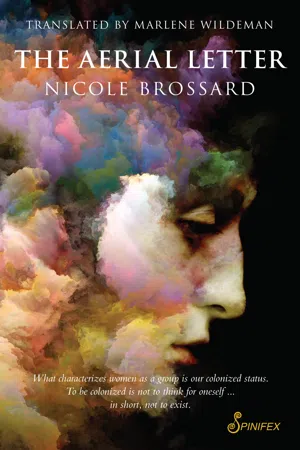
The Aerial Letter
About this book
What characterizes women as a group is our colonized status. To be colonized is not to think for oneself, to think on behalf of "the other," to put one's emotions to work in service of "the other." In short, not to exist. Nicole Brossard is known internationally for her writings on writing, on feminism, and on lesbian existence. This edition released for a new wave of feminist outrage is a book full of spirit, energy, insight, and chutzpah. She is a major voice in contemporary literature with incisive and hard-hitting essays about feminist imagination and culture. I believe there's only one explanation for all of these texts: my desire and my will to understand patriarchal reality and how it works, not for its own sake but for its tragic consequences in the lives of women, in the life of the spirit. Years of anger, revolt, certitude, and conviction are in
The Aerial Letter; years of fighting against the screen which stands in the way of women's energy, identity, and creativity. —Nicole Brossard
Information
Topic
Literatur
THE AERIAL LETTER
We concentrate avidly on the processes. Of writing, of desirous being, of ecstasy. We concentrate a great deal on the self. We exert ourselves, and in so doing we summon the other within ourselves to a reality which is transformed. Fiction seeks its own fictional subject and memory alone does not flinch. Memory makes itself plural, essential, like the vertigo that foreshadows an aerial vision. Authentic as a first written draft. With each page, the necessary willingness to start over.
For each time I must enunciate everything, articulate an inexpressible attitude, one that wants to remake reality endlessly, in order not to founder in its fictive version nor be submerged in sociological anecdote.
On the one hand, taking on sociological reality by taking risks within. In order to dissolve its fictive character, in order to foil the impostures of the day-to-day anecdote. Here, a question: the text as I.D. card or identity as a science fiction of self in the practice of creating text? Those who have never been able to speak the reality of their perceptions, those for whom the conquest of personal emotional territory has been precluded politically and patriarchally, will grasp that identity is simultaneously a quest for and conquest of meaning. Desire slowly emanates from what is inadmissible in her project: transformation of the self, and the collectivity. Inadmissible will to change life, to change her life. Imperatives with regard to what in the environment appears intolerable. Identity turns into project when the border between what’s tolerable and what’s intolerable disintegrates or, one might say, when it no longer holds up. This is when words make themselves void of sense or take on another meaning; take a new turn in the sequence of thought’s events. Words begin to turn round on themselves, inciting reflection, inciting thought toward new approaches to reality. And it is also when words begin to oscillate between derision and vitality, becoming, little by little, indispensable strategies for confronting reality’s two slopes: the actual and the fictive.
One the other hand, tackling reality the way one takes on a project; so as to take by surprise equations, for they give to the surface of all skin its vitality, its reasoning, if you will. Bathing in the atmosphere of the senses and giving form to enigmas we imagine out of the white, while the certain body8 refers us back to an implacable geometry: our feverish excitement, a fluidity of text seeking its source. Taking on reality in order that an aerial vision of all realities arises from the body and emotion of thought. Realities which, crossing over each other, form the matrix material of my writing. This text matter, like a fabulous mathematics, relates words to one another. All bodies carry within themselves a project of sensual high technology; writing is its hologram.
~ I ~
THE ORDEAL: THE TEST AND/OR THE PROOF OF MODERNITY
The text, the notion of text, has been, as we well know, subjected in the past few decades to several transformations; most have been a response to the necessity for politico-sexual subversion. The textual site has become the repository for the body, sex, the city, and rupture, as well as the theory that it generates, which in turn regenerates text. Text has systematically proliferated, profaning the state of mind of both the petit- and the grand-bourgeois. The ordeal of modernity (Rimbaud’s “one absolutely must be modern”) as initiation w/rite, has been succeeded by “one must be resolutely modern” as political initiation project. The experience of text, understood as crossing through writing, will be transformed by experimentation, that is, by a strategy bound to disrupt.
Everything conspires to ensure that the writing “I” speak desire and not its desire, keeping by this distancing its formal presence, its inherent prestige. In this there is a known principle of seduction whose function is both to excite and to incite. Seduction of what symbolically masters. Thus the textual “I” will say: I will make you neutral, my I, so as to prevent you from letting your origins show, those which might be deemed ideologically suspect, your bourgeois, religious, or feminine origins. I condemn you therefore to anonymity, such that you cannot be co-opted or alienated, like all those little “I’s” which capitalism has reduced to marionettes but who, all things considered, can still express themselves – do nothing but, in fact. I intend to, that is, I will speak the “I” which resolutely exists, I choose to speak out, I am subversion, I am transgression. If not, I do not exist. Theoretically.
Just as exposing oneself to everything seemed real to me, the “I impose myself on everyone,” which followed in the modern texts of the Sixties, seems to me fictive, like a seduction which has value only by virtue of a convention, a fiction.
It is here that writing begins, that I begin again.
I say that writing begins here between what’s real and what’s fictive, not between the knowledge we have of one and the intimate experience we have of the other, but between the words that we seek to conceive in their true relationship, so as to get to the bottom of the question, always integral, of thought and emotion; motifs and motivation.
We can imagine writing as a rapprochement, or as the concrete will to attract toward oneself the essential figures of thought/or even/to see one’s desire come as far as possible, that is, closer: to the very edge, right to the limits – where it might very well falter. Balance or vertigo, when the “exact expression” illustrates the thought of emotion, when what appears on the page seems like a coincidence: a perfect synchronization between explosion and mastery which breaks through to an opening. Each time it must be imagined; what would give access to.
I have just said “imagine writing.” After all, maybe that is as far as we have come. Forced to drift in total lucidity into the imaginary world of words, tempted by an improbable literature and – since theoretically and ideologically improbable – displacing it toward what we would agree upon calling fiction.
But before coming to fiction, I would like to say more about text. I take as a given that the text-fetish, in the sense used by Roland Barthes who wrote, “the text is a fetish object, and this text desires me,”9 has appropriated Literature, this practice of the written which consists of inscribing, among other things, the expressive part of a memory rooted in an environment at once geographic, social, and cultural, and which recalls the site of our origins as much as it does our first stimuli.
It is in order to avoid that these “unmentionable” origins (ideologically speaking), like those “unmentionables” (sexually speaking), be manifest in one’s writing that little by little the writer becomes, according to his own formula, a ‘technician’ of writing.10 For the same reasons, the text-fetish will reappropriate Literature (according to the old axiom), this having become prattle, too sentimental, and emotional (a bit too feminine, wouldn’t you say!). One can at this stage, without answering immediately, inquire whether fiction, or that which I personally would call the fictive text, will in turn appropriate the text-fetish, which now has become too reductive.11 (In chemistry, a “reducing-agent” is defined as being that which is apt to remove oxygen.)
Let us return once again to text.
To date, we have known a certain experience of text in which there is a vital practice of modernism, and several of these modernist texts are memento-screens testifying to the form emotion and thought have taken over the last thirty years. Emotion which, need I add, in Quebec is distinctly related to urban life. For the city concentrates energy; it calls for fiction, ellipsis, and theory, not to mention the politicization of texts. In some, the city stimulates a modern spirit; in others, it is responsible for modern performances.
I hold that this exciting experience of text which turns about itself, bearing and being borne by its own weight, simultaneously suggests excess, the circle, and the void. I say the circle, for it seems to me that in wanting to break the linearity, it is as if we have been forced into its opposite, to turn full circle, as if the text in this had come to its own end in itself, even were this to explode.
From excess, from the circle (as the sum of fragments accumulated from having been repeatedly shattered), and from the void, I would then translate the results into the feminine by a shift in meaning going from excess to ecstasy, from circle to spiral, and from void to opening, as a solution for continuity.
But I would like to come back to this “impression of void,” to which the practice of writing texts lends itself, for it is this impression which still motivates some of the lettered few (professors and critics, among others) to maintain the phobia of the text, an impression of a vacuum they preserve intact, in order to reach the conclusion that research and advances accomplished there are irrelevant.
If in Quebec the literary terrain is changing, this is not a result of criticism but rather because most of the textual few know how to re-read themselves in time. To this, I would add that the writing produced by women in the last ten years has considerably helped textual writers to re-read their work in time. For women have displaced the purpose of writing; the relevance of purpose. This may have been premature for some men, but for women, it came at precisely the right moment.
It is this very “impression of void,” I might add, that will disturb and displace the very people who are given to text the way one gives oneself up to the immediacy of pleasure. I have said “impression of void” because the text, we know very well, condenses; it sums itself up in certain words: city, sex, text, body, desire, script, the gaze (that of film, that of photography). The text is an ideogram. In a way, it is because the text condenses (it is not a chatterbox), that it does reduce (it takes the shortest route possible), that it gives this impression of running on empty, or of running wild12 (something to do with its excessive vitality).
Thus, for those who write text, on the one hand, an improbable Literature (hiding one’s roots), and on the other, an impossible text (an impression of void). But the desire to write survives. Absolutely.
Lucidity, the yearning for and of text, and for many, their very survival, will exact a new writing: one that drifts, that slips out from under; writing that eludes. Why not then submit proof of imagination by opening a breach: a spiral?
To conclude my remarks about text, one last comment: it was not symbolically important to know who the actual author behind a text was, whether in the flesh, in memory, or in childhood, for text was precisely the formula which permitted the writer not to have to submit to the test.
~ II ~
THE TEST AS SEEN FROM THE FEMININE (ENTER FICTION)
Here and now I search in vain for fiction. This fiction, so keenly called for, is in a sense the opposite of utopia for it seeks to compose itself from all that anchors history.
And the Damned of the damned raise themselves up little by little out of imprecision and non-existence.
Nothing is reassuring for a woman, if not herself, having gone and found herself among other women.
Women write, but at this point in time, they write more than ever with the conscious knowledge that they cannot write if they camouflage the essential, that is, that they are women.
The female body will speak its reality, its images, the censure it has been subjected to, its body filled to bursting. Women are arriving in the public square of Literature and Text. They are full of memories: anecdotal, mythic, real, and fictional. But above all women are filled with an original all-encompassing memory, a gyn/ecological memory. Rendered in words, its reality brought to the page, it becomes fiction theory.
Faced with text now impossible – because it denies the memory and the identity of its author, because it reduces the body to that of the neuter-masculine – how to, without reverting to a linear literature (that is, narrow and without perspective), how then to render what works at the female body on the inside and all over its surface? How to make use of words when, as Louky Bersianik points out: “The symbolic is the place Man allotted to himself, though this was neither solicited nor called for. In so doing, he usurped the place of the other, that is, that of woman. Then he could say she doesn’t exist.”13
What form could contemporary thought take exactly, giving to words an entirely new flair? For the body has its reasons. How to keep one’s distance from words without, for all that, giving up one’s place, without ending up neutered and neutralized in one’s text, without losing sight of an image of self finally liberated from its negativity, without omitting that which reflects it (women and honour, as Adrienne Rich would say), and that which sense always transforms and extrapolates.
Writing sense/reading sense. A sixth sense is at work in the life of women. Repressed to the point of appearing non-existent, and by this same fact rendered inoperative in the patriarchal system, it seems to me that this sixth sense, for circumstantial reasons in the development of western civilization, is reaching maturity, and that it can,...
Table of contents
- Cover
- About the Author
- Title Page
- Copyright
- Dedication
- Contents
- Saying the Unsayable—Susan Hawthorne
- Translator’s Introduction—Marlene Wildeman
- Preface 2020
- Preface 1988
- Turning-Platform
- Coincidence
- The Aerial Letter
- Critical Appreciation
- Synchrony
- From Radical to Integral
- Kind Skin My Mind
- A Captivating Image
- Lesbians of Lore
- Access to Writing: Rites of Language
- Intercepting What’s Real
- Certain Words
Trusted by 375,005 students
Access to over 1.5 million titles for a fair monthly price.
Study more efficiently using our study tools.
Frequently asked questions
Yes, you can cancel anytime from the Subscription tab in your account settings on the Perlego website. Your subscription will stay active until the end of your current billing period. Learn how to cancel your subscription
No, books cannot be downloaded as external files, such as PDFs, for use outside of Perlego. However, you can download books within the Perlego app for offline reading on mobile or tablet. Learn how to download books offline
Perlego offers two plans: Essential and Complete
- Essential is ideal for learners and professionals who enjoy exploring a wide range of subjects. Access the Essential Library with 800,000+ trusted titles and best-sellers across business, personal growth, and the humanities. Includes unlimited reading time and Standard Read Aloud voice.
- Complete: Perfect for advanced learners and researchers needing full, unrestricted access. Unlock 1.5M+ books across hundreds of subjects, including academic and specialized titles. The Complete Plan also includes advanced features like Premium Read Aloud and Research Assistant.
We are an online textbook subscription service, where you can get access to an entire online library for less than the price of a single book per month. With over 1.5 million books across 990+ topics, we’ve got you covered! Learn about our mission
Look out for the read-aloud symbol on your next book to see if you can listen to it. The read-aloud tool reads text aloud for you, highlighting the text as it is being read. You can pause it, speed it up and slow it down. Learn more about Read Aloud
Yes! You can use the Perlego app on both iOS and Android devices to read anytime, anywhere — even offline. Perfect for commutes or when you’re on the go.
Please note we cannot support devices running on iOS 13 and Android 7 or earlier. Learn more about using the app
Please note we cannot support devices running on iOS 13 and Android 7 or earlier. Learn more about using the app
Yes, you can access The Aerial Letter by Nicole Brossard in PDF and/or ePUB format, as well as other popular books in Literatur & Nordamerikanische Literarische Sammlungen. We have over 1.5 million books available in our catalogue for you to explore.