- 161 pages
- English
- ePUB (mobile friendly)
- Available on iOS & Android
eBook - ePub
About this book
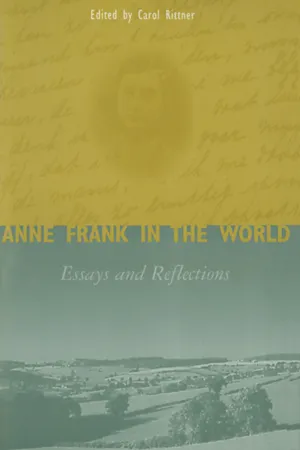
Scholars, clergy, teachers and writers present stimulating essays on the theme that Anne Frank's Diary movingly symbolizes the triumph of childhood innocence over totalitarian brutality. This may be of value for classes and study groups with interests in religion and religious ethics, the Holocaust, ethnic cleansing, discrimination, the role of the individual in society, and the daunting moral dilemmas posed by emerging nationalisms all over the world.
Part One
Encounters
Reflections on Anne Frank
I was introduced to Anne Frank in 1960, when I was ten years old. As I recall, the diary of Anne Frank seemed almost an adventure story. The fact that it was true rendered it more exciting; the fact that it had taken place on another continent and in another era made her story seem impossibly (and safely) remote.
What I remembered from my first reading of the book was not so much its account of Anne’s life in hiding and her terrible death, but the impression made on me by her idealism. The sentence I still know by heart is her haunting statement: “I still believe, in spite of everything, that people are truly good at heart.” As a child, that was what I wanted to believe and, particularly after I read the diary of Anne Frank, felt committed to believe. Neither I nor the young Jewish girl hiding in Amsterdam knew the fate that awaited her. At the age of ten, I could not imagine it.
That same year, I had another introduction to the Holocaust. My father taught English at a small college, and one of his colleagues was a woman named Georgette Schuler. She smoked cigarettes, dressed in suits, and spoke with a deep accent. Her dark hair was pulled back into a bun, and she wore lots of shiny, dangly jewelry. She was incredibly interesting to me, and she was also one of those rare adults who paid serious attention to children. As a result, I paid serious attention to her, and she is the only colleague of my father’s from the period that I can still recall vividly. When I walked into my father’s office, she was always friendly, and we would chat while I waited for my father.
One night, I heard my parents speaking in those ominously hushed tones that suggest that something terrible has happened. Indeed, it had: Georgette Schuler had killed herself. It was my first encounter with suicide, and I asked a number of questions. I recall only that my parents told me that Schuler was a refugee from Europe, where such terrible things had happened to her that she could no longer live with the memories.
I do not think that I associated Dr. Schuler’s death with that of Anne Frank. The word “Holocaust,” of course, was not yet in use. Although I read a great deal and had parents who explained things to me, my ten-year-old notions of history were based on impressions, things overheard or seen in books and magazines—bits and pieces of information that only gradually became part of the whole cloth of knowledge. For most children, history—whether it happened ten years or ten centuries ago—represents another world that seems to have very little to do with this one. The events of that world are far away in the past; they are over. Georgette Schuler’s death was my introduction to the concept that history does not end, that the past can intrude on the present, that experience (and the memory of it) can be so terrible as to drive someone to her death years later.
In 1979, I moved to Germany, where I spent the following twelve years. On a cold autumn afternoon during my first year there, I went to Bergen-Belsen, where Anne Frank had died. Bergen-Belsen has an eerie beauty. It is a flat northern landscape, covered with fields of blooming heather that are surrounded by forests of birch and fir trees. The fields are dotted with raised mounds, each marked by a bronze plaque on which numbers are engraved, 5,000, 8,000, 10,000: the estimated number of dead whose remains, or ashes, rest in the soft, sandy earth.
I have heard some people say that Bergen-Belsen is not an adequate memorial to the Holocaust. It is too much like a beautiful cemetery; the simplicity of the mounds and the haunting beauty of the place do not offer a graphic view of what the concentration camps were really like. There is a small exhibition at Bergen-Belsen that does portray the history and reality of the camp. But it is true that Bergen-Belsen feels different from the other concentration camps, where many of the original barracks and other structures are still standing. When the British liberated the camp in 1945, typhoid was so widespread that, in the weeks that followed, hundreds of survivors continued to die each day. As soon as they could, the British burned the entire camp, including the hundreds of corpses, to the ground. As a result, visitors cannot walk through narrow wooden barracks or into the gas chamber or crematorium, as they can in Dachau or Auschwitz. What is left is silence, emptiness, the whisper of fir trees, and the broad, pale northern sky.
It is possible, standing amid the purple heather and the birch trees, to feel overwhelming sadness but not horror, and this concerns some people. The Holocaust should be remembered with horror, with outrage, with a burning anger that prevents us from ever shutting the book on this history. Understandably, some people worry that memorials that do not explicitly show what happened offer an anesthetized, more comfortable, less graphic view of history—a history that we can live with.
And there are some who feel that way about Anne Frank’s diary. I myself can attest to the fact that a child reading this diary might feel the tragedy of her death without having any idea of what that death really entailed. Although her words are a testament to the anxieties of those who hid from the Nazis, the brutality is still in the background. Her diary ends with the Gestapo’s discovery of the hiding place; for what follows, she has left no words.
But the main problem in a contemporary reading of the diary, I think, is that our own lack of innocence makes it virtually impossible to understand the young girl who wrote this book. Everything we know today belies Anne’s ingenuous belief in the ultimate goodness of human beings. “I still believe, in spite of everything, that people are truly good at heart.” We read these words with different emotions—cynicism? anguish? irony? But the one emotion that is impossible to recapture is the full measure of that young girl’s innocence and idealism. We know the reality, which was humiliation, torture, mass graves: a reality so terrible that it continued to drive survivors to their deaths, even years later. It is hard to imagine that Anne, in the final days of her life—shivering and hungry, sick and miserable—could have possessed any remnant of that idealism.
And, therefore, it is hard to imagine that we ourselves have any right to idealism. In the late twentieth century, the Holocaust has led many of us to abandon this belief in the goodness of other human beings. At best, it seems naive and sentimental; at worst, an affront to the victims. Knowing what we know, who among us could make Anne’s statement today, with glowing eyes and a sincere heart?
The focus of many Holocaust scholars has been on the details of evil, for which there is abundant literature and documentation. We are experts in the historical factors–antisemitism, nationalism, mass psychology—that make people hurt others. It is easier for us to understand this than it is to grasp the phenomenon of rescue, or the reality of idealism. Last year, I heard a high school teacher talk about using the 1961 film Judgment at Nuremberg in a class on the Holocaust. The biggest problem, he said, was that his students couldn’t relate at all to the idealism of the film.
Idealism is passé. We know too much. We know the details of the hell that the Anne Frank who wrote the diary had not yet encountered. Above all, we know that she was taken to this hell and died there. Had she survived, her vibrant spirit might have been broken and defeated. Perhaps she would have ended like Georgette Schuler. Or perhaps her spirit would have triumphed, and her voice would have joined the numerous voices that say, “Never again.” But, even in triumph, Anne Frank would have had a different voice, colored by pain, anger, suffering, and the bleak knowledge of what is humanly possible.
But the only voice we have is that of an idealistic girl. Despite everything, I believe it is still important that this voice be heard when we speak about the Holocaust. Part of it, of course, is because only through a close look at individual fates do students begin to grasp the import of what happened in the Holocaust. By getting to know the victims as people with faces, families, histories, and personalities, the full scope of the tragedy becomes more vivid. Even today, the diary of Anne Frank tells an immediate, personal story about what happened to the European Jews that the numbers and statistics cannot convey.
But it does more than that. The diary is timeless because it raises this basic question about human nature: about who we are at heart. In reading Anne Frank’s diary, we are reminded of our possibility to be good, of her expectation (and her right to expect) that we be good, of our obligation to reawaken a sense of goodness within ourselves. And, read this way, the diary of Anne Frank is also a radical statement that refuses to allow the Nazi criminals to have the last word. The Nazis tried to wipe out all traces of Judaism, to reduce millions of individuals to numbers, to deprive them of all dignity and identity, and, ultimately, to erase the memory of who they were. With the survival of her diary, Anne has confounded them—not just in her account of the everyday details of a life in hiding, but in the sense of who she was that emerges from every page of the book. Then and now, she embodies the idealism and decency that were so utterly absent from Nazism and remain so lacking in our world today.
As an adult, I can no longer read her statement about the goodness of human beings with a childlike sense of triumph and certainty, but must read it with tears in my eyes. But, even if I cannot feel the same fervor that I did as a child, I believe that Anne’s idealism is the key today to understanding part of what happened in the Holocaust. I would like to think that keeping idealism alive is one way of preventing future Holocausts. I only understood the real tragedy of Georgette Schuler’s suicide once I had the sense of what had been lost from her world. And I suspect that Otto Frank’s decision to publish his murdered child’s diary was motivated by his hope that the world would remember Anne, not as part of the ashes in Bergen-Belsen, but as who she was, and was becoming.
The Resonance of Anne Frank in Our Time
I meet Anne Frank almost every year. What she says to me does not change in the course of time, even though the new “Critical Edition” prepared by the Netherlands State Institute has her speak in Linear A, B, and C. I am grateful to the dedicated scholars who have prepared this text, which clears up some ambiguities and removes that precious diary from all but the vilest and most obtuse attacks. But, after all, what Anne Frank says to us stands above the translations and transmutations of that moment in time when a young girl clutched a diary to her bosom and wrote on the front end cover: “I hope I shall be able to confide in you completely, as I have never been able to do in anyone before, and I hope you will be a great support and comfort to me” (June 12, 1942).1
My postwar friendship with Otto Frank and the times when we walked and talked together—in Amsterdam, London, Paris—gave me new insights into Anne as a person. Yet even during those talks I found myself testing the memories of others with the almost memorized diary. After all, she was entitled to speak for herself, to think for her self. As Anne would write, “I have my opinions, my own ideas and principles…. I feel quite independent of anyone.”2 Once, Otto Frank confided to me that he was surprised at the depth of Anne’s thinking and religious feelings when he read the diary, since he had tended to think of Margot as the more religious person. And, indeed, Margot’s criticism of her father’s plan to give Anne a New Testament on Chanukah tends to support the father’s impression.3 But there was the age difference. More than that, there were the constrained circumstances under which they lived, the close supervision by the parents of the children, which both Margot and Anne felt so clearly and resented. In that situation, constant examination leads to withdrawal into oneself on the part of the observed. That they were loved and that they loved rises out of the pages of the diary and continues to be a message to the children and adults who continue to turn to that text; and it must and will survive. But oh!—how we wish that she could have lived and that she could have become the writer she wanted to be.
One of the sad illusions in which we indulge is the “Peter Pan syndrome” in which the object of affection remains eternally youthful. “Would you really want to meet Anne Frank fifty years later?” I have been asked. “Think about it!” And my answer was always: “Yes!” She was entitled to the slow ripening into maturity, the joys and pains even of old age—she was entitled to life, quite apart from the way she has entered into the existence of others. Perhaps her later books might have been disappointing and she would have joined the legion of other authors with one great book against which later works would have been measured and found wanting. What of it? Life is more than a book, even that book, and the reading public can be parasitic in dreadful ways. I think of Otto Frank here. He did not write a book, but he became a legend, and was expected to be a legend rather than a living, growing, changing person. In effect, he was hounded out of Amsterdam because he was no longer the father of the diary, the Otto Frank (read Joseph Schildkraut) of the film and play. He committed the crime of wanting to be himself again, of marrying Fritzi and finding new happiness. But he was strong enough to cling to life, to affirm it and to work within the Anne Frank Foundation in a selfless, dedicated way. One might argue that Anne would not have survived an ungrateful public; but any argument that negates the right to survival cannot be sound. And so, while I talk to the Anne of a thousand nights, I mourn the Anne-that-should-have-been.
And of course, she is the Anne of the Foundation and of the exhibits. When the exhibition “Anne Frank in the World: 1929–1945” first came to London, I worked for it and spoke at the opening. There was criticism: Ken Livingstone, a left-wing radical politician who was often critical of Israel, opened the exhibition, and the Jewish community boycotted it (sometimes, we are extremely stupid as a community) and my wife, Evelyn, and I were among the very few “official Jews” who attended. Yet it gave me the opportunity to meet some of the people who are dedicated to the cause of Anne, and who rightly see the work of the Foundation as that of fighting all prejudice, xenophobia, and racism, which is so much on the rise in Europe and the rest of the world. The exhibition is far more than a presentation of Anne’s story: it is a fight against the forces of darkness that overwhelmed the Frank family, European Jewry, the Sinti-Roma, the homosexuals, and all those who tried to battle against the Nazis in those days.
When the exhibition closed, it had to wait a month for its next venue. Our Westminster Synagogue was delighted and honored by being a storage “depot.” Every once in a while, I would wander down to our basement and inspect the large panels and artifacts of the exhibition. Anne was at home in our synagogue in the same house where my family and I live—we live “on top of the shop” in the synagogue—and this was a good feeling for me. Through the years, I have been happy to rejoin the exhibition on various occasions. I participated in the Coventry Cathedral service that welcomed Anne and her message. ...
Table of contents
- Cover
- Half Title
- Title Page
- Copyright Page
- Dedication
- Table of Contents
- Introduction
- Chronology
- Part One ENCOUNTERS
- Part Two REFLECTIONS
- Part Three CHALLENGES
- Selected Bibliography, Videography, and Teaching Resources
- Contributors
- Index
Trusted by 375,005 students
Access to over 1.5 million titles for a fair monthly price.
Study more efficiently using our study tools.
Frequently asked questions
Yes, you can cancel anytime from the Subscription tab in your account settings on the Perlego website. Your subscription will stay active until the end of your current billing period. Learn how to cancel your subscription
No, books cannot be downloaded as external files, such as PDFs, for use outside of Perlego. However, you can download books within the Perlego app for offline reading on mobile or tablet. Learn how to download books offline
We are an online textbook subscription service, where you can get access to an entire online library for less than the price of a single book per month. With over 1.5 million books across 990+ topics, we’ve got you covered! Learn about our mission
Look out for the read-aloud symbol on your next book to see if you can listen to it. The read-aloud tool reads text aloud for you, highlighting the text as it is being read. You can pause it, speed it up and slow it down. Learn more about Read Aloud
Yes! You can use the Perlego app on both iOS and Android devices to read anytime, anywhere — even offline. Perfect for commutes or when you’re on the go.
Please note we cannot support devices running on iOS 13 and Android 7 or earlier. Learn more about using the app
Please note we cannot support devices running on iOS 13 and Android 7 or earlier. Learn more about using the app
Yes, you can access Anne Frank in the World by Carol Ann Rittner in PDF and/or ePUB format, as well as other popular books in History & Holocaust History. We have over 1.5 million books available in our catalogue for you to explore.