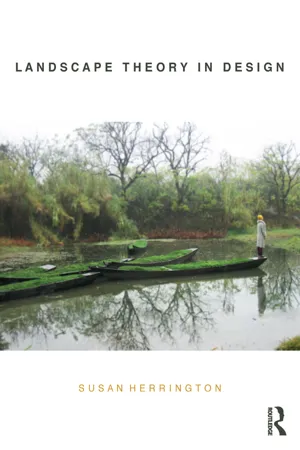
Phenomenology, Materiality, Cybernetics, Palimpsest, Cyborgs, Landscape Urbanism, Typology, Semiotics, Deconstruction - the minefield of theoretical ideas that students must navigate today can be utterly confusing, and how do these theories translate to the design studio?
Landscape Theory in Design introduces theoretical ideas to students without the use of jargon or an assumption of extensive knowledge in other fields, and in doing so, links these ideas to the processes of design. In five thematic chapters Susan Herrington explains: the theoretic groundings of the theory of philosophy, why it matters to design, an example of the theory in a work of landscape architecture from the twentieth and twenty-first centuries, debates surrounding the theory (particularly as they elaborate modern and postmodern thought) and primary readings that can be read as companions to her text. An extensive glossary of theoretical terms also adds a vital contribution to students' comprehension of theories relevant to the design of landscapes and gardens.
Covering the design of over 40 landscape architects, architects, and designers in 111 distinct projects from 20 different countries, Landscape Theory in Design is essential reading for any student of the landscape.
This chapter covers one of the most challenging aspects of design – the generation of forms. Where do forms come from? They can be drawn from the site, natural or cultural processes, the programme, and many other different sources. Historically, form generation in the design process was associated with the art-related aspects of landscape design. In fact one of the earliest textbooks for landscape architecture students, An Introduction to the Study of Landscape Design (1917) by Henry Vincent Hubbard and Theodora Kimball, argued that landscape architecture was aligned with the fine arts.1 In keeping with the École des Beaux-Arts traditions, if you were a landscape architecture student in 1917 you would probably be busy studying historic forms to be copied in your studio design projects. Yet, twentieth-century art was rapidly changing, as it was no longer securely tied to the task of mimesis – representing attributes found in the three-dimensional world. Cubism and other early twentieth-century art movements abstracted reality on the canvas, and in sculpture, photography, film, and theatre. A painting of a city, for example, didn’t need to look like a city one might encounter first hand. These changes in the formal qualities of art eventually influenced ideas about designed landscapes and the way they were conceived and theorized.
THEORETICAL GROUNDINGS OF FORMALISM
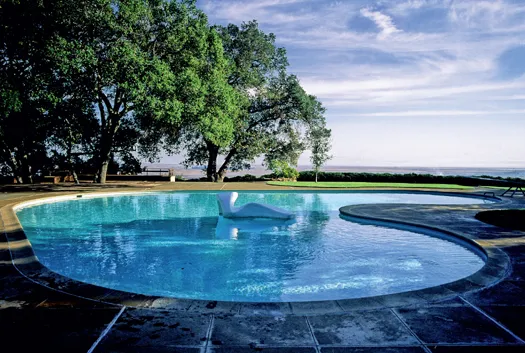
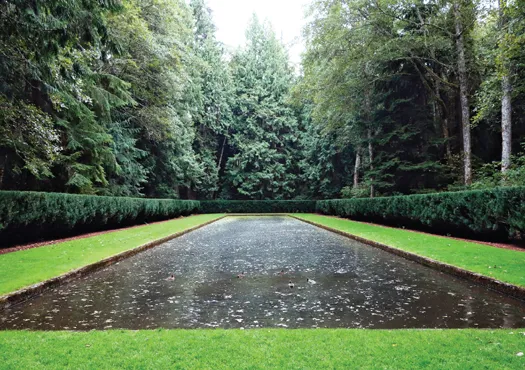
Compare the image of the Donnell pool with the reflection pool at the Bloedel Reserve.
One pool is for swimming and the other pool is for viewing, but how are their formal properties – in terms of their colour, line, and shape – different?
How do the colours and lines of the pools’ edges suggest stasis or movement?
By answering these questions you’ve just begun a formal analysis of two works of landscape architecture. Formalism in art and aesthetics addresses the formal qualities – the textures, forms, shapes, and lines – of a design or work of art. In general formalism prioritizes form and its qualities over form’s ability to represent something. A formalist analysis, for example, would not be concerned with the idea that the curving edges of the Donnell Garden pool mimic the edges of the salt marshes once in the distant background. Rather emphasis is placed on analysing the garden’s formal properties. The philosopher Nick Zangwill defines “formal properties as those aesthetic properties that are determined solely by sensory or physical properties – so long as the physical properties in question are not relations to other things and other times.”2 So, the salt marshes are not part of the formal properties of the Donnell Garden pool. In a formalist analysis, the focus is on the physical and sensory attributes of the design.
1.1 Donnell Garden pool (1948) by Thomas Church, image courtesy of Marc Treib, Sonoma, California, USA
1.2 The Bloedel Reserve reflection pool (1984) by Richard Haag, image courtesy of Marc Treib, Bainbridge Island, Washington State, USA
Formalism can be traced back to the work of the art critic Clive Bell (1881–1964) in his book Art (1913).3 While Bell never precisely defined formalism, his emphasis on the formal qualities of art, instead of what an artwork represented, became a dominant cultural attitude shaping the way art and design were discussed, conceived, and valued.4 Highlighting the far-reaching powers of Bell’s formalism, the philosopher Noël Carroll argues that even school children when reading a story “were taught not to let their attention wander away from the text: allow their concentration to become caught up in the story’s relation to real life, rather than to savour its formal organization and features (for example, its unity, complexity and intensity).”5
Indeed, the viewer’s recognition of form over other associations can be seen in the early writings of the landscape architect James Rose (1913–1991). In his 1938 article, “Freedom in the Garden” for Pencil Points magazine, Rose argued for a formalist conception of garden design, one that did not rely on the École des Beaux-Arts tradition of copying historical forms. Rose thought it was the garden’s basic forms and perception of the forms, and not what they represented, that counted. When form was perceptible “the thing acquires form and meaning. The arrangement may be pleasing or ugly, it may be loose or stiff, it may be symmetrical or unsymmetrical, but if the arrangement is perceptible, it possesses the quality of form, and to that extent is ‘formal.’”6
During the twentieth century formalism not only provided a method of evaluating art, but it also played an ontological role in defining what made something art. Art critics such as Clement Greenberg (1909–1994) proffered a version of formalism in order to champion abstract expressionist painting over painting that attempted to represent three-dimensional scenes or events, especially historic ones.7 Formalist approaches to landscape design also played an ontological role in defining a landscape as a modern one. This was particularly widespread after the Second World War, when the design professions sought a vocabulary that was “unfettered by religion, unconstrained by subject matter, free of national or linguistic boundaries.”8
It is this sense of the term formalism – as a language of basic forms – that reflects the formalist design theory of many mid-century landscape architects. These designers argued that the use of a basic design vocabulary was more egalitarian than École des Beaux-Arts designs. The landscape architect Garrett Eckbo (1910–2000) maintained “if our concept for design is held on a higher plane than our concept of people we introduce a contradiction in our work… how about the majority who experience our park designs? Do they require a course of training before they enjoy them?”9 Landscape designs referencing narratives and stories, for which historical interpretation was critical to their appreciation, were deemed elitist. In contrast, designs employing basic forms were considered egalitarian because they did not require an educational background or specialty in art history; one could simply sense them.
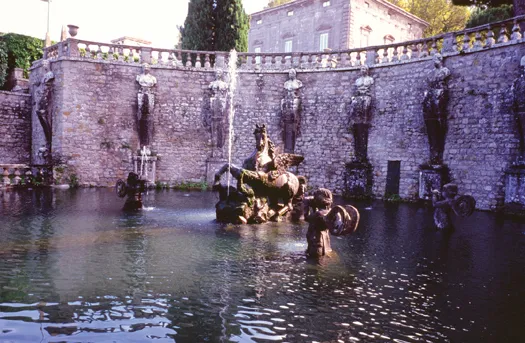
For a counterexample to formalism, look at the Fountain of Pegasus at the Villa Lante, Bagnaia, Italy. The fountain’s design includes at its centre a sculpture of a winged horse, Pegasus, with its front hooves in the air and its rear hooves perched on a rock-like base. Pegasus, a figure from ancient Greek mythology, produced a spring of water wherever he struck the ground with his hoof. The fountain’s design conveys this myth, a very appropriate one given the bountiful supply of water at the Villa Lante site.
Comparing this with the previous examples of the Donnell Garden pool or the Bloedel Reserve pool, how are they different?
If you were unaware of the myth of Pegasus would you be less likely to enjoy this fountain?
If you did know the myth would you have a deeper appreciation of the garden’s design?
1.3 Figure Fountain of Pegasus at the Villa Lante, image courtesy of Dominic McIver Lopes, Bagnaia, Italy
Why formalism matters
Formalism transformed what a landscape design could look like and opened up a range of forms that could be borrowed from other fields. However, a major critique of formalism charged that there could never be a universal language of forms because people’s reception of forms (in a landscape or in a painting) were culturally biased and determined by socio-economic status or other factors. Yet, formalism matters precisely because of these differences in reception.
Form, line, and colour can provoke extremely different reactions in people (including your studio critics and peers). In landscape architecture the employment of organic versus geometric forms are frequently points of passionate debate precisely because people do make associations with these forms. Some champion organic forms because they are commonly associated with natural processes. Some gravitate to geometrical forms because of their association with culture. Yet there are certainly geometries in nature (think of the precise distribution of petals in a flower or the crystalline shapes of a snow flake). Likewise, not all cultural processes need be geometrical (think of the wildly organic forms produced through digital fabrication).
Yet, it is this aspect of formalism – the attention to forma...
Table of contents
Cover
Half Title
Title Page
Copyright Page
Table of Contents
Introduction
1 Forming
2 Spatial practices
3 Material matters
4 Language
5 Systems logic
Glossary
Bibliography
Index
Trusted by 375,005 students
Access to over 1.5 million titles for a fair monthly price.
Study more efficiently using our study tools.
Frequently asked questions
Yes, you can cancel anytime from the Subscription tab in your account settings on the Perlego website. Your subscription will stay active until the end of your current billing period. Learn how to cancel your subscription
No, books cannot be downloaded as external files, such as PDFs, for use outside of Perlego. However, you can download books within the Perlego app for offline reading on mobile or tablet. Learn how to download books offline
Perlego offers two plans: Essential and Complete
Essential is ideal for learners and professionals who enjoy exploring a wide range of subjects. Access the Essential Library with 800,000+ trusted titles and best-sellers across business, personal growth, and the humanities. Includes unlimited reading time and Standard Read Aloud voice.
Complete: Perfect for advanced learners and researchers needing full, unrestricted access. Unlock 1.5M+ books across hundreds of subjects, including academic and specialized titles. The Complete Plan also includes advanced features like Premium Read Aloud and Research Assistant.
Both plans are available with monthly, semester, or annual billing cycles.
We are an online textbook subscription service, where you can get access to an entire online library for less than the price of a single book per month. With over 1.5 million books across 990+ topics, we’ve got you covered! Learn about our mission
Look out for the read-aloud symbol on your next book to see if you can listen to it. The read-aloud tool reads text aloud for you, highlighting the text as it is being read. You can pause it, speed it up and slow it down. Learn more about Read Aloud
Yes! You can use the Perlego app on both iOS and Android devices to read anytime, anywhere — even offline. Perfect for commutes or when you’re on the go. Please note we cannot support devices running on iOS 13 and Android 7 or earlier. Learn more about using the app
Yes, you can access Landscape Theory in Design by Susan Herrington in PDF and/or ePUB format, as well as other popular books in Architecture & Urban Planning & Landscaping. We have over 1.5 million books available in our catalogue for you to explore.