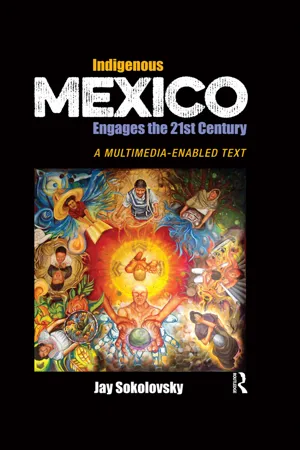
This innovative, interactive ethnography employs a range of media to explore the lives of the residents of a village set in the rugged mountains overlooking Mexico City, focusing on how these villagers react and adapt to a rapidly globalized world. Students can view the evolving life of San Jerónimo Amanalco and its region over the past four decades through print, web-embedded, and e-reader enabled resources. This book-offers a multimedia approach, including archival images and documents, original photographs, audio recordings, and extensive video;-incorporates ethnographic information gathered during the author's four decades of research in the region;-includes community members' responses to the author's research through social media, email, and video-taped comments.
Chapter One Never say “Chou-chou ley” to an Aztec!
Tepetloaxtoc, Mexico: First Field Encounters
This chapter introduces readers to the dilemmas of fieldwork and describes to the reader my early contact with the village and what one experiences today when visiting San Jerónimo Amanalco.
I was nervous enough about moving into Amanalco for my first stint of real anthropological fieldwork. I did not need Monolitón to tell me his definitive story about the ferocity of these mountain folk. Monolitón, age fifty-two, maintained a university field house in the rural Mexican town of Tepetlaoxtoc where I had been living during the fall of 1972. Using this house as a base, I ventured throughout the region learning about rural life in a variety of nearby communities. The night before I was to move into the indigenous village of San Jerónimo Amanalco, Monolitón came over to dissuade me from making the move, saying slowly but firmly, “But, Jay, my dear friend, I cannot let you do this.”
Puzzled, I said to him, “You seem very upset. Why are you saying this?”
I noticed Monolitón was drunk and swaying, and before he replied, his powerful peasant hands grabbed hard on my arms, as much to emphasize his seriousness as to steady himself. “I know you have been there a number of times, but you do not know them,” he said.
These Indios, they will seem polite, bending to kiss each other’s hand and saying “compadrito, compadrito,” but when your back is turned they will stick a knife in it and throw you in a ditch. Listen, a few years ago some forest workers came to look at Amanalco’s woods, and the people got nervous. The delegados [mayors] ordered some men to find these strangers, and with shotguns they killed them like dogs and dumped them into a barranca. This is the kind of people you are going to live with!
Knowing Monolitón, I was immediately dubious about this story. Like others in Tepetlaoxtoc, he frequently directed ethnic slurs toward any inhabitants of the four indigenous communities hugging the mountain wall a mere thirty-minute drive from his own mestizo village. In his community residents no longer spoke Nahuatl, the indigenous language then widely used in Amanalco. At a very deep level I was also afraid to find out whether Monolitón’s story was true and never inquired further about it until four months into my residence in Amanalco.
I wanted to think the best of the people I was about to live with, and for the most part Amanalco’s residents had so far been generous and kind to me. My initial contacts with the village produced some suspicious reactions and serious practical jokes to test my nerve. Yet I had regarded these events as something I might have done in their place. For example, the third time I came to the village to examine the soils used for different types of crops, a large extended family invited me to a festive lunch. Leaving the house with a group of men who were also at the meal, I asked what would be a special way, in the Nahuatl language, to thank the several ladies of the house who were standing at their doorway waving good-bye. One man, José Duran, paused just a moment and, with a very serious look, said, “Tell them chuchule.” I turned to the women, smiled, and shouted, “chuchule!” The ladies shrieked in unison and ran into the house. I turned to José, who was laughing so hard he had actually fallen on the ground in hysterics. He looked up at me as he stood and said, “No, no, you must say it faster like this: chuchule, chuchule.” Stunned and thinking it was just my poor pronunciation, I complied with a call toward the house. Again, unpleasant shouts rang out from the women inside, and José had once again fallen, doubled up in a hilarious state. It finally dawned on me that I had said something very stupid or worse. In my embarrassment and anger I stormed away as Jose’s seven-year-old nephew caught up to me and tugged at my sleeve. As I bent down he whispered intently in my ear, “Sir, why did you say ‘fuck off’ to the ladies?”
Over the course of that year this same boy, Juan Velazquez, and his family were to become the key to my survival in Amanalco. They taught me how to kick away attacking dogs, speak their village’s dialect of Nahuatl, show proper respect and generally become a person in the eyes of other villagers.
A month after my mortifying experience I ended up moving into their home, called Buena Vista, a few doors away from where I performed my linguistic disaster. Little did I suspect that over the course of the next forty years this family and I would nurture a relationship that went far beyond anthropology.
2010 Realities: From an Indigenous Peasant Village to a Globally Connected Town
Flash forward to the twenty-first century. I am making the eighth trip to Amanalco since my initial fieldwork. By now this research has spanned four decades, across which community residents have experienced—and I have witnessed—enormous cultural and economic transformations. In my prior visit in 2006 my wife, Maria, and I participated in the wedding of our goddaughter, Rosalba. Then, in November of 2009, our compadres called us in Florida to ask whether we could attend the marriage of Rosalba’s younger brother, Gordo, to take place the following month. Although we could not make this event, I promised to send some money to help with expenses and visit during the following summer. The family was pleased with the timing of our visit because it would be just before the birth of Gordo’s child. They hoped that my wife could participate in her role as comadre in a new ritual just catching on there, called “el baby shower.”
So it is now a warm, hazy, and dry morning in early June 2010, and before traveling to Amanalco I am spending my initial few days in chaotic, exciting Mexico City. I am thinking of the materials I want to gather for writing this book that could add to my decades of attempts to understand village culture and its transformation. One day was spent in a very productive visit to the magnificent National Museum of Anthropology discussing with a curator the newest exhibit and research on Nahuatl culture.
I also decided to travel somewhere I should have gone many years ago, to the beautiful village of Tepoztlán, a ninety-minute bus ride from the southern reaches of Mexico City, in the state of Morelos. The community has a mystical aura to it, teeming with colorful birds, surrounded by exotic semitropical vegetation and overlooked by a high mountain Aztec-era temple to Tepoztecatl, the god of pulque (an alcoholic beverage made from the sap of the agave cactus). It is here that anthropologist Robert Redfield, from 1926 to 1927, gathered data for his PhD work and used this to publish, in 1930, Tepotzlan: A Mexican Village—A Study in Folk Life. This book about a Nahuatl-speaking people became a touchstone for a multitude of other works in Latin America and elsewhere examining the impact of modern life and urbanization on a peasant community. Redfield’s book, written in accessible language, described the patterns of Aztec heritage such as their rituals of personal respect, the elaborate fiesta system, and women’s use of temazcals (sweat baths) for promoting health. Hidden within these idealized descriptions were the emerging ruptures in community life and the nascent rejection of indigenous culture.
Four decades earlier, in preparing for my own PhD research and in eventually writing up my results, I poured over Redfield’s book and a controversial restudy of that village in the early 1950s by Oscar Lewis (1960). Lewis’s study was much more sophisticated and found that the earlier work had oversimplified the complexity of peasant life and the dynamic relation to urban zones. In my own work I was to find this approach to analyzing peasant communities a key template for perceiving the dynamic reality people experienced in their daily life. In June of 2010 I experienced Tepoztlán as a highly regulated tourist town with boutique spa-hotels, Chinese and Indian restaurants, and jewelry-gift stores catering to international tourists.
Yet there is also an underlying feeling of a people well in control of what cultural traditions remain, especially in terms of religious rituals and, as JoAnn Martin illustrated in a recent book, the ability of the community to resist usurpation of their lands (2005). As I found in my work in Amanalco, the ability to aggressively and quickly respond to perceived threats to environmental resources has been an effective protective mechanism of community rights in a political system severely tilted toward vested elites.
The next day, back in Mexico City, the annual rainy season had not yet started in earnest, and air pollution was giving me daily, pounding headaches. This was my cue to take off for Amanalco with a Mexican graduate student assistant, Manuel Moreno, and pick up a rental car at the airport. We use the highway shortcut, the Via Corta, which passes across the dry hardpan bed of a once grand lake system and, within thirty minutes, reached the outskirts of the city of Texcoco (see figures 1.a and 1.1b below).1 This is the capital of the municipal district that bears the same name, and Amanalco is one of twenty-seven pueblos (rural villages) in the far eastern edge of the area politically led by Texcoco. In 1972 Texcoco was a sleepy regional capital of twenty-five thousand, but by 2010 its population had swelled to about two hundred thousand. It is here that inhabitants of Amanalco must come to register titles to land, obtain a civil marriage license, pay their electric bills, or complain about an injustice that their own authorities cannot handle. This urban center, with its banks, appliance stores, movie theaters, medical clinics, technical colleges, Volkswagen and Nissan car dealerships, Domino’s Pizza delivery, Home Depot, and one of Mexico’s newest Walmart superstores, serves as a juncture for the diffusion of Mexican national culture and increasingly international ideas and consumer goods.
Figures 1.1a and 1.1bThe map on the left sets the Municipio of Texcoco in the State of Mexico and the one on the right locates the community of San Jerónimo Amanalco in the eastern mountains of the municipal unit of Texcoco. A link here shows key communities mentioned in Chapter 1.
You can then “google map” the community of San Jerónimo Amanalco,
and at this map, even take a “street view” stroll through the residential areas of Amanalco.
The Acolhua people settled this ancient urban zone in the twelfth century and, along with the Tepanecs and the militarily dominant Mexica, eventually formed a powerful “Triple Alliance” of extraordinary imperial power of what Europeans eventually called the Aztec Empire. Texcoco came to be known as its seat of intellectual life, especially under the long reign of the fifteenth-century poet-king Nezahualcóyotl. Amanalco’s early history was most influenced by its connection in the pre-Hispanic period to what anthropologists call the Northern Acolhuacan domain. This was a state centered in urban Texcoco that ruled several dozen communities and extended over three major environmental zones, bounded by Lake Texcoco in the west and the Sierra Nevada mountain chain in the east. Today a massive modern statue of Nezahualcóyotl, with pointing arm, beckons drivers eastward onto the Mexico-Puebla highway. Drivers pass junk yards, dairy farms, the huge Rockefeller International Agricultural research center, tire repair businesses, simple restaurants, and the occasional soccer field, all of which edge this busy roadway.
Lying at seventy-two hundred feet above sea level, this is the flat eastern portion of the valley of Mexico, a region crucial to the history of Mexico and all of the Americas. Due north is the town of Tepexpan, where in 1948 there was found a late Pleistocene (about 9000 BC) female human skull and the oldest human skeleton then yet known from North America. Despite such early habitation, it is today a very sleepy town known only for one of the country’s few Chronic Care Hospitals. Just further north are found the famous pyramids of Teotihuacan.
From the third until the late eighth century AD the New World’s first megalopolis developed at this site, eventually spreading out over eight square miles and housing a quarter of a million urbanites.
Of more contemporary vintage, the town of San Salvador Atenco on the northern edge of Lake Texcoco gained more recent global notoriety when, in 2000, a group of armed farmers firmly rejected the federal government’s offer for land payment...
Table of contents
Cover
Half Title
Dedication
Title
Copyright
Contents
List of Illustrations
Using this Multimedia-enabled Book
Preface
Acknowledgments
Chapter One Never say “Chou-chou ley” to an Aztec
Chapter Two Orientation to This Book
Chapter Three Historical and Cultural Context of Community Transformation
Chapter Four “Hey, Mister, Are You an Anthropologist?” And Other Mysteries of Fieldwork, Culture, and History
Chapter Five “Never More Campesinos”: Life Course in Twenty-First-Century Perspective
Chapter Six Who Are You Calling Indio?: Ethnoscapes and the False Faces of Tradition and Modernity
Chapter Seven Why Rosalba Fainted at Her Wedding and Other Tales of Family, Work, and Globalization
Chapter Eight Ritual Drama, Religion, and the Spaces in Between
Chapter Nine Magical Cosmology: Myth, Witches, Vampires, and Water Dwarfs
Chapter Ten Conclusions: The Varied Meanings of “Never More Campesinos” With the assistance of Manuel Moreno
Notes
References
Index
About the Author
Trusted by 375,005 students
Access to over 1.5 million titles for a fair monthly price.
Study more efficiently using our study tools.
Frequently asked questions
Yes, you can cancel anytime from the Subscription tab in your account settings on the Perlego website. Your subscription will stay active until the end of your current billing period. Learn how to cancel your subscription
No, books cannot be downloaded as external files, such as PDFs, for use outside of Perlego. However, you can download books within the Perlego app for offline reading on mobile or tablet. Learn how to download books offline
Perlego offers two plans: Essential and Complete
Essential is ideal for learners and professionals who enjoy exploring a wide range of subjects. Access the Essential Library with 800,000+ trusted titles and best-sellers across business, personal growth, and the humanities. Includes unlimited reading time and Standard Read Aloud voice.
Complete: Perfect for advanced learners and researchers needing full, unrestricted access. Unlock 1.5M+ books across hundreds of subjects, including academic and specialized titles. The Complete Plan also includes advanced features like Premium Read Aloud and Research Assistant.
Both plans are available with monthly, semester, or annual billing cycles.
We are an online textbook subscription service, where you can get access to an entire online library for less than the price of a single book per month. With over 1.5 million books across 990+ topics, we’ve got you covered! Learn about our mission
Look out for the read-aloud symbol on your next book to see if you can listen to it. The read-aloud tool reads text aloud for you, highlighting the text as it is being read. You can pause it, speed it up and slow it down. Learn more about Read Aloud
Yes! You can use the Perlego app on both iOS and Android devices to read anytime, anywhere — even offline. Perfect for commutes or when you’re on the go. Please note we cannot support devices running on iOS 13 and Android 7 or earlier. Learn more about using the app
Yes, you can access Indigenous Mexico Engages the 21st Century by Jay Sokolovsky in PDF and/or ePUB format, as well as other popular books in Social Sciences & Anthropology. We have over 1.5 million books available in our catalogue for you to explore.