eBook - ePub
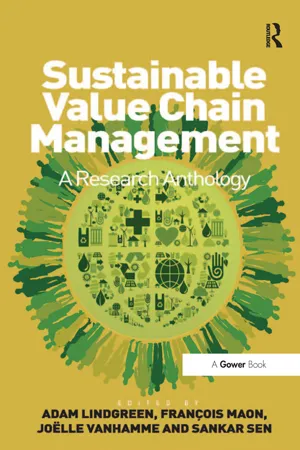
Sustainable Value Chain Management
A Research Anthology
- 580 pages
- English
- ePUB (mobile friendly)
- Available on iOS & Android
eBook - ePub
About this book
The way organizations manage their value chain has changed dramatically over the past decade. Today, organizations take account of economic issues, but they also adopt a broader perspective of their purpose including social and environmental issues. Yet despite its global spread, sustainable value chain management remains an uncertain and poorly defined ambition, with few absolutes. The social and environmental issues that organizations should address easily can be interpreted as including virtually everything. Current literature on the topic seeks to understand the effects and management of initiatives dealing with diversity, human rights, safety, philanthropy, community, and environment. However, the penetration of social and environmental considerations into value chain management is described as 'desire lacking reality' thereby making the idea a patchy success. The objective of this research anthology is to investigate different angles of sustainable value chain management. The book's 27 chapters fill holes and explore new fields; the chapters are organised in five sections: Sustainable value chains - context, drivers, and barriers; Sustainable value chains - managing activities; Sustainable value chains - managing networks and collaboration; Sustainable value chains - integrative perspectives; and Sustainable value chains - specific sectorial and industry perspectives.
Sustainable Value Chains: Context, Drivers, and Barriers
CHAPTER 1
Environmental Sustainability in the Supply Chain: A Review of Past Literature and Discussion of Potential Drivers and Barriers*
Keywords
Sustainability, environment, corporate social responsibility, green, purchasing/supply management, supply chain management.
Introduction
Previous literature on sustainability was found not only to be lacking, but is also void of standards, academically or conceptually.1 Much of the prior work, albeit limited, conducted in sustainability focuses on issues outside of the scope of supply management, and neglects the views of executives and managers whose explicit focus is on purchasing/supply management (P/SM). We extend Berns et al.’s (2009) work by conducting a thorough review of past sustainability literature. A review of the research uncovered significant discrepancies in the definitions of sustainability, and a significant lack of understanding of the drivers and barriers in P/SM sustainability efforts.
This chapter also extends previous research by developing a framework of potential drivers and barriers of sustainability in the supply management function, and specifically from the vantage point of multiple P/SM executives. The results seek to help eliminate confusion among researchers and practitioners with regards to the most pressing issues of concern in supply chain sustainability. This is done to help lay the groundwork for future research to be conducted in this area.
Literature Review
INCREASING STRATEGIC VALUE OF SUSTAINABILITY
Over the past few years, global organizations have recognized sustainability as an increasingly important strategic goal.2 Linton et al. (2007) propose that sustainability as an integrative concept is following the same trajectory as global warming by both the public and private sectors. The significance of this concept is shown by the global interest in sustainability as evidenced by the European Union (EU), which is a highly influential proponent of sustainability (Table 1.1).3 Additionally, if the EU’s earlier influence in the area of quality management and the global adoption of ISO 9001 certification is any indication, the EU’s emphasis on sustainability is likely to be a strong harbinger of actions by others. The UK organizations Business in the Environment and the Chartered Institute of Purchasing and Supply developed guidelines for addressing environmental issues in the supply chain early in the 21st century.4
Table 1.1 European Union sustainability milestone timeline

CHANGING THEMES WITH REGARD TO SUSTAINABILITY
Over the years, businesses have come under increasing pressure to pay attention to the environmental and resource consequences of their products and processes.5 Others researchers state that two common explanations of the emergence and study of “greening organizations” are: 1) that this development was the evolving outcome of the environmental and social movements that received considerable attention in the 1960s and 1970s; and 2) that the perception that organizational entities have or could have significant impacts on their respective ecosystems became widely held, providing various motivations for organizational change.6 One aspect of these overall themes is green supply chain management issues, and how organizations can maximize the potential of their suppliers to adopt green supply chain management practices.7
Several key themes exist in the sustainability literature. Environmental compliance was considered a “fringe” issue in the 1960s and 1970s and elicited little discussion at executive levels.8 In the late 1960s, with environmental protection gaining prominence on the political arena, producers of commodities focused on the externalities connected to their products by national and local governments with regulative approaches.9
The period from 1970 to 1985 saw the beginning of the integration of environmental concerns and business and marketing strategies. The beginning of a strategic and coherent approach to handling environmental concerns can be traced to this stage.10 During the 1980s, research was conducted on the various aspects of organizational greening.11 Several leading-edge firms started to change their corporate positions from ignoring or even resisting environmental pressures to trying to embrace, incorporate, and even profit from them.12 In the late 1980s, evidence indicates that businesses began internalizing the concept of sustainability into their own value sets.13
Beginning in the 1990s, the sustainability focus shifted to “green marketing” to gain or maintain a competitive advantage.14 One popular approach used in the 1990s was the argument that environmental sustainability could contribute to economic profitability as well as to competitiveness.15 In the 21st century, overall sustainability issues moved into the supply chain. researchers began to probe into consideration of product life cycle during material selection, the impact of green purchasing on a firm’s supplier selection, into waste management, packaging, and regulatory compliance.16 Table 1.2 highlights the coverage of sustainability research, and its various themes, throughout the years.
Table 1.2 Coverage of sustainability research

LACK OF GLOBAL AGREEMENT
Although global organizations have recognized sustainability as an increasingly important strategic goal, there are many definitions, focuses, and business activities associated with sustainability. Berns et al.’s (2009) research found that there is not a single established definition for sustainability. Linton et al. (2007) define sustainability as “using resources to meet the needs of the present without compromising the ability of future generations to meet their own needs.” This is the definition put forth previously by the World Commission on Environment and Development.17 Others suggest that a sustainable company is one that creates profit for its shareholders while protecting the environment and improving the lives of those with whom it interacts.18
Sustainability in the supply chain has taken a number of different labels in the literature, including socially responsible purchasing, green supply chain, or closed loop supply chain.19 The Institute of Supply Management describes socially responsible purchasing as “a framework of measurable corporate policies and procedures and resulting behavior designed to benefit the workplace and, by extension, the individual, the organization, and the community.”20 Green or closed loop supply chains incorporate similar aspects of social responsibility, by recycling and reusing as much as possible throughout the production and supply process, with a goal of minimizing waste. Other concepts used in the literature, such as corporate social responsibility (CSR), have similar definitions. A classic definition of CSR is “the firm’s consideration of, and response to, issues beyond the narrow economic, technical, and legal requirements of the firm.”21 Others maintain that the responsibilities of a business go beyond a base level of economic responsibility, to include legal, ethical, and discretionary responsibilities.22 Matten and Moon (2008) state that corporations have recently begun to adopt the language and practice of CSR, particularly in Europe, but also in Africa, Australia, South America, and Southeast Asia.23
An example that highlights this lack of consensus on the definition of sustainability is a discussion that took place in a workshop on business sustainability at an international business research conference in 2011. One of the topics included in this workshop was the issue of sustainability of diversity programs in corporate settings. More specifically, efforts to build a culture of inclusion that was not dependent on separate initiatives were discussed, showing that as recently as 2001, a drive toward consensus on sustainability is still being discussed. Despite these confusions in defining sustainability, Berns et al. (2009) found that businesses were unified in their view that sustainability will be a major force that will need to be dealt with. Further, they felt it that it will have a determining impact on the way their businesses think, act, manage, and compete. Therefore, sustainability may ultimately follow a path similar to other global standards being adopted, such as ISO 9001.
Research Approach
This research focused on an initial discovery of potential drivers and barriers that P/SM managers encounter in implementing sustainability. This is combined with a proper review of the literature on sustainability. The overview of such potential drivers and barriers provides an important base from which future research can be conducted. While past research has looked at various “triggers” and “barriers” of sustainability, much of this was performed before the global economic woes of 2007–2009.24
Purchasing and supply chain experts from three different organizations who were knowledgeable about sustainability were asked to submit their sustainability issues via interviews. At these face-to-face meetings, the experts were asked to describe each issue in detail. This helped to mitigate potential misinterpretation by the researchers if respondents provided the same issue, but used different terms.25
Discussion of Potential Drivers and Barriers
The sections which follow discuss the potential drivers and barriers brought forward by our industry experts during interviews. A review of pertinent literature on each potential driver or barrier is also provided. The identification of these potential drivers and barriers are important for building a foundation for future research on business-to-business (B2B) sustainability.
POTENTIAL DRIVERS
One of the objectives of this research was to discuss early steps taken to identify the drivers of P/SM sustainability efforts. The following is a review of the literature that addresses these drivers. Previous research identified motives for corporate “greening” such as regulatory compliance, competitive advantage, stakeholder pressures, ethical concerns, events, and top management initiative.26
Sroufe (2003) identifies growing environmental regulations, government pressures, international certification standards such as the International Organization of Standardization’s ISO 14000 series, changing customer demands, and managers recognizing pollution as waste as reasons why firms must now develop environmental policies for their manufacturing plants and supply chain partners while being consistent with new regulations.27
Pederson (2006) groups the drivers of green technology into five groups, all of which play a major role in stimulating companies’ interests in going green.28 The leading drivers are environmental regulations, consumer sentiment, environmental non-governmental organizations, global warming concerns, and economics.
Top management involvement
Members of the top management team are instru...
Table of contents
- Cover
- Half Title
- Dedication
- Title Page
- Copyright Page
- Table of Contents
- Reviews for Sustainable Value Chain Management
- List of Figures
- List of Tables
- Foreword and Acknowledgment
- About the Editors
- About the Contributors
- PART I SUSTAINABLE VALUE CHAINS: CONTEXT, DRIVERS, AND BARRIERS
- PART II SUSTAINABLE VALUE CHAINS: MANAGING ACTIVITIES
- PART III SUSTAINABLE VALUE CHAINS: MANAGING NETWORKS AND COLLABORATION
- PART IV SUSTAINABLE VALUE CHAINS: INTEGRATIVE PERSPECTIVES
- PART V SUSTAINABLE VALUE CHAINS: SPECIFIC SECTORIAL AND INDUSTRY PERSPECTIVES
- Index
Trusted by 375,005 students
Access to over 1.5 million titles for a fair monthly price.
Study more efficiently using our study tools.
Frequently asked questions
Yes, you can cancel anytime from the Subscription tab in your account settings on the Perlego website. Your subscription will stay active until the end of your current billing period. Learn how to cancel your subscription
No, books cannot be downloaded as external files, such as PDFs, for use outside of Perlego. However, you can download books within the Perlego app for offline reading on mobile or tablet. Learn how to download books offline
We are an online textbook subscription service, where you can get access to an entire online library for less than the price of a single book per month. With over 1.5 million books across 990+ topics, we’ve got you covered! Learn about our mission
Look out for the read-aloud symbol on your next book to see if you can listen to it. The read-aloud tool reads text aloud for you, highlighting the text as it is being read. You can pause it, speed it up and slow it down. Learn more about Read Aloud
Yes! You can use the Perlego app on both iOS and Android devices to read anytime, anywhere — even offline. Perfect for commutes or when you’re on the go.
Please note we cannot support devices running on iOS 13 and Android 7 or earlier. Learn more about using the app
Please note we cannot support devices running on iOS 13 and Android 7 or earlier. Learn more about using the app
Yes, you can access Sustainable Value Chain Management by François Maon,Sankar Sen, Adam Lindgreen in PDF and/or ePUB format, as well as other popular books in Business & Business Ethics. We have over 1.5 million books available in our catalogue for you to explore.