- 253 pages
- English
- ePUB (mobile friendly)
- Available on iOS & Android
eBook - ePub
About this book
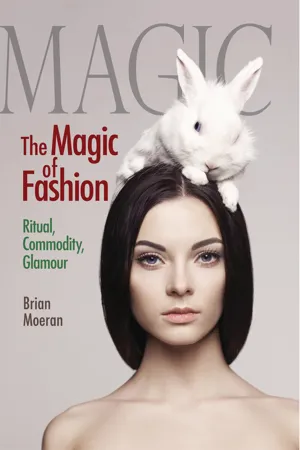
Drawing on 20 years of ethnographic fieldwork and anthropological theory, anthropologist Brian Moeran argues that fashion magazines are able to cast a spell over their readers by using practices and rituals found in age-old magical and religious rites.
Information
Chapter 1
First Look
Sprezzatura
It’s Fashion Week in New York: this year (2014) it falls in the first few days of September. The weather is almost summery, which is appropriate given that the collections being shown all over town are for the spring and summer season next year. In the plaza outside Lincoln Center, where an enormous marquee has been set up to host the collections sponsored by Mercedes Benz, women come and go. They talk not of Michaelangelo so much as of Luis Antonio, or any other of more than a dozen designers from around the world whose shows are being held during these hectic days: Vivienne Tam, Carolina Herrera, Tadashi Shoji, Naeem Khan, Son Jung Wan, Anya Caliendo, and Zang Toi. The city’s fashion stage is illuminated in more ways than one by other, local names: Ralph Lauren, Vera Wang, Michael Kors, J. Crew, BCBG Max Azria, and the eponymous Donna Karan’s DKNY, whose fragrance Be Delicious is sold in bottles presumably shaped like the Big Apple itself.
The Lincoln Center Plaza, with its fountain playing in the middle, is very much a stage. Those who alight from yellow taxicabs on 8th Avenue are extremely aware of their entrance and often take a few seconds to compose themselves as they prepare to walk up the steps and across the plaza before a motley, multiethnic audience, many of whom are also dressed to thrill: photographers, (would-be) models, fashion aficionados, bloggers, television interviewers and crews, media spotlight seekers, curious bystanders, occasional transvestites, and one elderly anthropologist (whose age makes at least one woman think he is the famous street fashion photographer Bill Cunningham), As these often-statuesque women walk across the plaza on — equally often — impossibly high heels, they are accosted and surrounded by photographers who want to take their pictures and place them, hopefully, in a fashion magazine.
How they go about this is intriguing. Some photographers start taking pictures of what they see as an interesting outfit, and this then attracts other photographers to do the same. At other times, one photographer will run up to a woman he's spotted, shouting her name as he crosses the plaza, and telling her how much he loves her (she must be famous). In his wake — and it is usually, though by no means necessarily, a male photographer who behaves in this manner—comes a trail of slightly bewildered other photographers who are clearly not as well plugged in to the fashion world, but who don't want somehow to be "left out" of what is going on. "Who is she?" I ask one Japanese photographer, as a dozen of us stand around taking pictures furiously of a slender young woman with long blonde hair dressed casually in a bellybutton-revealing black tank top, black skirt with hem netting, black trainers, and black bag slung over one shoulder. "A famous model," he replies, a little scathingly. 'Yes, but who?" I ask. "I don't know," he admits, before turning away to run after another woman (or another photographer) and calling over his shoulder. "Just a model."

Figure 1.1 Just a model? (Photo by Brian Moeran).
These women—for the most part, young, beautiful, and elegant, with freshly shampooed hair, carefully made-up faces, manicured fingers, and painted nails—gracefully accede to requests to pose this way and that, in the process sometimes cutting off a hitherto-animated conversation on their mobile phone (that “must have” fashion accessory) and leaving an interlocutor out there in cyberspace (or is it the real world?) feeling slightly lost, forlorn, and doubtless a little miffed. That said, these women rarely speak, so that the plaza—for all its size and number of people present—becomes strangely silent, apart from the sound of camera shutters, the occasional photographer’ directive, and the water splashing in the fountain.

Figure 1.2 Sprezzatura in the Lincoln Center Plaza (Briy Gilgeouy by Brian Moeran).
Almost all of the women know how to adopt a catwalk-like sprezzatura— that illusion of graceful nonchalance associated with effortless glamour (Postrel 2013, 79)—with one foot placed casually in front of the other, body turned slightly to the side, handbag (as well as sunglasses and mobile phone) clearly visible, to create the perfect fashion photograph. The camera click time and time again. The women turn slightly towards each lens, very aware of each of those who are photographing them. Many of them know how to adopt more than a single pose, and so keep photographers’ attention as they look this way or that, smile or are serious, and occasionally stretch out a shapely leg to reveal a silver pump or golden mule. Set free by the arrival on the plaza stage of another face, another body in other fashionable clothes, or else by some other distraction (photographers have a very short attention span), they turn — in some cases, a little disappointedly—to continue their stately procession to the marquee. There, black-suited officials scrutinize their invitations before letting them into the darkness — and sartorial excitement— beyond.
This staging of nonchalance and fashionable looks is no simple performance. It takes time, both in the preparation required—makeup, and matching of colours and accoutrements in the clothes—and in the actual procession from plaza entrance to marquee exit. Most of those concerned do their utmost to look unconcerned (that "I don't give a f***" kind of look), and express a somewhat laboured look of resignation that anyone should be interested in them and their clothes. Like fashion models, their features are almost expressionless and insolent, with that "who-the-hell-are-you-staring-at?" stare ahead (Inglis 2010, 245). Yet they are all checking one another out: they know exactly which designer made what, for which season, and how much it cost. In other words, they are all performing for one another (Kondo 1997, 103). So, if one of them feels she is being ignored for some reason, a cloud of concern envelops her. She pauses hesitatingly to look around, as if in search of a friend, before staring intently into the depths of her mobile phone screen, seemingly engaged in sudden matters of great import (and the look changes to "Why don't you give a f*** that I don't give a f* **?"). Like everyone else, she needs to give off the appearance of being on stage by accident, rather than by design.
One young woman in her early twenties appears totally immersed in the theatre taking place in front of her and clearly is enjoying the various comings and goings, the flurries of iconic activity. Leaning against one wall of the plaza—in the shadow of a colonnade that acts as a runway for each collection’s audience members who, once a show is over, head away from the marquee towards 8th Avenue and the city—she is casually dressed in pleated blue trousers and white tank top with design of a small girl on tiptoe about to fly away with a handful of balloons. Her naturalness and beauty, as well as her height (she is 6 foot 2 inches tall), catch my eye and, eventually, I ease my way under the colonnade and ask her how come she is the only tall woman in the plaza who looks real and human. Her reply is short, snappy, and playful: “Because I had breakfast this morning.”
We start talking and I learn that Clare Doyle is an American who lives in Madrid, where she teaches in elementary school, and is visiting New York. She just happened to be staying nearby, saw the crowds, and decided to do a bit of “people-watching” with a friend. And now she is mesmerized—by the women, and by everyone else making up this fashion scene—as she finds herself drawn into what is nothing less than a world of enchantment. At one point, Clare begins to imitate the poses she has witnessed that afternoon, and I snap a photo of her on my iPad. I still chuckle whenever I look at it. Her staged pose is so real. Now, that is magic.

Figure 1.3 Tall, snappy, and playful (Clare Doyle by Brian Moeran).
Glitterati Mode
So what’s it all about, this public posing on an impromptu stage set up for a week in the middle of a bustling city? Fashion involves the twin pleasures of seeing and being seen, of posing and proposing an image or style, of exhibiting oneself before the gaze of others. As Gilles Lipovetsky has commented, fashion “makes narcissism a constitutive and permanent structure of fashionable individuals, by encouraging them to pay more attention to the way they present and represent themselves, by inciting them to seek elegance, grace, and originality” (1994, 29). It is an enchantment of appearances.
If being fashionable attracts attention, the corollary is also true: to attract attention is to be in some sense fashionable. The two go hand in hand, rather like celebrity and prestige: certain people are celebrated because they occupy positions of prestige, and occupy positions of prestige precisely because they are celebrated (Mills 1956, 74). This is why the Lincoln Center Plaza was filled with so many people in such eye-catching clothes. All of them hoped— some obviously, others more covertly—to be noticed, and so to become - “fashionable.” By being fashionable they, too, could enter the glitterati world of fame and become “prestigious.” This was as true of wannabe and famous (but still anonymous) models as of a host of wide-eyed fashion bloggers revelling in the heady stratosphere of the “real” thing.
Whether any of them will succeed in their endeavours is, of course, a moot point. A few may make it, but many more, I suspect, will not. They know, deep down in their hearts—beneath their Intimissimi balconette bras or La Perla push-up bustiers—that a lot depends on luck. But that’s the nature of fame and fortune: being noticed by the right person in the right place at the right time, and having one’s image reproduced in a fashion magazine. Being a “celebrity” is the focus of all forms of media and cultural production and, these days, of the advertising and marketing of all kinds of commodities as “brands.” All they can do in the meantime is to make sure they’re in the right place at the right time and hope that magic happens.
The driving point I make in this book is that fame and fashion are underpinned by all kinds of magical practices. From Jenny Lewis's magical rainbow suit to "There is nothing quite as iconic as a classic Chanel tweed piece. . . . Its texture, its weight, and its very aura are the things magic is made of," fashion magazines and bloggers tell us about the magical nature of fashion and those who produce it. We read headlines like "Fashion Magic," "Magisch Anziehend," "Midsummer Magic," and "Magic in the Moonlight." We see ads for all kinds of magical underwear (from "magic pants" to "magic wire" and "magical top" bras, by way of "magical tummy" corsets). We come across Blogspots like couturamagic, and websites like MAGIConline and The Magic of Macy's at macys.com. The language of fashion is full of references to the realm of magic: "alchemy," "allure," "aura," "bewitchment," "captivation," "charm," "enchantment," "illusion," "sorcery," and "spells."
Glamour is the essential ingredient of fashion and celebrity, both of which are based on an “enchanted fabrication of images of seduction” (Lipovetsky 1994, 182). Glamour is visual deception: an old Scottish word, gramyre, meaning “magic, enchantment, or spell.” It came into English in the early 1800s to mean “delusive or alluring charm.” Since then it’s come to refer to “an enticing image, a staged and constructed version of reality that invites consumption” (Gundle and Castelli 2006, 3–4, 8). Just how glamour works, though, is never quite certain, and those who would be glamorous these days recognize the inherent magical qualities that accompany the fame constructed about them. As one American singer, actress, and model once put it:

Figure 1.4 Discovering the magic of cleavage (Magic Wire illuminated billboard; photo by Brian Moeran).
It’s kind of degrading to think that you’re just famous for singing, or just famous for acting, or just famous for dancing, or just famous for being funny. I want to be famous for the magic I possess. I’ve never happened before. (Angelyne, quoted in Gamson 1994)
Fashion magazines, and the fashion world they depict in their glossy pages, are all about glamour. From “Love on the Adriatic” to “Frock Stars,” they make use of those who are already stars to comment on fashion items: “Madonna’ name-check T-shirt,” “Sarah Jessica Parker’s corsage—sometimes a star’s look is so right it changes the way we dress.” They also turn fashion designers into celebrities by showing their readers who’s wearing what, made by whom, for what occasion, where, and with whom (who is also wearing what, made by whom, et cetera). This process of osmosis is carried over into the rest of the fashion world, where photographers, models, makeup artists, hairstylists, and other “gurus” are all thrust into the celebrity spotlight. The photographs, the gossip, the clothes, the accessories, the makeup, the hair, and the perfumes combine in glitterati mode (see Morin 1972, 79, 138–139). This is sympathetic and contagious magic at its most effective.
Fashion's Siamese Twins
Fashion magazines, like fashion itself, juxtapose two sociological themes in what, for some people, is an uncomfortable alliance: culture and economy. This is because they are both cultural products and commodities. They’re cultural products because they run features and fashion stories; because they tell us about family values, social issues, horoscopes, sex, how to get rid of cellulite, where to go for our holidays, and the best way to cook a quick, tasty meal without too much hassle when we get home at night; and because, as we’ve already seen, they celebrate by means of the latest gossip those working and hanging out in the fashion, media, and entertainment worlds. Fashion magazines make the latest fashions known to us. They spread the word about what’s “in” and what’s “out” when it comes to clothes, and they advise us on the “best” combinations in which to wear those clothes, plus the makeup and hairstyles that might suit us best during the coming “season” (which means that they also culturally prescribe time). In this sense, they provide us with lifestyle recipes as well as models for how, as readers, we might live our lives. They’re part of all those meanings that go to make up “culture.”
But magazines are also commodities in two different ways. First, they are products of the publishing and print industries and important sites for the advertising and sale of goods (especially those related to fashion, cosmetics, fragrances, and hair and personal care). Like women’s magazines in general, fashion magazines are deeply involved in capitalist production and consumption at national, regional, and g...
Table of contents
- Cover
- Half Title
- Title
- Copyright
- Contents
- Dedication
- List of Illustrations
- Acknowledgements
- On the Cover
- CHAPTER 1 FIRST LOOK
- CHAPTER 2 POINTS OF VIEW
- CHAPTER 3 A WORD FROM YOUR EDITOR
- CHAPTER 4 THEORETICAL BLING
- CHAPTER 5 PEOPLE ARE TALKING ABOUT
- CHAPTER 6 IN EVERY ISSUE
- CHAPTER 7 MAGICAL SYSTEM
- CHAPTER 8 SHAMANS & SPELLS
- CHAPTER 9 BEAUTY MANTRAS
- CHAPTER 10 MANE CHARMS
- CHAPTER 11 SMELLBOUND ALCHEMY
- Last Word
- Notes
- Reference
- Name Index
- Subject Index
- About the Author
Trusted by 375,005 students
Access to over 1.5 million titles for a fair monthly price.
Study more efficiently using our study tools.
Frequently asked questions
Yes, you can cancel anytime from the Subscription tab in your account settings on the Perlego website. Your subscription will stay active until the end of your current billing period. Learn how to cancel your subscription
No, books cannot be downloaded as external files, such as PDFs, for use outside of Perlego. However, you can download books within the Perlego app for offline reading on mobile or tablet. Learn how to download books offline
Perlego offers two plans: Essential and Complete
- Essential is ideal for learners and professionals who enjoy exploring a wide range of subjects. Access the Essential Library with 800,000+ trusted titles and best-sellers across business, personal growth, and the humanities. Includes unlimited reading time and Standard Read Aloud voice.
- Complete: Perfect for advanced learners and researchers needing full, unrestricted access. Unlock 1.5M+ books across hundreds of subjects, including academic and specialized titles. The Complete Plan also includes advanced features like Premium Read Aloud and Research Assistant.
We are an online textbook subscription service, where you can get access to an entire online library for less than the price of a single book per month. With over 1.5 million books across 990+ topics, we’ve got you covered! Learn about our mission
Look out for the read-aloud symbol on your next book to see if you can listen to it. The read-aloud tool reads text aloud for you, highlighting the text as it is being read. You can pause it, speed it up and slow it down. Learn more about Read Aloud
Yes! You can use the Perlego app on both iOS and Android devices to read anytime, anywhere — even offline. Perfect for commutes or when you’re on the go.
Please note we cannot support devices running on iOS 13 and Android 7 or earlier. Learn more about using the app
Please note we cannot support devices running on iOS 13 and Android 7 or earlier. Learn more about using the app
Yes, you can access The Magic of Fashion by Brian Moeran in PDF and/or ePUB format, as well as other popular books in Social Sciences & Fashion Design. We have over 1.5 million books available in our catalogue for you to explore.