- 248 pages
- English
- ePUB (mobile friendly)
- Available on iOS & Android
eBook - ePub
About this book
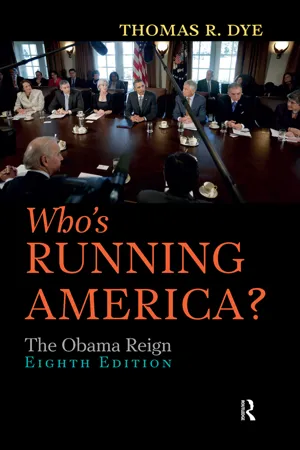
A classic of American government, Who's Running America? continues to demonstrate how power is concentrated in large institutions no matter who inhabits the White House. The eighth edition of this best-selling text focuses on the Obama administration and the ways in which it is different from but also similar to administrations that have come before. Based on years of exhaustive data compilation and analysis, Who's Running America? explores the influence and impact of governmental leaders, corporate officials, and other elites both inside and outside the United States. Employing an oligarchic model of national policymaking, Tom Dye doesn't just lay out theory and data. He very consciously "names names" in describing the people who inhabit the White House, the Cabinet, the leaders of Congress, members of the Supreme Court, as well as the board rooms of the nation's largest corporations and banks including leading media lights as well as "fat cat" political contributors. Dye argues that big institutions run America, but also that these institutions are made up of real people. Who's Running America? puts the flesh and bones on the statistics and delivers the inside scoop on the Obama reign.
Information
CHAPTER 1
ELITISM IN A DEMOCRACY
Great power in America is concentrated in a handful of people. A few thousand individuals out of 310 million Americans decide about war and peace, wages and prices, consumption and investment, employment and production, law and justice, taxes and benefits, education and learning, health and welfare, advertising and communication, life and leisure. In all societies—primitive and advanced, totalitarian and democratic, capitalist and socialist—only a few people exercise great power. This is true whether or not such power is exercised in the name of “the people.”
Who’s Running America? is about those at the top of the institutional structure in America—who they are, how much power they wield, how they came to power, and what they do with it. In a modern, complex industrial society, power is concentrated in large institutions: corporations, banks and investment firms, insurance companies, media empires, the White House, Congress and the Washington bureaucracy, prestigious law firms and powerful lobbyists, “fat cat” political contributors, foundations, universities, and private policy-planning organizations. The people at the top of these institutions—the presidents and directors, the senior partners, the governing trustees, the congressional committee chairpersons, the Cabinet and senior presidential advisers, the Supreme Court Justices—are the objects of our study in this book.
The Inevitability of Elites
The elite are the few who have power in society; the masses are the many who do not. We shall call our national leaders “elites” because they possess formal authority over large institutions that shape the lives of all Americans.
America is by no means unique in its concentration of great power in the hands of a few. The universality of elites has been a prominent theme in the works of scholars throughout the ages. The Italian sociologist Vilfredo Pareto put it succinctly: “Every people is governed by an elite, by a chosen element of the population.”1
Traditional social theorizing about elites views them as essential, functional components of social organization. The necessity of elites derives from the general need for order in society. Whenever human beings find themselves living together, they establish a set of ordered relationships so that they can know how others around them will behave. Without ordered behavior, the concept of society itself would be impossible. Among these ordered relationships is the expectation that a few people will make decisions on behalf of the group. Even in primitive societies someone has to decide when the hunt will begin, how it will proceed, and what will be done with the catch.
More than two centuries ago Alexander Hamilton defended the existence of the elite by writing:
All communities divide themselves into the few and the many. The first are the rich and well-born, the other the masses of people. The voice of the people has been said to be the voice of God; and however generally this maxim has been quoted and believed, it is not true in fact. The people are turbulent and changing, they seldom judge or determine right.2
The Italian political scientist Gaetano Mosca observed:
In all societies—from societies that are very underdeveloped and have largely attained the dawnings of civilization, down to the most advanced and powerful societies—two classes of people appear—a class that rules and a class that is ruled. The first class, always the less numerous, performs all of the political functions, monopolizes power, and enjoys the advantages that power brings, whereas the second, the more numerous class, is directed and controlled by the first, in a manner that is now more or less legal, now more or less arbitrary and violent.3
American social scientists have echoed the same theme. Sociologist Robert Lynd wrote:
It is the necessity in each society—if it is to be a society, not a rabble—to order the relations of men and their institutional ways of achieving needed ends …. Organized power exists—always and everywhere, in societies large or small, primitive or modern—because it performs the necessary function of establishing and maintaining the version of order by which a given society in a given time and place lives.4
Political scientists Harold Lasswell and Daniel Lerner were even more explicit:
The discovery that in all large-scale societies the decisions at any given time are typically in the hands of a small number of people confirms a basic fact: Government is always government by the few, whether in the name of the few, the one, or the many.5
Elitism is not a result of inadequate education of the masses, or of poverty, or of capitalism, or of any special problem in society. The necessity for leadership in social organizations applies universally. Robert Michels, who as a student was active in socialist politics in Europe in the early 1900s, reluctantly concluded that elitism was not a product of capitalism. All large organizations—political parties, labor unions, governments—are oligarchies, even radical socialist parties. In Michels’s words, “He who says organization says oligarchy.” Michels explains his famous “iron law of oligarchy” as a characteristic of any social system.6
Thus, the elitist character of American society is not a product of political conspiracy, capitalist exploitation, or any specific malfunction of democracy. All societies are elitist. There cannot be large institutions without great power being concentrated within the hands of the few at the top of these institutions.
The Institutional Basis of Power
Power is not an attribute of individuals, but an attribute of social organizations. Power is the potential for control in society that accompanies certain roles in the social system. This notion reflects Max Weber’s classic formulation of the definition of power:
In general, we understand by “power” the chance of a number of men to realize their own will in a communal act even against the resistance of others who are participating in the action.7
“Chance” in this context means the opportunity or capacity for effecting one’s will. Viewed in this fashion, power is not so much the act of control as the potential to act— the social expectation that such control is possible and legitimate—that defines power.
Power is simply the capacity or potential of persons in certain roles to make decisions that affect the conduct of others in the social system. Sociologist Robert O. Schultze put it in these words:
A few have emphasized that act as such rather than the potential to act is the crucial aspect of power. It seems far more sociologically sound to accept a Weberian definition which stresses the potential to act. Power may thus be conceived as an inherently group-linked property, an attribute of social statuses rather than of individual persons …. Accordingly, power will denote the capacity or potential of persons in certain statuses to set conditions, make decisions, and/or take actions which are determinative for the existence of others within a given social system.8
Thus, elites are people who occupy power roles in society. In a modern, complex society, these roles are institutionalized; the elite are the individuals who occupy positions of authority in large institutions. Authority is the expected and legitimate capacity to direct, manage, and guide programs, policies, and activities of the major institutions of society.
It is true, of course, that not all power is institutionalized. Power can be exercised in transitory and informal groups and in interpersonal interactions. Power is exercised, for example, when a mugger stops a pedestrian on the street and forces him to give up his wallet, or when a political assassin murders the President. But great power is found only in institutional roles. C. Wright Mills, a socialist critic of the structure of power in American society, observed:
No one … can be truly powerful unless he has access to the command of major institutions, for it is over these institutional means of power that the truly powerful are, in the first instance, powerful.9
Individuals do not become powerful simply because they have particular qualities, valuable skills, burning ambitions, or sparkling personalities. These assets may be helpful in gaining positions of power, but it is the position itself that gives an individual control over the activities of other individuals. This relationship between power and institutional authority in modern society is described by Mills:
If we took the one hundred most powerful men in America, the one hundred wealthiest, and the one hundred most celebrated away from the institutional positions they now occupy, away from their resources of men and women and money, away from the media of mass communication … then they would be powerless and poor and uncelebrated. For power is not of a man. Wealth does not center in the person of the wealthy. Celebrity is not inherent in any personality. To be celebrated, to be wealthy, to have power, requires access to major institutions, for the institutional positions men occupy determine in large part their chances to have and to hold these valued experiences.10
Power, then, is an attribute of roles in a social system, not an attribute of individuals. People are powerful when they occupy positions of authority and control in social organizations. Once they occupy these positions, their power is felt as a result of not only their actions but their failures to act as well. Both have great impact on the behaviors of others. Elites “are in positions to make decisions having major consequences. Whether they do or do not make such decisions is less important than the fact that they do occupy such pivotal positions: Their failure to act, their failure to make a decision, is itself an act that is often of greater consequence than the decisions they do make.”11
People in top institutional positions exercise power whether they act overtly to influence particular decisions or not. When the social, economic, and political values of elite groups, or, more importantly, the structures of the institutions themselves, limit the scope of decision-making to only those issues that do not threaten top elites, then power is being exercised. Political scientists Peter Bachrach and Morton S. Baratz refer to this phenomenon as “non-decision-making.”12 A has power over B when he or she succeeds in suppressing issues that might in their resolution be detrimental to A’s preferences. In short, the institutional structure of our society and the people at the top of that structure encourage the development of some kinds of public issues but prevent other kinds of issues from ever being considered by the American public. Such “non-decision-making” provides yet another reason for studying institutional leadership.
Power as Decision-Making: The Pluralist View
It is our contention, then, that great power is institutionalized—that it derives from roles in social organizations and that individuals who occupy top institutional positions possess power whether they act directly to influence particular decisions or not. But these views—often labeled as “elitist”—are not universally shared among social scientists. We are aware that our institutional approach to power conflicts with the approach of many scholars who believe that power can be viewed only in a decision-making context.
This alternative approach to power—often labeled as “pluralist”—defines power as active participation in decision-making. Persons are said to have power only when they participate directly in particular decisions. Pluralist scholars would object to our presumption that people who occupy institutional positions and who have formal authority over economic, governmental, or social affairs necessarily have power. Pluralists differentiate between the “potential” fo...
Table of contents
- Cover
- Half Title
- Title
- Copyright
- Contents
- List of Tables and Figures
- Preface
- Chapter 1 Elitism in a Democracy
- Chapter 2 The Corporate Directors
- Chapter 3 The Money Elite
- Chapter 4 The Media Moguls
- Chapter 5 The Governing Circles
- Chapter 6 The Civic Establishment
- Chapter 7 How Institutional Elites Make Public Policy
- Chapter 8 The Structure of Institutional Power
- Chapter 9 Institutional Elites in America
- Notes
- Index
- About the Author
Trusted by 375,005 students
Access to over 1.5 million titles for a fair monthly price.
Study more efficiently using our study tools.
Frequently asked questions
Yes, you can cancel anytime from the Subscription tab in your account settings on the Perlego website. Your subscription will stay active until the end of your current billing period. Learn how to cancel your subscription
No, books cannot be downloaded as external files, such as PDFs, for use outside of Perlego. However, you can download books within the Perlego app for offline reading on mobile or tablet. Learn how to download books offline
Perlego offers two plans: Essential and Complete
- Essential is ideal for learners and professionals who enjoy exploring a wide range of subjects. Access the Essential Library with 800,000+ trusted titles and best-sellers across business, personal growth, and the humanities. Includes unlimited reading time and Standard Read Aloud voice.
- Complete: Perfect for advanced learners and researchers needing full, unrestricted access. Unlock 1.5M+ books across hundreds of subjects, including academic and specialized titles. The Complete Plan also includes advanced features like Premium Read Aloud and Research Assistant.
We are an online textbook subscription service, where you can get access to an entire online library for less than the price of a single book per month. With over 1.5 million books across 990+ topics, we’ve got you covered! Learn about our mission
Look out for the read-aloud symbol on your next book to see if you can listen to it. The read-aloud tool reads text aloud for you, highlighting the text as it is being read. You can pause it, speed it up and slow it down. Learn more about Read Aloud
Yes! You can use the Perlego app on both iOS and Android devices to read anytime, anywhere — even offline. Perfect for commutes or when you’re on the go.
Please note we cannot support devices running on iOS 13 and Android 7 or earlier. Learn more about using the app
Please note we cannot support devices running on iOS 13 and Android 7 or earlier. Learn more about using the app
Yes, you can access Who's Running America? by Thomas R. Dye in PDF and/or ePUB format, as well as other popular books in Politics & International Relations & Political Economy. We have over 1.5 million books available in our catalogue for you to explore.