
- 206 pages
- English
- ePUB (mobile friendly)
- Available on iOS & Android
eBook - ePub
Just-in-Time Logistics
About this book
The enduring repercussions of the Asian financial crisis in 1997, the worsening global economy following the burst of the dotcom bubbles in 2001, the financial tsunami in 2008, and the incessant rise in customer demand for better services have all contributed to shrinking profit margins for businesses around the world. To cope with these challenges, firms are discovering logistics as a competitive weapon when looking for ways to strengthen and preserve their market positions. One successful solution has been the adoption of Just-in-Time manufacturing systems, which involve many functional areas of a firm such as manufacturing, engineering, marketing, and purchasing, among others. Just-in-Time Logistics extends the JIT concept in manufacturing to business logistics, an area that has been observed to account for more than 30 per cent of sales revenue for some firms. It gives you an overview and an introduction of JIT logistics, and provides managerial insights on how to achieve improved logistics performance in terms of cost and service enhancements. A discussion of the quality, implementation, and performance measurement issues related to the application of JIT in business logistics is also presented.
CHAPTER 1
Introduction
In face of the challenges of global competition, business firms are concentrating more on the needs of customers and seeking ways to reduce costs, improve quality and meet the ever-rising expectation of their customers. To these ends, many of them have identified logistics as an area to build cost and service advantages. On the other hand, the Just-in-Time (JIT) management approach, which has long been proven effective in the manufacturing sector in increasing quality, productivity and efficiency, improving communication and decreasing costs and waste, might enhance the chances of firms to achieve cost and service advantages through logistics. However, the potential of JIT has not been widely recognized in logistics as compared to in manufacturing. Similar to manufacturing, logistics employs processes that add value to the basic inputs used to create the end product. As the focus of JIT is on business processes, not products, the management principles of JIT can be replicated and applied in logistics. This book sets out to explore the possibilities of employing JIT to manage logistics activities, and provide an introduction to the application of JIT in the major areas of business logistics, which mainly deals with inter-organizational move-store activities. These move-store activities in business logistics can, in general, be categorized into four core elements, namely 1) customer service; 2) order processing; 3) inventory management; and 4) transportation management, and a number of supporting elements including materials handling, packaging, purchasing, warehousing and so on. This book concentrates on illustrating how the JIT principles can be applied in business logistics with a focus on the four core elements. ‘Logistics’, ‘business logistics’ and ‘logistics management’ are used interchangeably in the text to collectively represent inter-organizational move-store activities.
The expanding global competition, emerging new technologies and improved communications have increased customers’ expectation of full satisfaction with the products and services that they purchase. These changes have, in recent years, brought to many manufacturing and service firms the challenges of improving the satisfaction of their customers and the quality of their products and services. Faced with these challenges, business firms worldwide are prompted to look for ways to reduce costs, improve quality and meet the ever-escalating demands of their customers. One successful solution has been the adoption of JIT manufacturing systems, which involve many functional areas of a firm such as manufacturing, engineering, marketing and purchasing, among others.
In the past decades, JIT has been primarily applied to manufacturing. Its obvious application with measurable outcomes in manufacturing has made JIT relatively easy to employ in a manufacturing environment. Although JIT has achieved a strong foothold in manufacturing, its application in business logistics is relatively recent for many firms. Yet, many developed and developing economies are experiencing a rapidly growing service base. For instance, in Hong Kong, logistics has evolved as one of the pillar business sectors. Logistics activities and the associated import/export trade account for more than 20 per cent of the GDP of the economy. Increased growth and competition in the logistical flows of products and services are likely to lead firms to embrace the practices of JIT in order to be cost-effective. The shift from a production-oriented to a service-oriented economy has led to a surge in firms’ awareness of the potential of logistics to gain cost and service advantages. Many of them, particularly those in the retailing and transportation logistics sectors, have been challenged to sharpen their focus on customer satisfaction and the quality of their move-store activities. In response, they have been examining ways to satisfy the evolving customer expectation in a cost-effective manner. In such service settings as the physical distribution of manufactured goods with repetitive operations, in high volumes, and with tangible items, the implementation of JIT can help firms to streamline their move-store activities with less cost and greater effectiveness.
Indeed, JIT is also valuable for improving the performance of activities in service contexts. Among others, business logistics is an area where the implementation of JIT can help attain its performance objectives, that is, cost reduction and service improvement. Deliveries of pizzas, express mail and fast food are some examples of services that can benefit from the implementation of JIT for cost and service improvements. A growing number of studies on the subject have been published since the 1990s and the adoption of JIT in service settings is fast becoming an elusive area for both academics and practitioners to explore. Here in this book, we attempt to provide an introduction of JIT application in a service-based manufacturing context, that is, business logistics, an important but under-explored area in which the JIT management principles can be applied to further enhance business performance. After the burst of the dotcom bubbles in 2001, many firms have woken up and reverted to recognize the importance of offline business processes in serving their customers. Among others, business logistics is attracting the greatest attention as an area for firms to achieve cost and service advantages. In this regard, we target this book on providing a timely and useful contribution on this subject.
This book has two broad objectives, namely: 1) to provide an overview and an introduction of JIT logistics; and 2) to provide managerial insights on how to achieve improved logistics performance in terms of cost and service enhancements through practising of the concepts introduced in this book. The first objective is to familiarize the reader with the overall JIT concept and its application in business logistics, as well as the factors necessary for its effective implementation. The second objective is to illustrate how the concepts introduced in this book can help a firm improve performance in business logistics from both the cost and service perspectives. A discussion of the quality, implementation and performance measurement issues related to the application of JIT in business logistics will be presented too.
The Value of JIT
JIT is a management approach, which originated in Japan in the 1950s. It was subsequently adopted by Toyota and many Japanese manufacturing establishments with considerable success in raising productivity by eliminating waste (Kaneko and Nojiri 2008). Since its wide application in manufacturing in the 1970s, JIT has been widely regarded as an operations management approach designed for manufacturing firms to improve performance through waste reduction. According to Chase et al (2006), waste in Japan, as defined by Toyota’s Fujio Cho, is ‘anything other than the minimum amount of equipment, materials, parts, and workers (working time) which are absolutely essential to production’. The management philosophy underlying JIT is to continuously search for ways to make processes more efficient with the ultimate goal of producing goods or services without incurring any waste.
The first to embrace the JIT management approach were the production plants in Toyota. JIT gained widespread recognition during the 1973 oil embargo and wide adoption in many other organizations later. The industry-wide diffusion of JIT was, to a large extent, due to the oil embargo and the increasing shortage of other natural resources. To stay competitive, firms need to look for ways to reduce waste in their business processes. To cope with the difficult economic challenges, Toyota managed to survive by adopting an innovative management approach, that is, JIT, which was vastly different from what was characteristic of the time, which focused on the integration of people, plants and systems to reduce waste in its manufacturing processes.
JIT is an integrated, problem-solving management approach aimed at improving quality and facilitating timeliness in supply, production and distribution (Davy et al. 1992). Toyota believed that the only way for JIT to be successful is to have every individual within the organization involved and committed to it, if the resources and processes are fully utilized for maximum output and efficiency, and if the product and service offerings are delivered to satisfy market requirements without delay. Even three decades later in the twenty-first century, many firms are still struggling with the JIT management approach. JIT has gained considerable interest because it allows a firm to deliver high-quality products/services with reduced waste and increased productivity.
The implementation of the JIT management approach requires a body of knowledge, encompassing a comprehensive set of management principles and toolkits. These principles and toolkits are to be introduced in later parts of this book. Generally, it is accepted that the implementation of JIT can lead to improved firm performance. For example, in a study on the financial impact of JIT adoption, Kinney and Wempe (2002) found that JIT adopters outperform non-adopters in asset turnover and profit margins. The reason behind this is that the ability of the adopters of JIT to turn their asset is increased with improved product quality, greater responsiveness to customer demand because of shorter lead times and greater product line variety. These performance dimensions are underpinned by the philosophical elements of the JIT management approach on waste reduction and system flexibility for the performance of business processes.
Kinney and Wempe (2002) suggested further that firms practising JIT are associated with increased profit margins as the waste reduction emphasis of JIT helps reveal activities that add no value. Generally, these activities and their related costs are either hidden by excessive buffer inventories, or are ignored because holding buffer inventories is a convenient solution to such problems as failure of production lines or other systems. With the implementation of JIT, excessive inventories are no longer allowed to mitigate these problems and the adopters of JIT are more inclined to develop cost-saving solutions, thereby increasing profit margins. Another study also found a positive relationship between the level of JIT implementation in US manufacturing firms and their performance improvements (Fullerton and McWatters 2002).
The Value of Logistics
Logistics refers to all the move-store activities from the point of raw materials acquisition to the point of final consumption. Its core elements include customer service, order processing, inventory management and transportation (Ballou 2004).
• Customer services relates to the quality with which the flow of goods and services is managed. It is about the creation of time and place utility in the seven rights (7Rs), that is, the ability to deliver the right product to the right customer at the right place, in the right condition and right quantity at the right time, at the right (lowest possible) costs.
• Order processing involves all the activities in the order cycle, including collecting, checking, entering and transmitting order information. It is the means by which firms in the logistics processes exchange order information. The information collected will provide useful data for market analysis, financial planning, production scheduling and logistics operations.
• Inventory management is about managing appropriate inventory levels to serve the demand in a supply chain.
• Transportation is concerned with the ways in which physical items, for example, materials, components and finished products, are transferred between different parties, for example, raw materials suppliers, distributors, retailers and end customers, in a supply chain.
Effective and efficient logistics management is key to the success of business firms. For instance, the role of logistics plays an important role in such retail chains as Wal-Mart and 7-Eleven. They sell identical commodity products, for example, Coca-Cola, Campbell Soup and Kleenex, as other household retailers do. The core competence of these retail chains is logistics management, not product design and innovation, which help them outperform their competitors and attain sustainable growth. Nevertheless, poor logistics management can result in higher logistics costs, for example, inventory, transportation, order processing, whereby firms handling the processes will suffer from the higher logistical costs, and consequently lower profitability and reduced competitiveness. Viewed from this perspective, logistics management is not only a ‘good-to-have’ business strategy but a ‘must’ to sustain the growth of a firm or even a supply chain in the long run.
The value chain concept of Porter (1985) provides further insights on how logistics can contribute to the cost and service advantage of firms. The value chain, depicted in Figure 1.1, illustrates the activities that a firm must perform in order to provide benefits to customers. Primary activities in the value chain include those involved in the ongoing production, marketing, delivery and servicing of the product or service. There are support activities including such primary tasks as purchase inputs, technology, human resources and overall infrastructure needed to support the primary activities. It is important to note that two of the five primary activities are related to logistics: supplying raw materials, component parts and related services into the production line (inbound logistics), and managing the flow of finished goods from the end of the production line to the customer (outbound logistics).
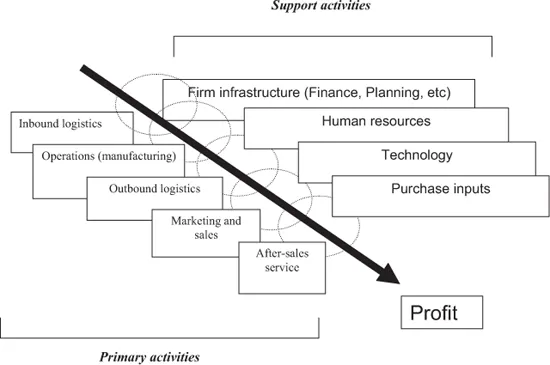
Figure 1.1 The value chain
On the other hand, past research has indicated that logistics influences a manufacturer’s ability to satisfy customers and overall performance (Tracey 1998). It is important for firms to develop logistics capabilities to attain cost and service advantages (Lai 2004). Similarly, another study has found that logistics service performance engenders customer satisfaction, which has links with customer loyalty and market share (Stank et al. 2003).
Significance of JIT for Logistics
The goal of JIT in reducing waste and improving services is relevant and applicable to business logistics. Similar to manufacturing, JIT can be embraced as an operating management approach designed to eliminate waste. In business logistics, waste can be defined as anything other than the minimum amount of equipment, space and workers’ time, which are absolutely essential to add value to the product or service. As logistics involves move-store activities in the supply chain, firms can embrace the philosophy of JIT to identify waste and improve service in the processes, for example, to plan the manpower and facilities requirements to meet the distribution needs, to reduce product introduction time by responsive delivery, to improve logistics service quality by forging supplier and customer partnerships and so on. In sum, there are many areas where the philosophical emphases of JIT on waste reduction and service improvement can be applied to improve logistics performance in the four core elements of business logistics, that is, customer services, order processing, inventory management and transportation.
WASTE REDUCTION
The primary objective of JIT practices is to eliminate waste. Wastes in JIT are not limited to tangible items such as excessive inventories and defective items, but also intangible items such as under-utilized manpower and facilities that have better use elsewhere. Waste can be generated in the different core elements of business logistics. One may wonder what kind of waste will be present in logistics activities. To deliver good customer service, flows of product/services must be managed well to meet customer requirements. Any activities that occupy time and consume resources in the product/service flows, but do not add any time and place utilities to the flows or the involved parties, for example, final customers, in the logistics processes can be considered as ‘waste’. For example, delayed product delivery due to backorder by suppliers is a waste because the extra time needed to deliver the required items is of no value to the customers. In JIT logistics, all the activities that take up motion time, for example, order picking, shipment marshalling, transporting and so on, need to be managed efficiently and the performance outcomes need to conform to what are expected by the customers. The aim is to meet customer service requirements at the lowest possible cost.
Delay in information flow between suppliers and customers, for example, due to paperwork, is another example of waste because the administrative procedures may extend the order cycle time and result in higher safety stock against unforeseen events in the lengthened ordering process. Under JIT, the order processing procedures need to be simple and responsive. To these ends, the Continuous Improvement (CI) in the procedures involved in order cycles and the adoption of enabling technologies such as a Logistics Information System (LIS), often in the form of Electronic Data Interchange (EDI) or Value-Added Network (VAN), or the Internet are desirable so that different parties in the logistics processes can gain access to the needed information for decision making, therefore meeting the market requirements responsively.
Carrying large volume of inventories due to price discounts by suppliers or to prevent possible stock-outs are wastes in inventory management. These wastes often incur extra cash to finance, plus the manpower and physical space to handle the excess inventories. Under a JIT environment, raw materials, work-in-process (WIP) items and finished products are available in the exact quantities only when needed. Billesbach and Hayen (1994) argued that the adoption of JIT will lead to significant improvement in inventory efficiencies. This can be achieved through the elimination of unnecessary inventories, thereby shifting the resources to other revenue-generating activities.
Idle capacities for transportation facilities are wastes as well. For instance, queues of trucks for loading and unloading can be avoided if there is a proper loading schedule in the loading bay. There are also chances for trucks to maximize the carriage capacity if the routes are carefully planned such that trucks can be dispatched to different suppliers to gather partial shipments so that the transportation costs are reduced among suppliers, intermediaries and firms (Schnedider and Leatherman 1992).
SERVICE IMPROVEMENT
Quality of service in logistics is concerned with the achievement of the 7Rs. The role of JIT in service improvement is to help firms better understand their customers’ requirements and their capabilities to satisfy those requirements. For instance, the practice of JIT enhances logistics customer services by ensuring the availability of goods to meet demand requirements, thereby creating time, place and possession utilities for the customers.
JIT also contributes to promoting close working relationships with suppliers to ensure the quality and dependability of supply. The pull-based nature of JIT requires a series of management practices. It will lead firms to continuously look for ways to improve their logistics activities with supplier firms to meet the JIT requirements. So...
Table of contents
- Cover Page
- Title Page
- Copyright Page
- Contents
- List of Figures
- List of Tables
- Acknowledgements
- About the Authors
- Preface: Just-in-Time Logistics
- Chapter 1 Introduction
- Chapter 2 Basics of JIT
- Chapter 3 Basics of Logistics
- Chapter 4 JIT Logistics
- Chapter 5 Quality Management Issues
- Chapter 6 Implementation Issues
- Bibliography
- Index
Trusted by 375,005 students
Access to over 1.5 million titles for a fair monthly price.
Study more efficiently using our study tools.
Frequently asked questions
Yes, you can cancel anytime from the Subscription tab in your account settings on the Perlego website. Your subscription will stay active until the end of your current billing period. Learn how to cancel your subscription
No, books cannot be downloaded as external files, such as PDFs, for use outside of Perlego. However, you can download books within the Perlego app for offline reading on mobile or tablet. Learn how to download books offline
Perlego offers two plans: Essential and Complete
- Essential is ideal for learners and professionals who enjoy exploring a wide range of subjects. Access the Essential Library with 800,000+ trusted titles and best-sellers across business, personal growth, and the humanities. Includes unlimited reading time and Standard Read Aloud voice.
- Complete: Perfect for advanced learners and researchers needing full, unrestricted access. Unlock 1.5M+ books across hundreds of subjects, including academic and specialized titles. The Complete Plan also includes advanced features like Premium Read Aloud and Research Assistant.
We are an online textbook subscription service, where you can get access to an entire online library for less than the price of a single book per month. With over 1.5 million books across 990+ topics, we’ve got you covered! Learn about our mission
Look out for the read-aloud symbol on your next book to see if you can listen to it. The read-aloud tool reads text aloud for you, highlighting the text as it is being read. You can pause it, speed it up and slow it down. Learn more about Read Aloud
Yes! You can use the Perlego app on both iOS and Android devices to read anytime, anywhere — even offline. Perfect for commutes or when you’re on the go.
Please note we cannot support devices running on iOS 13 and Android 7 or earlier. Learn more about using the app
Please note we cannot support devices running on iOS 13 and Android 7 or earlier. Learn more about using the app
Yes, you can access Just-in-Time Logistics by Kee-hung Lai,T.C.E. Cheng in PDF and/or ePUB format, as well as other popular books in Business & Business generale. We have over 1.5 million books available in our catalogue for you to explore.