eBook - ePub
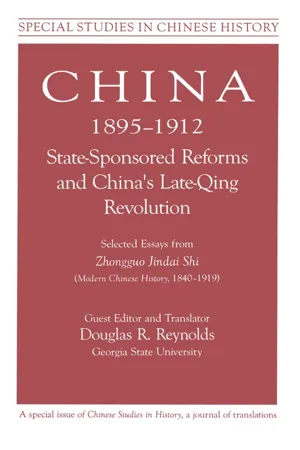
China, 1895-1912 State-Sponsored Reforms and China's Late-Qing Revolution
Selected Essays from Zhongguo Jindai Shi - Modern Chinese History, 1840-1919
- 191 pages
- English
- ePUB (mobile friendly)
- Available on iOS & Android
eBook - ePub
China, 1895-1912 State-Sponsored Reforms and China's Late-Qing Revolution
Selected Essays from Zhongguo Jindai Shi - Modern Chinese History, 1840-1919
About this book
Offering recent scholarship in Chinese historiography, this text focuses on radical, even revolutionary, changes of the period 1895-1912. The book investigates intellectual and institutional changes associated with the government's Xinzheng or New Systems reforms.
Part I
Antecedents and Continuities, 1866–1911
1
Chinese Investigative Missions Overseas, 1866–1907*
Editor’s Note: This article provides important background to understanding the chief concern of the present collection: state-sponsored reforms of the 1895–1912 period. Essentially a summary of the relevant portions of Zhong Shuhe, Zou xiang shijie—Jindai Zhongguo zhishi fenzi kaocha Xifang de lishi [Going Out Into the World: A History of Modem Chinese Intellectuals’ Investigations of the West (and Japan)] (Beijing: Zhonghua Shuju, 1985, 1993), Dong and Wang is a valuable brief overview not previously available in any language. Zou xiang shijie, it should further be noted, consists of Zhong Shuhe’s critical introductions to individual Chinese travel accounts to the West and Japan before 1911, for the ten-volume reprint series compiled by Zhong himself, Zou xiang shijie congshu [“From East to West: Chinese Travelers Before 1911”] (10 vols.; Changsha: Yuelu Shushe, 1984–86).
The article by Dong and Wang ends during the Xinzheng reform period, 1901–11, about which they say: “Indeed, it was mainly during this time period that the great transformation of China’s modem society occurred. … [Tjhese missions abroad resonated with the times and ended up facilitating China’s earth-shaking social transformation” (below, pp. 24 and 20). Despite such statements, Dong and Wang remain somewhat tentative about the study missions and their impact on Xinzheng reforms themselves. My own interpretation, explored briefly through several missions in my 1993 study, China, 1898–1912: The Xinzheng Revolution and Japan (Cambridge: Council on East Asian Studies, Harvard University, 1993), is more positive. Lending support to a positive evaluation is the fine chapter by Paula Harrell, “Study Tours for Chinese Officials,” in her monograph, Sowing the Seeds of Change: Chinese Students, Japanese Teachers, 1895–1905 (Stanford: Stanford University Press, 1992), pp. 40–60.
It is striking how much the language and arguments of the present essay resonate with the language and commentary in China since December 1978, after formalization of Deng Xiaoping’s Four Modernizations policy. It is as if China of the 1980s and 1990s is reliving its distant past, at least with respect to “going out into the world.”
Translator’s Note: The book by Zhong Shuhe, the primary source of this article, is frequently cited by Dong and Wang with erroneous page numbers and inaccurate quotations. The translator has attempted to correct all misinformation against Zhong Shuhe’s original work.
During the Qing period, missions of investigation (kaocha) were called youli [literally, travel tours]. In 1860, after China and Western countries ratified the Treaty of Tianjin and signed the Convention of Beijing, the Qing government began to set aside its conceit of being the “Celestial Kingdom” (Tianchao shang-guo), and embarked on sending various youli abroad to investigate the affairs of other countries. These missions played a very real role in bringing about China’s development as a modem society.
I. The Phased-in Nature of Qing Policy Decisions on Investigative Missions
Qing government policy decisions went through several phases, both in terms of the growing recognition of the importance of investigative missions and also of the changing content of the orders given to mission members.
1. Investigations on a Makeshift Basis
The Qing government’s first youli mission to investigate the West was in 1866. Occasioning this mission was the request from Robert Hart, British Inspector General of the Chinese Customs Service, for a long-term leave to return home. He proposed that the Qing government appoint an investigative official to accompany him on home leave. It happened that the Beijing Tongwen Guan or College of Foreign Languages had several outstanding graduates who had just attained the eighth rank of probationary diplomat (jianxi waijiaoguan), and who were in need of an overseas experience. As soon as Hart proferred his proposal, it was therefore “approved” by the Qing government.
A deeper reason for sending out this mission was the keen concern among members of the Westernization movement (yangwu pai) within the Zongli Yamen or Foreign Office that lack of knowledge about the world was obstructing China’s foreign relations. The Zongli Yamen petitioned the throne to send investigators abroad, explaining its necessity: “Ever since China started exchanging treaty agreements with other countries, foreigners have been coming to China (Zhongguo; the Middle Kingdom) and learning all there is to know about our every province. China, on the other hand, knows nothing about these foreign countries, which is a major impediment to our conduct of foreign relations. We have for some time petitioned to send persons to various countries to investigate their strengths and weaknesses, so that the information brought back can serve as reference material in our future relations.”1
In this effort of trying to learn about foreign countries, the [Zongli Yamen] heads or decision makers (juecezhe) had given little thought to exactly what information it sought, however. Its instructions to the investigators [as worded in the Zongli Yamen petition to the throne] were therefore both sweeping and vague: “[Mission members] will be under instructions to be observant in their travels, and to record all information about land forms and about customs and peoples. After returning to China (Zhongguo), these will be used to corroborate other information.”2
With respect to this assignment, Binchun (b. 1804), who headed the mission, remarked in a poem,
Off to foreign countries, folk songs to collect (caifeng),
Drawings to make, and history to learn.3
Binchun knew about “folk songs to collect” from ancient Chinese writings.
In selecting a mission leader, the [Zongli Yamen] heads gave the matter more than casual thought. Robert Hart had offered his good services, so that a mission could have gone out immediately. The Zongli Yamen insisted however that the Tongwen Guan graduates, “all at an impressionable age, must have an older reliable person to accompany them as head, and to look after their needs en route. After arrival in a country, moreover, a leader’s direction is needed to prevent these young and inexperienced youth from making a laughingstock of China.”4
The simple fact is that the government lacked confidence in Robert Hart. The man finally chosen to head the mission was sixty-three-year-old Binchun, [a Manchu and] a former magistrate of Xiangling County in Shanxi Province, a former officer of the third rank in the army, and [since 1864] a Chinese-language secretary for Inspector General Hart. Because of Binchun’s advanced age, however, it was decided to send along his son, Guangying, a clerk in the Imperial Household, to look after Binchun’s own needs en route. In this way, the group ended up with five persons [three of them Tongwen Guan graduates]. After completion of the mission, Binchun submitted his travel diary, Cheng chai biji [Jottings of a Commissioner to the West] of one juan or chapter, and two sets of poems, Haiguo shengyou cao [Draft of A Triumphal Mission Overseas] and Tianwai gulf an cao [Draft of Away From and Back to the Celestial Kingdom]. Mission member Zhang Deyi [1847–1919] submitted a work entitled Hang hai shu qi [Wondrous Tales from Across the Seas]. [Note: For a translation into English of an 1868–69 travel account by Zhang—one of the three diary accounts by Zhang Deyi included in Zhong Shuhe, ed., Zou xiang shijie congshu, used without attribution—see Zhang Deyi, Diary of a Chinese Diplomat, trans. Simon Johnstone (Beijing: Panda Books, Chinese Literature Press, 1992).—Trans.]
In the year 1868, the Qing government sent [Manchu] Zhigang and [Chinese] Sun Jiagu [as co-envoys] on a mission known in history as the Burlingame Mission. The purpose of this mission was to prepare for forthcoming treaty revisions. Its charge, however, went beyond simply to explain Qing government positions to countries having treaty relations with China; it included the investigation of those countries in order to understand conditions abroad. The [Zongli Yamen] heads gave as their reason for sending this mission: “There is nothing about China’s recent situation that foreign countries do not know, whereas China is completely ignorant about the affairs of those same nations. One reason for our many misunderstandings is that these countries send envoys to China, whereas we do not send envoys to their countries.”5
Although a roving diplomatic mission, this mission had tightly circumscribed duties, as laid out in the Zongli Yamen petition: “This mission will be sent out on a one-year trial basis. Its instructions will be to do everything in its power to prevent affairs harmful to China and to consent to affairs beneficial to China. The envoys must seek Yamen approval on all matters, and act accordingly. In this way, other countries will not be able to act arbitrarily on their own, while we will be able to reap benefits.”6
Inasmuch as the powers of this mission were utterly circumscribed, the best use the envoys could make of their year abroad was to concentrate on information gathering. But the Qing government had issued no specific guidelines as to what to investigate. Mission members simply went ahead and recorded their observations and impressions. After the end of the mission, Zhigang submitted his Chu shi taixi ji [Record of China’s First Diplomatic Mission to the West], Sun Jiagu wrote Shi Xi jicheng [Record of A Diplomatic Mission to the West], and entourage member Zhang Deyi wrote his Hanghai zai shu qi [More Wondrous Tales from Across the Seas] in six juan. [Note: This is the translated work cited above.—Trans.]
2. Ancillary Investigative Work
In 1876, the Qing government formally began to send resident Ministers to foreign countries. Then, in 1878, the government issued regulations that “Chinese Ministers abroad must periodically send diaries and other reports” to the Zongli Yamen. More specifically, “all matters relating to our mutual affairs and to a country’s customs and its peoples should be reported in detail by Ministers and their staff, and submitted periodically as reports.”7 In other words, investigative reporting became a required ancillary part of diplomatic work overseas.
In accordance with this Qing government directive, most diplomats stationed abroad left detailed and systematic records in the nature of investigative reports. For example, Guo Songtao [1818–1891], Chinese Minister to England, sent his first diary report back to China not long after arriving at post, and this was published by the Zongli Yamen under the title of Shi Xi jicheng [Record of A Diplomatic Mission to the West]. Later, Guo’s complete diaries were published under the title of Lundun yu Bali riji [Diaries of London and Paris], consisting of more than 700,000 characters. Guo, whose appointment contrasted with the practice of sending aged officials overseas, would frequently write seven- or eight-thousand word entries in his diary, discussing Western society systematically and in depth. Guo’s vice minister, Liu Xihong, carried out his own informed studies of England, known under the title of Ying zhao si ji [A personal account of England]. Li Shuchang (1837–1897), a junior member of Guo’s staff, remained in Europe for five years until returning home in 1881. Having traveled widely in Europe, he combined his various writings into a single collection called Xiyang za zhi [Miscellaneous Writings on the West], which gave Chinese readers a picture of life in nineteenth century Western Europe.
Zeng Jize [1839–1890], Minister to England and France from 1878, remained in Europe at various diplomatic posts until 1886. In accord with directives, Zeng forwarded to the Zongli Yamen his diaries which eventually added up to about 500,000 characters. These have been published in Taiwan in eight volumes, under the title of Zeng Huimin gong shoushu riji [The personal diaries of Zeng Jize]. From 1890 to 1894, Xue Fucheng [1838–1894] was China’s Minister to the four countries of England, France, Italy, and Belgium. His first diary [covering the period 31 January 1890 to 8 April 1891] consisted of 170,000 characters in six chapters. He had six copies printed in London, of which he sent copies to the Zongli Yamen and others to have republished in woodblock form in China. This work, bearing the title Chu shi Ying Fa Yi Bi si guo riji [Diary of a diplomat in England, France, Italy, and Belgium], caused his findings to become widely known among Chinese. Following Xue’s death, his remaining diplomatic writings [covering the period 9 April 1891 to 1 July 1894] were compiled by his son into a work of ten chapters and about 350,000 characters, under the title of Chu shi riji xuke [Diary of a diplomat, Supplemental Volumes]. [Note: A very readable, abridged translation by Xue’s great-granddaughter of these diaries, highlighting Xue’s impressions of European culture, has been published in English under the title, The European Diary of Hsieh Fucheng: Envoy Extraordinary of Imperial China [1890–94], translated by Helen Hsieh Chien (New York: St. Martin’s Press, 1993).—Trans.]
Other such diplomatic accounts, to mention only a few, include Minister to Japan He Ruzhang’s [1838–1891] Shi Dong zayong [Odes from a diplomatic mission to Japan] and Shi Dong shulue [Brief account of a diplomatic mission to Japan]; Huang Zunxian’s [1848–1905] famous Riben guozhi [Treatises on Japan], an in-depth study of Japan while he served as a counselor to He Ruzhang, and Huang’s Riben zashi shi [Miscellaneous poems on Japan]; and Minister to the Uni...
Table of contents
- Cover
- Title Page
- Copyright Page
- Table of Contents
- Acknowledgments
- Editor’s Introduction
- Part I. Antecedents and Continuities, 1866–1911
- Part II. Case Studies, 1895–1912
- Index to Chinese Studies in History, Vol. 28 (Fall 1994–Summer 1995)
- Erratum
Trusted by 375,005 students
Access to over 1.5 million titles for a fair monthly price.
Study more efficiently using our study tools.
Frequently asked questions
Yes, you can cancel anytime from the Subscription tab in your account settings on the Perlego website. Your subscription will stay active until the end of your current billing period. Learn how to cancel your subscription
No, books cannot be downloaded as external files, such as PDFs, for use outside of Perlego. However, you can download books within the Perlego app for offline reading on mobile or tablet. Learn how to download books offline
Perlego offers two plans: Essential and Complete
- Essential is ideal for learners and professionals who enjoy exploring a wide range of subjects. Access the Essential Library with 800,000+ trusted titles and best-sellers across business, personal growth, and the humanities. Includes unlimited reading time and Standard Read Aloud voice.
- Complete: Perfect for advanced learners and researchers needing full, unrestricted access. Unlock 1.5M+ books across hundreds of subjects, including academic and specialized titles. The Complete Plan also includes advanced features like Premium Read Aloud and Research Assistant.
We are an online textbook subscription service, where you can get access to an entire online library for less than the price of a single book per month. With over 1.5 million books across 990+ topics, we’ve got you covered! Learn about our mission
Look out for the read-aloud symbol on your next book to see if you can listen to it. The read-aloud tool reads text aloud for you, highlighting the text as it is being read. You can pause it, speed it up and slow it down. Learn more about Read Aloud
Yes! You can use the Perlego app on both iOS and Android devices to read anytime, anywhere — even offline. Perfect for commutes or when you’re on the go.
Please note we cannot support devices running on iOS 13 and Android 7 or earlier. Learn more about using the app
Please note we cannot support devices running on iOS 13 and Android 7 or earlier. Learn more about using the app
Yes, you can access China, 1895-1912 State-Sponsored Reforms and China's Late-Qing Revolution by Zhongguo Jindai Shi,Douglas R. Reynolds in PDF and/or ePUB format, as well as other popular books in History & Chinese History. We have over 1.5 million books available in our catalogue for you to explore.