
- 270 pages
- English
- ePUB (mobile friendly)
- Available on iOS & Android
eBook - ePub
Bid Writing for Project Managers
About this book
At what stage in the process do commercial projects go wrong? Some of the worst problems (unrealistic objectives, faulty assumptions, and poorly understood constraints) are 'programmed in' at conception when the bid is written, long before the project manager is brought on board. If the bid is misconceived, no amount of clever project management is going to recover the situation. Involving the designated project manager at the bidding stage is becoming the norm in many commercial organizations. Some make the project manager the bid manager so they can direct all aspects of the project's conception. Getting the bid right is the essence of planning for project success, and is the main theme of this book. However, many project managers are unfamiliar with the pitfalls of competitive bidding and don't know how to balance a compelling sales message against a realistic delivery plan. Bid Writing for Project Managers will guide prospective project managers through the bid-writing lifecycle, providing comprehensive guidelines and numerous tips on how to craft a winning bid and how to set the project up with the best possible chance of success.
1
Zen and the Art of Bid Writing
You cannot teach people anything. You can only help them to discover it within themselves.
Galileo Galilei (Italian astronomer and physicist, 1564–1642)
In the Beginning
Matthew’s boss calls him the archetypal ‘safe pair of hands’. With nearly a decade of solid experience, Matthew knows what is expected of him as project manager. The first few weeks on the new project are hectic but exhilarating. He meets with his new team and together they start to map out key stages of the project. Matthew is pleased that an early brainstorming session on risks really seems to get everyone fired up. Everyone relaxes over a few drinks in the pub after work and it is clear to Matthew he is leading a team of dedicated individuals with a broad range of skills.
Matthew also meets with the client to discuss the requirements, and all goes well. Not unusually for a government-funded project, there is a large group of stakeholders with diverse interests. At the first monthly Project Board meeting Matthew’s project report is upbeat, and demonstrates that good mitigation plans are in place for a small number of risks that have been identified.
But a week later, his technical lead brings him a problem. She has been analysing the requirements in more detail and has discovered that an important off-the-shelf component in the proposed solution simply won’t meet the requirements. Adapting the component will be time-consuming and potentially risky because the necessary skills don’t exist within the team. Sourcing an alternative will be both time-consuming and costly.
A couple of days later, Matthew has a disturbing conversation with one of his subcontractors. It emerges that no binding subcontract was ever agreed for this part of the work. Extra time will be needed to agree terms with the subcontractor, delaying a critical milestone. Worse, the subcontractor is now pitching a higher price than originally budgeted for. Unforeseen delays and budget overruns are now threatening Matthew’s project.
His technical lead brings more bad news. She has found further problems in the requirements document. Their original proposal to the client states compliance with a number of important requirements which, it now becomes clear, can’t be met by the proposed technical solution. This news is a potential show-stopper.
Matthew holds a requirements workshop with the client, aiming to negotiate away the problematical requirements. Not surprisingly, the client is initially reluctant to reduce the scope but is persuaded to trade off these requirements for additional (and more affordable) functionality in other areas. But yet another problem emerges. The workshop reveals that there are big holes in the client’s requirements; important things have been overlooked in the Invitation To Tender. Worse, several of the client stakeholder groups are unhappy with the proposed solution, feeling that they were excluded from the bid evaluation process. The client’s internal politics are awkward; some of the stakeholders may not sign off on the design unless their views are taken into account.
Matthew knows these problems are solvable, but it means new and unexpected effort (for example, carrying out a more detailed requirements analysis which will add months to the schedule). He initiates change control procedures to recover these extra costs and the relationship with the client deteriorates rapidly. They thought they were contracting for a turnkey system but are suddenly facing long delays and significant cost increases.
By the end of month three, Matthew’s highlight report is awash with critical issues and forecast overruns. After such a promising start, where did it all go wrong?
SEEDS OF FAILURE
In Matthew’s case, as with many projects, the seeds of failure were sown long before the project manager was appointed. A combination of poor decisions during the bid and failure to do important groundwork led to problems laying dormant for some months. Let’s examine some of them.
• Feasibility of the solution. The bid team proposed a solution which in several important respects didn’t meet the client’s requirements. Almost certainly time pressure was a contributing factor. Nobody felt they had enough time during the bid to properly analyse what the client was asking for and determine which solution (or indeed, if any solution) would meet these requirements.
• Commercial agreements. Failing to get subcontractors ‘signed up’ during the bid stage was an elementary mistake. It left Matthew’s organization exposed, taking on the risk of delivering something outside their immediate control without transferring part of that risk to the subcontractor.
• Missing or misunderstood requirements. In a large or complex bid, it can be easy to overlook the significance of certain requirements. It is one of the reasons why requirements tracking tools are a good idea. This ensures that each requirement maps on to some element of the solution. It means nothing gets forgotten and there are no nasty surprises when the project is delivered to the client.
• Lack of vision or understanding on the part of the client. It is not uncommon for a client to have an incomplete picture of what they want the project to deliver. This is fine if a project methodology is selected which takes this into account, for example by working iteratively to gradually refine the requirements. But if the project is organized to deliver only what was asked for during the bidding process, it can be a recipe for disaster.
Each of these problems originated in the bid stage. Undoubtedly, preventing these sorts of problems during the bid stage is hard. There is never enough time, or enough people, or the right skills available, or enough information from the client to properly understand what is needed. But laying the foundations of the project during the bid is crucial. It is the single biggest factor in determining the success of the project.
What is a Bid?
There are many kinds of bids, just as there are many kinds of projects. The bidding process is a key sales activity for most service- and product-oriented organizations. The principles of bid writing apply equally across the scale from the very small to the very large project.
Principally, we will focus on a commercial bid, usually resulting in one of several possible suppliers being awarded a contract to execute a project or programme of work. However, many of the principles to be discussed remain valid outside of a commercial context, such as when pitching for an internal project or undertaking work on a non-commercial basis.
THE BID (OR PROPOSAL)
The bid is the supplier’s response to a client’s concept for the project; the answer to the questions posed by the client. It is also referred to as a proposal and we will use the two terms interchangeably. The bid is a binding document, initially evaluated by the client to determine if the work should be awarded and if it is, it becomes a commitment on the part of the supplier as to what will be done.
THE ITT
To keep things simple we will use the term ‘ITT’ (Invitation To Tender) or ‘tender’ as the catch-all for the client’s description (or concept) for the project. You may be familiar with other variants such as: Request For Proposal, Request For Quote, Invitation To Bid, and Invitation To Quote, etc. Each refers to information issued by the client to prospective bidders which, in theory, completely defines the work to be done.
On a large bid, there may be several stages of bidding. For example, an initial response to a Pre-Qualification Questionnaire is often used to select a longlist of bidders who will then respond to a full ITT. Following evaluation of proposals, bidders are whittled down to a shortlist who may then have to submit further refinements to their bids, culminating in what is often termed a ‘Best And Final Offer’ (BAFO).
As we step through the principal bid stages, we will encounter some key terms which have specific meanings. A full glossary is provided in Appendix B. Combining these elements, a picture of the generic bidding process begins to emerge (see Figure 1.1).
Although there is only one client project team, there are usually multiple supplier teams, each vying to win the work. This is a competition that only one supplier can win – the one who demonstrates their abilities and aptitude for delivering a compliant solution at an acceptable price. Even in the case of a sole supplier bid (i.e. where there are no competitive pressures), the benefits of following a good bid process still apply.
This picture of the bidding process also gives us some clues about where things can go wrong. The ITT is critical because it contains the detail of what the project must achieve. However, formal procurement processes often forbid contact with the client during bidding except through closely controlled channels to ensure that no supplier is given favourable treatment. Without an open dialogue with the client, errors and omissions in the ITT may propagate into the project leading to problems down the line.
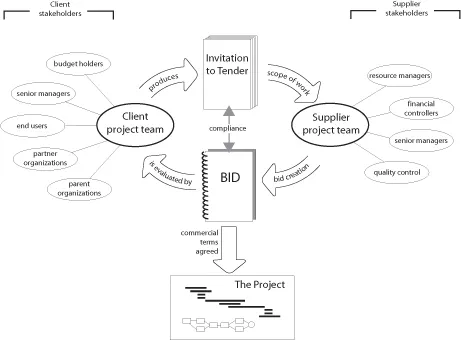
Figure 1.1 What is a bid? In a commercial setting, the ITT and the bid sit at the interface between the client and the supplier. A project is formed around the commercial agreements struck on the basis of a successful bid
Notice that the set of project stakeholders often extends beyond the immediate teams involved in the project from the client and supplier organizations. Both parties have other masters that must also be served. Active stakeholder involvement naturally varies from bid to bid but good communication between all stakeholder groups is very helpful (if permitted within the rules of the procurement).
Compliance is an important consideration for every bid. Begin by assuming the bid must meet all the requirements laid down in the ITT. However, submitting a non-compliant bid can sometimes be a smart move. Perhaps the client has overlooked something and you can see a better way of doing things, thereby stealing a march on the competition whose proposals will look dreary and unimaginative by comparison. Or perhaps you have realized that what the client is asking for can’t be achieved – in which case you can score points for your foresight and honesty, and help the client avoid a nasty problem before it occurs.
Back to Basics
Sometimes it is good to be reminded of the obvious, particularly when the consequences are far reaching. How, precisely, does a successful project manager manage a project? This is an important question because if we don’t know the answer, we cannot expect to write a bid which will lead to successful delivery of the project.
So – back to basics. Figure 1.2 illustrates a project manager’s six key responsibilities. Notice how each of these has its roots in tasks which are begun during the bid stage. Critical decisions are being made which will have profound implications once the project is underway.
This project framework is usually driven by the needs of the bid – for example, most clients want to know when key milestones will be reached, so preliminary planning must be done even though many aspects of the project will be uncertain at this stage. Similarly, the client may want to understand what risks are entailed, so the bid team must carry out risk analyses and write these up in the proposal. Although driven by what the client asks for in the tender, these items are actually creating the project framework. If the bid is successful, this project framework is transitioned into the operational project. In other words, a large part of the preliminary planning (or ‘project start-up’ in PRINCE2 terms) is fixed and agreed with the client during the bid stage. Naturally, getting this right goes a long way towards ensuring project success later on.
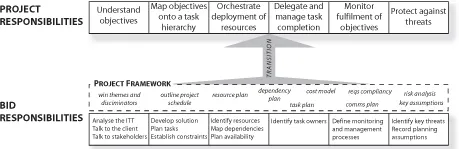
Figure 1.2 How bid responsibilities map onto the project. Key activities performed during the bid create the project framework which becomes the basis for executing the project
However, problems arise when too much effort goes in to making the bid as attractive as possible without sufficient thought for what is feasible, i.e. making promises to the client that can’t be kept. We will look at these key elements in more detail.
KEY ELEMENTS OF THE PROJECT FRAMEWORK
Understand the project objectives
A better understanding of the objectives increases opportunities for the project team to resolve problems and come up with more innovative solutions. This requires a thorough appreciation of not just the tangible project objectives but awareness of how these fulfil broader business objectives. The tender documents must be analysed in detail but are only a starting point for developing this understanding. Omissions and apparent contradictions can be revealing.
Map objectives to a task hierarchy
The sole purpose of the task hierarchy is to deliver the objectives in the most efficient way. It determines how the project is divided into discrete, manageable activities, what inputs are expected and what outputs are generated. These are the fundamental building blocks of the project. Assembling these in the correct order will ultimately lead to the deliv...
Table of contents
- Cover
- Half Title
- Dedication
- Title Page
- Copyright Page
- Table of Contents
- List of Figures
- List of Tables
- List of Abbreviations
- Preface
- Chapter 1 Zen and the Art of Bid Writing
- Chapter 2 The Anatomy of a Bid
- Chapter 3 Planning to Win
- Chapter 4 Analysing the Requirements in Depth
- Chapter 5 Developing the Bid
- Chapter 6 Establishing the Project Framework
- Chapter 7 Estimation Methods
- Chapter 8 Realistic Costing and Pricing
- Chapter 9 A Structured Approach to Writing the Bid
- Chapter 10 Getting the Message Across
- Chapter 11 The Management Solution
- Chapter 12 Quality Control
- Chapter 13 The Transition to a Project
- Appendix A A Bid Checklist
- Appendix B Glossary
- Index
Trusted by 375,005 students
Access to over 1.5 million titles for a fair monthly price.
Study more efficiently using our study tools.
Frequently asked questions
Yes, you can cancel anytime from the Subscription tab in your account settings on the Perlego website. Your subscription will stay active until the end of your current billing period. Learn how to cancel your subscription
No, books cannot be downloaded as external files, such as PDFs, for use outside of Perlego. However, you can download books within the Perlego app for offline reading on mobile or tablet. Learn how to download books offline
Perlego offers two plans: Essential and Complete
- Essential is ideal for learners and professionals who enjoy exploring a wide range of subjects. Access the Essential Library with 800,000+ trusted titles and best-sellers across business, personal growth, and the humanities. Includes unlimited reading time and Standard Read Aloud voice.
- Complete: Perfect for advanced learners and researchers needing full, unrestricted access. Unlock 1.5M+ books across hundreds of subjects, including academic and specialized titles. The Complete Plan also includes advanced features like Premium Read Aloud and Research Assistant.
We are an online textbook subscription service, where you can get access to an entire online library for less than the price of a single book per month. With over 1.5 million books across 990+ topics, we’ve got you covered! Learn about our mission
Look out for the read-aloud symbol on your next book to see if you can listen to it. The read-aloud tool reads text aloud for you, highlighting the text as it is being read. You can pause it, speed it up and slow it down. Learn more about Read Aloud
Yes! You can use the Perlego app on both iOS and Android devices to read anytime, anywhere — even offline. Perfect for commutes or when you’re on the go.
Please note we cannot support devices running on iOS 13 and Android 7 or earlier. Learn more about using the app
Please note we cannot support devices running on iOS 13 and Android 7 or earlier. Learn more about using the app
Yes, you can access Bid Writing for Project Managers by David Cleden in PDF and/or ePUB format, as well as other popular books in Business & Business Writing. We have over 1.5 million books available in our catalogue for you to explore.