- 172 pages
- English
- ePUB (mobile friendly)
- Available on iOS & Android
eBook - ePub
Human Rights in Crisis
About this book
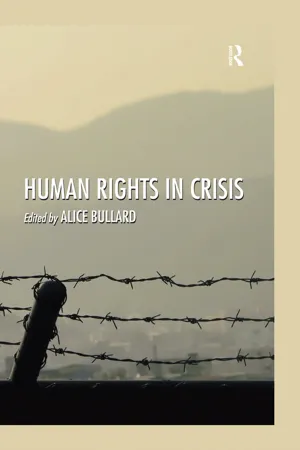
This volume expands our understanding of the pursuit of human rights during the era of the War on Terror. The threat to human rights both in the United States and among detainees in US-governed detention facilities created a widely perceived crisis in human rights. This text explores the broad and complicated ramifications of crisis by looking comparatively at societies in the present era and looking back at the historical and legal foundations of human rights. Human Rights in Crisis contains an element of hope derived from a conviction that the pursuit of human rights happens on many fronts and in many ways around the globe; that a retreat from human rights in the United States does not necessarily signal a global retreat. The essays here include perspectives from History, Anthropology, and Legal Studies, with a resulting interdisciplinary portrait of the complexities of pursuing human rights in wartime.
Part I
The Post-9/11 Climate
Chapter 1
Human Rights Law, Executive Powers, and Torture in the Post–9/11 Era
Declaiming that “we do not torture” has become routine for President George W. Bush. Every time the torture and abuse of foreign prisoners in US custody makes the headlines, as it has with regularity since photos from an interrogation wing of the Abu Ghraib prison were first published in April 2004 (CBS’s 60 Minutes II 2004; Hersh 2004), he expounds some version of this denial (see Lederman 2005A). In November 2005 President Bush repeated this no-torture claim several times in response to an article in the Washington Post (Priest 2005, A01) that some CIA “black sites” – secret places where so-called “high value targets” had been disappeared for interrogation – were located in Eastern Europe (subsequently confirmed by Human Rights Watch to be Poland and Rumania; see HRW 2007).
The CIA black sites-in-Europe scandal was intensified by official acknowledgment that CIA tactics include “waterboarding,” a form of mock execution through simulated drowning (see Priest 2004, A1). However, waterboarding, American advocates and apologists have claimed, does not constitute “torture” (as interpreted by Bush administration lawyers) because the pain that results is not “protracted” (Smith and Eggen 2004, A1). Former CIA head Porter Goss went so far as to characterize this tactic, a favorite of medieval inquisitors’ “professional interrogation practice” (Diamond 2005).
On December 6, 2005, Secretary of State Condoleeza Rice went to Germany to issue her own version of the “we do not torture” routine in response to revelations about the CIA’s abduction (from Macedonia) and detention (in Afghanistan) of German citizen Khaled el-Masri, who they wrongly suspected of complicity in terrorism, and who they subsequently dropped off in a remote spot in Albania after the error was realized (see Democracy Now! 2005). Rice was dispatched to reassure European allies that whatever was done to prisoners in US custody was not “torture,” but, as ABC News reported on December 5, in advance of Rice’s visit the CIA “scrambled” to move 11 detainees from European locations to a new black site somewhere in North Africa (later revealed to be Morocco).
These official denials are typical of torturing regimes and come in several forms (see Cohen 2001). “Literal denial” is when a state accused of torture (or some other gross crime) responds by saying that nothing happened and that those who claim otherwise are liars or “enemies of the state.” This was the official American pattern of response to allegations of torture until December 2002, when the Washington Post reported that unnamed officials confirmed the use of “stress and duress” (position abuse, sleep deprivation, exposures to extremes in temperature, sound and light, and other tactics), as well as the transfer of prisoners who could not be “broken” by these means to countries whose intelligence services are known to use torture (Priest and Gellman 2002, A1). This ground-breaking article shifted the American pattern to “interpretative denial,” namely refutation through euphemism. This entails acknowledging the practices but saying that they do not constitute “torture” but “something else” – “stress and duress” and “coercive interrogations” are two American euphemisms of choice (Bowden 2003). This interpretative denial was aided by prodigious work of some government lawyers to interpret laws to exclude tactics used by American interrogators from their interpretation of the definition of torture. The third variation is “implicatory denial” – that is, denial by implicating others – which occurs when a state acknowledges torture but blames it on “aberrant agents,” claiming that rogue elements have breached official norms and policies. Official responses to the Abu Ghraib prison photos exemplify implicatory denial, as officials initially blamed the problem on “bad apples” (see Carter 2004).
The reason American officials – or officials from any country – are inclined to deny torture is, above all, because it is illegal and those who engage in or abet it are liable to prosecution. Since 2002, the plausibility of such American denials has eroded apace with continuing allegations and mounting evidence about the routine and pervasive use of torture against people in US custody in Afghanistan, Guantanamo and Iraq (see Human Rights Watch 2005; 2006A; 2006B). Photos, first-person accounts and even official investigations into interrogation and detention policies have confirmed that prisoners have been held naked in chilled cells, tied in stress positions and sleep deprived for protracted periods, subjected to deafening music and snarling dogs, sexually humiliated, and beaten. The coup de grâce is the plethora of declassified and leaked documents that these practices were sanctioned as policy by American authorities at the highest levels (see Greenberg and Dratel 2005).
In this chapter, I elaborate on the prohibition against torture and various efforts in the twentieth and twenty-first century to carve out exceptions, including America’s post-9/11 development into a torturing regime. I also provide some discussion about the efforts to expose and prevent torture, including roles played by some military lawyers and others working to close the gap between “we don’t torture” rhetoric and the reality of interrogation and detention practices.
Law and (International) Order
During the Enlightenment, the common and quite pervasive practice of torture began to be criticized as illegitimate and ineffective (see Dubois 1991; Peters 1996). Consequently, the renunciation of torture spread as country after country enshrined prohibitions in the processes of modernizing their legal systems. The prohibition constituted a limit to what state agents could do to people in custody who had not been found guilty of a crime. In US law, forbidding torture traces back to the founding of the nation and was enshrined in the Eighth Amendment of the Constitution barring cruel treatment, an enlightened repudiation of the tyrannical excesses of kings. Along with habeas corpus and the separation of powers, the ban on extralegal cruel treatment served as a foundation of the modern rule of law, because it was understood as essential to curbing tyranny and enabling conditions of human dignity, liberty, security and due process to thrive.
In the twentieth century, torture garnered universal prohibition and criminalization through developments in international law. The unprecedented horrors and violence of World War II provided the negative inspiration for a revolution in international law to forge the principle that people should have rights as humans, and not merely as protected classes of subjects, such as citizens, civilians or prisoners of war. The right not to be tortured became a human right when international law prohibited the practice, and established legal liabilities and penalties (see Foley 2003).
As a matter of law, torture is a crime with rather unique strength and scope (see Hajjar 2000). It is absolutely non-derogable, meaning that it is prohibited under all circumstances. In the words of the UN Convention Against Torture and Other Cruel, Inhuman or Degrading Treatment or Punishment (1984), “No exceptional circumstances whatsoever, whether a state of war or a threat of war, internal political instability or any other public emergency, may be invoked as a justification for torture.” The prohibition of torture is also “universal” because it has status as a jus cogens norm and constitutes a part of customary international law, which means that it applies everywhere (i.e., territorially universal) and can be prosecuted anywhere. This means that anyone suspected or accused of torture is “an enemy of all mankind” because the crime of torture attaches universal jurisdiction; any perpetrator who is not prosecuted in his or her own country can be prosecuted in any competent legal system anywhere in the world (see Macedo 2003).
The right not to be tortured is dialectically related to the prohibition, which is absolute and universal. This means that the right applies to all people everywhere, regardless of their social status, their political identity or affiliations, or any aspect of their activities. In contrast, even the right to life is not nearly as strong as the right not to be tortured since there are many ways in which people can be killed “legally.” Even the right of persons not to be exterminated through genocide, as prohibited by the Genocide Convention (1948), depends on the intent of the killing, which hinges on a collective identity as members of a national, religious or ethnic group. The right not to be deliberately targeted in war hinges not on one’s humanity but rather on one’s status as a civilian or non-combatant, or a surrendered or captured soldier.
Why is the Prohibition of Torture So Strong?
Torture occurs when someone who is in custody – unfree to fight back or protect himself or herself and imperiled by that incapacitation – is purposefully harmed (physically and/or mentally). Historically, the purposes have included punishment (penal torture) and extraction of a confession (judicial torture; see Foucault 1977). In the modern era, an additional purpose is extraction of security-related intelligence (interrogational torture) which may or may not also be a basis for prosecution (i.e., confessional; see Peters 1996). Other violent practices, like domestic violence and battery, also involve purposefully causing pain, but they lack the public dimension of custodianship and therefore do not constitute “torture,” despite that pain and suffering, humiliation and injury are common to all. Legally, severe pain, suffering, humiliation and injury constitute torture only if they serve some public purpose and if the status and role of the torturer emanates from a public authority and if the person being harmed is in custody.
Notwithstanding these qualifications, there is no bright line empirically distinguishing torture from “everything else.” Rather, torture is like a core within layers of violence. For example, being beaten while being arrested changes from “cruel treatment” to “torture” only when “custody” has been achieved, obviously a very blurry and contestable line. The combination of “torture” and “cruel, inhumane and degrading treatment” in the same international laws contributes to this confusion, which is further compounded by the exclusion of painful – but lawful – punishments such as floggings, amputations or the death penalty. Many forms of violence may lead to torture and many forms of violence may result from torture, but the core violence that is torture – and what makes torture a “core international crime” – is violence (physical or psychological) against a person already in the custody of an authority.
An “authority” obviously would include states and their agents, but it would not exclude non-state groups and their agents, or civilians. Torture is not contingent on legitimacy, jurisdiction or international recognition of the custodian; it is contingent on an organized rather than individualized capacity to take people into custody and then harm them for a purpose that is public rather than personal.
Torture and Terror
One of the great paradoxes of torture is that although it is so strongly prohibited and so widely construed as fundamentally illegitimate, it is shockingly common. According to Amnesty International, about two-thirds of the world’s governments utilize tactics that could be deemed to constitute torture. While states torture people for numerous reasons, one common reason invoked by many states is that they claim to be engaged in conflicts with “terrorists.” Consequently there is a tendency to proclaim that “coercion” (i.e., euphemized torture) is crucial for the protection of national security and/or to assert that terrorist enemies lack the right not to be abused in custody (see Ignatieff 2002).
Terrorism is a broad and flexible concept, and there is no clear, internationally accepted definition. It is used, variously, to describe certain kinds of actions, including attacks on civilians, hijackings, organized resistance or repression, and to identify certain types of actors. In national security discourse, the term terrorism typically is used to refer to non-state actors or organizations engaged in attacks or struggles against the state, emphasizing but not necessarily limited to violence, to which the state responds with “counter-terrorism.”
Terrorism is not a figment of the politically paranoid imagination. Any and every instance of deliberately targeting civilians or civilian infrastructures as a tactic in the furtherance of some cause, whatever the political or ideological motivation and whomever the targeting agents, is terroristic. If the deliberate targeting of civilians constitutes terrorism, then states can be as culpable as non-state groups. However, as Richard Falk (2002, xix) explains:
With the help of the influential media, the state over time has waged and largely won the battle of definitions by exempting its own violence against civilians from being treated and perceived as “terrorism.” Instead, such violence was generally discussed as “uses of force,” “retaliation,” “self-defense” and “security measures.”
National security is a legitimate interest of any state, and states have responsibility to provide for the security of their citizens. But the tendency to characterize all “enemies” as “terrorists” or “terrorist sympathizers” contributes to the delineation between “legitimate” and “illegitimate” communities, leaving the latter vulnerable to state violence, including torture and other violations of human rights (see Palti 2004).
A Distinction is Born
Israel was the first state in the world to break the “torture taboo” by publicly authorizing interrogation practices for Palestinians that constitute torture, albeit under the euphemistic term “moderate physical pressure.” In the 1967 Arab-Israeli war, Israel captured and occupied the West Bank and Gaza and established a military administration to rule the Palestinians residing in these areas. A military court system was established to prosecute Palestinians suspected of violating Israel’s military and emergency laws, which criminalized not only violence, sabotage and militancy, but also a vast array of political and non-violent activities. Israel used prosecution as one of its key strategies to rule Palestinians and to thwart and punish resistance to the occupation (Hajjar 2005A). Since 1967, over half a million Palestinians have been prosecuted in the military court system, out of a population that now numbers 3.2 million. There have been periods when incarceration rates in the West Bank and Gaza were among the highest in the world.
For two decades (1967–87), allegations that Israeli soldiers and interrogators were routinely torturing Palestinian detainees were consistently refuted by Israeli officials as lies and fabrications of “enemies of the state.” Then for reasons unconnected to the interrogation of Palestinians, the Israeli government established an official commission of inquiry to investigate the General Security Services (GSS). The report produced by the Landau Commission (Landau 1987) was path-breaking in a number of ways: It confirmed that, in fact, GSS agents had used violent interrogation methods routinely on Palestinian detainees since at least 1971, and that they had routinely lied about such practices when confessions were challenged in court on the grounds that they had been coerced. The Landau Commission was harsh in its criticism of GSS perjury, but adopted the GSS’s own position that coercive interrogation tactics were necessary in the struggle against “hostile terrorist activity.” The Landau Commission accepted the broad definition of terrorism utilized by the GSS, which encompassed not only acts or threats of violence, but virtually all activities related to Palestinian nationalism.
The most radical aspects of the Landau report were its conclusions and recommendations. The report’s authors argued that national security requires physical and psychological coercion in the interrogation of Palestinians, and that the state should sanction such tactics in order to rectify the problem of perjury. The Landau Commission’s justification for this recommendation was based on a three-part contention: that Palestinians have no right to legal protections given ...
Table of contents
- Cover
- Half Title
- Title
- Copyright
- Contents
- List of Illustrations
- List of Contributors
- Acknowledgments
- Introduction
- PART I The Post-9/11 Climate
- PART II Defining Human Rights in an Era of Controversy
- PART III Pursuing Human Rights and Prosecuting Violators
- Conclusion
- Index
Trusted by 375,005 students
Access to over 1.5 million titles for a fair monthly price.
Study more efficiently using our study tools.
Frequently asked questions
Yes, you can cancel anytime from the Subscription tab in your account settings on the Perlego website. Your subscription will stay active until the end of your current billing period. Learn how to cancel your subscription
No, books cannot be downloaded as external files, such as PDFs, for use outside of Perlego. However, you can download books within the Perlego app for offline reading on mobile or tablet. Learn how to download books offline
Perlego offers two plans: Essential and Complete
- Essential is ideal for learners and professionals who enjoy exploring a wide range of subjects. Access the Essential Library with 800,000+ trusted titles and best-sellers across business, personal growth, and the humanities. Includes unlimited reading time and Standard Read Aloud voice.
- Complete: Perfect for advanced learners and researchers needing full, unrestricted access. Unlock 1.5M+ books across hundreds of subjects, including academic and specialized titles. The Complete Plan also includes advanced features like Premium Read Aloud and Research Assistant.
We are an online textbook subscription service, where you can get access to an entire online library for less than the price of a single book per month. With over 1.5 million books across 990+ topics, we’ve got you covered! Learn about our mission
Look out for the read-aloud symbol on your next book to see if you can listen to it. The read-aloud tool reads text aloud for you, highlighting the text as it is being read. You can pause it, speed it up and slow it down. Learn more about Read Aloud
Yes! You can use the Perlego app on both iOS and Android devices to read anytime, anywhere — even offline. Perfect for commutes or when you’re on the go.
Please note we cannot support devices running on iOS 13 and Android 7 or earlier. Learn more about using the app
Please note we cannot support devices running on iOS 13 and Android 7 or earlier. Learn more about using the app
Yes, you can access Human Rights in Crisis by Alice Bullard in PDF and/or ePUB format, as well as other popular books in Law & International Law. We have over 1.5 million books available in our catalogue for you to explore.