Tells a story of injustice and passionate resistance to religious persecution in the last years of Queen Elizabeth's reign. Through an analysis of a sensational series of demonic possessions and exorcisms, this book highlights the existence of controversies in print in the late Elizabethan period of the kind that would one day lead to civil war.
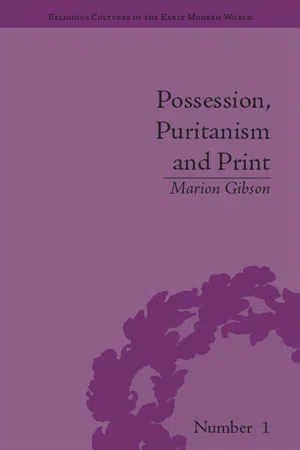
eBook - ePub
Possession, Puritanism and Print
Darrell, Harsnett, Shakespeare and the Elizabethan Exorcism Controversy
- 218 pages
- English
- ePUB (mobile friendly)
- Available on iOS & Android
eBook - ePub
Possession, Puritanism and Print
Darrell, Harsnett, Shakespeare and the Elizabethan Exorcism Controversy
About this book
1 A Literary Geography of Exorcism: ‘Farre from the Eye of Justice'
DOI: 10.4324/9781315653297-2
Beginnings: Mansfield
When John Darrell was released from prison in London in 1599, he vanished, keeping his whereabouts secret for a period of eight years until he reappeared in the records of an ecclesiastical court, and was shown to be living at Teversal in Nottinghamshire. But although his disappearance was initially by design, for Darrell it was merely a return to the condition in which he was born and lived in his home town of Mansfield in the years c. 1562–75. The lives lived in Mansfield in the late sixteenth century were only written as they touched such bodies as the church, the civil administration or the courts. And many of these records are now lost. Darrell’s story is one of an emergence into view, and then into text, because what he had been quietly doing and the beliefs that he had been quietly holding for over a decade had suddenly been raised to prominence by geographical, literary and political accidents. Darrell was noticed, and became an author, because other people perceived him – rather suddenly – as a threat and some began to write urgently about his activities, attacking or defending him. So we still have only these two views of his life – offensive and defensive, both from polemical angles. His history is thus the history of texts, of attitudes to writing and its purposes. And in Mansfield in the 1560s and 1570s there was literally nothing about John Darrell that anyone thought worthy of committing to paper for posterity.
Darrell was probably born in Mansfield in the early 1560s, the son of Henry Dorrell and his wife, who is not named in the records.1 But there is no record of his baptism in the church of St Peter, and the silence about his early life is deafening. It is typical of its time and place, however. Mansfield was a small market town, far from the centres of power, and not the residence of any significant courtier or divine, governmental or educational institution. Darrell probably attended the Free Grammar School, which was founded in 1561 in a cottage near the church. His father leased property from the governors and seems to have been one of their number. Henry had in farm a watermill and windmill at Mansfield, the rent from which, with other mills, contributed thirty pounds a year to pay the schoolmaster and usher.2 In the late 1570s he and his fellow millers were accused of impeding the water rights of William Cotton, lessee of the Queen’s Mills at Mansfield, so that his name and business dealings were recorded in some detail. In the lawsuit is evidence of a violent, if confused, antipathy between the ways of a declining world of obligation and automatic deference and a new world of competition and upward mobility. Henry and his colleagues had been challenging the right of the Queen’s Mills to mill all the corn of the manor of Mansfield, as had been the practice formerly, and they had made some powerful conservative enemies. Landowners could still sometimes behave like warlords and Sir John Byron (who would one day sit in judgment on Henry Dorrell’s son John) had supported Cotton by sending some of his men to attack Henry’s Memotte Mill. They had severed troughing and demolished a weir, according to several witnesses.3 Like his son, Henry was in trouble for asserting new freedoms, which seemed to others an attack on order itself, justifying extreme repression. And like his son, his actions therefore created a textual trace.
The Darrells seem to have been ambitious, and John went to Queens’ College, Cambridge, in autumn 1575. His life became interesting to record-keepers at this centre of power and learning. The College was also the choice of a number of fellow godly whose lives would intersect with his – the Earls of Huntingdon and their relatives the Hastings family, the Bowes family and the minister Richard Rothwell, whom Darrell must have known at Queens’. The Hastings or Bowes family might have helped to him to get a place: we do not know. But he went as a poor scholar, a sizar, which meant that his father did not have enough money to pay his fees, lodging and other costs and that he had no wealthy patron to do so. Sizars were boys supported by scholarship money from the College and by their own work – waiting on tables in the College, reading the Bible aloud during meals and running errands for fellows and the president. Darrell was one of some twenty sizars, in a community of about one hundred and twenty fellows and scholars at the College. He would have worked alongside College servants and his reputed egalitarianism may have begun then. He certainly would not have lived the high life like fellow-Queensman Anthony Byron, who in 1576 got into trouble for marrying illegally, and becoming simultaneously engaged to another girl.4 Sizars were expected to behave impeccably, and since they were dependent on the College they tended to do so. The terms of Darrell’s scholarship also meant that he had to take his Bachelor of Arts degree four years after his entry, which was then the earliest possible moment: this meant studying hard.
Undergraduates studied the trivium; grammar, rhetoric and logic, and the last two years of their studies also introduced them to moral, natural and metaphysical philosophy. It was a broad preparation for Darrell’s life as a preacher and writer. Students’ education was also supposed to continue in pious activities – sermons, with note-taking and discussions, and religious groups debating passages of scripture, such as that led by Laurence Chaderton at Emmanuel College. However, Darrell’s religious radicalism does not seem to have had its origin at Cambridge. The presidents during his time at Queens’ were William Chaderton and Humphrey Tyndall, both orthodox men. Chaderton in particular regarded the presbyterian controversies of the time as tantamount to rebellion, although he was sympathetic to moderate godliness. Of Cartwright’s lectures on church government in 1570 he wrote:
such errors and schismes openlie taught and preached, boldlie and without warrant, are latelie growne amongst us, that the good estate, quietnes, and governance of Cambridge, and not of Cambridge alone, but of the whole church and realme, are for great hazard unles severlie by authorities they be punished.
He did not change his view, and when he left Queens’ in 1579, he became successively Bishop of Chester and Lincoln.5
Queens’ enjoyed the attentions of the Earl of Leicester – Chaderton’s and Tyndall’s own patron but also the leading reformist at court – but there were only two fellows whose godliness was notable. Leicester had pushed his chaplain, Robert Some, into a fellowship and Some continued to attack Church governance throughout Darrell’s period there. Another fellow, Edmund Rockrey, was expelled for similar views, but by the time of Darrell’s arrival had returned, refusing to wear vestments, academic dress or to receive communion. Darrell must have been familiar with the controversies eddying around godly men at the University. But if he felt sympathy with them there is no evidence that he acted upon it. He completed his studies quietly, with a single interruption when plague broke out at the College in 1578, and took his degree (by participating in public disputations) in 1579. There is a discrepancy, however, in the dating of his return to the Midlands. He says in a book written in 1599–1600 (published 1600) that he left the University ‘about eightene years past’: thus, in 1581 or 1582. Did he take a Masters degree which is unrecorded and – even more unlikely – unmentioned during the controversy over exorcism? Did he begin study, continue as long as his funding lasted (three years after the BA) and then leave without taking the degree? The three years of MA study focused on arithmetic, geometry, music and astronomy. Perhaps Darrell found himself in academic, financial or other difficulty. If he had been in trouble for religious or behavioural reasons it would certainly have appeared in the later controversy, for Darrell said that Samuel Harsnett had made enquiries about him at Cambridge, with the intention of writing up and publishing anything discreditable. But he, and the records, again tell us nothing. Darrell was not interested in his own biography, except where it related to what he saw as the works of God.6
He certainly returned home to the Midlands, however, in the early 1580s and says that he lived at Mansfield and then Bulwell near Nottingham in the period to about 1584–5. On 24 January 1583/4, he married Joan (Johane) Gadsbery in St Peter’s Church, Mansfield. Little more is known of his wife’s family – the register-keeper even stopped recording the surnames of brides at one point, neatly demonstrating once again the selectivity of texts. Sometime after his marriage – in 1599–1600 he tells the reader that it was ‘about fifteene yeares past’ – Darrell went to London to study common law. But his period at the Inns of Court was unsuccessful. As he explains:
the Lorde (who had longe before purposed to imploye me otherwise, and in the studye of an other [l]aw) did draw me another waye, by layinge his hande upon me, in causinge a strange and extraordinary sluggishnes to fall upon me.
He found that he wanted to work on men’s souls, not their worldly goods and rights, and gave up study after a year. In 1599 Harsnett took a swipe at Darrell’s allies during his trial, the common lawyers, by claiming that ‘having begunne the study of law, he perceyved therein such great corruption, as he gave him selfe to the study of Divinity, that so hee might serve God, and keepe a good conscience’. Darrell denied that he thought lawyers corrupt: ‘the common lawes I hold and ever did since I studied them, to be grounded upon the lawe of God and reason’. It is possible, however, that his beliefs were radicalized by the preachers at the Inns of Court. Richard Bancroft regarded them as ‘Seducers’ of law students, by whose means ‘the flower of the Gentilitie of England … [is] trayned up in a disobedient mislikinge of the present estate of the Churche’.7 And shortly after Darrell’s return from London he participated in the dispossession of Katherine Wright, which we shall discuss in this chapter. This suggests that his commitment to godliness was now a strong one. He was also ready to begin writing about it, although not in published form.
Meanwhile, Darrell’s family began to grow. In 1584/5, on 8 February, John and Joan’s first recorded child, Margery, was christened in Mansfield, on 30 July 1586 her sister Elizabeth, and on 18 January 1587/8 another daughter, Ellen. Sadly, either Ellen or Elizabeth died and was buried in summer 1587. The register is damaged and unclear: the month is not certain and the child’s name may be Ellin or Ellis, which is elsewhere (although inconsistently) used as an abbreviation for Elizabeth. On 2 March 1588/9, Armada year, the Darrells’ son, Thomas, was christened. This is the last entry in the Mansfield register relating to John Darrell. Another child must have been born elsewhere, probably at Bulwell where the register is now lost, for by 1599 Darrell describes himself as having five children (only two children are recorded as having later been born to the Darrells, one of whom died as an infant, as we shall see). Darrell’s father and stepmother did not live long to enjoy their grandchildren, however. On 3 June 1589 Ellis (presumably Elizabeth), the wife of Henry Darrell, was buried, and Henry Darrell himself was buried on 15 August of the same year. John inherited his father’s property, as the eldest or only son – no will or other paperwork has yet been found to offer clarification – and he continued his father’s businesses. On 27 April 1591 a woman who was probably his mother-in-law, Joyce Walby alias Gadbury, died and he was granted administration of her estate by Mansfield manorial court.8 He was also ordained soon after Henry Dorrell’s death. There is no official record of this important event either, although Darrell would have had to produce a copy of his certificate and preacher’s licence(s) if asked. It is infuriating to know so little about the crucial religious experiences that made him so controversial in later life, but entirely typical. Although spiritual autobiography was to become a godly genre, it is not yet in evidence in Darrell’s world.
These previously unexplored records show that Darrell stayed in Mansfield until at least April 1591. There is also another text showing that his godliness was now evident, and was well received. William Horner Groves represents him in his 1894 History of Mansfield as ‘minister of the Puritanical sect in the town’, but his account makes unjustified assumptions and it is unlikely that Darrell held any such separatist-sounding position. He was, however, an occasional lecturer at the church, as its accounts show. He preached at St Peter’s in 1589, and a gift of ten pence worth of wine and sugar to him is recorded among ‘disbursments for the P’cher’. There was a preacher in residence, who lodged in a room belonging to the schoolmaster and received a wage of twenty shillings a year. But there were payments to a number of preachers other than Darrell in 1589, the only year for which accounts survive. In the 1580s, money was plentiful and the parish was very committed to a preaching ministry. This, with the establishment of an exercise at Mansfield, suggests that godliness was active there – although very sensibly an hourglass was also purchased out of the moneys allocated for preaching, to make sure sermons kept to time.9 There are other indications of godly sympathies in the town: in 1574 two Mansfield men had been presented to the Archdeaconry Court for nonconformity, one of whom had remarked that ‘M[aster] Archdeacon knoweth no more what a puritane is then his ould horse’ and ‘preached suche doctrine, that by goddes worde, yf [I] mette with him, [I] aught not to bidde him good morrowe’.10 Later Mansfield would become a haven for the godly, like Darrell’s fellow-exorcist Richard Rothwell, and Quakers. It is not hard to see why Darrell felt at home there, but he presumably also wanted further engagement with the spiritual life beyond his home town.
‘In an Obscure Place': Eckington and Whittington
Darrell must have established a reputation in Mansfield as a godly man whilst still in his early twenties. This may be why, in about 1586, he was called upon to help dispossess a young woman of seventeen or eighteen years of age, Katherine Wright of Eckington in Derbyshire. Wright lived in the hamlet of Ridgeway Lane with her mother Cecily and stepfather, a ‘poor’ cutler named John Mekin. He had beaten her, she said later, and she had become ill as a result. Mekin was a controversial figure in Eckington, appearing in the manorial court records very regularly. In the period leading up to Wright’s ‘possession’, he was fined for letting his animals stray (1579) and for his reluctance to use the lord of the manor’s mills (1583, 1584), he settled a dispute with Philip Ibbotson (1581), was complained against for trespass and debt (1581, 1585), and complained himself against others (1582). Interestingly two of those accusing him of trespass, and being accused by him, were Thomas and Robert Wright, and although it has proved impossible to establish their exact relationships, it sounds as if there was dispute over the lands of Cecily Mekin, formerly Cecily Wright. Katherine’s statements suggest that Mekin treated his wife badly as well as his stepdaughter. In 1587 the battle between the Wrights and the Mekins came to a head with two accusations of trespass and of debt made against the Mekins. The Great Court decided on 29 April 1588 that lands held by Cecily Mekin for her lifetime had been granted without the permission of the lord of the manor to Laurence Stansall in 1585, and as a result the lands were seized by the bailiff.11 This ended the dispute in the court, but neither party can have been pleased with the outcome.
The Mekins’ unofficial land transaction in 1585, which earned them an unspecified but sizeable sum, was against the background of the 1585 debt suit mentioned above. It was brought against John Mekin by William Hill; the Hills were tenants of land that Cecily Mekin leased. Mekin denied that he owed anything, much less the three shillings and four pence claimed. But on 31 January 1586 the Great Court found for Hill. They decided that Mekin owed him three shillings and three pence, with damages of one penny, costs of five pence and they imposed a further fine of two pence. It was just after this that Katherine Wright began to complain of illness, and beatings. She could not sleep, felt light-headed and began to swell, which she believed was caused, she later told Harsnett and his fellow-examiner William Pigott, by ‘some stopping of humours, not unknowne to divers women’. As she was going to the well one morning, she said she saw a vision of a child without feet, and when she told her stepfather about this, he began to behave more kindly towards her. The visions stopped, but to keep Mekin’s favour Wright continued to fake fits. She would scream and fall down, and (according to the pro-Darrell pamphlet The Triall of Maist. Dorrell) so often seemed about to fall into fire, water or the well that she was chained to a post. She also tried to cut her own throat. Drink spouted up to the ceiling when it was offered to her – said the author of The Triall, excitedly adducing evidence to prove that, whatever Wright later said, she could not have faked her symptoms. The High Commission, who in 1598 tried Darrell for teaching Wright as well as Sommers to counterfeit, was never going to accept that her possession was real, but her account of the abuse by Mekin bought her sympathy when they questioned her: her examiner Samuel Harsnett portrays Wright as living a pitiable life of toil and subjection in the back end of beyond.12
According to her own account, Wright had found a way of escape: her condition became known to her neighbour Edward Beresford of Cutthorpe-in-Brampton, and ‘mooved in compassion’, he took her into his home. Her father’s house, Harsnett reports, ‘was no fitte place to give entertainement to any that should come to helpe her’. Beresford seems to have considered a range of remedies, as it was usual to try other treatments before a possession was formally identified. He strongly believed in Wright’s affliction. It may have been because of his involvement (and that of his brother John) that Gilbert Talbot, the seventh Earl of Shrewsbury, who knew the Beresfords well through shared interests in Chesterfield, later attended the proceedings of the High Commission against Darrell. During the trial, we know that Beresford attempted to create a new text about the case. He tried to write an account of Wright’s symptoms and his proceedings, but Harsnett took away his paper: the last thing that he wanted was another godly me...
Table of contents
- Cover Page
- Half-Title Page
- Title Page
- Copyright Page
- Table of Contents
- Acknowledgements
- Introduction
- 1 A Literary Geography of Exorcism: ‘Farre from the Eye of Justice’
- 2 ‘A Booke Declaring the Fearfull Vexation’: Spreading the Word
- 3 ‘Sinnful, Shamfull, Lying and Ridiculous’: The Possession of William Sommers
- 4 ‘Pare thy Nails, Dad’: Authority and Subversion in Possession Narratives
- 5 Dialogicall Discourses and Summarie Answeres
- 6 The Madman in the Wilderness
- Notes
- Works Cited
- Index
Trusted by 375,005 students
Access to over 1.5 million titles for a fair monthly price.
Study more efficiently using our study tools.
Frequently asked questions
Yes, you can cancel anytime from the Subscription tab in your account settings on the Perlego website. Your subscription will stay active until the end of your current billing period. Learn how to cancel your subscription
No, books cannot be downloaded as external files, such as PDFs, for use outside of Perlego. However, you can download books within the Perlego app for offline reading on mobile or tablet. Learn how to download books offline
Perlego offers two plans: Essential and Complete
- Essential is ideal for learners and professionals who enjoy exploring a wide range of subjects. Access the Essential Library with 800,000+ trusted titles and best-sellers across business, personal growth, and the humanities. Includes unlimited reading time and Standard Read Aloud voice.
- Complete: Perfect for advanced learners and researchers needing full, unrestricted access. Unlock 1.5M+ books across hundreds of subjects, including academic and specialized titles. The Complete Plan also includes advanced features like Premium Read Aloud and Research Assistant.
We are an online textbook subscription service, where you can get access to an entire online library for less than the price of a single book per month. With over 1.5 million books across 990+ topics, we’ve got you covered! Learn about our mission
Look out for the read-aloud symbol on your next book to see if you can listen to it. The read-aloud tool reads text aloud for you, highlighting the text as it is being read. You can pause it, speed it up and slow it down. Learn more about Read Aloud
Yes! You can use the Perlego app on both iOS and Android devices to read anytime, anywhere — even offline. Perfect for commutes or when you’re on the go.
Please note we cannot support devices running on iOS 13 and Android 7 or earlier. Learn more about using the app
Please note we cannot support devices running on iOS 13 and Android 7 or earlier. Learn more about using the app
Yes, you can access Possession, Puritanism and Print by Marion Gibson in PDF and/or ePUB format, as well as other popular books in History & British History. We have over 1.5 million books available in our catalogue for you to explore.