Taking Teaching Seriously expands and enriches discussions about teacher preparation in the United States. Its authors describe the unique contexts for teacher preparation offered by liberal arts institutions and analyze the effects of these programs on their graduates and on K12 schools. They emphasize that the goals and conditions for teacher preparation differ from larger public institutions in several key respects including supervisor-student teacher relationships, philosophical foundations, and approaches to clinical fieldwork. Taken together, the essays provide compelling evidence that educational studies programs in liberal arts colleges and universities constitute a vital component of the teacher education system in the United States.
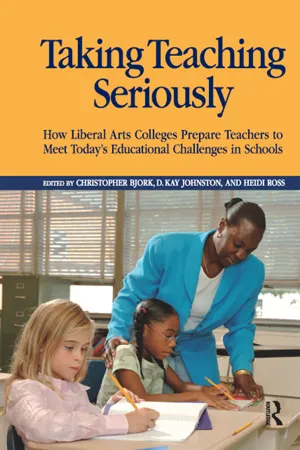
eBook - ePub
Taking Teaching Seriously
How Liberal Arts Colleges Prepare Teachers to Meet Today's Educational Challenges in Schools
- 250 pages
- English
- ePUB (mobile friendly)
- Available on iOS & Android
eBook - ePub
Taking Teaching Seriously
How Liberal Arts Colleges Prepare Teachers to Meet Today's Educational Challenges in Schools
About this book
Information
1
Introduction
Taking Teaching Seriously is designed to expand and enrich discussions about teacher education in the United States. Over the last decade, dissatisfaction with the quality of instruction provided in public schools provoked a reexamination and revision of teacher certification policies (Coleman & DeBey, 2000; NCTAF, 1996; Wise et al., 1988). Resulting pressure to reform teacher education programs prompted states to enact policies that mandated high-stakes assessments for licensure, rigorous accreditation standards for teacher education programs, and more complex certification procedures (Darling-Hammond et al., 1995). In addition, reports published by the Carnegie Task Force on Teaching as a Profession and the Holmes Group advocated for the elimination of undergraduate teacher education. These trends toward increased accountability and high-stakes testing have produced intense stress on all involved in the preparation of prospective educators (Barksdale-Ladd & Thomas, 2000).
Although much attention has been paid to the challenges teacher education programs are currently facing, research on reforming teacher education tends to draw conclusions and provide recommendations based on the conditions, resources, and educational cultures of large research universities (Angus, 2001; Cochran-Smith & Zeichner, 2005). State departments of education and commissions, too, have failed to assess the effects of education policy on students and faculty at liberal arts institutions (Travers & Sacks, 1989). Likewise, the experiences of liberal arts institutions are rarely considered when decisions are made about the most effective approaches to teacher education. This oversight on the part of policymakers and scholars is unfortunate in that it essentially means that widely held assertions about “liberally trained” teachers go unexamined at the same time teacher certification and accreditation of teacher education programs are undergoing rapid reform. In calling attention to the experiences of teacher education programs at liberal arts colleges, we are not offering yet another prescription for the best model of teacher education. Rather, our point is there is no one winner in the “horse race” of teacher education, and if we “ignore the wide range of quality that exists within all models, we will continue to be disappointed in the results” (Zeichner & Schulte, 2001, 280).
We firmly believe that the needs of large research and/or state universities should not become the sole basis for the prescriptions and regulations that guide the education of future teachers. The programs described in this book are not programs funded and found at large research and/or state universities. Nor are they so-called alternate routes to certification. Alternate routes seem to promote the idea that not much beyond a liberal arts degree is necessary in order to teach well. The programs described in this book suggest that a liberal arts degree alone is not enough to teach well, but that programs teaching students to teach in the context of a liberal arts institution are important avenues in the education of teachers. In these programs individual attention is paid to students and relationships are formed that often last long after a student has graduated. These programs provide an important education for future teachers, and this book documents what that education looks like in a variety of contexts and how those educated in these contexts work in the challenging world of teaching.
As the authors will illustrate, education faculty working in liberal arts institutions often feel compelled to respond to multiple pressures within the institutional and bureaucratic contexts in which they operate. As they make decisions about how best to prepare new teachers, these scholars must balance forces that are not always in alignment. They must balance demands to hold students to high standards but also to resist standardization. They must balance pressure to meet the bureaucratic requirements imposed by government agencies with the desire to develop in students a stance of critical inquiry. They must balance their obligation to prepare students to enter the teaching profession with the mission of liberal arts education. The authors describe how they keep their programs in balance, despite the tensions and conflicts they must constantly negotiate.
The chapters in this book describe a variety of teacher education programs at liberal arts institutions. While the differences in these programs are important to note, the commonalities across these chapters help us to focus on what is important in teacher education. All of the authors describe ways that liberal arts teacher education programs educate teachers to think in complex ways and, most especially, to continually shape their practice to fit the unique characteristics of the students they teach.
The authors are telling us to pay attention to what has been called transformative education and to resist simplistic ideas about teacher accountability and education that simply transmits knowledge. We need to attend to these voices and ideas in an age of accountability narrowly defined and measured. In some ways the teacher educators writing in this book are talking back to the voices that tend to dominate discussions about teacher education. They acknowledge that five-year programs, alternative routes to certification, and undergraduate programs at large public universities all represent viable options for individuals considering careers in teaching. However, liberal arts teacher education programs should be included on that list, because carefully designed and implemented programs, such as the ones profiled in this volume, also provide pre-service teachers with a solid foundation in theory, combined with frequent opportunities to hone their instructional skills in classrooms. In addition, they prepare teachers to be lifelong learners and critical thinkers. The chapters that follow will supply abundant examples of the specific benefits—for students, schools, and the teachers themselves—of this last point.
These descriptions move from discussions of policy, to descriptions of programs, to descriptions of the teachers who are students or who graduated from these programs. In many ways each chapter focuses on a different aspect of teacher education within the context of a liberal arts education. Yet even as each author takes a slightly different approach to thinking about teacher education, there is remarkable similarity in what they tell us. All discuss the importance of teaching and learning and learning to teach well—within a context of critical thinking. These authors refuse to accept an outsider’s definition of what should be happening in a classroom, and refuse to decontextualize learning. They emphasize to their students the importance of locating the classroom and the school within the context of neighborhood, city, country, and dominant social ideas. There is a call by these authors to think of education not only in relationship to schools, but in a broader sense, for as Lesnick et al. write, teaching and learning are profoundly enmeshed in all of life. Another theme repeated in the chapters is the idea that education is a way to make our society better, more equitable and just.
The title of this volume draws inspiration from a widely quoted article examining the process of “taking learning seriously” by educational researcher Lee Shulman. Shulman argues that “learning is basically an interplay of two challenging processes—getting knowledge that is inside to move out, and getting knowledge that is outside to move in” (Shulman, 1999, 10). Liberally trained student teachers come to understand that taking teaching seriously begins with what they and their students know (inside knowledge), builds upon the “outside knowledge” they receive from both their liberal arts training and their field experiences, and scaffolds further learning through collaborative reflection upon the relationship between the two.
All of the authors suggest ways that graduates of these programs are learning to meet the challenges facing education today. They are indeed taking teaching seriously and they are also taking the context in which teaching occurs seriously. They are not ignoring high standards and accountability, but are resisting simplistic ideas about these current trends in education. They are saying that the public perception about the purpose of education “needs to be reimagined,” as Johnston and Ross argue in this volume, and they are holding fast to the ideas and ideals of transformative education—education should not only convey information, it should also work toward a more just society.
REFERENCES
Angus, D. L. 2001. Professionalization and the public good: A brief history of teacher certification. Washington, D.C.: Thomas B. Fordham Foundation.
Barksdale-Ladd, M. and K. Thomas. 2000. What’s at stake in high-stakes testing. Journal of Teacher Education 51(5): 387–397.
Cochran-Smith, M. and K. M. Zeichner, eds. 2005. Studying teacher education: The report of the AERA panel on research and teacher education. Mahwah, NJ: Lawrence Erlbaum Associates, Publishers.
Coleman, D. and M. DeBey. 2000. Weaving teacher education into the fabric of a liberal arts education. Phi Delta Pi Record 36(3): 116–120.
Darling-Hammond, L., A. Wise, and S. Klein. 1995. A license to teach: Building a profession for 21st century schools. Boulder, CO: Westview Press.
National Commission on Teaching and America’s Future (NCTAF). 1996. What matters most: Teaching for America’s future: Summary report. New York: National Commission on Teaching and America’s Future 1996.
Shulman, L. 1999. Taking teaching seriously. Change 31(4): 10–17.
Travers, E. F. and S. R. Sacks. 1989. Joining teacher education and the liberal arts in the undergraduate curriculum. Phi Delta Kappan (February): 470–474.
Wise, A., L. Darling-Hammond, and S. Purnell. 1988. Impacts of teacher testing: State educational governance through standard-setting. Santa Monica, CA: RAND Corporation.
Zeichner, K. M. and A. K. Schulte. 2001. What we know and don’t know from peer reviewed research about alternative teacher certification programs. Journal of Teacher Education 52(4): 266–282.
Part I
Contested Views of Effectiveness and Professionalism in Undergraduate Institutions
We open the book with three chapters that identify key issues and questions that will be explored in greater depth in succeeding sections. These essays look across states and programs, grappling with tensions between the ideal and the practical in the field of teacher education. Not surprisingly, all three discuss practices at liberal arts institutions with reference to policy trends that have forced education departments across the country to rethink, sometimes restructure, the programs they offer to students interested in becoming teachers. Moving back and forth between political debates about teacher education and strategies employed on liberal arts campuses, the authors highlight the value of connecting policy and practice when considering possible reform approaches. Grounding their arguments in specific examples from the field, the authors avoid the temptation of resorting to hypothetical or ideological argumentation, an approach that is all too common in publications on this topic. Among the issues that are raised in this opening group of essays are the following: What types of professional knowledge should be emphasized during pre-professional preparation? Which factors support and impede an institution’s ability to cultivate effective teachers? What kind of an impact is the current political environment having on education departments and programs in liberal arts institutions?
Chapter 2, “Teaching to Higher Standards: From Managing to Imagining the Purposes of Education,” began as an op-ed piece for Teachers College Record written by D. Kay Johnston and Heidi Ross. The thinking in this essay provided the springboard for a series of conversations among liberal arts teacher educators that evolved into this book. While writing the essay, Johnston and Ross felt at odds with the standards movement and with accreditation institutions, which seemed to be framed by a discourse largely defined by the research university. Likewise, they felt their goals of education distorted as they negotiated what Irving Epstein calls the “delicate balance” between an ethos of liberal al learning and the high degree of state control that defined teacher education requirements. Johnston and Ross argue that in focusing discussions about teaching and learning solely on issues of accountability, we run the risk of oversimplifying questions that pre-service instructors and teacher educators should be grappling with in all of their complexity. We also run the risk of flattening the purpose of education to one that is only about learning information.
Chapter 3, “Teacher Education in Liberal Arts Institutions: An ‘Intellectual-Educational’ Endeavor,” focuses on the ways in which the current framing of discussion about reforming teacher education has created challenges for teacher educators working in small liberal arts colleges. In this chapter, Christopher Bjork examines the structure, goals, and effects of a sample of ten teacher education programs at liberal arts institutions located around the country. Bjork analyzes these programs through the filter of Seymour Sarason’s vision for “rethinking the preparation of educators” (Sarason, 1993). Sarason’s study highlights the attitudes and attributes that educators need to succeed in contemporary schools and links these to specific practices in teacher education programs that can develop those qualities in their students. This perspective, which is usually absent from publications about education, expands our understanding of what teacher education can and should accomplish.
In the final chapter in this section, Irving Epstein builds on several of the questions raised in the first two chapters, tracing them to deeper political issues connected to the preparation and evaluation of teachers. He posits that, unlike practitioners of the traditional liberal arts disciplines, proponents of standards-based systems have sought and obtained political protection to guarantee the legitimacy of the professional knowledge that they argue is essential to the preparation of future teachers. In so doing, they have established a professional knowledge base that is in direct conflict with core values and concepts traditionally associated with the liberal arts. Using examples of policies enacted in the state of Illinois to support his assertions, Epstein shows how this situation places education faculty within the liberal arts college in vulnerable positions, particularly because their political and social influence within the educational profession has not been strong historically.
REFERENCES
Sarason, Seymour. 1993. The case for change: Rethinking the preparation of educators. San Francisco: Jossey-Bass.
2
Teaching to Higher Standards: From Managing to Imagining the Purposes of Education
We write this essay as the former and current chairs of the Department of Educational Studies at Colgate University. Three years of revising Colgate’s teacher education program have left us with serious reservations regarding our national conversation about education. Simply put, national discourse on education has narrowed to a single-minded focus on testable standards. Our concern about the poverty of this measure for educational excellence grows from our challenge to align our liberal arts approach to educating future teachers with new state of New York requirements for teacher certification. This struggle has made clear to us that standards discourse obscures what in fact should be our primary conversation—the purposes of education. Separated from sustained debate about the ends of education, our public conversation about high standards has been narrow, instrumentally conceived, and isolated from the diverse needs and resources of school communities.
Since 1996, the New York State Department of Education has mandated the gradual implementation of sweeping reforms in student learning standards and standards for teacher preparation. Requirements for teacher education programs, which go into effect in the autumn of 2001, are linked to student learning standards that are assessed through statewide examinations.
We have been revising our teacher education program from a position of strong institutional support. In fact, the preparation of teachers at Colgate University is recognized as integral to the liberal arts mission and an all-university responsibility. How is it then, when flexibility, risk-taking, tolerance, and global vision are the qualities of the post-modern knowledge worker, that educating teachers through a liberal arts curriculum has become so difficult?
A careful reading of the Regents’ Task Force on Teaching, Teaching to Higher Standards: New York’s Commitment, and their most recent strategy for the year 2000, provide part of the answer. Neither document requests or inspires reflection upon the purposes of education. Substituting discrete outcomes for educative purpose, both direct us toward “setting higher standards, building capacity, and accounting for results.” The instrumentalism of this charge reflects the managerial control and economic rationalism that have been used to restructure other public services. Higher standards are presented as not only desirable but separable from serious deliberation about the multiple ways they might be achieved and from serious attention to the resources, both human and financial, necessary for that end.
The poverty of ideas about the purpose of education that results from standards discourse deprives our educational conversation and imagination of complexity and nuance. Consider three stark examples from different states. First, Mayor Giuliani suggests tying merit pay for teachers to the test scores their students achieve. Second, schools eliminate recess from their d...
Table of contents
- Cover
- Half Title
- Title Page
- Copyright Page
- Table of Contents
- Foreword
- Acknowledgments
- 1 Introduction
- PART I Contested Views of Effectiveness and Professionalism in Undergraduate Institutions
- PART II Cultivating Liberally Educated Teachers: Distinctive Approaches of Liberal Arts Institutions
- PART III Opportunities and Obstacles for Liberal Arts Programs in Recruiting and Retaining New Teachers
- About the Contributors
- Index
Trusted by 375,005 students
Access to over 1.5 million titles for a fair monthly price.
Study more efficiently using our study tools.
Frequently asked questions
Yes, you can cancel anytime from the Subscription tab in your account settings on the Perlego website. Your subscription will stay active until the end of your current billing period. Learn how to cancel your subscription
No, books cannot be downloaded as external files, such as PDFs, for use outside of Perlego. However, you can download books within the Perlego app for offline reading on mobile or tablet. Learn how to download books offline
Perlego offers two plans: Essential and Complete
- Essential is ideal for learners and professionals who enjoy exploring a wide range of subjects. Access the Essential Library with 800,000+ trusted titles and best-sellers across business, personal growth, and the humanities. Includes unlimited reading time and Standard Read Aloud voice.
- Complete: Perfect for advanced learners and researchers needing full, unrestricted access. Unlock 1.5M+ books across hundreds of subjects, including academic and specialized titles. The Complete Plan also includes advanced features like Premium Read Aloud and Research Assistant.
We are an online textbook subscription service, where you can get access to an entire online library for less than the price of a single book per month. With over 1.5 million books across 990+ topics, we’ve got you covered! Learn about our mission
Look out for the read-aloud symbol on your next book to see if you can listen to it. The read-aloud tool reads text aloud for you, highlighting the text as it is being read. You can pause it, speed it up and slow it down. Learn more about Read Aloud
Yes! You can use the Perlego app on both iOS and Android devices to read anytime, anywhere — even offline. Perfect for commutes or when you’re on the go.
Please note we cannot support devices running on iOS 13 and Android 7 or earlier. Learn more about using the app
Please note we cannot support devices running on iOS 13 and Android 7 or earlier. Learn more about using the app
Yes, you can access Taking Teaching Seriously by Christopher Bjork,D. Kay Johnston,Heidi A. Ross in PDF and/or ePUB format, as well as other popular books in Education & Education General. We have over 1.5 million books available in our catalogue for you to explore.