- 325 pages
- English
- ePUB (mobile friendly)
- Available on iOS & Android
eBook - ePub
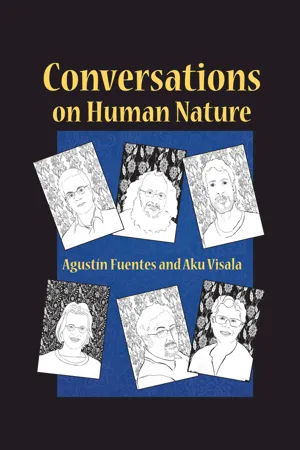
Conversations on Human Nature
About this book
Recent empirical and philosophical research into the evolutionary history of Homo sapiens, the origins of the mind/brain, and the development of human culture has sparked heated debates about what it means to be human and how knowledge about humans from the sciences and humanities should be understood. Conversations on Human Nature, featuring 20 interviews with leading scholars in biology, psychology, anthropology, philosophy, and theology, brings these debates to life for teachers, students, and general readers. The book-outlines the basic scientific, philosophical and theological issues involved in understanding human nature;-organizes material from the various disciplines under four broad headings: (1) evolution, brains and human nature; (2) biocultural human nature; (3) persons, minds and human nature, (4) religion, theology and human nature; -concludes with Fuentes and Visala's discussion of what researchers into human nature agree on, what they disagree on, and what we need to learn to resolve those differences.
Information
Chapter 1
Defining and Debating Human Nature
There are some that believe human nature to be an outdated, old-fashioned notion. Does not Darwinian evolutionary biology deliver us from essentialism? Is it not crudely deterministic and reductionistic to claim that we humans have some core properties? Such questions and problems have led many to reject the notion of human nature. We do not share these sentiments. There are many reasons why the notion is still useful and relevant.
One reason is that human nature has recently become a hot topic of debate in the sciences. Indeed, the last few decades have seen an unprecedented surge of empirical research into the evolutionary history of Homo sapiens, the origins of the mind/brain and human culture. The research and its popular interpretations have sparked heated debates about the nature of human beings and how knowledge about humans from the sciences and humanities should be properly understood.
Compare, for instance, Steven Pinker's The Blank Slate: The Modern Denial of Human Nature (2002) and Jesse Prinz's Beyond Human Nature: How Culture and Experience Shape the Human Mind (2012), to see how wildly experts disagree on the topic. For some, human nature is an enemy that needs to be abolished or an outdated scientific idea, whereas for others, it is the cornerstone of the scientific study of humanity.
Representatives of evolutionary psychology, for instance, fall into the latter camp. Pinker, among others, has argued that behind the dizzying variety of human cultures, lays a universal psychology that strongly constrains possible expressions of human thinking and behavior. Furthermore, this universal psychology is largely innate in the sense that its various aspects are adaptations to the challenges that humans faced during the last two million years of our evolution. The driving force behind the evolutionary psychologists program, it seems, is the conviction that biological and psychological sciences can and will answer our questions about human nature.
Critics have maintained that not only are these programs based on questionable philosophical and methodological assumptions, but they also fail to account for all the relevant data. Cultures and behaviors are far too diverse to be accounted for by invoking an innate, universal cognition. Furthermore, recent developments in evolutionary theory seem to challenge the strong adaptationism underlying the arguments of evolutionary psychologists.
One possible option is to see a much closer integration of cognition and culture in human evolution and development along the lines of niche-construction or gene/culture coevolution theories.1 This would mean, however, that we could not identify human nature with a set of innate cognitive mechanisms. Instead human nature should be sought from our flexible capacity to create and sustain culture and be shaped by it.
Another reason for the sustained interest in the idea of human nature has to do with human universals. Anthropologists have long sought to identify both universal and distinct features in human cultures. Are there patterns in human cultural diversity or not? If a common ground between cultures could be found, perhaps that could function as a basis for shared ethical views. If there indeed is a biologically determined universal human psychology as evolutionary psychologists suggest, we should expect to see some general patterns or structures.
The quest for uniquely or distinctively human traits has also been of great interest to biologists, psychologists, and anthropologists. What, if anything, distinguishes humans from other animals? How are the psychological and biological traits that contemporary humans possess related to those of their long-dead ancestors?
Finally, one reason why human nature is relevant is that the notion carries with it strong ethical and political dimensions. Whether or not there is such a thing as human nature can surely make a difference in the way we live our lives. Take just one debate as an example.
Philosopher John Gray caused controversy in intellectual circles by arguing for a certain kind of nihilistic view of human nature. In his collection of essays The Straw Dogs (2002), Gray argues that the radical political and ethical consequences of human evolution have not been fully recognized. In his view, popular advocates of evolutionary naturalism, like Richard Dawkins, have failed to realize the radical consequences of their views; they hold onto a humanistic view of humans and human progress, even after giving up the metaphysical framework of Christian theism. For Gray, humanism and the faith in human progress are incompatible with an evolutionary view of humans. Given our biological imperatives, altruism and morality are both dropped at the first sign of trouble and self-preservation will take over. Our complex ethical systems are slaves to our passions and our passions are geared for survival and power, not collaboration or kindness.
For Gray, war and genocide are at least as deeply ingrained in human nature as art and prayer. Moral progress and technological progress do not necessarily go hand in hand: moral change is cyclical rather than linear. Technological progress can thus produce both better healthcare and more advanced tools of destruction.
It is not a surprise that Gray has received a lot of flak from his fellow intellectuals. One of his opponents, neurologist and philosopher Raymond Tallis, argues for a different interpretation for biological and neuroscientific results. Indeed, Tallis's Aping Mankind: Neuromania, Darwinitis and the Misrepresentation of Humanity (2009) offers a sustained critique of all who attempt to deny our freedom, morality, or consciousness on the basis of biology and neuroscience.
Tallis accuses Gray and others of unjustifiably reducing "human worlds" to crude biologically determined worlds. Tallis claims that humans have inherited a dual nature that includes tendencies towards both violence and cooperation. In addition, he emphasizes that our human nature is flexible and malleable; it is our ability to adapt to complex circumstances and shape ourselves via culture that makes moral progress possible. We are not slaves to our biology but are biologically adapted to develop ways to overcome physical, physiological, and ecological constraints.
This debate is a good example of why "human nature" is still a relevant concept. What does biology actually say about the origins of human morality and its flexibility? Is it true that we are slaves to our biological imperatives, or can we use our flexible minds to significantly change our behavior? These are clearly scientific issues of interest to biologists and psychologists.
But controversies about human nature do not end with biology and psychology: there are ethical, philosophical, and even theological assumptions being made. How do we ground human dignity? How should we go about forming ethical theories? Is there inherent teleology2 to nature or not and what are the implications in each case?
Human Nature from Biology? Evolution, Brains, and Human Nature
In our intuitive usage, human nature refers to something being essential, innate or shared among all human beings as opposed to being culturally specific. It seems that there is a rather robust, intuitive notion of human nature—a notion to which we might refer as the everyday or folk concept of human nature. It seems that our folk concept of human nature is a source of much confusion, because it lumps together a number of ideas that in principle could (and should) come apart.
Common notions of human nature assume a specific essence to being human, a kind of trans-historical core for all human beings. If this were true, underlying all human diversity and variation, there would be something constant, some traits, tendencies and capacities that all humans shared. Usually this is cashed out in terms of distinguishing human biology from the influence of culture and upbringing: we have the same genes (ingredients) on top of which culture and upbringing bake into the "cake" that is our final form.
This folk concept of human nature seems to entail that the essential and universal human features have the same causal history. That is to say, there is something very deep in human biology or some sort of a plan in nature itself that causes the similarities. Traditionally, in western and many other societies, such causal powers were usually attributed to something like the Soul or the Self inside the individual or the purposes of God (or gods) or the brute purposefulness of nature. It is the innate essence that is causally responsible for our uniquely and universally human features.
The third aspect of the folk concept of human nature is a normative one: given that there is a purposeful human essence, some human actions, practices, or societies are more natural than others. Unnatural is not only bad, but also wrong, whereas natural is good and right.3
With Charles Darwin's writings, a new perspective on human nature emerged. Darwin was the first to offer systematic tools and theories linking human capacities, development, and history to that of other animals: the same kinds of causes that are driving change in animals also work in the human case. This put the whole question of human nature in a new light: the move from an essentialist notion of species to an evolutionary, Darwinian notion of species as populations seemed to cast strong doubt over there being an innate essence to humanity. The Darwinian turn also seemed to undermine the teleological or normative aspects of the folk notion of human nature. Natural selection, Darwin maintained, does not work with a goal or end in mind.
While the Darwinian turn created a strong pressure to see human nature in biological, evolutionary terms, social sciences and humanities at the same time were going in a completely different direction. Nineteenth and twentieth century European thinking in philosophy and social theory had a strong tendency to reject both the everyday notion and the Darwinian notion of human nature. Marxists and existentialists, for instance, maintained that there is no such thing as a biologically given essence. For the Marxist, it is our institutions and relationships that make us what we are, and society is the sum of such relationships. However, these relationships are in no way given by nature but can be reorganized. Thus, by changing society, we change human nature. For the existentialist, it is not biology or society that determines our nature; it is instead our own will. We are thrown into the world and without the help of God or Nature must decide what we want to be. Both Marxism and existentialism, thus, point to a kind of anti-essentialism about human nature.
Hermeneutical and postmodern views propose that the proper subject of the study of humanity is the interpretation of human experience. Here a dividing line is introduced: since there is no essential, biologically conditioned human nature, human actions should not be scientifically explained but instead understood "from the inside." The sciences deal with facts, but since there are no discrete scientific facts about human behavior, another method is needed. The sciences study humans as physical and biological entities, whereas the humanities, philosophy, and theology account for the personal, the social and the religious world of humans. One of the reasons why contemporary debates about human nature have been so vitriolic is that some scientists have strongly criticized these no-nature views and sought to revitalize something like the folk view of human nature.
Although Darwinian ideas were developed after Darwin's death, the evolutionary perspective remained a minority view in the social sciences. Controversies began in the 1970s when ethologist Edward O. Wilson introduced the idea of sociobiology of humans. Working inside the Modern Synthesis,4 Wilson adopted an uncompromisingly neo-Darwinian view of human social behavior, especially altruism: outwardly altruistic behavior can be explained by invoking the underlying fitness effects it has for individuals. In other words, human social behavior was not to be explained by invoking cultural influences or some such factors, but instead by seeing them as adaptations for survival and reproduction. Here Wilson envisaged a program under which the social sciences and psychology would ultimately be subsumed under evolutionary biology. In terms of human nature, Wilson's program amounted to a rather robust view: under the veneer of individual and cultural variation, humans share a set of biological dispositions and traits that is not too far from their primate cousins. So, not only is there a biologically driven innate human nature, there is no unique or distinct human nature to speak of.
Wilsons claims created a large-scale debate on various overlapping issues, sometimes known as the sociobiology debate. Some of Wilsons biologist opponents, like Steven Jay Gould, challenged his strong reliance on natural selection as the only possible explanation for traits of organisms. For many social scientists at the time, the explanations of human behavior were sought at the level of cultures, institutions, and individual motivations. Wilson turned this upside down: now it was our genetic inheritance shaped by our evolutionary past that held cultures, institutions, and motivations on a tight leash. Finally, the sociobiology debates could have not been so vitriolic were it not for the ethical and political implications of Wilsons work. Many of his opponents saw him as offering a pseudo-scientific defense of a rather conservative or traditionalist view of human nature, where human beings were naturally selfish.5
Subsequently, it was the evolutionary psychologist who took Wilsons basic idea and ran with it. Serious adjustments were made, though. Evolutionary psychologists like Steven Pinker, Leda Cosmides, and John Tooby maintained that we should not jump directly from the possible adaptive effects of social behaviors to the explanation of current behaviors. Instead, we should focus on the mechanisms of the human mind that are both products of natural selection and are the causes of current behaviors. Our minds are adapted to solve specific problems in our ancestral environment. Under the veneer of contemporary culture, we all still have these Stone Age minds.
Again, evolutionary psychology leads to a rather robust view of human nature. It is at this level of cognitive mechanisms where human nature is found. For Cosmides and Tooby, the modules of the mind are "the psychological universals that constitute human nature."6 Regardless of culture, humans develop a rather unified set of psychological mechanisms, so Cosmides and Tooby can also claim that human nature is everywhere the same. This nature is innate in the sense that it is genetically coded and rather invariably produced by normal human development.
It is worth pointing out that sociobiology, evolutionary psychology, and their opponents are mainly interested in explaining human behavior. The controversy is ultimately about where to look for explanations of human behavior: from innate biology or psychology or from culture and experience. If there are kinds of human behavior that have pretty much the same biological and psychological causes regardless of cultural context, then a theory of human nature is viable. If there is no innate human nature and there are no general, scientifically tractable facts about human behavior (because human behavior is, say, so context sensitive), the scientific quest for human nature does not seem like a worthwhile enterprise.
Defenses and criticisms of evolutionary psychology have been one of the main driving forces behind the current scientific debates on human nature. Diverse fields of evolutionary human sciences have emerged in its wake. By the 2010s, the variety of theories and approaches is dizzying: Fuentes' Evolution...
Table of contents
- Cover
- Half Title
- Title
- Copyright
- Contents
- Prologue Human Nature—A Contested Concept
- Chapter 1 Defining and Debating Human Nature
- Chapter 2 Evolution, Brains, and Human Nature
- Chapter 3 The Biocultural Animal
- Chapter 4 Persons and Human Nature
- Chapter 5 Human Nature, Religion, and Theology
- Chapter 6 Parting Thoughts on Human Nature(s)
- Index
- About the Authors
Trusted by 375,005 students
Access to over 1.5 million titles for a fair monthly price.
Study more efficiently using our study tools.
Frequently asked questions
Yes, you can cancel anytime from the Subscription tab in your account settings on the Perlego website. Your subscription will stay active until the end of your current billing period. Learn how to cancel your subscription
No, books cannot be downloaded as external files, such as PDFs, for use outside of Perlego. However, you can download books within the Perlego app for offline reading on mobile or tablet. Learn how to download books offline
Perlego offers two plans: Essential and Complete
- Essential is ideal for learners and professionals who enjoy exploring a wide range of subjects. Access the Essential Library with 800,000+ trusted titles and best-sellers across business, personal growth, and the humanities. Includes unlimited reading time and Standard Read Aloud voice.
- Complete: Perfect for advanced learners and researchers needing full, unrestricted access. Unlock 1.5M+ books across hundreds of subjects, including academic and specialized titles. The Complete Plan also includes advanced features like Premium Read Aloud and Research Assistant.
We are an online textbook subscription service, where you can get access to an entire online library for less than the price of a single book per month. With over 1.5 million books across 990+ topics, we’ve got you covered! Learn about our mission
Look out for the read-aloud symbol on your next book to see if you can listen to it. The read-aloud tool reads text aloud for you, highlighting the text as it is being read. You can pause it, speed it up and slow it down. Learn more about Read Aloud
Yes! You can use the Perlego app on both iOS and Android devices to read anytime, anywhere — even offline. Perfect for commutes or when you’re on the go.
Please note we cannot support devices running on iOS 13 and Android 7 or earlier. Learn more about using the app
Please note we cannot support devices running on iOS 13 and Android 7 or earlier. Learn more about using the app
Yes, you can access Conversations on Human Nature by Agustín Fuentes,Aku Visala in PDF and/or ePUB format, as well as other popular books in Philosophy & Mind & Body in Philosophy. We have over 1.5 million books available in our catalogue for you to explore.