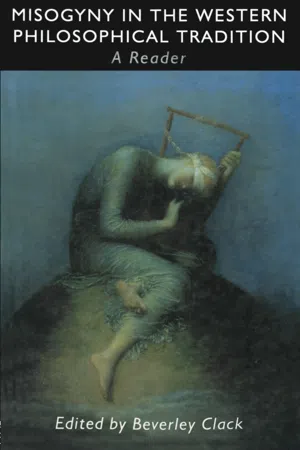
- 320 pages
- English
- ePUB (mobile friendly)
- Available on iOS & Android
eBook - ePub
About this book
From some of the great philosophers of the Western tradition: The Devils gateway --Tertullian A misbegotten male --Aquinas Big children their whole life long --Schopenhauer The roots of philosophical misogyny in the writings of thinkers from the ancient Greeks through the modern age are exposed and explored in this collection. Beverley Clack questions whether the wisdom of these philosophers can be separated from the misogyny, and whether feminists should seek an alternative to the Western philosophical canon. This collection offers chronological evidence of how the great male thinkers debated the question of woman, provides and introduction of each thinker. The philosophers included are: Plato, Aristotle, Tertullian, Augustine, Aquinas, Kramer, Sprenger, Descartes, Hobbes, Locke, Hume, Kant, Rousseau, Hegel, Schopenhauer, Nietzsche, Freud, Weininger, Spengler and Lucas.
Information
The Greeks
1 Plato c.427-347 BCE
Introduction and Background
Plato's philosophy has dominated the discourse of the western tradition. A pupil of Socrates, Plato develops his philosophy through a series of dialogues between Socrates and his pupils. Central to this philosophy is a dualistic understanding of reality. For Plato, the physical world is a pale reflection of the 'Ideal World' of Absolutes, Forms and Ideas. Human beings are understood to combine features of both worlds; the body relates to the material world, the soul to the World of Ideas or Forms. The task of the philosopher is to attain true understanding of this higher dimension by resisting the desires of the physical world.
In recent years, attention has been given to Plato's account of women, and particularly the apparently 'feminist' content of some of his writings. At the heart of the case for a 'feminist Plato' lies the Republic. In Book V, Plato argues that women should receive the same education as men. If a woman is appropriately educated and shows leadership qualities, there is no reason why she should not be a 'Guardian' (or leader) of Plato's ideal state.
However, the claim that Plato is feminist has been much disputed. While parts of the Republic may suggest an egalitarian Plato, other aspects refute such a claim. The language Plato uses suggests that while in theory women might be leaders of his ideal society, in practice he expects men to take on this role. This is notably the case when he argues for the dissolution of the family. 'Wives and children' – not 'spouses and children' – are to be held in common. More explicitly, Plato accepts the argument that men tend to be better at all things than women. As Julia Annas points out, 'it is hardly a feminist argument to claim that women do not have a special sphere because men can outdo them at absolutely everything'.1
In other works, Plato argues for the innate inferiority of women. In the Symposium he argues that love of man for man is a higher form of love than love of man for woman. The latter form of love is purely connected with procreation; the love of man for man leads to the higher appreciation of the Good. In the Timaeus, a hierarchy of creation is advanced, for women are closer to animals than are men. This hierarchical account of creation is coupled with a dualistic view of reality which Plato adopts from Pythagoras.2 For Pythagoras, bodiliness is associated with femaleness, and spirituality or higher reasoning with maleness. While Plato does not explicitly accept this distinction, implicitly this notion supports his understanding of men and women. In the Laws, a later work than the Republic, this notion comes to the fore.
Straightforward identifications of Plato's writings as 'feminist' seem without grounds. While aspects of his work are useful for those wishing to argue for the equality of woman, other aspects betray the thinking of an age where women's lives were very much in the hands of men.
Republic V (451–7)*
I suppose that I must retrace my steps and say what I perhaps ought to have said before in the proper place. The part of the men has been played out, and now properly enough comes the turn of the women. Of them I will proceed to speak, and the more readily since I am invited by you.
For men born and educated like our citizens, the only way, in my opinion, of arriving at a right conclusion about the possession and use of women and children is to follow the path on which we originally started, when we said that the men were to be the guardians and watchdogs of the herd.
True.
Let us further suppose the birth and education of our women to be subject to similar or nearly similar regulations; then we shall see whether the result accords with our design.
What do you mean?
What I mean may be put into the form of a question, I said: Are dogs divided into 'hes' and 'shes', or do they both share equally in hunting and in keeping watch and in the other duties of dogs? or do we entrust to the males the entire and exclusive care of the flocks, while we leave the females at home, under the idea that the bearing and suckling their puppies is labour enough for them?
No, he said, they share alike; the only difference between them is that the males are stronger and the females weaker.
But can you use different animals for the same purpose, unless they are bred and fed in the same way?
You cannot.
Then, if women are to have the same duties as men, they must have the same nurture and education?
Yes.
The education which was assigned to the men was music and gymnastic.
Yes.
Then women must be taught music and gymnastic and also the art of war, which they must practise like the men?
That is the inference, I suppose.
I should rather expect, I said, that several of our proposals, if they are carried out, being unusual, may appear ridiculous.
No doubt of it.
Yes, and the most ridiculous thing or all will be the sight of women naked in the palaestra,1 exercising with the men, especially when they are no longer young; they certainly will not be a vision of beauty, any more than the enthusiastic old men who in spite of wrinkles and ugliness continue to frequent the gymnasia.
Yes, indeed, he said: according to present notions the proposal would be thought ridiculous.
But then, I said, as we have determined to speak our minds, we must not fear the jests of the wits which will be directed against this sort of innovation; how they will talk of women's attainments both in music and gymnastic, and above all about their wearing armour and riding upon horseback!
Very true, he replied.
Yet having begun we must go forward to the rough places of the law; at the same time begging of these gentlemen for once in their life to be serious. Not long ago, as we shall remind them, the Hellenes were of the opinion, which is still generally received among the barbarians, that the sight of a naked man was ridiculous and improper; and when first the Cretans and then the Lacedaemonians introduced the custom, the wits of that day might equally have ridiculed the innovation.
No doubt.
But when experience showed that to let all things be uncovered was far better than to cover them up, and the ludicrous effect to the outward eye vanished before the better principle which reason asserted, then the man was perceived to be a fool who directs the shafts of his ridicule at any other sight but that of folly and vice, or seriously inclines to weigh the beautiful by any other standard but that of the good.
Very true, he replied.
First, then, whether the question is to be put in jest or in earnest, let us come to an understanding about the nature of woman: Is she capable of sharing either wholly or partially in the actions of men, or not at all? And is the art of war one of those arts in which she can or cannot share? That will be the best way of commencing the enquiry, and will probably lead to the fairest conclusion.
That will be much the best way.
Shall we take the other side first and begin by arguing against ourselves; in this manner the adversary's position will not be undefended.
Why not? he said.
Then let us put a speech into the mouths of our opponents. They will say: 'Socrates and Glaucon, no adversary need convict you, for you yourselves, at the first foundation of the State, admitted the principle that everybody was to do the one work suited to his own nature.' And certainly, if I am not mistaken, such an admission was made by us. 'And do not the natures of men and women differ very much indeed?' And we shall reply: Of course they do. Then we shall be asked, 'Whether the tasks assigned to men and to women should not be different, and such as are agreeable to their different natures?' Certainly they should. 'But if so, have you not fallen into a serious inconsistency in saying that men and women, whose natures are so entirely different, ought to perform the same actions?' What defence will you make for us, my good Sir, against any one who offers these objections?
That is not an easy question to answer when asked, suddenly; and I shall and I do beg of you to draw out the case on our side.
These are the objections, Glaucon, and there are many others of a like kind, which I foresaw long ago; they made me afraid and reluctant to take in hand any law about the possession and nurture of women and children.
By Zeus, he said, the problem to be solved is anything but easy.
Why yes, I said, but the fact is that when a man is out of his depth, whether he has fallen into a little swimming bath or into mid-ocean, he has to swim all the same ... Well then, let us see if any way of escape can be found. We acknowledged –did we not? that different natures ought to have different pursuits, and that men's and women's natures are different. And now what are we saying? – that different natures ought to have the same pursuits – this is the inconsistency which is charged upon us.
Precisely.
Verily, Glaucon, I said, glorious is the power of the art of contradiction!
Why do you say so?
Because I think that many a man falls into the practice against his will. When he thinks that he is reasoning he is really disputing, just because he cannot define and divide, and so know that of which he is speaking; and he will pursue a merely verbal opposition in the spirit of contention and not of fair discussion.
Yes, he replied, such is very often the case; but what has that to do with us and our argument?
A great deal; for there is certainly a danger of our getting unintentionally into a verbal opposition.
In what way?
Why we valiantly and pugnaciously insist upon the verbal truth, that different natures ought to have different pursuits, but we never considered at all what was the meaning of sameness or difference of nature, or why we distinguished them when we assigned different pursuits to different natures and the same to the same natures.
Why, no, he said, that was never considered by us.
I said: Suppose that by way of illustration we were to ask the question whether there is not an opposition in nature between bald men and hairy men; and if this is admitted by us, then, if bald men are cobblers, we should forbid the hairy men to be cobblers, and conversely?
That would be a jest, he said.
Yes, I said, a jest; and why? because we never meant when we constructed the State, that the opposition of natures should extend to every difference, but only to those differences which affected the pursuit in which the individual is engaged; we should have argued, for example, that a physician and one who is in mind a physician may be said to have the same nature.
True.
Whereas the physician and the carpenter have different natures?
Certainly.
And if, I said, the male and female sex appear to differ in their fitness for any art or pursuit, we should say that such pursuit or art ought to be assigned to one or the other of them; but if the difference consists only in women bearing and men begetting children, this does not amount to a proof that a woman differs from a man in respect of the sort of education she should receive; and we shall therefore continue to maintain that our guardians and their wives ought to have the same pursuits.
Very true, he said.
Next, we shall ask our opponent how, in reference to any of the pursuits or arts of civic life, the nature of a woman differs from that of a man?
That will be quite fair.
And perhaps he, like yourself, will reply that to give a sufficient answer on the instant is not easy; but after a little reflection there is no difficulty.
Yes, perhaps.
Suppose then that we invite him to accompany us in the argument, and then we may hope to show him that there is nothing peculiar in the constitution of women which would affect them in the administration of the State.
By all means.
Let us say to him: Come now, and we will ask you a question: – when you spoke of a nature gifted or not gifted in any respect, did you mean to say that one man will acquire a thing easily, another with difficulty; a little learning will lead the one to discover a great deal; whereas the other, after much study and application, no sooner learns than he forgets; or again, did you mean, that the one has a body which is a good servant to his mind, while the body of the other is a hindrance to him? – would not these be the sort of differences which distinguish the man gifted by nature from the one who is ungifted?
No one will deny that.
And can you mention any pursuit of mankind in which the male sex has not all these gifts and qualities in a higher degree than the female? Need I waste time in speaking of the art of weaving, and the management of pancakes and preserves, in which womankind does really appear to be great, and in which for her to be beaten by a man is of all things the most absurd?
You are quite right, he replied, in maintaining the general inferiority of the female sex: although many women are in many things superior to many men, yet on the whole what you say is true.
And if so my friend, I said, there is no special faculty of administration in a state which a woman has because she is a woman, or which a man has by virtue of his sex, but the gifts of nature are alike diffused in both; all the pursuits of men are the pursuits of women also, but in all of them a woman is inferior to a man.
Very true.
Then are we to impose all our enactments on men and none of them on women?
That will never do.
One woman has a gift of healing, another not; one is a musician, and another has no music in her nature?
Very true.
And one woman has a turn for gymnastic and military exercises, and another is unwarlike and hates gymnastics?
Certainly.
And one woman is a philosopher, and another is an enemy of philosophy; one has spirit, and another is without spirit?
That is also true.
Then one woman will have the temper of a guardian, and another not. Was not the ...
Table of contents
- Cover
- Half Title
- Title
- Copyright
- Dedication
- Contents
- Acknowledgements
- Introduction: A Fling with the Philosophers
- PART I THE GREEKS
- PART II THE CHURCH FATHERS
- PART III EARLY MODERN PHILOSOPHERS
- PART IV THE ENLIGHTENMENT
- PART V MISOGYNY IN THE MODERN AGE
- Notes
- Index
Trusted by 375,005 students
Access to over 1.5 million titles for a fair monthly price.
Study more efficiently using our study tools.
Frequently asked questions
Yes, you can cancel anytime from the Subscription tab in your account settings on the Perlego website. Your subscription will stay active until the end of your current billing period. Learn how to cancel your subscription
No, books cannot be downloaded as external files, such as PDFs, for use outside of Perlego. However, you can download books within the Perlego app for offline reading on mobile or tablet. Learn how to download books offline
Perlego offers two plans: Essential and Complete
- Essential is ideal for learners and professionals who enjoy exploring a wide range of subjects. Access the Essential Library with 800,000+ trusted titles and best-sellers across business, personal growth, and the humanities. Includes unlimited reading time and Standard Read Aloud voice.
- Complete: Perfect for advanced learners and researchers needing full, unrestricted access. Unlock 1.5M+ books across hundreds of subjects, including academic and specialized titles. The Complete Plan also includes advanced features like Premium Read Aloud and Research Assistant.
We are an online textbook subscription service, where you can get access to an entire online library for less than the price of a single book per month. With over 1.5 million books across 990+ topics, we’ve got you covered! Learn about our mission
Look out for the read-aloud symbol on your next book to see if you can listen to it. The read-aloud tool reads text aloud for you, highlighting the text as it is being read. You can pause it, speed it up and slow it down. Learn more about Read Aloud
Yes! You can use the Perlego app on both iOS and Android devices to read anytime, anywhere — even offline. Perfect for commutes or when you’re on the go.
Please note we cannot support devices running on iOS 13 and Android 7 or earlier. Learn more about using the app
Please note we cannot support devices running on iOS 13 and Android 7 or earlier. Learn more about using the app
Yes, you can access Misogyny in the Western Philosophical Tradition by Beverley Clack in PDF and/or ePUB format, as well as other popular books in Philosophy & Philosophy History & Theory. We have over 1.5 million books available in our catalogue for you to explore.