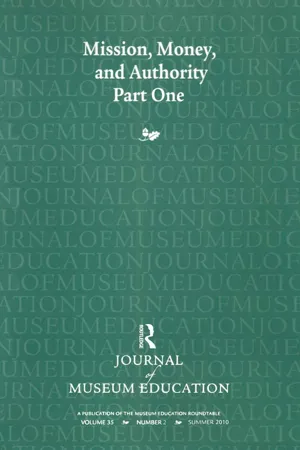
Sponsored by the Museum Education Roundtable, this is volume 35, Number 2 of the Journal of Museum Education (JME) Part One of Mission, Money, and Authority, published in the summer of 2010. This edition includes articles on museums and other non-profits in the current recession; project fundraising; managing museum priorities in a difficulty economy; obtaining support and reducing obstacles; the value of online learning and making programs self-sustaining.
eBook - ePub
Mission, Money, and Authority, Part One
Journal of Museum Education 35:2 Thematic Issue
- 70 pages
- English
- ePUB (mobile friendly)
- Available on iOS & Android
eBook - ePub
Mission, Money, and Authority, Part One
Journal of Museum Education 35:2 Thematic Issue
Museums and Other Nonprofits in the Current Recession
A Story of Resilience, Innovation, and Survival

with the technical assistance of Kasey L. Mengel
Abstract This article presents the results of a nationwide survey conducted in the spring of 2009 that examined the impacts of the current recession on nonprofit organizations, including museums. The survey identified a host of negative effects that nonprofits have been experiencing as a result of the recession, including reduced organizational revenues, increased costs, and increased demand. However, the survey also demonstrated that nonprofits, including museums, are exhibiting enormous resilience, responding to the increased fiscal stress by initiating a range of fundraising, belt-tightening, and entrepreneurial strategies. The article highlights key results for the nonprofit sector as a whole and indicates when and how the museum field diverges from these averages. lt concludes with some advice for museum educators to help them not only support their organizations through these troubling times but also emerge as even stronger institutions.
The current recession has already resulted in serious economic costs for our nation, with nearly 10 percent of the workforce unemployed and significant reductions in corporate profits and stock valuations.
But what has been the effect of the current recession on our country’s critical nonprofit sector—the sector comprising museums, theaters, orchestras, human service agencies, homeless shelters, community development groups, hospitals, universities, and many more? Are nonprofits facing a parallel decline in revenues? Have nonprofits been forced to reduce their programs and services? How are nonprofits responding to these pressures and what consequences, if any, have they had to endure?
To answer these important questions, the Johns Hopkins Listening Post Project1 conducted a survey of its nationwide sample of over 1,400 nonprofit organizations in five key fields (children and family services, elderly housing and services, education, community and economic development, and the arts) in April of 2009. The focus of this survey was on the period between September 2008 and March 2009, when recessionary pressures intensified, though some questions were asked as well about fiscal year 2008 as compared to 2007. Altogether, 363 organizations responded to this Sounding, producing a response rate of 26 percent, which is quite respectable in this field, particularly at a time of economic hardship.2
The results of our inquiry were troubling, but also showed some encouraging signs. As described more fully in this article, our research resulted in three major findings:
» First, nonprofits, including museums, are being hit by a perfect storm of impacts, including declining revenues, increasing costs, and increasing demand.
» Second, in the face of this fiscal stress, museums and other nonprofits are exhibiting enormous resilience.
» Finally, museums and other nonprofits are relying on a range of coping strategies to survive and strengthen their organizations for the long-haul.
SIGNIFICANT ECONOMIC STRESS
The vast majority of our Sounding respondents (83 percent) reported experiencing fiscal stress, and close to 40 percent described this stress as “severe” or “very severe.” Museum respondents were not immune from this pressure: in fact, 85 percent of all responding museums indicated that they experienced fiscal stress during our target period (i.e. September 2008–March 2009), and nearly a third described this stress as severe or very severe. Demonstrating the significant pressures museum respondents have been experiencing, one executive noted, “We have always struggled financially, but this year, we are struggling even more. This year, we are in survival mode.”
Contributing to the fiscal stress afflicting nonprofit organizations have been declining revenues (reported by 51 percent of respondents), increased costs (reported by 53 percent of respondents), declining endowments (reported by 80 percent of respondents with endowments), increased competition for financial resources (reported by 58 percent of respondents), and increased demand (reported by 46 percent of respondents).

Museums were particularly hard hit by declining revenues, with 58 percent of museum respondents noting revenue losses during the target period. Among revenue sources, museum losses were particularly widespread from individual contributions (losses for 61 percent of organizations), fee-for-service income (53 percent), corporate contributions (52 percent), and foundation support (45 percent), (see Figure 1).
By contrast, museums were slightly less affected by increased costs (49 percent), declining endowments (69 percent), increased competition for financial resources (53 percent), and increased demand (35 percent) than other nonprofit fields, although significant proportions of museums still felt the effects of these pressures.
The sense of exposure was well captured by one museum respondent who explained his predicament this way: “As a small historic site museum in a resort town, we are seeing less and less visitors and they are also spending less money. The problem also is that we own 11 buildings and our insurance is horribly expensive. We also have extremely high maintenance requirements with these old houses and buildings. Our cash flow is very bad at this time and we are constantly stressed about making ends meet. Membership dues are down as well as income producing enterprises.”
IMPRESSIVE RESILIENCE IN THE FACE OF FISCAL PRESSURES
Despite these troubling findings, our survey also generated some encouraging insights. In particular, we found that in the face of daunting fiscal pressures, museums and other nonprofits are displaying considerable resilience. For example, we found that the proportion of organizations reporting “severe” or “very severe” fiscal stress during the target period of this survey, while substantial, was still considerably below the level reached in the recession that followed September 11, 2001 (37 percent vs. 51 percent of the organizations). What is more, fewer than 5 percent of all respondents, and actually just 3 percent of museum respondents, reported that they were in imminent danger of folding due to financial reasons.
However, the real test of the impact of the current recession on the nonprofit sector is not the consequences for the organizations, but the consequences for those they serve. Here as well, the record emerging from our Sounding is encouraging despite current financial pressures. Thus, just 27 percent of responding organizations reported a decline in the number of people they served during our target period compared to the same period a year earlier. By contrast, 73 percent of respondents reported that they had maintained or increased the number of people served despite the fiscal pressures they faced.
While the record for museums diverges from the national averages (a sizeable 47 percent of museum respondents reported a decline in populations served), over half of all museum respondents (53 percent) still managed to maintain or increase service levels. Moreover, like their counterparts in other fields, museums that serve vulnerable populations such as children, the elderly, the economically disadvantaged, and people with disabilities were even more likely to maintain or increase the number of people they served. Thus, the proportions of museums serving these populations that reported maintaining or increasing service levels was 87 percent with respect to people with disabilities and the economically disadvantaged, 81 percent for the elderly, and 77 percent for children and youth.
Moreover, the museum field’s commitment to beneficiaries and maintenance of existing operations took other forms as well. Thus, during the target survey period:
» Only 18 percent of museum respondents reported higher staff turnover;
» Only 12 percent reported greater difficulty in managing their volunteers;
» Only 9 percent reported greater difficulty attracting or retaining staff;
» Only 6 percent reported increasing their patron waiting time;
» Only 3 percent reported a weakening of their reputation in the community;
» Only 3 percent lost volunteers; and
» No museums experienced greater difficulty recruiting volunteers nor decreased the time spent per customer or patron.
In short, despite the recession and the resulting fiscal pressures they faced, museums and other nonprofits largely maintained their financial footing and maintained or expanded their activities, serving more people, and particularly more vulnerable people.
HOW DID THEY DO IT?
To achieve these results in the face of such serious economic conditions, museums and their nonprofit counterparts in other fields have displayed unusual resolve and have launched a host of inventive coping strategies, focusing particularly on four approaches:
Fundraising
In the first place, and perhaps not surprisingly, a widespread strategy nonprofits have used to cope with the economic crisis has been to intensify their fundraising efforts. Common targets of these fundraising efforts were individuals (61 percent of organizations), state or local funds (57 percent), federal funds (56 percent), and foundations or corporations (55 percent). Likely reflecting their reduced dependence on governmental funding in comparison to other nonprofit fields, museum respondents focused their fundraising most heavily on donations from individual donors (59 percent) and foundations and corporations (50 percent), rather than on state and local (47 percent) and federal funds (38 percent), (see Figure 2).
...Table of contents
- Cover
- Half Title
- Title Page
- Copyright Page
- Table of Contents
- From the Co-Editors-in-Chief
- Museums and Other Nonprofits in the Current Recession: A Story of Resilience, Innovation, and Survival
- Wagging the Dog: Managing Museum Priorities in a Difficult Economy
- Education: A Perfect Partner for Project-based Fundraising
- The Educational and Economic Value of Online Learning for Museums
- Seeing Potential, Pushing Possibilities: Thinking Creatively About Revenue Opportunities
- Assessment and Planning Using Portfolio Analysis
- Stakeh older Analysis for Educators: Obtaining Support and Reducing Obstacles
- No Mission, No Money: No Money, No Mission
- Making Programs Self-Sustaining at a Small Historic House Museum
Trusted by 375,005 students
Access to over 1.5 million titles for a fair monthly price.
Study more efficiently using our study tools.
Frequently asked questions
Yes, you can cancel anytime from the Subscription tab in your account settings on the Perlego website. Your subscription will stay active until the end of your current billing period. Learn how to cancel your subscription
No, books cannot be downloaded as external files, such as PDFs, for use outside of Perlego. However, you can download books within the Perlego app for offline reading on mobile or tablet. Learn how to download books offline
Perlego offers two plans: Essential and Complete
- Essential is ideal for learners and professionals who enjoy exploring a wide range of subjects. Access the Essential Library with 800,000+ trusted titles and best-sellers across business, personal growth, and the humanities. Includes unlimited reading time and Standard Read Aloud voice.
- Complete: Perfect for advanced learners and researchers needing full, unrestricted access. Unlock 1.5M+ books across hundreds of subjects, including academic and specialized titles. The Complete Plan also includes advanced features like Premium Read Aloud and Research Assistant.
We are an online textbook subscription service, where you can get access to an entire online library for less than the price of a single book per month. With over 1.5 million books across 990+ topics, we’ve got you covered! Learn about our mission
Look out for the read-aloud symbol on your next book to see if you can listen to it. The read-aloud tool reads text aloud for you, highlighting the text as it is being read. You can pause it, speed it up and slow it down. Learn more about Read Aloud
Yes! You can use the Perlego app on both iOS and Android devices to read anytime, anywhere — even offline. Perfect for commutes or when you’re on the go.
Please note we cannot support devices running on iOS 13 and Android 7 or earlier. Learn more about using the app
Please note we cannot support devices running on iOS 13 and Android 7 or earlier. Learn more about using the app
Yes, you can access Mission, Money, and Authority, Part One by Cynthia Robinson,Tina R Nolan in PDF and/or ePUB format, as well as other popular books in Business & Museum Administration. We have over 1.5 million books available in our catalogue for you to explore.