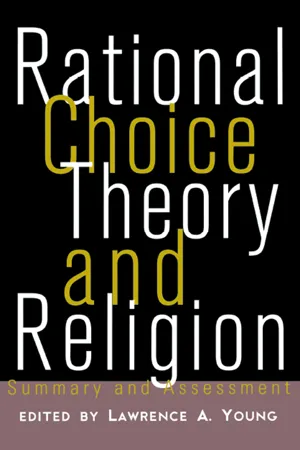
Rational Choice Theory and Religion considers one of the major developments in the social scientific paradigms that promises to foster a greater theoretical unity among the disciplines of sociology, political science, economics and psychology. Applying the theory of rational choice--the theory that each individual will make her choice to maximize gain and minimize cost--to the study of religion, Lawrence Young has brought together a group of internationally renowned scholars to examine this important development within the field of religion for the first time.
- 256 pages
- English
- ePUB (mobile friendly)
- Available on iOS & Android
eBook - ePub
About this book
Information
SUMMARY
part I
BRINGING THEORY BACK IN
chapter 1
I GREATLY appreciate this opportunity to survey the recent renaissance of theorizing in the sociology of religion—a development of such significance that Stephen Warner (1993: 1044) has correctly described it as a “paradigm shift in progress.” I do not think it too immodest to agree with Warner that I played a major role in these developments. Therefore, I found it useful to organize my survey on an autobiographical framework.
Several years before I began graduate school—while completing my military service and then working as a reporter for the Oakland Tribune—I became very interested in the philosophy of science. I read everyone important, but no one influenced me more than Karl Popper. Although I first read it more than 30 years ago, my reaction to Popper’s essay, “Philosophy of Science: A Personal Report” (1957), which subsequently became the first chapter in his Conjectures and Refutations (1968), is entirely vivid.
The start of the essay recounts Popper’s student days in Vienna in 1919 when four theories dominated student discussion: Marx’s theory of history, Freud’s psychoanalysis, Alfred Adler’s individual psychology, and Einstein’s theory of relativity. Popper became increasingly uneasy with the scientific standing of the first three, but not because they were less mathematical and exact. Rather, he came to the conclusion that, because of their logical structure, each was merely posing as a scientific theory. In fact, as he put it, each of the three “resembled astrology rather than astronomy” (1968: 34). In particular, he faulted these theories because they appeared to have too much explanatory capacity. Thus, while that year Eddington had journeyed to an island just west of Africa to observe an eclipse of the sun—hoping thereby to falsify Einstein’s theory—Popper’s friends who advocated Marx, Freud, or Adler claimed the power of each theory lay in its capacity to incorporate all possible events and outcomes. That is, these theories always fit the data. Popper wrote, “they were always confirmed—which in the eyes of their admirers constituted the strongest argument in favour of these theories. It began to dawn on me that this apparent strength was in fact their weakness” (p. 35). Thus did Popper discover, or at least make explicit, the proposition that a real theory must be “incompatible with certain possible results of observation.” Aside from Einstein and his handful of followers, no one at this time really believed that light was influenced by gravity. Therefore, scientists around the world assumed that Eddington would not observe light to bend when an eclipse made the appropriate observation possible. But Einstein’s theory did not predict that light might or might not bend, but that it must bend. Had it not done so, the theory of relativity would have been falsified.
Thus I learned from Popper and from many other philosophers of science that a real theory must predict and prohibit certain observations, and that some outcomes must be incompatible with the theory. Systems of thought that could accommodate all possible observations explained nothing because ahead of time they were of no predictive use—they were merely post hoc classification schemes capable only of description or codification.
Popper and his colleagues also taught me that theories should begin with abstract, general statements, or axioms, from which a set of propositions could be derived, and that one tested such theories by testing empirical predictions derived from the propositions. Moreover, one does not attempt to establish the truth of the axioms inductively or to induct axioms from observations, since universal statements cannot be induced—a point that Hume had irrefutably established by the middle of the eighteenth century. So, when I began graduate studies at Berkeley I regarded these views of theory not only to be self-evident, but to have long since become the prevailing wisdom. This assumption was correct insofar as the philosophy department was concerned, but the sociology department was quite another matter.
At that time, two semesters of theory and two semesters of methods were required of all first-year sociology students at Berkeley. It took me only a few days to discover that we would read no theories during the first semester theory course which was instead a history of social thought. It took me not much longer to realize that the faculty in the first semester methods course had no notion of what a theory was either. One of them told our class that “theory is the baloney you put at the front of a paper so the intellectuals have to publish it.” He reported that in his experience one could usually get by just fine by using Robert Merton’s “means/ends typology” as one’s theory.1
Things got much worse in the second semester when I discovered we would read no theories, as I understood that term, in modern social theory. For, in the early 1960s, theory sometimes meant Marxism, but usually theory meant structural functionalism and the premier theorist was Talcott Parsons. So I paid my dues by reading The Structure of Social Action and The Social System. My fellow inmates complained about how badly written these books were, and how dense and muddled the prose. I would have forgiven all of that had they included any effort at theorizing. But they did not. The thing about the structural functionalists was that they did not constitute a theoretical school at all because they never theorized. This massive body of concepts and definitional statements contains not one contingent, or falsifiable statement that I ever was able to discover. Structural functionalism was, as with Freudianism, Marxism, and Adlerism, far more like astrology than astronomy.
Not being entirely unperceptive, even I soon learned not to express such views—as I might as well express faith that the earth is flat. Indeed, as I passed around excerpts from Popper to some of my peers, they treated it as a species of pornography—exciting to read, but one must not be detected doing so. Nevertheless, I remained determined that one day I would write some social theories.
In 1964, I went to Montreal for the ASA meetings and heard George Homans give his famous (some said infamous) presidential address, “Bringing Men Back In”—a title I intentionally echoed for this essay. Having been introduced by Neil Smelser, Homans devoted the first part of his address to trashing structural functionalism, in part by showing that the first 65 or so pages of Smelser’s book on the industrial revolution of the cotton industry in Great Britain were entirely superfluous to the explanations that followed. These initial “theoretical” pages introduced a structural-functionalist account of change and modernization. But, Homans crowed, since there wasn’t a single contingent statement in the theory, nothing was predicted about what would be found in the analysis; hence nothing of explanatory value would be lost simply by excising that portion and getting on with the analysis that made up the remainder of the book. Moreover, Homans noted, when Smelser actually turned to the explanatory task, all the conceptual boxes and all “four functional exigencies” disappeared, to be replaced by references to rational actors—albeit these statements seem intentionally cloudy. Homans then proceeded to clarify what a real scientific theory is and to argue, convincingly, why the rational choice axiom is fundamental to any social scientific theory—hence the need to bring humans back into social theory.
I was delighted by the entire performance, and not least by the theatricality of Homan’s delivery. At the time, I knew who Homans was but had not read him—he had barely been mentioned in any class or seminar I took at Berkeley, George Herbert Mead still being regarded as the social psychologist. Once back in Berkeley, I quickly read the first edition of Social Behavior: Its Elementary Forms (1961). I found it exciting and disappointing. The good part was that Homans had constructed an authentic social theory, albeit borrowing a lot from the Skinnerian version of behaviorism. But the book ended many chapters too soon. I shall never understand why Homans was content to settle for so very little. That is, as soon as he got people interacting and thereby beginning to like one another, he quit. He failed to take what seemed to me to be obvious next steps by which he could have deduced how interactions must generate norms, how interaction among larger numbers of actors must produce social structures, how increasingly complex culture is accumulated and thereby forces a division of labor, and on and on. That is, if Homans seemed determined to explain to us what we ought to do and where to start, he also seemed to have had no real stomach for the job at hand.
But at least he got me tinkering in spare moments with theoretical exercises. Soon I thought I might have found a real theorist more ambitious than Homans when I ordered a copy of Gerhard Lenski’s Power and Privilege (1966), which was billed as a propositional theory of stratification. Lenski was in fact far more ambitious than Homans and, in the beginning of the book, he did pursue a deductive theory. But, seemingly out of a concern to cover his flanks against inductionist critics, he made the theory increasingly specific and inductive as he went along and eventually the system became circular and descriptive. Even if I ultimately found the book wanting, I had many exciting moments while reading it, and I found it to be a very instructive example of how to organize a large, abstract, deductive system for a social scientific audience.
In 1967, I began a three-volume work on religious behavior with Charles Glock. The first volume appeared in 1968. It was a largely conceptual and descriptive book called American Piety: The Nature of Religious Commitment. The scheduled second volume was to focus on sources of religious commitment, and the third was to be concerned with the consequences of religious commitment. Neither the second nor the third volume ever appeared. And theory was a major reason.2
When I wrote the second volume, I began it with a deductive theory of religious commitment that was not much different from one included in the essay, “Towards a Theory of Religion: Religious Commitment,” that William Sims Bainbridge and I (1980) published more than a decade later. I began with a rational choice axiom: Humans seek what they perceive to be rewards and avoid what they perceive to be costs. Another axiom explicitly introduced human cognition: Human action is directed by a complex information-processing system that functions to identify problems and attempt solutions to them. I pause here to point out that, from the very beginning, my theoretical work has always included an explicit and significant cognitive component, something frequently overlooked by those who worry that I rely too much on exchange theory (cf. Garrett, 1990).
Another axiom imposed scarcity upon the concept of rewards: Some desired rewards are limited in supply, including some that simply do not exist (in the physical world). I also introduced the notion of compensators. I have never liked that word. It carries unmeant negative connotations, but I have not yet found a more suitable alternative. Compensators are a sort of substitute for desired rewards. That is, they provide an explanation about how the desired reward (or an equivalent alternative) actually can be obtained, but propose a method for attaining the reward that is rather elaborate and lengthy. Often the actual attainment will be in the distant future or even in another reality, and the truth of the explanation will be very difficult, if not impossible, to ascertain in advance. When a child asks for a bike and a parent proposes that the child keep his or her room clean for a year and get no grade below B during the same period, whereupon the bike will appear, a compensator has been issued in lieu of the desired reward. We can distinguish compensators from rewards because one is the thing wanted, and the other is a proposal about gaining the reward.
As reward-seeking beings, humans will always prefer the reward to the compensator, but they often will have no choice because some things we want can’t be had in sufficient supply by some people and some rewards cannot be had, here and now, by anyone. Compensators abound in all areas of life, but my primary interest has been in religious compensators. Let me note only the most obvious example. Most people desire immortality. No one knows how to achieve that here and now—the Fountain of Youth remains elusive. But many religions offer instructions about how that reward can be achieved over the longer term. When one’s behavior is guided by such a set of instructions one has accepted a compensator. One also is exhibiting religious commitment, since the instructions always entail certain requirements vis-à-vis the divine. Indeed, it usually is necessary to enter into a long-term exchange relationship with the divine and with divinely inspired institutions, in order to follow the instructions: churches rest upon these underlying exchange relationships.
I want it to be clear that the theory does not, and should not, imply anything about the truth or falsity of religious compensators. It merely postulates the process of rational choices by which humans value and exchange these compensators.
By logically manipulating the axioms and definitions of the theory, I was able to reach what I thought were some striking deductions concerning the relationship between power and piety. Noting that religious compensators typically include both scarce and unavailable rewards, we can see that:
1. The power of an individual or group will be negatively associated with accepting religious compensators for rewards that are only scarce. That is, powerful people will simply pursue the rewards—material luxuries, for example. Less powerful people will tend to accept compensators that, for example, assure them that by forgoing luxury now they are piling up riches in the life to come. We might call this the sectlike form of religious commitment.
2. The power of an individual orgroup will be positively associated with control of religious organizations and with gaining the rewards available from religious organizations. Here I deduced what could be called the churchlike form of religious commitment.
But it is the third deduction that has always interested me most:
3. Regardless of power, persons and groups will tend to accept religious compensators for rewards that do not exist in this life. Here I noted that in some regards everyone is deprived and everyone has a motive for being religious—that since everyone faces death, doctrines of an afterlife appeal to all. We could call this the universal form of religious commitment.
Finally, ...
Table of contents
- Cover Page
- Half Title Page
- Title Page
- Copyright Page
- Contents
- Contributors
- Introduction
- Part I Summary
- Part II Assessment
- Index
Trusted by 375,005 students
Access to over 1.5 million titles for a fair monthly price.
Study more efficiently using our study tools.
Frequently asked questions
Yes, you can cancel anytime from the Subscription tab in your account settings on the Perlego website. Your subscription will stay active until the end of your current billing period. Learn how to cancel your subscription
No, books cannot be downloaded as external files, such as PDFs, for use outside of Perlego. However, you can download books within the Perlego app for offline reading on mobile or tablet. Learn how to download books offline
Perlego offers two plans: Essential and Complete
- Essential is ideal for learners and professionals who enjoy exploring a wide range of subjects. Access the Essential Library with 800,000+ trusted titles and best-sellers across business, personal growth, and the humanities. Includes unlimited reading time and Standard Read Aloud voice.
- Complete: Perfect for advanced learners and researchers needing full, unrestricted access. Unlock 1.5M+ books across hundreds of subjects, including academic and specialized titles. The Complete Plan also includes advanced features like Premium Read Aloud and Research Assistant.
We are an online textbook subscription service, where you can get access to an entire online library for less than the price of a single book per month. With over 1.5 million books across 990+ topics, we’ve got you covered! Learn about our mission
Look out for the read-aloud symbol on your next book to see if you can listen to it. The read-aloud tool reads text aloud for you, highlighting the text as it is being read. You can pause it, speed it up and slow it down. Learn more about Read Aloud
Yes! You can use the Perlego app on both iOS and Android devices to read anytime, anywhere — even offline. Perfect for commutes or when you’re on the go.
Please note we cannot support devices running on iOS 13 and Android 7 or earlier. Learn more about using the app
Please note we cannot support devices running on iOS 13 and Android 7 or earlier. Learn more about using the app
Yes, you can access Rational Choice Theory and Religion by Lawrence A. Young in PDF and/or ePUB format, as well as other popular books in Social Sciences & Religious Institutions & Organizations. We have over 1.5 million books available in our catalogue for you to explore.