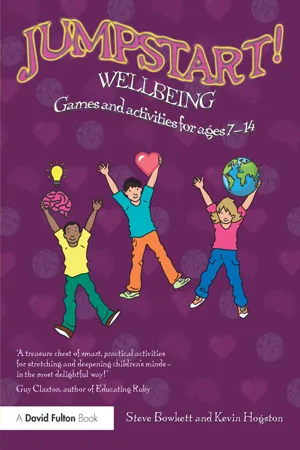
This collection of engaging and simple to use activities will help teachers to develop children's mental and emotional wellbeing while also including the thinking skills necessary for learning.
The authors show how developing such skills within the context of a wellbeing agenda aids children's motivation, their ability to concentrate and their willingness to explore, investigate and question, bringing huge benefits for children's sense of achievement, self-confidence and resilience. Drawing on a wealth of practical activities that include both creative and critical ways of thinking, chapters cover:
Wellbeing in the Classroom;
Emotional Resourcefulness;
Relaxation and Meditation;
Mindfulness and Reflectiveness;
Being Well.
Jumpstart! Wellbeing is a treasure trove of fun activities and ideas for building wellbeing and its constituent skills into the curriculum.
This section features some quick and easy activities that you can build into the children’s day, and which pave the way for the higher-challenge yet more powerful techniques you’ll find in the subsequent sections.
MEMORY AND IMAGINATION
Two important points to note at the outset are, first, that we all possess the vital resources of memory and imagination. ‘Memory’ here is not being used in the same sense as recall. To recall is to ‘call back again’ into conscious awareness previous thoughts and feelings in the form of memories. We often do this deliberately, as when we choose to think about a holiday that we have enjoyed, a good time we had with friends or some particular achievement that gave us pleasure. Notice that the thoughts and feelings that constitute a memory are fully entwined: it’s difficult if not impossible to think about a past event without the accompanying feelings and attendant physiological reactions.
Memory used in the broader sense means the sum total of our experiences and the associations we have made between them. Much of this material exists at a subconscious level, but is nonetheless active in shaping our attitudes, beliefs and consequent behaviours. This astonishingly complex network of memories is sometimes called the ‘map of reality’, yet like any map it is not the real thing but rather a representation of the sense that each of us has made of the world, based on our (conscious and subconscious) interpretation of events. Thus our individual map, while having many things in common with other people’s, is still highly subjective and individual.
Sometimes memories come to mind unbidden, spontaneously. This might be because something happening at the present moment triggers an association that ‘lifts’ the memory into conscious awareness. Such a recollection might be pleasant or unpleasant. Negative memories that keep coming back can represent ‘unfinished business’ or issues that have not yet been resolved. When these are deeply troubling then specialist help is recommended, but less serious negative thoughts-and-feelings can often be dealt with successfully by using the techniques we explain in this book. The crucial point is that once a memory has become conscious it can be noticed, reflected upon, reappraised and modified as necessary in order to make it more useful to us, insofar as it adds to a sense of wellbeing rather than detracts from it.
Imagination is the ability we have to create mental scenarios that need have nothing to do with our immediate circumstances. We can imagine things (using the resource of memory, as defined above) to visualise a future that hasn’t happened yet and, indeed, to experience in our minds things that are in reality impossible. By the same token we can envisage things that are possible and that we desire to achieve. As the saying goes; before the action comes the vision.
The second key point is that the resources of memory and imagination can be more fully utilised by cultivating the behaviours of noticing and questioning. Encouraging children to do these more actively and deliberately will enhance the effectiveness of the wellbeing techniques below and, indeed, children’s more general ability to learn.
But enough of the theory. Let’s get stuck in to some practical activities…
OUTSIDE WORLD, INSIDE WORLD
The ‘common sense’ view of reality is that my sense of self – my conscious mind – exists inside my head while the world at large lies ‘out there’ and consists of everything else. There are all kinds of philosophical implications to this idea (which unfortunately we don’t have space to explore), but it will serve as a working model for helping children to develop a greater sense of wellbeing.
A powerful tendency in many if not all people is to perceive the world through the filter of our values and beliefs. This can be summed up by saying that ‘perception is projection’: we see and interpret things according to the way we think and feel, which we then ‘project’ back on to the world such that our ongoing view is confirmed. As the old saying goes, an angry man lives in an angry world. This principle applies both to shortterm moods and more entrenched and ongoing attitudes. An important aspect of developing mental and emotional wellbeing is to recognise the perception-is-projection process as a precursor to doing something about it.
• The World Inside. Show the class the image in Figure 1.1 and say, ‘This is what’s going on in the mind of someone of about your age. Firstly, what do you notice in the picture? Why might he (or she) be thinking about these things? And why might he be thinking about them in this way?’
Point out to the children that there isn’t necessarily a right answer to these questions. Their interpretations are all equally valid. Take the children’s ideas one at a time and follow up with the question, ‘So if he’s looking at things in that way, how do you think it makes him feel?’ This reinforces the notion that ‘We don’t see things as they are, we see them as we are’ (Anais Nin).
If an interpretation of the images in the circle results in the character feeling good, ask the class how they would redraw the images to make the character feel even better. Similarly, if a child says that the character would feel angry, sad, etc., by imagining the images in a certain way, ask how they could be changed to turn negative feelings into more positive ones.
Figure 1.1 The world inside
Extend the activity by asking the children what they would put into a circle to create a chosen positive feeling.
This very simple and straightforward task can lead to some useful and searching discussions. For instance, a child might say he would put bars of chocolate into the circle to create a feeling of happiness. Explore this further with the class by asking questions such as these:
– How long might such happiness last?
– Would the chocolate make lots of people feel happy? Most people? All people?
– Does happiness always depend on physical things?
– What else can make people happy?
• A more sophisticated version of the circle game uses a template like the one in Figure 1.2. Again, the large circle represents a person’s conscious mind, while the other circles represent things that the character is thinking about.
The size of the subsidiary circles indicates their importance to the person concerned. Overlapping circles mean that whatever they represent are linked in some way. Circles that protrude beyond the edge of the large circle are being outwardly expressed in some way.
Split the class into groups and ask each group to label the subsidiary circles – in other words, to suggest what’s on the character’s mind. Again there is no single right answer to this task.
• Extend the activity by making sets of circles out of thin card. Children in groups or individually can then move circles around to alter the mental-emotional landscape of the character. The benefits of this activity include the following:
– Helping children to make links between different emotions.
– Becoming more familiar with a greater range of emotions.
– Sowing the seeds of the idea that emotions are not fixed and unchanging.
– Reinforcing the notion that feelings can be changed by deliberate, conscious interventions.
Literacy link: Both of the circle-based activities above can be used to help children to create more well-rounded characters in their stories.
Figure 1.2 Circle game
BE NOSY AND NOTICE SOMETHING
Children are often asked to ‘pay attention’ without necessarily being shown how to develop that skill. Here are some ideas for you to try out.
• Ask the children to look around the classroom to notice something they have either not noticed before or not noticed for a long time.
• Assemble a tray of small objects and make one change each day; add something, take something away, swap something. Challenge the children to spot what you’ve done. Increase the difficulty of the task by increasing the number of objects in the tray and make two or three changes each day. This is the classic Kim’s game.
• Encourage the children to notice something positive about a classmate and, as appropriate, pay them a compliment.
• Type ‘images of objects hidden in pictures’ into your search engine. There are hundreds of such pictures that can be downloaded to help develop the children’s observational skills.
• Invite the children to keep a notebook of interesting things they notice at school, home and in the area.
• One unique detail. Ask children to notice something about an object that makes it different from others of its kind. Extend the activity by inviting the children to notice one unique detail about a classmate that reflects something positive about them, either in terms of appearance or personality.
• Get the children to work in pairs. Give each pair two similar items – two stones, flowers, leaves, coins, etc. – and ask them to notice as many differences between these things as they can.
Literacy link: Show the class two almost identical sentences and ask them to point out the difference or differences.
For example:
I took a book from my brother’s bookcase. I took a book from my brothers’ bookcase.
It’s not necessary for children to understand the use of the possessive apostrophe in this case (though you can explain or revisit if you wish). What matters is that they are encouraged to notice the subtle difference. Extend the activity by showing the class two almost identical pieces of text and inviting them to spot the differences. Subsequently, ask the children to create examples of their own. This helps to develop editing skills as well as concentration.
• Ask the children to sit quietly with their bodies relaxed. Show them a small object such as a t...
Table of contents
Cover
Half Title
Title Page
Copyright Page
Table of Contents
List of figures
Acknowledgements
Introduction
1 Jumpstart wellbeing in the classroom
2 Jumpstart emotional resourcefulness
3 Jumpstart meditation and relaxation
4 Jumpstart mindfulness and reflectiveness
5 Jumpstart being well
Afterword
Bibliography
Trusted by 375,005 students
Access to over 1.5 million titles for a fair monthly price.
Study more efficiently using our study tools.
Frequently asked questions
Yes, you can cancel anytime from the Subscription tab in your account settings on the Perlego website. Your subscription will stay active until the end of your current billing period. Learn how to cancel your subscription
No, books cannot be downloaded as external files, such as PDFs, for use outside of Perlego. However, you can download books within the Perlego app for offline reading on mobile or tablet. Learn how to download books offline
Perlego offers two plans: Essential and Complete
Essential is ideal for learners and professionals who enjoy exploring a wide range of subjects. Access the Essential Library with 800,000+ trusted titles and best-sellers across business, personal growth, and the humanities. Includes unlimited reading time and Standard Read Aloud voice.
Complete: Perfect for advanced learners and researchers needing full, unrestricted access. Unlock 1.5M+ books across hundreds of subjects, including academic and specialized titles. The Complete Plan also includes advanced features like Premium Read Aloud and Research Assistant.
Both plans are available with monthly, semester, or annual billing cycles.
We are an online textbook subscription service, where you can get access to an entire online library for less than the price of a single book per month. With over 1.5 million books across 990+ topics, we’ve got you covered! Learn about our mission
Look out for the read-aloud symbol on your next book to see if you can listen to it. The read-aloud tool reads text aloud for you, highlighting the text as it is being read. You can pause it, speed it up and slow it down. Learn more about Read Aloud
Yes! You can use the Perlego app on both iOS and Android devices to read anytime, anywhere — even offline. Perfect for commutes or when you’re on the go. Please note we cannot support devices running on iOS 13 and Android 7 or earlier. Learn more about using the app
Yes, you can access Jumpstart! Wellbeing by Steve Bowkett,Kevin Hogston in PDF and/or ePUB format, as well as other popular books in Pedagogía & Educación general. We have over 1.5 million books available in our catalogue for you to explore.