History of the EU
Introduction
At the conclusion of the Second World War with Europe in a state of economic, political and moral turmoil, it was clear that a pathway was needed for reconstruction and cooperation between the European states. The first step was the Council of Europe formed in 1949 for closer political integration.
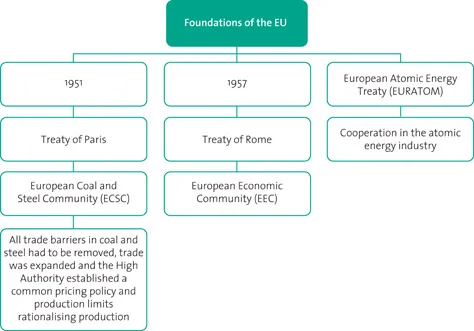
However in economic terms it was from the Schuman Plan that the current European Union developed.
The Schuman Plan envisaged the merging of production of what, at that time, were the two wartime necessities, coal and steel, to ensure these could not be used to promote war. With this in mind it proposed that the control of these sections of the economy was given over to an independent international authority, the High Authority, comprising individuals who were not Government representatives but who were given the power to fix prices and ensure compliance with competition rules.
The Schuman experiment in economic cooperation involved the removal of these vital wartime industries from the control of the national governments in the hope of providing a sounder foundation for peace and stability in Europe.
While the original plan (drafted by French statesman Jean Monnet and the French Foreign Minister Robert Schuman) only envisaged France and Germany acceding to this Treaty, Schuman invited the rest of Western Europe to join.
In the resulting conference (1950) France, Germany, Italy and the Benelux nations produced the draft treaty (1951) that created the European Coal and Steel Community (ECSC).
Significantly, the Treaty aimed at a federal Europe.
The beginning
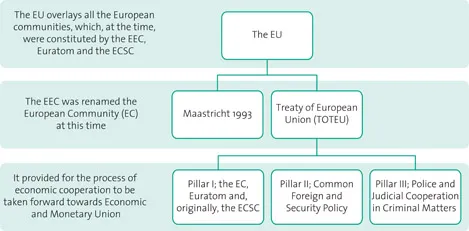
Following these early steps, the EU was created as outlined below:
The next step
However, the ambitions of the Member States did not stop there and the EU really came into being following the Maastricht reforms and innovations in 1992.
These four treaties, the ECSC Treaty, the Euratom Treaty, the EC Treaty and the TOTEU, are the founding treaties of the EU.
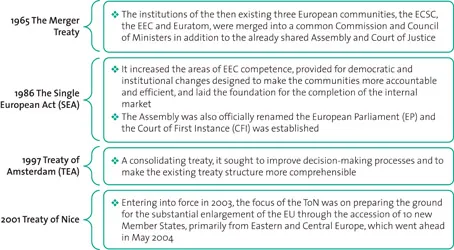
The amending treaties
As noted in the preface, EU law is civil law and advanced through a sequence of further, amending treaties;
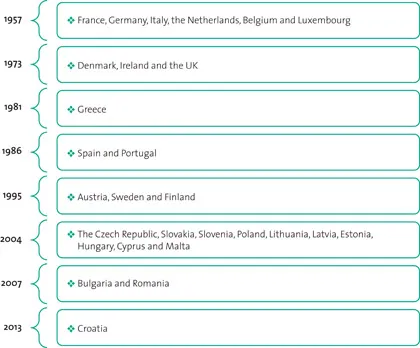
The accession treaties
The accession treaties are the treaties through which new Member States join the communities and the Union. The EU is now comprised of 28 Member States.
The UK and the EU
The UK signed the Treaty of Accession in 1972 and became a full member of the
European Community (now known as the European Union) from 1 January 1973. As treaties have no direct effect in English Law, Parliament passed legislation to incorporate the Treaty of Rome 1957 into domestic law. This was achieved by the European Communities Act (ECA) 1972.
Since 1972 a number of other treaties have modified or amended the original Treaty.
These have also been incorporated into UK law by statute or by statutory instrument.
Lord Denning, in Bulmer v Bollinger [1974] 2 All ER 1226, described the effect of the ECA 1972 as follows:
‘When we come to matters with a European element the Treaty is like an incoming tide. It flows into the estuaries and up the rivers. It cannot be held back … Parliament has decreed that the Treaty is henceforward to be part of our Law. It is equal in force to any Statute.’
The main provisions of the European Communities Act for sovereignty purposes are as follows.
The ECA 1972, s 2(1) gives direct effect to Community law within the UK. It provides that:
‘All such rights, powers, liabilities, obligations and restrictions from time to time created or arising by or under the Treaties, and all such remedies and procedures from time to time provided for by or under the Treaties, as in accordance with the Treaties are without further enactment to be given legal effect or used in the United Kingdom, shall be recognised and available in law, and be enforced, allowed, and followed accordingly; and the expression “enforceable Community right” and similar expressions shall be read as referring to one to which this subsection applies.’
In addition, the ECA 1972, s 2(4) provides that:
‘… any Act passed or to be passed shall be construed and have effect [subject to directly applicable Community Law]’.
According to the ECA 1972, s 3(1), questions of law relating to the Community shall be determined according to the principles and decisions laid down by the European Court of Justice (ECJ).
Since the UK became a member of the EC/EU, there have been a number of interpretations as to the effect of European Law on parliamentary sovereignty.
Developments since UK accession
Following the UK’s entry into the European Community in 1973, there was an initial period of gradual accommodation with the implications of the new legal order.
To begin with a great deal of residual loyalty to the traditional doctrine of parliamentary sovereignty remained in the approach taken by the UK judiciary. This older approach stressed the traditional doctrine very strongly and relied on the principle of implied repeal.
Traditionalists would ultimately refuse to give effect to ECA 1972, s 2(4), insisting that later UK legislation always, by implication, repealed earlier legislative provisions with which it was inconsistent, whether such provisions derived from EU law or not. See for instance the approach taken in Felixstowe Dock and Railway Co v Br...