- 157 pages
- English
- ePUB (mobile friendly)
- Available on iOS & Android
eBook - ePub
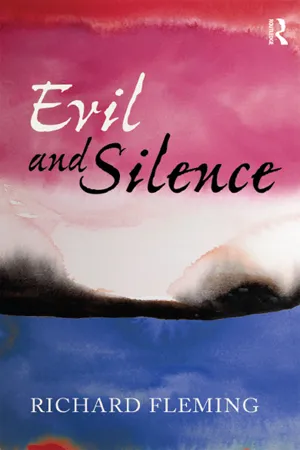
Evil and Silence
About this book
Inspired by Ludwig Wittgenstein and Stanley Cavell, this book is a profoundly original philosophical work put together as a network of quotations, to show that our language is never our own and that ethics can be understood as an effect of our attitude to language. It is a meditation on justice and addresses the question of how to lead a non-violent life and acknowledge the humanity of others following 9/11 and extending right up to the current moment.Using extensive interdisciplinary sources, "Evil and Silence" investigates the nature of evil and the ways to make a life worth living in the face of such a fact of existence. It argues that we must reject the choice of violence as a justified way of life and embrace the creative efforts of nonviolence. The text begins with Socrates argument that it is never just to harm another and ends with Cage s exploration of silence as all the sounds we don t intend. Drawing on his past work in philosophy of language and music, Fleming develops arguments for the logic of nonviolence and the value of silence. He demonstrates that living consistently by way of silence and meaningful sound, understanding the music and language of our lives, is a justified response to the truth and miseries of evil.Links to Musical Illustrations and Scores Mentioned in the TextMozart's "Symphony 40," Beethoven's "Symphony 6," and Ives' "The Unanswered Question" http: //www.leonardbernstein.com/norton_scores.htmMozart's "Symphony 40"Beethoven's "Symphony 6"First page of Wagner's "Tristan und Isolde" http: //www.dlib.indiana.edu/variations/scores/bfk2835/index.htmlFirst page of Wagner's "Parsifal" http: //www.dlib.indiana.edu/variations/scores/baj5813/index.htmlFirst and second pages of Debussy's "Prelude to the Afternoon of a Faun" http: //www.dlib.indiana.edu/variations/scores/bgn9673/index.htmlAn original manuscript page from Schoenberg's Opus 23, "Five Piano Pieces" http: //www.schoenberg.at/scans/Ms23/Ms23/10.jpgThe central tone-row from Berg's "Violin Concerto" (section B) and the last page of "Wozzeck" http: //solomonsmusic.net/wozzeck.htmLast page of Mahler's "Symphony 9" http: //imslp.info/files/imglnks/usimg/5/5d/IMSLP21194-PMLP48640-Symphony_No._9_-_IV.pdfFirst page of Stravinsky's "Petrushka" http: //www.dlib.indiana.edu/variations/scores/aad9501/index.htmlPage from Bernstein's "Mass" http: //www.leonardbernstein.com/mass_scores.htmPage from Tchaikovsky's "Symphony 6" http: //www.leonardbernstein.com/norton_scores.htmCage's "4'33''" manuscript page and precursor materials: http: //solomonsmusic.net/4min33se.htm "
Information
Supplements to First and Second Books
Supplements to First and Second Books

The temptation is overwhelming to say something further, when everything has already been described. Whence this pressure? What produces it? The difficulty here is: to stop.
Contents
Chapter One: | Words Not My Own |
Chapter Two: | Extended Contents |
Chapter Three: | Dark Matters |
Chapter Four: | Reading the Dictionary |
Chapter Five: | Pro and Contra |
Chapter Six: | Musical Illustrations |
Chapter Seven: | Index of Names |
Chapter One Words Not My Own
(Remarks on foreword, pr–1, 6, 66, 85)
Foreword: “it is still likely the text will be understood best by someone who has already said or read the words that are used in it—or at least similar words.”
Many of the words of the First and Second Books are found here:
Socrates: Plato’s Republic, Apology, Crito
Aristotle: Metaphysics, Nicomachean Ethics
Thoreau: Walden, Civil Disobedience
Goldman: The Psychology of Political Violence
Dostoevsky: The Brothers Karamazov, The Idiot, Notes from the House of the Dead
Fanon: The Wretched of the Earth
Camus: The Rebel, Letters to a German Friend, Reflections on the Guillotine
Schopenhauer: The World as Will and Representation
Bernstein: The Unanswered Question
Rousseau: Essay on the Origin of Languages
Schoenberg: Style and Idea
Ives: Essays Before a Sonata
Cage: I–VI
Many are also found here:
Wittgenstein: Tractatus Logico-Philosophicus, Philosophical Investigations
Austin: Philosophical Papers, How to Do Things with Words
Cavell: Must We Mean What We Say?, The Claim of Reason
Some are still to be found elsewhere:
Beauvoir: The Second Sex
Einstein: Atomic War or Peace
Emerson: Essays: First and Second Series
Gandhi: Satyagraha
Kierkegaard: Either/Or, Concluding Unscientific Postscript
King: Pilgrimage to Nonviolence
O’Neill: Long Days Journey into Night
Veblen: An Inquiry into the Nature of Peace and the Terms of Its Perpetuation
Anonymous
Preliminary Remark, First Book: “(In fact, it loudly proclaims to be only the words of others—it is best to avoid the beginnings of evil.)”
Removing these words from the parentheses, by a constrained footnoting of some of remark one of the First Book, helps show the structure, the repetition, and the variation of the whole text. (It is also a reminder that silence is an expression of sourcelessness and unassertiveness.)
We talk and act.1
1. The world is2 our word.3 It wears the colors and expresses the sounds it does by means of the things we say and do.4 A word has meaning in its use, in the context of a sentence. A sentence has meaning in a language and a language requires a form of life. A form of life has significance only in a world. A world has meaning within the context of a word.5 There is more to the world, to be sure, than we can talk about, more than we can say about any particular world or aspect of the world6 [“I can’t put it in words, you must experience it for yourself,” “what we continue to face and live with is not to be described or explained,” “that world is strange and incomprehensible to me”]; but it is empty to suggest the world might be different from what we do or say, as there is no possibility of our having any demonstration or representation of how it might be different from any way in which we might talk about or act in it. “Different from what?” would be the pressing question posed in such a context or elicited by such a claim.7 It might be objected that facts simply are and we humans try our best to come to terms with them. But this, of course, had to be said, and no matter how hard we try to imagine a world of mere fact, without even the word “fact” with which to think and speak of it, the moment we try to give shape to these inchoate imaginings we must use words. It is seductive to consider a fact-in-itself, but a fact “as such” would be something we could literally say nothing about, must necessarily be silent about.8
1. Wittgenstein, Remarks on the Foundations of Mathematics [321].
2. Schopenhauer, The World as Will and Representation [first sentence], and Wittgenstein, Tractatus [first sentence].
3. Austin, Philosophical Papers, “Performative Utterances” [236].
4. Emerson, Essays: First and Second Series, “Experience” [259], and Cavell, The Senses of Walden, “Thinking of Emerson” [128].
5. Cavell, The Senses of Walden [112].
6. Camus, The Myth of Sisyphus [14].
7. Wittgenstein, Philosophical Investigations [#227].
8. Van Buren, The Edges of Language [58-59], and Wittgenstein, Tractatus, [last sentence].
Chapter Two Extended Contents
(Remarks on First and Second Books)
First Book: Just Plain Evil
We talk and act.
1. The world is our word.
2. Talk and action are materially inseparable.
3. Language and world exist in harmony.
4. There is an unfated connection between meaning and saying.
5. The ordinary is unapproachable.
6. There is a logic to each word we speak.
7. A respect for the ordinary is a necessary beginning.
8. Living deliberately is the task of accepting finitude.
Justifiable action is a question of harm.
9. Individual or collective action may not be just.
10. Justice, good, and virtue are mutually exclusive from harm, evil, and injustice.
11. Injured or harmed humans are worse with respect to human virtue.
12. To do wrong or retaliate with a wrong is never right.
13. Socratic questioning is a nonviolent activity that makes enemies.
14. One who does not know everything cannot justifiably destroy everything.
Harm to innocents is just plain evil.
15. The suffering of others enlivens retribution.
16. Sensitivities to evil lead to violence.
17. Unfeeling indifference and intentional evil produce desperation.
18. It is not individuals but human nature that is at stake.
Evil is met by violence and nonviolence.
19. Evil is eliminated or accepted.
20. Evil challenges the rationality of existence.
21. It is better not to be than to be.
22. Evil is not faced but hidden.
23. Evil, as opposed to what?
24. Evil stands within the harmony of being.
25. The empirical data of evil restricts generalizations.
26. Evil can be demarcated.
27. A categorical assertion and a disputable judgment breathe in the uses of evil.
28. Justified action faces a conflict and choice.
29. Living in the world involves a choice of intolerance or acknowledgment.
30. Equivocations on “evil” threaten clarity of thought.
31. Evil shows how we stand in the world.
Violence seeks to solve the problem of evil.
32. The last shall be first and the first last.
33. Violence aims to change the daily order.
34. All suffering, all misery, all ills result from the evil of submission.
35. At the level of individuals, violence is a cleansing force.
36. Violence has its logic.
37. Violence and deceit are necessary to make the world better.
38. Violence patiently seeks the eradication of suffering.
39. Nonviolence misunderstands human nature.
40. Violence is necessary for a moral existence.
Nonviolence attempts to accept the fact of evil.
41. Violence and crime are inevitable parts of the complexity of human nature.
42. Arguments for violence allow uncertainty to produce certainty.
43. Without absolute innocence, there is no supreme judge.
44. Evil is multiplied when the state is the remedy.
45. Violence leads to more violence when ideology of a state is accepted.
46. The concrete particularity of existence exhibits the truth of nonviolence.
47. Premeditated violence, capital punishment, is without justification.
48. Silence is an individual means to answer violence.
Logic calls for nonviolence not violence.
49. Calculated murder is conscious passion without logic.
50. The few common words we find in ourselves hold our origins and consequences.
51. We couldn’t live as we do without a daily, ordinary peace.
52. There ar...
Table of contents
- Cover
- Half Title
- Title Page
- Copyright Page
- Table of Contents
- First Book: Just Plain Evil
- Second Book: Ordinary Silence
- Supplements to First and Second Books
Trusted by 375,005 students
Access to over 1.5 million titles for a fair monthly price.
Study more efficiently using our study tools.
Frequently asked questions
Yes, you can cancel anytime from the Subscription tab in your account settings on the Perlego website. Your subscription will stay active until the end of your current billing period. Learn how to cancel your subscription
No, books cannot be downloaded as external files, such as PDFs, for use outside of Perlego. However, you can download books within the Perlego app for offline reading on mobile or tablet. Learn how to download books offline
Perlego offers two plans: Essential and Complete
- Essential is ideal for learners and professionals who enjoy exploring a wide range of subjects. Access the Essential Library with 800,000+ trusted titles and best-sellers across business, personal growth, and the humanities. Includes unlimited reading time and Standard Read Aloud voice.
- Complete: Perfect for advanced learners and researchers needing full, unrestricted access. Unlock 1.5M+ books across hundreds of subjects, including academic and specialized titles. The Complete Plan also includes advanced features like Premium Read Aloud and Research Assistant.
We are an online textbook subscription service, where you can get access to an entire online library for less than the price of a single book per month. With over 1.5 million books across 990+ topics, we’ve got you covered! Learn about our mission
Look out for the read-aloud symbol on your next book to see if you can listen to it. The read-aloud tool reads text aloud for you, highlighting the text as it is being read. You can pause it, speed it up and slow it down. Learn more about Read Aloud
Yes! You can use the Perlego app on both iOS and Android devices to read anytime, anywhere — even offline. Perfect for commutes or when you’re on the go.
Please note we cannot support devices running on iOS 13 and Android 7 or earlier. Learn more about using the app
Please note we cannot support devices running on iOS 13 and Android 7 or earlier. Learn more about using the app
Yes, you can access Evil and Silence by Richard Fleming in PDF and/or ePUB format, as well as other popular books in Philosophy & Aesthetics in Philosophy. We have over 1.5 million books available in our catalogue for you to explore.