![]()
Part I
Introduction
![]()
1
Remembering in the Time of the Crusades
Concepts and practices
Megan Cassidy-Welch
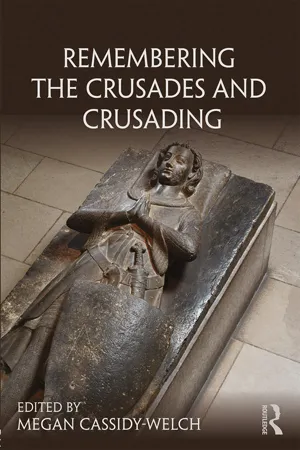
The image on the cover of this book shows a thirteenth-century tomb effigy of a crusader, Jean d’Alluye, who died in 1248. Jean d’Alluye was buried at La Clarté-Dieu near Tours in north-western France, the abbey he had founded before setting off on his crusade to the Holy Land. His limestone effigy shows him in a pose that emphasizes both his piety (his hands are crossed in prayer) and his martial identity (he wears his knightly armour). Now in the Cloisters collection at the Metropolitan Museum of Art in New York, the effigy has been recently restored in public view by museum conservators. As the recumbent knight is painstakingly cleaned of centuries of accumulated grime, Jean d’Alluye’s commemorated form is made visible to the crowds of visitors to the museum, who gather to watch the work in progress. One conservator wrote in the museum’s blog that the relationship between conservator and object is intimate and the task of conservation is usually conducted away from the public gaze. Indeed, ‘[t]he sight of a work in the process of being conserved might also come as a shock to passersby; seeing a work of art in its “stripped” state – where all fills and old restorations have been removed – is like seeing a celebrity un-Photoshopped or without makeup’.1 There is a certain tenderness discernible in the relationship between modern conservator and medieval knight, as the restorative labour of conservation gently reanimates the memory of this long-dead French crusader.
The modern conservator at work reminds us that acts of remembering are always dynamic and relational. They involve processes of communication, reception and assimilation all of which are shaped by the relationships we forge with each other and with the past. This was also true of the medieval period, where memory was cognitive and epistemological, as well as socially constituted and performative.2 Remembering contained and conveyed meaning according to the mode of communication, audience and perceived function but it was always inherently dialogic. Medieval people distinguished between the art of ‘memory’, which was the internal organization, collation and retrieval of information, and ‘remembrance’, which was the outward communication of the past through text, word, image and ritual. But the Latin words for these different dimensions of remembering could be the same. Memoria, the memory, in Latin was a located concept, a place in the body (or soul, in the Augustinian tradition) or it could intimate, as Patrick Geary has identified, the ‘objects and actions by which memory could be preserved’.3 Jean d’Alluye’s tomb was one of many funeral memoriae, for instance. As a material object it was intended to bring to mind the dead crusader himself and create a lasting remembrance of him. But it was also intended to stimulate the individual viewer to remember God, a profound and self-conscious remembering that brought together subjective and social practices of memoria.4
The crusading culture of which Jean d’Alluye was a part was intensely memorial. Crusaders understood that they were spiritual pilgrims engaged in a holy war the collective nature of which alluded to Christ’s sacramental instruction ‘do this in memory of me’. Their participation in the collective endeavour of crusading located them in the corporate body of Christian community and it brought them deeply personal spiritual rewards, the remission of sins being the most significant.5 Yet as historians have begun to show, crusading was a memorial culture in a range of social ways, too. Crusaders were keen to memorialize their own experiences and those of their crusading ancestors. Through the collection and circulation of objects such as relics, through participation in liturgy, through the production of texts such as letters, chronicles and family histories, through the commission and patronage of monastic houses, churches and chapels, the actions of crusaders and the act of crusading saturated the landscape of the past with memoriae. Different communities created their own forms and modes of remembering the crusading past; monastic houses, royal courts, and kinship and religious groups communicated and commemorated the Crusades uniquely and specifically.
In recent years, our understanding of how crusading was remembered and commemorated in the Middle Ages has deepened considerably. This has been a result of more general trends in the scholarship of the Crusades, which has increasingly moved to analyse crusading as part of the cultural landscape of the medieval world and as a series of religious movements that were experienced in different ways by different participants. As cultural history suggests new approaches to the history of the Crusades, so the conceptual frameworks of crusading have attracted renewed attention: from motivations for crusading first intensively analysed by Jonathan Riley-Smith and Marcus Bull, to the experience of crusading for groups other than soldier knights, including women, families, Jews, the Muslims of the Levant, Byzantines and others.6 A move towards reading crusading as experience has also necessitated new questions about the communication of that experience. Close attention is now being paid to the early narratives of the Crusades; new work has recently been produced on the Crusades and visual culture; the shared experience of liturgical commemoration is now receiving more study.7 These scholarly directions all address, to different extents, the question of how crusading was remembered.
Academic interest in Crusades and memory has advanced particularly since 2012, when two important books provided both the first collection of essays devoted to the theme of remembering the Crusades and the first full-length monograph about the Crusades and family memory. The essay collection (edited by Nicholas Paul and Suzanne Yeager) suggested that ‘the crusades became a central element in discourses of identity for individuals, institutions and communities’ during the Middle Ages, and that memory itself, as a key medium for identity formation, was integral to this historical process. Specifically, how the Crusades ‘were recalled or commemorated have been shown to include a sense of religious identity … what it meant to be Christian, Jewish or Muslim, or in more local contexts, what it meant to be English, a French king, a member of a Jewish community in a Rhineland town, or a nobleman aspiring to chivalry’.8 As a category of analysis, ‘identity’ has been extensively critiqued and qualified by scholars of the humanities and social sciences who wish to resist the collapse into one umbrella term all ideas of selfhood, self-understanding, sameness and solidarity across time.9 But the integration of self, belonging and affinity was strong in medieval thought and medieval identity can be understood as a broad category encompassing a variety of meanings. In terms of remembering, the general category of ‘identity’, as Paul and Yeager show, hints at the interiority of medieval memory-making just as much as it implies collective belonging. This is particularly apparent in the context of crusading, where the individual crusading vow required someone both to look inward and to affirm their status outwardly as a participant in collection action.
Nicholas Paul’s monograph To Follow in their Footsteps: The Crusades and Family Memory in the High Middle Ages brought to light the place of dynastic and ancestral memory in the promotion and commemoration of crusading during the twelfth and early–mid thirteenth centuries.10 Paul’s book focussed on the noble family and his analysis of family histories, objects of memory and the place of women as custodians of remembrance was the first to show how ancestral identities were built through memories of crusading. Remembrance was a careful process in the creation of medieval family memory; it brought individual achievement, religious practice, the written word and material culture together for the particular purpose of crafting familial status and meaning. Aristocratic lineages relied heavily on crusading as a mark of past and future prestige. Paul’s work delineated very clearly the contemporary advantages of remembering the Crusades for these families.11
Since the publication of Paul’s monograph, a number of other scholars have explored the connections between Crusades and memory. For instance, a recent issue of the Journal of Medieval History brought together a range of studies on diverse aspects such as liturgy, romance, place and memory, relics as memorial objects.12 Increasingly, the materiality of remembrance has attracted attention, especially in relation to the Fourth Crusade: work by David Perry, Anne E. Lester and Thomas Madden, for example, has brought to light the significance of objects, especially relics, in the transmission of memory of that crusade.13 Other studies have highlighted the particular roles played by religious communities in constructing and fostering memories of crusaders and crusading. One example is the work of Jochen Schenk, whose study of Templar families exposed the lineages of affiliation and commemoration built and maintained by the military orders and their supporters.14 The participatory demands of remembering have been studied by M. Cecilia Gaposchkin and Amnon Linder in liturgical contexts, which were shared by communities often far removed from direct experience of crusading.15 Such work has increasingly emphasised the lived practices of remembering for medieval people. Not only was remembrance dynamic and purposeful, but it was collective and engaging for family groups, religious communities, parishioners and others.
If we understand remembrance to be ‘a set of cultural forms that bring into collective consciousness things that have occurred in the past’ then we need to understand both what those ‘cultural forms’ might be, and the means by which they bring past events and experiences to light.16 In doing this, the conceptual frameworks of communicative and cultural memory are especially helpful. Communicative memory, a term first coined by Jan and Aleida Assmann, refers to the manifestations of remembrance that are created and circulated within a few generations or within living memory of an event.17 Moreover, communicative memory is shared within social groups as part of collective interaction and acculturation; it necessarily fades within a century as the group dissipates and eventually ceases to exist. The personal, conversational and unstructured nature of communicative memory draws attention to its deeply interactive nature, too. As communicative memory fades, so cultural memory takes over. This may be a less fluid sort of remembering, perhaps more formally delineated, more overtly politicized or narrative, and including such elements as tradition. Cultural memory may exist alongside communicative memory but its life is longer. This is the memory of nations and dynasties, religion and ritual, archives and museums. It is not memory as a subjective practice, but remembrance as a social, political and organizational force.18
The communicative and cultural practices of remembering are the focus of this collection, which aims to build on and extend the recent scholarship outlined above. The book concentrates mostly on the ‘heyday’ of crusading – the twelfth and thirteenth centuries – but also considers the longer-term remembrance of the Crusades beyond the thirteenth century and into the modern era. It is divided into three parts, the first and longest of which deals primarily with the sources for crusade remembrance. Contributors have been asked to provide an overview of a particular body of primary source material and to provide a case study from their own research to show those sources ‘in action’. The aim of this part is to illuminate the specific modes through which remembering was articulated, transmitted and integrated into medieval cultures. The diversity of these modes of communication is highlighted here. In the first chapter of Part II Jessalynn Bird looks at preaching, reading biblical exegesis and sermons as exercises in memory, showing how crusade preachers used such concepts as spiritual and legal memory to commemorate past Crusades and to stimulate interest in the conduct of new ones. Cecilia Gaposchkin examines the commemorative practices of liturgy after the First Crusade, specifically the so-called ‘Jerusalem Feast’, performed each 15 July in remembrance of the Christian capture of the holy city in 1099. Elizabeth Lapina writes about the visual culture of crusade memory with a case study of the depiction of the miraculous intervention of saints in battle. As historians have increasingly shown, material culture was a meaningful and effective conduit of remembrance during the crusading period. Anne Lester’s chapter considers spatial and temporal change as embodied in and through the things crusaders carried with them on what were often long and arduous journeys. Sacred objects were particularly important for crusaders, and the relics and other memorabilia they collected communicated and commemorated their own experiences. Darius von Güttner-Sporzyński explores the vast and complex genre of historical writing, with a careful exposition of the links between memory and fiction in representations of crusading in western and eastern Europe. Written texts are also the subject of Lee Manion’s chapter on romance, which illustrates the genre’s varied approach to memory as a way of constructing past achievements, imagining reform, and promoting contemporary crusading action. As Manion argues, vernacular literature was an influential means of transmitting particular and powerful group memories.
The third part of the collection looks closely at four specific communities of memory. Monastic communities were perhaps the most active communities of crusade remembrance throughout the Middle Ages, as religious men and women saw themselves as professional guardians and interpreters of the Christian past. In her chapter on monastic memory, Katherine Allen Smith shows how Christian conceptions of sacred time informed monastic memories of crusading, while the actions of crusaders themselves were evaluated in terms of a Christian moral economy based on the Gospels. The case study of one early crusader, knight-turned-hermit Adjutor of Tiron (d. 1131) is presented to show how the memory of one pious crusader was retold throughout the twelfth century in order to address contemporary needs. James Naus and Vincent Ryan explore how remembering was constructed and shared among royal courts of the twelfth and thirteenth centuries. Using the particular case study of Richard I of England, the ‘Lionheart’, Naus and Ryan consider how royal identities were fashioned through affiliation with crusading, even as the success of the Crusades waned across time. Nicholas Paul and Jochen Schenk write about family and ancestral memory, with particular reference to noble families. The final chapter in Part III is by Rebecca Rist, who revisits the Hebrew chronicles of the First Crusade to analyse how medieva...