eBook - ePub
Views of Ancient Egypt since Napoleon Bonaparte
Imperialism, Colonialism and Modern Appropriations
- 239 pages
- English
- ePUB (mobile friendly)
- Available on iOS & Android
eBook - ePub
Views of Ancient Egypt since Napoleon Bonaparte
Imperialism, Colonialism and Modern Appropriations
About this book
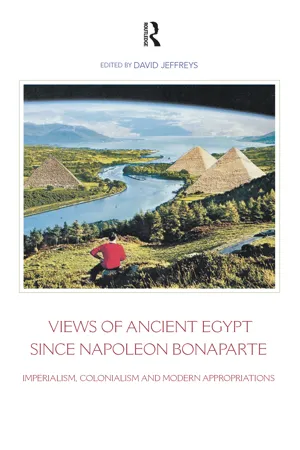
This book addresses some of the main themes of the study of Egypt during the nineteenth and twentieth centuries. In a combination of case studies and discursive chapters, the status of Egypt as an important example of traditional Asian scholarship, and as an ancient model of imperialism itself, is examined. Contributions range from studies of nineteenth century antiquarianism, and the collecting of Egyptian antiquities as an extension of the territorial ambitions and rivalries of the European powers, to explorations of how Egypt is understood and interpreted in contemporary societies. Views of Ancient Egypt also considers the way in which Ancient Egypt has been adopted by less privileged members of some societies as a cultural icon of past greatness.

CHAPTER 1
INTRODUCTION – TWO HUNDRED YEARS OF ANCIENT EGYPT: MODERN HISTORY AND ANCIENT ARCHAEOLOGY1
Few past societies can have exerted a broader or stronger cultural attraction in recent times than that of the Nile Valley. This book explores some of the ways in which that appeal has been translated, at the level of modern nation states as well as that of the individual, into expressions of a collective awareness that take Ancient Egypt, and above all pharaonic Egypt, as a model. It looks not only at the effect of European colonialist mentalities on the way that pharaonic society was explored, portrayed, purveyed and exploited, but also at the adoption of Egypt as a resonant image and a paradigm for more far-flung empires, notably in the New World.
The volume takes as its starting point Bonaparte’s expedition to Egypt, between the years 1798 and 1801, which was a watershed event, not only in the development of professional academic Egyptology and in the increasingly important role that Egypt and its culture played in the international politics of the 19th century, but also as the first major imperialist incursion into the Middle East in modern times. Until then, interest in the Egyptian past had been of a largely individual, antiquarian nature, exemplified by Pococke, Norden, Sonnini and other European travellers since the beginning of the Renaissance, who had increased in number and in their intimacy with the country during the 18th century. Bonaparte’s supplementary army of savants (the Commission) brought an unprecedented weight of scholarly authority to questions of history, geography, identity and the value of traditional classical and medieval sources on Egypt (Ucko and Champion 2003).
Familiarity has perhaps clouded somewhat the extraordinary nature of the French Expedition: not only was it a strategic military undertaking, designed to pre-empt Britain’s easy access to its acquired territory farther east and to counter its rising profile in the area itself; it was also an ideological strike, against the political and intellectual oppression by the Mamluk rulers of the great labouring majority of the population, framed in an historical setting that directly recalled and invoked the supposed ‘liberation’ of Egypt by Alexander of Macedon ca. 330 BC. Napoleon’s reasons for launching both a cultural and a military offensive may have been partly to do with personal initiative – he had apparently already become intrigued by pharaonic civilization in the 1880s (Hassan, Chapter 2) – but he was also motivated by the intellectual acquisition of the territory, its contents, including its inhabitants, and its past. The Egyptian campaign, which followed a brief intervention in Italy (similarly intended to be a combination of military, fact-finding and collecting exercises, and an imposition of cultural superiority over a supposedly backward neighbour), was also considered an extension of French revolutionary and republican culture into a primitive but deserving part of the world (see Wengrow, Chapter 12).
Bonaparte may also have been motivated by a sense of the British lead in discussions of pharaonic Egypt up to that time. If not exactly dominating the antiquarian debate, writers in English certainly had a prominent role: John Greaves (1646) as the most scientific and independently-minded authority on the pyramids; Richard Pococke as the author of one of the key texts (his Description of the East, 1743–45) on contemporary and Ancient Egypt; and James Bruce (1813) as a pioneer explorer of the Upper Nile in the 1790s.
The result of the Commission’s work, the encyclopedic Description de l’Égypte (Anderson and Fawzi 1987; Gillispie and Dewachter 1987; Wheatcroft 2003) consists of not only the Antiquités volumes of elephant folio plates and accompanying text, but also two other sections, at the time considered equally important: the État moderne, a catalogue of the contemporary environment, life and customs; and the Histoire naturelle. Significantly, it also produced in a companion Atlas volume the first large-scale maps of the Nile Valley, reliable on the whole (Ball 1932), and a body of privileged information, as a preliminary to the acquisition of cultural knowledge, territorial occupation and control of land rights (Godlewska 1995). At the same time a popular account of the Expedition, published with much greater speed by a Commission member, Vivant Denon (1802), captured the public imagination on both sides of the English Channel – British audiences were attracted to this adventure by the successful involvement of their hero Nelson at the naval Battle of the Nile (Abu Qir) in 1798. From the shared European perspective, the French Expedition appeared as one of a series of early military forays by Bonaparte that later encompassed most of Europe itself and provided a grand theatre for world events; it has also often been portrayed as a conferring of the benefits of advanced western civilization on a backward subject, as well as providing the kickstart that such a stagnant, oriental society needed to set it on the road to progress. To many Egyptians, however, it has been symbolic as the first example, since the Crusades, of many unwanted and resented western intrusions into the Arab and Muslim worlds (Dykstra 1998: 115).
The recent bicentennial commemorations of the French Expedition (Bret 1999) with their particular focus on the colourful personalities involved and on the discovery and decipherment of the Rosetta Stone (Parkinson 1999) – again a race to the finish between the French and English scholars Champollion and Young – have if anything tended to obscure the longer and broader perspectives of others’ perceptions of Ancient Egypt and its place in the world. The narratives reproduced in such accounts rarely consider the effects of the Expedition, the highly politicized background to the official acquisition of antiquities, and the intrusive and destructive field expeditions that ensued during the early 19th century. In addition, despite its reputation, the publication of the work of the scholarly Commission was not necessarily an unqualified boon to the study of Egypt: the finished result of the Description (1809–1828) volumes is rightly regarded as a monumental achievement; but its weight of antiquarian authority, and the reverence accorded to it at the time and subsequently, have to a certain extent stifled the spirit of inquiry.
Timing is crucial to an appreciation of the French Expedition, its aftermath, and Ancient Egypt’s recent role in the modern world. The Egypt recorded in the Description (1809–1828) is a world already on the point of disappearing: by the time the publication appeared in full, the emergence of Mohammed Ali as semi-autonomous ruler of Egypt in the early 1800s had set Egypt on a trajectory of economic reform and territorial expansion that changed its character in fundamental ways, from a passive and agricultural community to one reliant on heavy industry and a massive military capability (Fahmy 1998). Egypt’s industrial revolution directly impinged on archaeological sites of all periods, many of which were quarried for their limestone for slaking and stripped of their topsoil for fertilizer and saltpeter: in several instances munitions factories were established alongside substantial sites for greater efficiency. A development of equal or greater significance since then has been the sequence of dams at Aswan, which have transformed Egypt’s economic infrastructure in stages from one of seasonal flood recession agriculture to perennial irrigation, planting and cropping.
For global strategic reasons the western powers, notably France and Britain, viewed Mohammed Ali’s developments with alarm and moved to establish larger numbers of diplomatic personnel within Egypt (Figure 1:1), both to observe and to influence his domestic and foreign policies (Dykstra 1979). In response to their increasing demand, Egyptian artefacts were turned into a kind of currency in the competition between the major players, as is illustrated by Bierbrier (Chapter 3) and Thompson (Chapter 4), from small portables such as amulets and figurines to monumental trophies such as colossal statues and architectural fragments including obelisks (Hassan, Chapter 2). A classic example of the antiquities race was the competition between Henry Salt (Manley and Rée 2001) and Bernardino Drovetti (Ridley 1998), Consuls of Britain and France respectively, both of whom retained and deployed large numbers of agents to trawl the country for prestige pieces (Werner 2003). One of the leading agents – for the British – was Giovanni Battista Belzoni, whose exploits brought him at times to open hostility with the rival collectors of Drovetti – who continued to be a proxy for Napoleon’s acquisition of antiquities. The Egyptian authorities, while deriding the western obsession with antiquities as items of ownership, colluded in this activity, often using art objects (or the promise of them) to play off the representatives of different nationalities against each other. Although national prestige was certainly served by the financing of these collecting expeditions, it is curious how reluctant some of the fledgling national museums were to benefit from them. Belzoni, Salt, Drovetti and others, in addition to the logistical problems of organizing their expeditions, often had difficulty hawking their collections around the major institutions (Manley and Rée 2001). The chaotic nature of such activities at this time, and the constant process of extraction, confiscation or exchange, and transport, go a long way to explain why so many collections, even those of national and international stature, contain hundreds of exhibits which are virtually without provenance or whose pedigree is at best uncertain. For example, a contorted background history is found in the case of a small block-statue of Nedjem, originally found at Memphis in 1852 by Joseph Hekekyan, which somehow came into the possession of a Boston sea captain, who shipped it home during the American Civil War. It then disappeared into private ownership before being bought by the Boston Museum of Fine Arts in 1929 (Dunham 1935: 150–151) with documentation records only going as far back as the captain’s purchase in Alexandria. The Boston Museum of Fine Arts then allowed it to go on permanent loan to the Egyptian collection of Memphis State University, where it has remained on display – until recently listed as “provenance unknown” (Crown 1982: 14)!

At the same time, and entirely in the western Orientalist tradition (cf. Said 1978), the myth developed of two kinds of cultural superiority: that of the west over the east, and by extension that of the ancient east over the modern. In this way the Egypt of remote antiquity was conveniently detached from the Islamic world and, like the etic study of that world, became the preserve of western scholarship: Egyptian nationals (with one or two remarkable exceptions) were excluded from any participation in the teaching or administration of Egyptian archaeology until the early 1900s (Reid 1985; Wood 1998). Even today, as a discipline ‘Egyptology’ has an unusually precise meaning, being specifically the study of society in the Nile Valley from 3000 BC (the beginning of unitary rule, or the dynastic period) to 330 BC (the arrival of Alexander), or at the latest the first century AD. Many would even narrow it down still further and define the end date as 1000 BC (regarded as the final period of indigenous dynastic rule). Egyptian prehistory (except very late prehistory) is often not considered a proper concern of Egyptology; Islamic archaeology in Egypt is similarly treated as the territory of Arabists, and its administration is the responsibility of an entirely different department of government. Few other regional culture-historical specialisms are so narrowly defined: Sinology, for example, deals with all recoverable periods of Chinese history and culture, including the present, in a discipline that is certainly as intrinsically rich in data as Egyptology.
Egypt’s industrial revolution also brought into the country a first generation of foreign technocrats and engineers, who often became absorbed with the physical remains of Egypt’s past and applied their own area of expertise to its observation and explanation. Thus began a curious duality in the 19th century study of pharaonic civilization: on the one hand a group of highly specialized practitioners (architects and engineers, geologists and botanists, physicians and surgeons) who treated the study of many aspects of Ancient Egypt with seriousness and as something more than a mere hobby; and on the other the profession of Egyptology – the term dates from the mid-1850s (see Champion, Chapter 8) – with its core of academics usually, but not exclusively, raised in the Classical-textual or Biblical-textual tradition.
The textual emphasis in the history of Ancient Egypt’s appropriation is particularly significant. At the time of the French Expedition the original Egyptian language was still effectively a closed book; although Coptic (written using mostly Greek characters) was recognized as a descendant of the ancient language, and some preliminary insights had been gained into the nature of the three indigenous scripts, a full consensus on the decipherment of the hieroglyphic script was not to emerge until the early 1830s. After that the number of expeditions organized to feed the academic demand for new inscriptions grew exponentially, and such enterprises were pursued with little or no reflection on, or regard to, archaeological context (France 1991); interpretations of pharaonic society were increasingly made almost exclusively from written sources, and even today documentary evidence is privileged (Kemp 1984). To complicate matters, the practice of field excavation in Egypt, with its notorious bias towards funerary and monumental municipal sites and away from settlement zones (Bietak 1979a; 1979b; O’Connor 1993: 577–578), and towards the Nile Valley and away from the Delta, has also generated a frame of reference which is at variance with that of many other regional archaeologies.
This emphasis on documentary and representational sources, and the very nature of many of the sources themselves, may be in part responsible for the widely felt belief in an almost revelatory personal access to the Ancient Egyptians. Compared with other contemporary or near-contemporary literate societies, and in addition to its huge, colourful and lively representational record, Egypt presents a greater than usual quantity and range of documents with some human appeal, such as private letters, popular tales, proverbial sayings and teachings, poetry, and even satirical and erotic texts. As Wengrow (Chapter 12) points out, the strength of the phenomenon of ‘Egyptomania’ is more or less unique: there was, for example, no corresponding ‘Babyloniamania’, in that other region of the Middle East where there had been study of developments in social behaviour of a comparable scale and date. The perception of Egyptian society as a unique entity has also persisted almost unchallenged to the present: until quite recently few students of pharaonic Egypt seemed prepared to make cross-cultural comparisons with civilizations elsewhere in the region, much less to consider Egypt’s achievement on a global scale against those of more remote cultures; Trigger (1984) being, significantly, an anthropological – not an Egyptological – exception (see Manley and Rée 2001). Egyptologists are collectively accused of being concerned with the particular and descriptive rather than the general and explanatory, and of being generally resistant, if not actually hostile, to methodological progress, especially in archaeological theory, taking place in most of the rest of the world (Lustig 1997; Meskell 1999; Weeks 1979). In some recent syntheses of archaeology globally, and even some collective treatments of the Middle East, Egypt features rarely or not at all: for example, in Renfrew and Bahn’s introductory manual to archaeology worldwide, which contains several general references to Egypt, only two are concerned with developments within Egyptian archaeology since Petrie’s time (1991: 80, 189).
There are, however, heartening signs that this trend may be changing: recent studies of gender, the aged, climate change, and of state formation, wealth and legitimacy in the ancient Near East, all adopt a more or less integrated approach in which Egypt features equally or prominently (Baines and Yoffee 1998; Cameron and Kuhrt 1983; Dalfes et al. 1997). Even voices from outside a Near Eastern specialism have suggested that Egypt, with its rich documentary and archaeological resources, might be rehabilitated into a more rewarding worldwide debate, and contribute more substantially through new approaches to cognitive aspects of all past societies (Scarre 1994).
It comes almost as a surprise today that Egyptian archaeology has at any time given any kind of lead in archaeological thought and method. There have been, exceptionally, suggestions and observations from within that have generated discussion outside the narrow boundaries of Egyptology (Hoffman 1984; Hoffman et al. 1986; Smith 1969; Trigger 1981, 1984); and as Champion (Chapter 8) observes, Egyptian material at least, in the form of well-preserved human anatomical specimens, provided Elliot Smith with fuel for his ideas – innovative and influential at the time – on theories of hyperdiffusionism in the early 20th century. As Medina-González describes (Chapter 7), it is interesting that even before an academic formulation of diffusionist theory, the discoverers and colonizers of Mesoamerica had already taken Egypt as a prescriptive model and frame of reference for the past cultures encountered there. In general terms the study of Egypt may be said to have had a broader influence on antiquarian thinking elsewhere during the 19th century than in the 20th.
By the end of the 19th century, Flinders Petrie had introduced new methodological advances such as quantitative methods, in the form of seriation, into archaeological analysis, and new non-intrusive recording techniques (x-radiography) for delicate specimens such as mummified remains. Petrie also had an almost visionary approach to archaeological assemblages, collecting for information value rather than financial return, and building the superb teaching and research collection at University College London that bears his name. It is often forgotten too that in the early 1900s pioneering work was done in Egypt on predictive survey techniques such as soil phosphate analysis, long before it was widely applied in Scandinavia (Proudfoot 1976: 110; Russell 1957: 145). Significantly, few of these pioneering methods were appreciated or adopted at the time, and through the 20th century Egyptian archaeology became increasingly out of step with the practice of archaeology elsewhere. There were many who, like Petrie, had begun their archaeological careers in Europe or the United States, but unlike him remained competent and respected practitioners rather than contributing to innovative approaches, and even the Unesco Nubian campaign of the 1950s and 1960s, which involved an unprecedented infusion of international expertise, failed to convey other than incidentally to the mainstream of academic Egyptology any of the current archaeological thinking elsewhere (e.g. processualism).
The early years of the 20th century also saw one of the rare periods in which archaeologists in Egypt paid any attention to settlement archaeology as opposed to funerary and religious sites. Attention had first been paid ...
Table of contents
- Cover
- Half Title
- Title Page
- Copyright Page
- Series Editor’s Foreword
- Table of Contents
- Contributors
- List of Figures
- 1 Introduction – Two Hundred Years of Ancient Egypt: Modern History and Ancient Archaeology
- 2 Imperialist Appropriations of Egyptian Obelisks
- 3 Art and Antiquities for Government’s Sake
- 4 “Purveyor-General to the Hieroglyphics”: Sir William Gell and the Development of Egyptology
- 5 Some Egyptological Sidelights on the Egyptian War of 1882
- 6 Forgers, Scholars and International Prestige: Ancient Egypt and Spain
- 7 ‘Trans-Atlantic Pyramidology’, Orientalism, and Empire: Ancient Egypt and the 19th Century Archaeological Experience of Mesoamerica
- 8 Egypt and the Diffusion of Culture
- 9 Approaching the Peasantry of Greco-Roman Egypt: from Rostovtzeff to Rhetoric
- 10 The British and the Copte
- 11 Ancient Egypt and the Archaeology of the Disenfranchised
- 12 Forgetting the Ancien Régime: Republican Values and the Study of the Ancient Orient
- References
- Index
Trusted by 375,005 students
Access to over 1.5 million titles for a fair monthly price.
Study more efficiently using our study tools.
Frequently asked questions
Yes, you can cancel anytime from the Subscription tab in your account settings on the Perlego website. Your subscription will stay active until the end of your current billing period. Learn how to cancel your subscription
No, books cannot be downloaded as external files, such as PDFs, for use outside of Perlego. However, you can download books within the Perlego app for offline reading on mobile or tablet. Learn how to download books offline
Perlego offers two plans: Essential and Complete
- Essential is ideal for learners and professionals who enjoy exploring a wide range of subjects. Access the Essential Library with 800,000+ trusted titles and best-sellers across business, personal growth, and the humanities. Includes unlimited reading time and Standard Read Aloud voice.
- Complete: Perfect for advanced learners and researchers needing full, unrestricted access. Unlock 1.5M+ books across hundreds of subjects, including academic and specialized titles. The Complete Plan also includes advanced features like Premium Read Aloud and Research Assistant.
We are an online textbook subscription service, where you can get access to an entire online library for less than the price of a single book per month. With over 1.5 million books across 990+ topics, we’ve got you covered! Learn about our mission
Look out for the read-aloud symbol on your next book to see if you can listen to it. The read-aloud tool reads text aloud for you, highlighting the text as it is being read. You can pause it, speed it up and slow it down. Learn more about Read Aloud
Yes! You can use the Perlego app on both iOS and Android devices to read anytime, anywhere — even offline. Perfect for commutes or when you’re on the go.
Please note we cannot support devices running on iOS 13 and Android 7 or earlier. Learn more about using the app
Please note we cannot support devices running on iOS 13 and Android 7 or earlier. Learn more about using the app
Yes, you can access Views of Ancient Egypt since Napoleon Bonaparte by David Jeffreys in PDF and/or ePUB format, as well as other popular books in History & Egyptian Ancient History. We have over 1.5 million books available in our catalogue for you to explore.