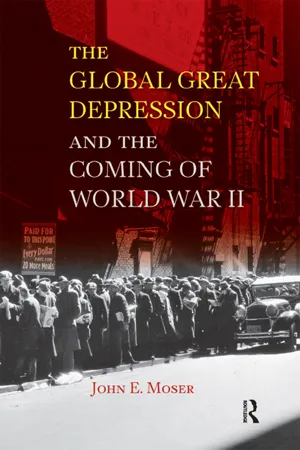
The Global Great Depression and the Coming of World War II demonstrates the ways in which the economic crisis of the late 1920s and early 1930s helped to cause and shape the course of the Second World War. Historian John E. Moser points to the essential uniformity in the way in which the world s industrialized and industrializing nations responded to the challenge of the Depression. Among these nations, there was a move away from legislative deliberation and toward executive authority; away from free trade and toward the creation of regional trading blocs; away from the international gold standard and toward managed national currencies; away from chaotic individual liberty and toward rational regimentation; in other words, away from classical liberalism and toward some combination of corporatism, nationalism, and militarism.For all the similarities, however, there was still a great divide between two different general approaches to the economic crisis. Those countries that enjoyed easy, unchallenged access to resources and markets the United States, Great Britain, the Soviet Union, and France tended to turn inward, erecting tariff walls and promoting domestic recovery at the expense of the international order. On the other hand, those nations that lacked such access Germany and Japan sought to take the necessary resources and markets by force. The interplay of these powers, then, constituted the dynamic of international relations of the 1930s: have-nots attempting to achieve self-sufficiency through aggressive means, challenging haves that were too distrustful of one another, and too preoccupied with their own domestic affairs, to work cooperatively in an effort to stop them.
- 238 pages
- English
- ePUB (mobile friendly)
- Available on iOS & Android
eBook - ePub
Global Great Depression and the Coming of World War II
CHAPTER 1
A RETURN TO NORMALCY? THE UNITED STATES, 1920–1928

In a campaign speech given in May 1920, Republican presidential candidate Warren Harding informed his audience that “America’s present need” was “not nostrums, but normalcy.” Contrary to popular belief, he did not coin the term “normalcy”—it had been around since at least the mid-nineteenth century—but it came to be identified closely not only with his administration, but with the entire decade of the 1920s.
In some ways the term was perfectly clear. Americans had become exhausted by the pace of Progressive Era reform, and particularly with the myriad demands that had been made upon them during the nineteen months of direct US involvement in World War I. In this sense the move toward normalcy began immediately after the armistice was proclaimed in November 1918; conscription stopped on that very day, and in the following months a number of wartime boards had been dissolved and regulations lifted. Under Harding the pace would accelerate, as the new administration slashed both federal spending and taxation. The federal debt, which had stood at over $27 billion in mid-1919, would fall to less than $17 million by 1929.
However, beyond a general reduction in the burdens of taxation and regulation, the meaning of normalcy remained vague. It could not be denied that during the previous twenty years the United States had changed in some important ways. The census of 1920 demonstrated that for the first time more Americans lived in towns and cities than in rural areas. Big business had grown bigger, in spite of (and in some ways because of) Progressive Era regulation, fueled by wartime contracts awarded by the federal government. Moreover, even though conscription had been abruptly ended, the National Defense Act of 1920 kept the structure of a standing army intact, and the United States still possessed the world’s second-largest navy.
But the most striking change was the expansion of the country’s economic power. The US economy had been growing rapidly long before 1914; indeed, more than a third of the world’s manufactured goods were produced in the United States in 1913. However, the war had brought unprecedented benefits to the American economy, particularly to the export trade. For four years the industrial economies of Europe had been forced to focus exclusively on the production of war materiel, allowing US firms to compete in new markets around the world. Between 1914 and 1918, the gross domestic product per capita grew by nearly 18 percent. Furthermore, the demands of war—as well as the physical destruction that it brought about—had so disrupted the economies of the leading industrial powers (Great Britain, France, and Germany) that they would continue to struggle through the 1920s. Between 1921 and 1928, therefore, per capita GDP expanded by nearly 30 percent (see Figure 1.1), and by the end of the decade the United States was producing nearly 45 percent of the world’s manufactured goods. Investment abroad by US firms and banks soared as well, with the value of foreign holdings skyrocketing from $2.7 billion in 1914 to $35.1 billion in 1929. American corporations such as IBM, Standard Oil, Goodyear, Firestone, and International Telephone & Telegraph established branches abroad, often buying out foreign businesses, so that the number of US-owned and -operated firms in Europe grew from fewer than 100 in 1914 to more than 1,300 by 1929.
The United States, then, had emerged from the war as the world’s most powerful economy, leading some to conclude that it was the natural successor to Great Britain as the center of international trade and finance. One concerned British diplomat, comparing US economic power to that of his own country, gloomily recognized “a State twenty-five times as large, five times as wealthy, three times as populous, twice as ambitious, almost invulnerable, and at least our equal in prosperity, vital energy, technical equipment and industrial science.”1 However, predictions that the United States might take Britain’s place as leader of the global economy overlooked the fact that there were crucial differences between Britain’s place in the prewar economy and that of the United States after 1918. The former’s prosperity had always been based in foreign trade, and even during the 1920s—after it had lost its place as the chief trading nation to the United States—imports accounted for between 25 and 30 percent of net national product. By contrast, imports represented less than 5 percent of US gross national product. With the exception of a few types of raw materials, such as rubber and coffee, the United States remained to a great extent self-sufficient.
The contrast between America’s newfound status as the world’s leading industrial power and the relative unimportance of foreign commerce to its national wealth created a deep division in public opinion regarding the country’s role in national affairs. On one hand, a powerful internationalist elite had emerged in the northeast, particularly in New York City, centered on Wall Street banking firms, certain export-oriented industrial corporations, and the Federal Reserve Bank of New York. This group was cosmopolitan and deeply concerned about global affairs, both for self-interested and sentimental reasons. It was instrumental in directing American investment abroad for the purposes of postwar reconstruction. Its leaders were international bankers such as Thomas W. Lamont, Dwight Morrow, Russell Leffingwell, and J. P. Morgan Jr.; corporate executives such as Owen Young of General Electric; and the governor of the New York Federal Reserve Bank, Benjamin Strong. These men tended to possess a more expansive definition of the term “normalcy” than a mere return to the status quo ante; financier Paul Warburg explained that “the normal of the past is not likely to be the normal of the future, which raises the question of what the normal ultimately will be.”2
Figure 1.1 Per Capita GDP of the Great Powers, 1922–1928

Source: Data from Angus Maddison, 2014, “Maddison Historical GDP Data,” World Economics, www.worldeconomics.com/, accessed May 14, 2014.
But while these individuals were wealthy and influential, they remained a tiny minority among the US population. The census of 1920 may have shown that less than half the population lived in rural areas, but the definition of “urban” included any location with more than 2,500 inhabitants. In fact, more than half of the American people lived in locations with fewer than 5,000 inhabitants, and well over two-thirds lived in places with fewer than 50,000. For small-town America, normalcy meant a return to the values of a day when the United States had practically nothing to do with the rest of the world. To the extent that residents of this “Main Street” thought about Wall Street they tended to distrust it, and during the 1920s they tended to elect to federal office men who shared this outlook. Both Warren Harding and his successor, Calvin Coolidge, had grown up in small towns. Neither had spent significant time traveling abroad, nor did they demonstrate any particular interest in doing so. “I always tell people,” Coolidge announced at a press conference, “that I have so many places still to go in the United States that I don’t know when those will be so much exhausted that I will arrive at a time when I can visit other countries.”3
Yet even Harding and Coolidge included in their administrations men who could safely be categorized as internationalists, and could from time to time even make tentative forays into world affairs. When they did so, however, they frequently encountered resistance from members of Congress. As a group, the nation’s legislators were, if anything, even more provincial than its presidents—particularly the legislators from farm states, which were heavily overrepresented in the US Senate. Agriculture had enjoyed a wartime boom no less impressive than that of industry, with exports of foodstuffs peaking at more than $2.6 billion by 1919. However, while industry continued to enjoy prosperity through the 1920s, farming seriously lagged. European agricultural production recovered quickly, so that world prices fell by nearly a third in the first half of the decade, and the value of US agricultural exports dropped by more than two-thirds. Far from seeking to expand the nation’s involvement with the rest of the world, therefore, they sought as far as possible to insulate agriculture from the fluctuations of the global economy. The farm bloc’s preferred remedy was a bill called the McNary-Haugen Act, which would have required that the federal government purchase surplus crops at an artificially high price and then dump them on world markets. McNary-Haugen came before Congress repeatedly between 1924 and 1928, passing both houses on two occasions, only to encounter presidential vetoes each time. Had it passed, it almost certainly would have generated substantial ill will from abroad as huge quantities of American foodstuffs would have flooded an already saturated world market.
The dilemma of the Republican administrations of the 1920s—caught between the internationalism of Wall Street and the isolationism of much of the rest of the country—was personified in the secretary of commerce, Herbert Hoover, who would emerge as one of the most important public figures of the era. Although like Harding and Coolidge he hailed from a small town, he had spent much of his adult life abroad as a successful mining engineer. During the war he had won fame by overseeing food relief to German-occupied Belgium, and in 1919 he was appointed head of the American Relief Administration, charged with overseeing food shipments to postwar Europe. In that position he won wide acclaim as an able administrator and humanitarian, and this led him to an unsuccessful run for the presidency in 1920. A longtime Progressive Republican—he had supported Theodore Roosevelt’s presidential bid in 1912—Hoover was a passionate advocate of “third way” policies, and had long sought to establish partnerships between government and leading businesses to solve pressing national problems.
Hoover’s 1920 quest for the Republican nomination had been a disappointing experience. His international reputation had not been enough to win him domestic support. Quite the contrary: he found himself subject to blistering attacks from fellow Republicans, particularly senators William Borah of Idaho and Hiram Johnson of California, as well as certain press outlets, charging that his foreign experience had somehow made him un-American. Some political cartoons even portrayed him as a lackey of the king of England. Secretary of commerce was not a particularly prestigious appointment; indeed, the Department of Commerce had not even existed before 1903. Nevertheless, he accepted the post, determined to use it as a launching pad for another run at the White House. Specifically, Hoover would use his office to recast himself as a patriotic defender of the American consumer as well as US business interests overseas. Therefore, during a decade when nearly every government department faced significant budget cuts, the Department of Commerce grew larger, at times interjecting itself into matters normally handled by the departments of State and the Treasury (to the clear annoyance of Charles Evans Hughes and Andrew Mellon, the respective secretaries).
The tension between an internationalist Wall Street and a nationalist Main Street had clear implications for US foreign relations in the 1920s. The financial clout of the United States meant that it was bound to play some role in world affairs, but Congress and the public generally stood in the way of anything that sounded like an actual commitment to a foreign country. Thus while France repeatedly sought guarantees of assistance from the United States in the event of attack from a revived Germany (see Chapter 2), Washington responded with a suggestion that the nations of the world simply make war illegal—an idea embodied in the Kellogg-Briand Pact, in which sixty-two nations, including all of the great powers, pledged to “renounce” war “as an instrument of national policy.” The other major priority in the 1920s was disarmament, with the United States repeatedly advocating and concluding arms-control agreements. At the Washington Naval Conference of 1921–1922 the United States, Great Britain, Japan, France, and Italy all agreed to place limits on construction of new battleships, and even to scrap some that had already been built. The great powers also promised to respect the status quo in the Pacific and to guarantee the integrity of China. However, since there was no enforcement mechanism for any of this—neither Congress nor the public would have accepted such a mechanism, even if Harding had been interested in pursuing one—these agreements could be easily violated when they became inconvenient. In short, the United States might have kept up an interest in global affairs, but it would play virtually no part in rebuilding the international order that had been shattered in 1914.
Congress and the administrations of the 1920s would also demonstrate their essential isolationism by acting to keep out foreign goods and foreign people. The Republican Party had favored protection since its inception in the 1850s, and the United States remained a high-tariff nation throughout the period of Republican dominance in the decades following the Civil War. Woodrow Wilson, a Democrat, had presided over a sharp reduction in trade barriers, although the outbreak of war in 1914 did far more to protect US agriculture and industry from European competition than could tariffs. However, with the end of the war Americans feared that their markets might be swamped with cheap goods from Europe. Congress responded in 1922 by passing the Fordney-McCumber Tariff, with rates even higher than those of the late nineteenth century. Given the relative self-sufficiency of the United States and the comparative inefficiency of European industry during this period, worries over foreign competition were no doubt overstated, and it is unlikely that European manufactured goods would have found much of a market even without Fordney-McCumber. Nevertheless, foreigners regarded the new rates as a slap in the face and evidence that the United States was unwilling to play a constructive role in the global economy.
It was a matter of trade—specifically concerning raw rubber, one of the very few natural resources for which the United States was entirely dependent on foreign imports—that gave Herbert Hoover his best opportunity to shed his image as an internationalist. Over a six-month period in 1925 the price of rubber tripled as the result of the Stevenson Plan, a British effort to control output from rubber plantations in British-owned Malaya, the world’s leading source of raw rubber. American tire companies, by far the largest purchasers of rubber, had reason for concern, but their preferred course was to negotiate with the British government. Hoover, on the other hand, opted for a massive public-relations campaign urging the public to repair rather than replace worn tires. Moreover, he played the anti-British card by ostentatiously promoting the use of the slogan “1776–1925”; once again Americans were fighting the tyranny of British colonial authorities. The effort paid off, and when the price of rubber fell slightly in early 1926, Hoover was quick to claim credit. The title of an article in the Washington Post read “Rubber Fight Won by Americans…. Hoover Attributed Cut in British Price to His Campaign.”4
Efforts to limit immigration went back almost as far in American history as trade protectionism, but it was not until the early 1920s that Republicans joined with Southern Democrats to pass meaningful legislation along these lines. The movement to restrict immigration had received a powerful boost in the early twentieth century from the growth of eugenics, a pseudoscientific “third way” idea that advocated managing a country’s population by checking the growth of groups deemed undesirable or “unfit.” Eugenicists criticized US immigration policy, under which foreigners, primarily “Slavics” and “Latins” from southern and eastern Europe, had accounted for more than 40 percent of the country’s population growth during the period 1890–1920. Indeed, in the ten years before the outbreak of World War I an average of more than one million foreigners had entered the country annually. The outbreak of war brought an end to the stream, but just as the return of peace conjured the specter of a flood of cheap foreign goods landing on American shores, it raised fears of a flood of impoverished foreign people watering down the country’s Anglo-Saxon stock. The Emergency Immigration Act of 1921, followed by the Immigration Act of 1924, reduced the flow to a trickle—no more than 160,000 were allowed to immigrate per year. Given that immigration had provided an important safety valve for countries in economic distress, these new laws were regarded as one more sign that the United States was not prepared to “play ball” with the rest of the world.
But although US trade and immigration policy irritated world opinion, neither issue generated as much European ill will toward the United States as that of war debts. In the final months of World War I, as well as during the immediate postwar period, the US government had provided massive loans to the Allied powers, and in 1920 the total debt stood at roughly $10 billion—$5 billion from Great Britain, $3.5 billion from France, and the remainder from Italy and several smaller nations. The debtor countries suggested that the economic distress prevailing in Europe in the postwar era made it impossible to repay anything like the full amount. Some, particularly in France, argued that as a matter of simple justice the debts should be written off entirely, since they had been incurred as a result of the common effort against Germany. Wall Street and the export-oriented business community sympathized with this view, arguing that insistence on repayment of the debts would hinder Europe’s recovery, and thus hurt the global economy. Herbert Hoover, appointed to Harding’s World War Foreign Debt Commission in 1921, felt likewise. “Some sacrifices on our part,” he wrote to the president, “might bring definite economic compensations as well as a better world.”5
Neither Congress nor the public at large, however, seemed ready to consider anything close to cancellation of the debts. It remains unclear whether Calvin Coolidge ever uttered the phrase, “They hired the money, didn’t they?” but it was a fair summation of the prevailing attitude of Main Street. Progressive Republicans from the Midwest and West joined with Southern Democrats to insist on repayment, accusing Wall Street—with some justification—of advocating cancellation for self-interested reasons. The Allies also owed substantial debts to international banking firms such as J. P. Morgan, they reminded their colleagues, and cancellation of the debt to the US government would make it easier for them to repay their private loans. Congress made it clear that it did not trust the executive branch to set policy on this issue; Congress would need to be consulted on any final settlement.
Such views dictated that the Harding and Coolidge administrations tread carefully in their negotiations over the financing of the debts. Cancellation was, of course, out of the question. The loans accounted for more than 20 percent of the increase in the national debt between 1916 and 1919, and their repayment was believed to be a precondition for reducing income tax rates, which was a top priority for Republicans during this period. Nor could they accept the argument, advanced by the French and British governments, that a single agreement be reached with the debtor nations, and that the size of the required payments be tied to the amounts received in reparations payments from Germany. The White House instead insisted on concluding individual financing agreements with each debtor nation, and the State Department refused to authorize private loans to any country that had failed to take part in these agreements. In practice, however, the White House demonstrated a high degree of flexibility on war debts. Th...
Table of contents
- Cover
- Half Title
- Title Page
- Copyright Page
- Table of Contents
- Acknowledgments
- Introduction
- 1 A Return to Normalcy? The United States, 1920–1928
- 2 The Victors Diverge: The “Haves,” 1920–1928
- 3 Liberalism and Its Discontents: The “Have-Nots,” 1920–1928
- 4 The Crisis Begins: The United States, 1928–1933
- 5 A Tale of Two Countries: The “Haves,” 1928–1933
- 6 Dancing on a Volcano: The “Have-Nots,” 1928–1933
- 7 Beggar Thy Neighbor: The United States, 1933–1936
- 8 The Unraveling of the Western Alliance: The “Haves,” 1933–1936
- 9 Recovery through Nationalism: The “Have-Nots,” 1933–1936
- 10 Stumbling toward Internationalism: The United States, 1936–1939
- 11 The Economics of Appeasement: The “Haves,” 1936–1939
- 12 Taking the Plunge: The “Have-Nots,” 1936–1939
- 13 War for Plunder, 1939–1941
- Conclusion
- Notes
- References
- Index
- About the Author
Trusted by 375,005 students
Access to over 1.5 million titles for a fair monthly price.
Study more efficiently using our study tools.
Frequently asked questions
Yes, you can cancel anytime from the Subscription tab in your account settings on the Perlego website. Your subscription will stay active until the end of your current billing period. Learn how to cancel your subscription
No, books cannot be downloaded as external files, such as PDFs, for use outside of Perlego. However, you can download books within the Perlego app for offline reading on mobile or tablet. Learn how to download books offline
Perlego offers two plans: Essential and Complete
- Essential is ideal for learners and professionals who enjoy exploring a wide range of subjects. Access the Essential Library with 800,000+ trusted titles and best-sellers across business, personal growth, and the humanities. Includes unlimited reading time and Standard Read Aloud voice.
- Complete: Perfect for advanced learners and researchers needing full, unrestricted access. Unlock 1.5M+ books across hundreds of subjects, including academic and specialized titles. The Complete Plan also includes advanced features like Premium Read Aloud and Research Assistant.
We are an online textbook subscription service, where you can get access to an entire online library for less than the price of a single book per month. With over 1.5 million books across 990+ topics, we’ve got you covered! Learn about our mission
Look out for the read-aloud symbol on your next book to see if you can listen to it. The read-aloud tool reads text aloud for you, highlighting the text as it is being read. You can pause it, speed it up and slow it down. Learn more about Read Aloud
Yes! You can use the Perlego app on both iOS and Android devices to read anytime, anywhere — even offline. Perfect for commutes or when you’re on the go.
Please note we cannot support devices running on iOS 13 and Android 7 or earlier. Learn more about using the app
Please note we cannot support devices running on iOS 13 and Android 7 or earlier. Learn more about using the app
Yes, you can access Global Great Depression and the Coming of World War II by John E. Moser in PDF and/or ePUB format, as well as other popular books in History & Economic History. We have over 1.5 million books available in our catalogue for you to explore.