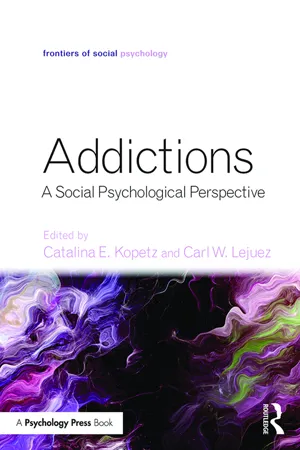
The current volume brings together social psychological theories and concepts and discusses their relevance to understanding substance use and addiction. It identifies convergence points between traditional perspectives on addiction and social psychological theory and research. This coexistence, which acknowledges the value of the conceptual and methodological advancements in each relevant field and attempts to integrate them, promotes scientific understanding and a more effective prevention and treatment of addiction.
- 290 pages
- English
- ePUB (mobile friendly)
- Available on iOS & Android
eBook - ePub
About this book
Information
Introduction
1
ALLERGIES AND AFFINITIES
Social Psychology Pathways as Ways of Seeing Inside ‘Addiction’
Within the broader knowledge ecology of addiction research, social psychology investigates relationships between social context and emotional, cognitive, and behavioral processes typically represented as individual processes in other disciplines that produce knowledge about addiction as an object of study (Campbell, 2007). Approaches to addiction that bring together “psyche” and social context were relatively rare and extremely contentious in the social history of addiction research and treatment. Indeed, the overall narrative of addiction research is cast as one in which behavioral, neurochemical, and pharmacological views of substance abuse triumph in ways that drive out sociological and/or psychological ways of knowing. Yet the social contexts, cultural meanings, and pharmacological effects of drugs remain significant for understanding why people do them. This volume draws attention to the significance of social psychological concepts such as social inclusion and exclusion, stereotypes, groups, and attitudes for understanding addiction. As a historian of addiction research, I contextualize this project within attempts to understand how and when social psychology advances or retreats upon the object and subject of addiction. The history may be characterized as a series of allergies and affinities between various conceptualizations of the role played by inner or subjective states in patterning outward social behavior and activities that are culturally intelligible as addictions.
Historically, the project to place addiction research on scientific footing has been motivated by desire to destigmatize addiction, to render it less subject to the whims of moral judgment, sin, or vice. The amalgamated approaches designated as addiction research comprise a kaleidoscope that is reconfigured in ways that reveal distinct hierarchies within the history of the social and human sciences that study addiction and addicts, those who live with addictions.
Mapping the Conceptual History of Addiction
One way to trace the history of social psychological approaches to addiction is to track the genealogy of the disease concept, asking what kind of disease addiction is considered at any given historical moment into the present (Campbell, 2009, 2011, 2012). In the early twentieth century, addiction was strategically defined through the lens of psychopathology by physicians who argued against criminalization of addicts and prosecution of physicians under the Harrison Act (1914). Lawrence C. Kolb undertook animal and human research on narcotic addiction at the federal Hygienic Laboratory in Washington, DC, to dispel misconceptions that addiction was a crime resulting from weakness and overindulgence in sinful or vicious activity (1925a, 1925b, 1925c). He created a diagnostic classification scheme that divided addicts between those whose response to narcotics was psychologically normal and those having a psychopathological relationship to the pleasures of heroin and cocaine that consequently deteriorated into addiction (Kolb, 1925c; Kolb & Ossenfort, 1938; Pescor, 1939). When the first United States Narcotic Farm opened in Lexington, Kentucky, in 1935, Kolb was appointed medical officer in charge. Later he returned to Washington to head the federal division of mental hygiene, which became the National Institutes of Mental Health (NIMH) in 1948. Kolb’s protégé, Robert H. Felix, was the founding director of NIMH. While working at the narcotic farm, Felix studied psychopathology in relation to sociological factors such as family configuration and relationships with “bad companions” (Felix, 1939; Felix, 1944). NIMH incorporated the laboratory-based and clinical research at Lexington into its intramural program and renamed the laboratory there the NIMH Addiction Research Center (ARC).
As the world’s premier scientific laboratory studying drug addiction, the ARC emphasized neurological and pharmacological approaches and was directed by Harris Isbell from 1945 to 1963, and by William R. Martin from 1963 to 1977. Although most ARC researchers were convinced that addicts became conditioned to social cues that triggered craving and relapse, they primarily studied neurophysiological markers, such as those comprising the Morphine Abstinence Syndrome defined by Clifton K. Himmelsbach. Conceptual and methodological divisions between the scientific and clinical sides of the USPHS institution kept intact a wall between modes of thought. Whereas Kolb’s K-classification system was clinically useful, ARC investigated objective measures of drug effects, including quantification of subjective effects. Adoption of experimental methods and operationalizable variables was the means by which some of the psychological sciences gained purchase and credibility over others within the field of early-to-mid-twentieth-century addiction research.
Mapping the historical field reveals conceptual and practical obstacles to the formation of a genuinely social psychology of addiction in addition to the construction of it as a disease to which the proper response was medicine. The status of intoxication, pleasure, or euphoria in development of addiction was contested. Kolb differentiated between a “positive pleasure” that elevated some individuals far “above [their] usual emotional plane” and a “negative pleasure” that simply provided relief from pain or anxiety in “normal” individuals (1925c). Whereas addicted individuals sought “positive pleasure,” considered a marker of psychopathology, they were observed to build up tolerance and increase their dose to obtain even “negative pleasure.” Similarly, Freud’s account of addiction, articulated in Three Essays on the Theory of Sexuality (1905), characterized addiction as a disorder of desire derived from “phenomena of intoxication and abstinence that arise from the habitual use of toxic, pleasure-producing substances” (1975, p. 82). Psychodynamicist Sandor Rado theorized that the pleasure of heroin use constituted a “pharmacogenic orgasm” (Rado, 1926, 1933, 1956). Early psychoanalytic and psychodynamic theories acknowledged that pleasure could be derived psychologically from drug effects, but failed to situate drug use within social context.
Sociology become more central to the study of addiction by the mid-twentieth century as interest in psychoanalysis waned. Sociologists emphasized how social groups interacted within environmental context in ways that shaped individual actions that led to “addiction.” Sociologist Alfred E. Lindesmith, who co-authored one of the first textbooks on Social Psychology, (1949), studied social norms pervading the life worlds of opiate addicts in Chicago (1937, 1947). Critical of Durkheim’s notion of “anomie” or “normlessness,” Lindesmith and Gagnon (1964) argued against the dominant sociological theory that addicts used drugs to “escape” their circumstances and reject dominant social goals and conventional means to reach them (Merton, 1938). Howard S. Becker extended the insights of Lindesmith (1947) to the process by which marijuana users became committed to “moral careers” reflecting concerted effort (Becker, 1953, 1963). While the dominant social order marked these careers “deviant,” Becker argued they were patterned sequentially and productive of social order. Lindesmith and Becker’s approaches became the basis of “social learning” or social constructionist approaches. However, Durkheim and Merton’s structural-functionalist sociology of crime as deviance became dominant within the study of drug addiction as a social problem.
Lindesmith’s work was roundly rejected by scientific researchers seeking to integrate psychiatry and pharmacology at the ARC, who turned a skeptical eye to sociology’s value for understanding addiction. Lindesmith criticized Kolb’s theory of addiction as psychopathology (Kolb 1925a, 1925b, 1925c; Keys & Galliher, 1999, p. 21; Acker, 2001, p. 185). A recurring scientific puzzle is why some individuals exposed to drug use become addicted, and others do not. Today’s explanations for this long-observed phenomenon include biogenetic vulnerability or genetic variation; these are partial and incomplete explanations similar to older proto-ideas concerning “predisposition,” “addictive personality,” “psychopathology,” or mental illness. One enduring question was whether or not psychologically “normal” individuals could become addicted—or whether addiction was a problem for only “abnormal” or “psychopathological” individuals. Lindesmith (1947) argued that the process of becoming an opiate addict took place within a social milieu in which those more experienced with drug effects taught less experienced users how to manage pharmacological exposure and consequent physiological habituation. Not until a person learned to interpret the symptoms of withdrawal distress did s/he become an opiate addict according to Lindesmith (1947). Only when that social learning process was complete did individuals adopt behaviors and language aligning self-understanding, identity, and social activity in such a way that they understood themselves to be addicts. For those emphasizing neurophysiology or psychopathology, social learning theory was anathema. With evident dissatisfaction, Kolb dismissed Lindesmith (1947): “the main theme of his story is that an addict is not an addict unless he knows it” (quoted in Acker, 2001, n. 54, p. 257). Thus were sociological theories of addiction as a learning process considered to contradict psychiatric, psychological, and physiological models of addiction, particularly those validated via experimental or objective methods. Indeed, sociology was positioned in opposition to both psychopathology and physiology, an antipathy cast into political terms. A persistent antipathy between interpretive methods and inductive processes for knowledge production, and deductive or scientific methods for doing so took hold.
Sociological theories integrated some aspects of social context with response to inner sensations, learning, and motivation. An important aspect of Lindesmith’s theory was that addiction to opiates followed not from positive effects, but from “individual reaction[s] to the withdrawal symptoms which occur when the drug effects are beginning to wear off” (1947, p. 87). Deeply interested in relapse but skeptical of non-experimental work, ARC researcher Abraham Wikler, reviewing Lindesmith’s book for the American Journal of Psychiatry, suggested that Lindesmith become acquainted with clinical research (1948, v. 105, pp. 74–75) but acknowledged that addiction was an “interdependency of subjective and physiologic processes in the human organism” and hence partly a psychiatric and partly a “sociologic” problem. However, Wikler opposed the “linguistic” aspects of Lindesmith’s analysis of the process by which individuals come to call themselves addicts and understand that administration of opiates relieved withdrawal distress (p. 74). The sociological content of Lindesmith’s book was perceived as an incursion onto the scientific terrain carved out by the federal mental health and public health research apparatus.
Indeed it took near-Herculean efforts by John A. Clausen, chief of the Laboratory of socio-environmental studies at NIMH, to create a social science section at the ARC in 1962. Two sociological criminologists, John Ball and Jack O’Donnell, jointly established a section concentrating on drug abuse epidemiology, using thousands of patient records from the two federal narcotic farms and the etiology of heroin use in juvenile gang affiliation. Their quantitative, demographic approach was accepted at the ARC. Work by Clausen (1957) relied on structural-functionalist sociological theories concerning individuals’ relative degree of social isolation or exclusion from urban social groups with emphasis on divergence from normative value commitments as predictive of addiction. Clausen understood drug addiction as both a psychophysiological state and a social category produced by behavior within specific social contexts that could not be understood apart from the legal definitions and social disadvantages salient to these contexts. Citing William F. Whyte’s influential Street Corner Society (1943), Clausen noted that research on personality, psychological factors, and patterns of association and/or family formation that made some persons more vulnerable than others had to date been carried out almost entirely in samples of institutionalized narcotic addicts. As one of the first researchers to deploy an explicitly social psychological frame of reference that included attention to migration and immigration patterns, Clausen’s work integrated psychological and sociological theory within the specific context of the mid-twentieth-century urban United States.
Chief among the formative figures combining epidemiology with social psychology was Isidor Chein, whose magisterial tome, The Road to H, stands as the classic study of an era defined by a national moral panic about heroin addiction. Although the late 1940s was the likely peak of postwar recruitment to heroin use, a well-documented demographic shift toward younger users of color became evident to state and federal authorities in the 1950s. The Road to H centered on the five boroughs of New York City, running male and female heroin users through an extensive battery of psychological tests. Chein described how certain concepts shaped individual behavior:
The typical individual … conceives of his addiction as essentially ego-alien–‘a monkey on his back.’ With repeated experiences of failure in efforts to rid themselves of the habit, some unknown proportion of cases come to a realization that the habit really reflects some aspect of themselves and not something externally imposed.
(Chein, 1958, p. 149)
Addiction was recast as a relationship of alienation within as the figure of the monkey pervaded popular culture, primitivizing and racializing addiction at a time when it was shifting demographically from majority White population to include far more persons of color. In “The Man with the Golden Arm” (1955), Hollywood’s first take on addiction, the dealer who tempts Frankie Machine (played by Frank Sinatra) back into heroin use, dismisses Frankie’s vow not to get hooked again with the dramatic prediction that “the monkey never dies.” The individual psychological mode—and the idea that inner life-directed behavior and action in the social world—contrasted to the emergence of behaviorist approaches within the field.
Intense Interactivity: The Longing for Integration between Social and Psychological Domains
Behavioral pharmacology integrated pharmacological principles with psychological principles of conditioning, learning and motivation (Stolerman, 1991, p. 17). Whereas conventional pharmacological approaches such as those pioneered at the ARC from the 1930s on emphasized negative effects of withdrawal and avoidance of abstinence, the behavioral approaches emerging in the 1960s emphasized that drugs were positive reinforcers, coping mechanisms, or rewards to which animals and humans developed cue-conditioned responses. By manipulating the space of experimentation, behavioral pharmacologists incorporated a thin version of social and environmental cues into models of addiction, but eschewed scrutiny of interior states. They developed treatment approaches such as contingency management, based on driving behavior from drugs to alternative reinforcers that make sense within particular social environments. Behavioral pharmacology characterized “drug-taking [as] a basic characteristic of drug-organism interactions under conditions where there is ready availability of drugs” (Stolerman, p. 17). Whereas sociologists and social psychologists might see such conditions as aspects of the social world in which drug exposure has historically shaped opportunity and motive, behavioral approaches bracketed the question of how such conditions came to be and reduced the question to one of patterned repetition of reinforcement. Persistence of drug-taking despite negative consequences became part of the definition of addiction in the late twentieth century.
Whereas sociologists and social psychologists were generally agnostic or opposed to concepts of classical and operant conditioning central to experimental approaches within behavioral psychology and pharmacology, longitudinal study approaches emerged in the mental health field toward which they migrated in the mid-twentieth century. A nascent developmental and life cycle perspective emerging from NIMH-funded longitudinal studies in the 1950s became central to a movement towards community-based social psychology. George Vaillant’s NIMH-funded follow-up studies relied on ARC data to analyze the “natural history” of New York opiate addic...
Table of contents
- Cover Page
- Half Title page
- Frontiers of Social Psychology
- Title Page
- Copyright Page
- Contents
- List of Contributors
- Foreword
- Part I Introduction
- Part II Basic Processes
- Part III Application Challenges. How Basic Science Can Inform Prevention, Treatment, and Policy
- Index
Trusted by 375,005 students
Access to over 1.5 million titles for a fair monthly price.
Study more efficiently using our study tools.
Frequently asked questions
Yes, you can cancel anytime from the Subscription tab in your account settings on the Perlego website. Your subscription will stay active until the end of your current billing period. Learn how to cancel your subscription
No, books cannot be downloaded as external files, such as PDFs, for use outside of Perlego. However, you can download books within the Perlego app for offline reading on mobile or tablet. Learn how to download books offline
Perlego offers two plans: Essential and Complete
- Essential is ideal for learners and professionals who enjoy exploring a wide range of subjects. Access the Essential Library with 800,000+ trusted titles and best-sellers across business, personal growth, and the humanities. Includes unlimited reading time and Standard Read Aloud voice.
- Complete: Perfect for advanced learners and researchers needing full, unrestricted access. Unlock 1.5M+ books across hundreds of subjects, including academic and specialized titles. The Complete Plan also includes advanced features like Premium Read Aloud and Research Assistant.
We are an online textbook subscription service, where you can get access to an entire online library for less than the price of a single book per month. With over 1.5 million books across 990+ topics, we’ve got you covered! Learn about our mission
Look out for the read-aloud symbol on your next book to see if you can listen to it. The read-aloud tool reads text aloud for you, highlighting the text as it is being read. You can pause it, speed it up and slow it down. Learn more about Read Aloud
Yes! You can use the Perlego app on both iOS and Android devices to read anytime, anywhere — even offline. Perfect for commutes or when you’re on the go.
Please note we cannot support devices running on iOS 13 and Android 7 or earlier. Learn more about using the app
Please note we cannot support devices running on iOS 13 and Android 7 or earlier. Learn more about using the app
Yes, you can access Addictions by Catalina E. Kopetz,Carl W. Lejuez in PDF and/or ePUB format, as well as other popular books in Psychology & Clinical Psychology. We have over 1.5 million books available in our catalogue for you to explore.