- 246 pages
- English
- ePUB (mobile friendly)
- Available on iOS & Android
eBook - ePub
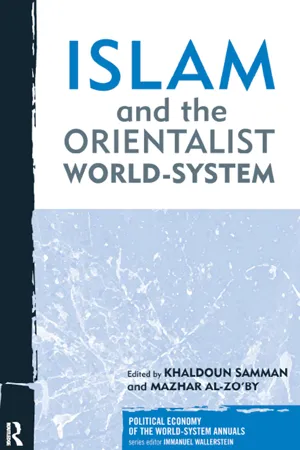
Islam and the Orientalist World-system
About this book
Featuring Immanuel Wallerstein, Joseph Massad, Marnia Lazreg, and other well-known and emerging new authors, this book seeks a more accurate understanding of Islam and Islamic societies' role and relations to global cultural and economic realities. The book confronts a trend today of analyzing Islam as a "cultural system" that stands outside of, and even predates, modernity. The authors see this trend as part of a racist discourse unaware of the realities of contemporary Islam. Islamic societies today are products of the world capitalist system and cannot be understood as being separate from its forces. The authors offer a more carefully constructed and richer portrait of Islamic societies today and forcefully challenge the belief that Islam is not part of, nor much affected by, the modern world-system.
Information
Part I
Introduction
1
Islam, Orientalism, and the Modern World-System
I: ORIENTALISM AND THE MODERN WORLD-SYSTEM
The Middle East and the multiple Islamic regions of the world have been incorporated into a modern historical system that functions on highly supremacist terms. Indeed, from its beginnings, such discourse paved the incorporation of much of the Islamic world into a global and modern racialized system, which introduced a new and hierarchical taxonomy of civilizations, religions, and cultures. The lens through which cultural, religious, and civilizational differences came to be understood was racially tainted. This led to the interpretation of a world in which the “Western civilization’s” religion, race, ethnicity, and culture were deemed to possess some unique trait that produced superior characteristics, placing the “West” above the rest (see Stuart Hall). Many highlighted, either singly or in combination, the Renaissance, the Reformation, and the Industrial, Political, and Scientific Revolutions as the ingredient(s) that gave the “West” its due advantage over all Others, positing that these were qualities which the rest of the world’s peoples had lacked because of their own internal cultural or political obstacles.
Even some of the elites of the global south who were themselves racialized and located in the regions on the losing side of modernity came to measure their standing, in the early phases of incorporation, by comparing themselves to the “West,” which was believed to have acquired refined qualities that they now desired to emulate. We can call this new global entity the Modern Orientalist World-System: a world-order that is politically, economically, and culturally stratified, with race constituting the very epicenter of the stratification. Such a system ranks the “West” and “whiteness” as the superior race/civilization, signifying all those qualities and characteristics in a manner that sets it exactly opposite to those of the Orient (Edward Said 1979, 1994).
While the epistemological origin of Orientalism dates much earlier, we can say with confidence that it was thoroughly in place by the late nineteenth century. As with Ferdinand Tönnies’s gemeinschaft and gesellschaft, or Emile Durkheim’s mechanical and organic societies, typing societies and civilizations into ontological binaries became, at that time, the norm for understanding the differences between “our” modern way of life and those which were relegated to both the past and the Other. From this point on, a list of characteristics perceived to be the sole possession of the West, was used to justify the racial and cultural stratification of our modern global historical system. This included a whole array of social and political practices that made the West not only different from the rest of the world, but superior. Western man thus came to be understood as the supreme perfection of everything progressive and modern that all Other peoples of the world needed to emulate and make their own.
Consider, for instance, what Hegel wrote in 1840 about Africa in his introduction to The Philosophy of History. For him, Africa was “a continent enclosed within itself” which resembled “the land of childhood, removed from the light of self-conscious history and wrapped in the dark mantle of night.” Africa was, indeed, so “different from our own culture, and so remote and alien in relation to our own mode of consciousness” that “if we wish to understand [Africa] at all, we must put aside all our European attitudes.” “For this very reason,” he continued, “we cannot properly feel ourselves into [its] nature, no more than that of a dog” (all quotes from Susan Bordo 1999: 76–8).
Our intention here is not to simply show yet another example of a racist European philosopher but to illustrate, as Susan Bordo asserts, “the deep historical sources of still-living ideologies” (Bordo 1999: 80). By juxtaposing the child of Africa to the adult of Western civilization, Hegel was participating in a fundamental discourse that would continue unchallenged well into the first couple decades of American hegemony. As one American stated in a 1960s book on the “psychology of development,” if we are to understand our mature Self, we must first begin by studying our childhood. For it is only then that “we can discover what in reality we are” (Doob 1960: 2). In the same way that a “parent learns something about himself from his own child,” a mature civilization like ours can learn something about itself from the less civilized (Doob 1960:2). With a hint of modernization discourse made popular under post-World War II American hegemony, therefore, non-Western civilizations are in effect seen as “undeveloped potential Europeans” (Hardt and Negri 2001:
116).
The persistence of this representation continues into our own time, so evident as to belong to such mainstream recreational spaces as Epcot Center. Recently, roaming Epcot Center during a visit to Disney World in central Florida, we could see how glaringly this triumphalistic vision of a modern Orientalist world-system is on display. Epcot Center is organized by two central themes. On one side sits Future World, which, immediately upon entry, depicts a “highly developed” civilization, comprised of science, technology, and progress. This side of the park contains science exhibits and such rides as Spaceship Earth, in which passengers travel through time “from the dawn of man to the future.” Here, Europe and the U.S. represent the civilizational location in which science, philosophy, and secularism are assumed to have been invented and, over time, diffused off to far-away worlds.
The narrative suggests that only during the Dark Ages have other, particularly Islamic, civilizations lent a hand to the enterprise of human development. The manner in which Epcot’s thematic structure incorporates the Other within its storyline of progress, maintains the prevalent sense that Islamic civilization is marginal to the developmental trajectory, in essence acting only to safeguard “our” torch of progress, which appears to be detained in some sort of mid-life crisis during the Dark Ages. Once “we” have recuperated from this temporary illness, the Islamic Other simply hands the torch back to its rightful owner, unchanged, and the West continues upon its path of enlightenment and progress, developing its science, its printing, its philosophy, and its creative arts.
Moreover, upon exiting Spaceship Earth and proceeding to other sectors within this side of the park, one is in constant interaction with technological gadgets and robotic machines. By contrast, on the other far-side of the park, where the World’s Showcases can be reached by crossing a bridge over a body of water, one may visit many “traditional folk cultures,” such as Morocco, Germany, and China. Here, the visitor is invited to explore other cultures within suggested representative spaces. Morocco, for example, is showcased in part inside of a Mosque, where one can shop and experience the Orient, meeting such figures as Aladdin and observing a sensuous belly dancer perform on stage to Arabic music.
Thus Disney World, obsessively embodying themes of progress and the future, is an iconic representation of our racialized discourse regarding civilization and progress, providing a typical Eurocentric understanding of modern global history as entertainment. In a sense, it offers a popular version of the colonizer’s model of the world, deploying a clear distinction between the rational, scientific, enlightened, and “developed” nations of Western civilization and the undeveloped, particularistic, religious, sensuous, and emotional civilizations of Islam and all Others. This colonialist narrative implies, implicitly, that the global south sits far behind the West not because of a historical system organized on an unequal foundation, but simply the result of the distinctive and political qualities “we” possess. In this sense, Disney-reality fits snugly into a political project that posits the West as superior to any other civilizational model of past and present.
This Orientalist representation of the world is, of course, not new. Orientalism is, after all, defined by its constant urge to plagiarize past texts (see Timothy Mitchell 2002: 123–52). Long before the arrival of Disney World, there existed its predecessors. A good illustration of this can be found, for instance, in the World’s Colombian Exposition in Chicago of 1893, where organizers, much like future Disney Imagineers, divided their exhibitions into two categories that look almost identical to Epcot. Here, The civilized white sector of the city’s exhibition, with its commerce, advanced manufacturing, iron, and steel, displayed buildings of Manufacture, Art, Administrations, Machinery, and Electricity, in contrast with the primitive villages of Samoans, Egyptians, Dahomans, Turks and others (Bederman 1996: 31, 35). Indeed, as in Epcot, there was a spatial and temporal divide between the civilized and primitive sector of the Exhibition, and in order to go from one to the other, one had to leave the white man’s city and enter through another gate in order to reach the colored man’s world.
Of particular notice is how, in the Colombian World’s Fair as well as in Disney’s Epcot Center, the industrial, modern, scientific-rational Self is distanced from the Other, both spatially and temporally. Although non-Western and Western civilizations exist on the planet simultaneously, they are constructed as living in different historical times and spaces. The Muslims, in the case of Epcot, live in the time of old Danish and German folk culture, before the latter moved into modernity and evolved into a mature civilization. The Muslims, the Native Americans, and all Others are frozen in time while the West takes off into space. The Other thus is distanced from the West, although it exists simultaneously with it. The implication is that Western civilization, in past epochs, once lived in a developmental stage similar to that of Other races and cultures, which are indeed seen as live examples of a prior Self that has become Other. However, having evolved and matured into a highly developed human species, the West is understood to have progressed forward in time, crossing the bridge to the other, more scientific and mature, side.1 In short, this form of representation “has the explicit purpose of distancing those who are observed from the time of the observer, a denial of coeval time” (Massad 2001: 78). This distancing between the modern and non-modern becomes a measuring rod for how far Western Civilization has evolved in comparison to the stagnant Others.
II: WORLD-SYSTEM ANALYSIS AS CRITIQUE OF ORIENTALISM
Such distancing of Self and Other can also be understood as a way in which non-Western people have been constructed “as fundamentally hostile to modernity and incompatible with modernization” (Mirsepassi 2000, 2). Indeed, for many contemporary Western academic writers, such as Bernard Lewis (1990) and Samuel Huntington (1993), crossing over the bridge into modernity means that Islam itself may have to disappear. According to Bernard Lewis, the prophet of Islam and his religion, while having served Muslims well in the premodern world, through some measure of success, now blocks their development into a better, more civilized world of modernity. Moreover, such pundits interpret the rise of contemporary Islamist movements as the natural and essential expression of a religious and civilizational project that stems from some time-immemorial source. This source is characterized as predating modernity and containing a world-view that makes it literally impossible to join the modern civilized world.2 According to these writers and others, the fact that prior modernization efforts failed in some Islamic regions proves that Islam cannot accommodate itself to the modern world. Indeed, the present conflict between “the West” and “Islam” is due largely to the fact that these are two antithetical civilizations, they claim. Islam represents a cultural universe that is in essence anti-modern and anti-Western. That is, Muslims, according to this narrative, are culturally indigestible to the modernist project. This is because they have learned from their seventh-century predecessors in Mecca and Medina traits and mentalities that are intrinsically anti-modernist.
World-systems analysis, from our point of view, can be seen as inherently antagonistic to this highly Orientalist representation of the world (see Samman 2001). Such a representation posits that every cultural entity has a singular essence within a globe composed of a multiple, yet limited, variety of civilizations, which are reduced to a crude list, a small number of “interacting” cultures, each containing its own geist. Such a portrayal runs counter to the idea, as put forward by Wallerstein and others, that modernity, at the macro level, structures those micro civilizational differences. What appears as an essential expression of difference is in effect the product of power asymmetries which form and constitute those differences. For the Orientalists, each nation, religion, or civilization appears to have its own ethos that is stable within its spatial boundaries and temporal origins. In this sense, the people of a specific group are understood as having a single will, one mind, one race, one Qur’an, one five-pillars, one masculinist culture, one “unreformed religion” waiting for a Luther or a Newton to bring them into the modern world. A world-system analysis challenges this highly essentialized notion of difference by positing that all civilizations are the invention of one modernity. Such an analysis suggests that actors in different locations of the modern world-system are constrained to act within multiple political containers, which elites mobilize to their advantage through the use of national, religious, and cultural discourses.
Given such strengths, one of the challenges we now ask of world-system scholars is to address the resurgence of colonialist and racist discourses that are emerging in our midst, especially in Europe, the United States, and Israel. Just as Wallerstein in the 1970s shattered the orthodox theorem that capitalism is reduced to the proletariat-bourgeosie dichotomies by illustrating that non-wage labor, including such labor forms as slavery and second-serfdom, are all a product of the world-capitalist system, we also need to shatter present hegemonic discourses that suggest there are certain “cultural systems” which stand outside and even predate modernity. In previous decades, we challenged those who often accorded the industrial working class a leading “historical role” of revolution over other figures of labor (such as peasant labor and reproductive labor). We did so by demonstrating that different labor formations were an intrinsic functioning characteristic of capitalism, rather than being different modes of production belonging to different historical periods of mankind. Similarly, today we must forcefully challenge the belief that Islam stands as the symbol of premodern, feudal society.
As many of us have now recognized, Marxists are not immune from holding this essentialist discourse. The manner by which some Marxists have traditionally dealt with religious movements, especially of the Islamic variant, is congruent with the racist discourse found in Bernard Lewis and Samuel Huntington. The more orthodox variants of Marxist thought tend to see religious identity as “pre-capitalist,” belonging to a primitive, fourteenth-century feudal mentality that has not evolved and caught up with the modern mode of global capital production. Islam, then, is a preindustrial social structure frozen in time, in which “most people still work in agriculture or in handicraft production.” Hence, the lack of a vibrant capitalist class and a vanguard proletariat which moves the system forward, both of which, according to some Marxists, are crucial for modernity, forms the explanation of “what went wrong” and why Islam has been unable to adapt itself to “modernity, industrialization, and representative democracy.”3
This assertion strikes us as quite odd, for as far as we know, mankind has not yet invented H.G. Wells’s time machine. The fact that the holders of this view can characterize and classify people as living in different historical times shows the alluring and racist power of this discourse. As Ali Mirsepassi has argued, Marxism does not really differ from liberal or conservative views of the global order in that, like its more conservative counterpart, it views history in a linear and evolutionary manner: “The scheme of historical gradation implied in this narrative forecloses the fullness of historical possibility by insisting on the adherence of human practice to an abstract, allegedly scientific, scheme of historical progress” (Mirsepassi 2000: 40). In the same way that Hegel conceptualized Africa as “a continent enclosed within itself…[where] history is in fact out of the question,” some Marxists, armed with this Orientalist view of history, at times supported nationalist policies which aimed to destroy what they perceived to be archaic institutions acting as obstacles to capitalist or postcapitalist modernity.
As we now know so well, this is in fact where World-system scholars have contributed by showing that, within the constitution of the modern world-system, an “outside,” external, pre-existing civilization that is destined to articulate other, more modern civilizations can no longer be posited to exist. We need to take another step and begin to demonstrate that the so-called civilizations of Islam and the West need not be understood as two entities external to each other, destined for some cosmic cultural clash. World-system scholars can offer a much more convincing argument by demonstrating that these civilizations are discursively and dialogically formed within the very same system. The civilizational conflict is a product of social forces competing within the same singular historical system. Moreover, world-system analysis can show the limits of the following highly racialized questions that many so-called scholars of Islam are now asking: “Is Islam in need of a Reformation?”; “Can the Muslim world adapt to modernity?”; “Is Islam compatible with Capitalism or Socialism?” Indeed, what all these questions share in common is a linear view of history, of ranked and disparate civilizations across asynchronous time and space, in which the Orientalist discourse of Self and Other remains the underlying assumption of our racist and modern Orientalist world-system.
III: THE HIDDEN INJURIES OF THE MODERN ORIENTALIST WORLD-SYSTEM
What is most troubling about this Orientalist world-system is that a large sector of the world is asked to transform its self in order to emulate its more powerful Other, not only through economic and social pressure, but also, as is the case today, through the threat of cruise missiles and other deadly military arsenal designed to kill and maim those who dare refuse to bow before the godlike neoliberal notions of progress and democracy. This type of intimidation and bullying makes the unequivocal demand that many southern cultures and religions must, as Amin Maalouf eloquently depicts:
admit that their ways were out of date, that everything they produced was worthless compared with what was produced by the West, that their attachment to traditional medicine was superstitious, their military glory just a memory, the great men they had been brought up to revere—the poets, scholars, soldiers, saints and travelers—disregarded by the rest of the world, their religion s...
Table of contents
- Cover
- Half Title
- Title Page
- Copyright Page
- Table of Contents
- Acknowledgments
- PART I: Introduction
- Part II: Systems, Culture, and Difference
- Part III: Islam and the World-System
- PART IV: Religion, Capitalism, and Social Movements
- PART V: Identity, Binaries, and Difference
- About the Contributors
- Series List
Trusted by 375,005 students
Access to over 1.5 million titles for a fair monthly price.
Study more efficiently using our study tools.
Frequently asked questions
Yes, you can cancel anytime from the Subscription tab in your account settings on the Perlego website. Your subscription will stay active until the end of your current billing period. Learn how to cancel your subscription
No, books cannot be downloaded as external files, such as PDFs, for use outside of Perlego. However, you can download books within the Perlego app for offline reading on mobile or tablet. Learn how to download books offline
Perlego offers two plans: Essential and Complete
- Essential is ideal for learners and professionals who enjoy exploring a wide range of subjects. Access the Essential Library with 800,000+ trusted titles and best-sellers across business, personal growth, and the humanities. Includes unlimited reading time and Standard Read Aloud voice.
- Complete: Perfect for advanced learners and researchers needing full, unrestricted access. Unlock 1.5M+ books across hundreds of subjects, including academic and specialized titles. The Complete Plan also includes advanced features like Premium Read Aloud and Research Assistant.
We are an online textbook subscription service, where you can get access to an entire online library for less than the price of a single book per month. With over 1.5 million books across 990+ topics, we’ve got you covered! Learn about our mission
Look out for the read-aloud symbol on your next book to see if you can listen to it. The read-aloud tool reads text aloud for you, highlighting the text as it is being read. You can pause it, speed it up and slow it down. Learn more about Read Aloud
Yes! You can use the Perlego app on both iOS and Android devices to read anytime, anywhere — even offline. Perfect for commutes or when you’re on the go.
Please note we cannot support devices running on iOS 13 and Android 7 or earlier. Learn more about using the app
Please note we cannot support devices running on iOS 13 and Android 7 or earlier. Learn more about using the app
Yes, you can access Islam and the Orientalist World-system by Khaldoun Samman,Mazhar Al-Zo'by in PDF and/or ePUB format, as well as other popular books in Theology & Religion & Islamic Theology. We have over 1.5 million books available in our catalogue for you to explore.