- 298 pages
- English
- ePUB (mobile friendly)
- Available on iOS & Android
eBook - ePub
Flying Ahead of the Airplane
About this book
Airlines willing to develop insight from foresight relating to the expected 'step phase changes' will eventually improve their margins. However, the backward-looking airline, managed using old strategic levers and short-term metrics, will cease to exist, merge, shrink, become more dependent on government support, or become irrelevant. 'Management innovations' are not going to deliver the required improvements; innovation within management is essential for airlines' survival. In Flying Ahead of the Airplane, Nawal Taneja analyzes global changes and thought-provoking scenarios to help airline executives adjust and adapt to the chaotic world. Drawing on his experience of real airline situations worldwide, the author concludes that there is a gulf between what executives are doing now and what they need to do to stay ahead of the curve. To close this gap, the author suggests that airline executives focus on just three relevant initiatives: a) aligning business and technology strategies, b) redesigning organization structures to centralize the role of the scheduling function, and c) developing relevant brands that integrate social networking technology. To support this third initiative, the book provides insights on branding from 20 fascinating non-aviation case studies from around the world. Flying Ahead of the Airplane will assist practitioners in airlines of every size to integrate future trends into their mainstream thinking and launch flexible business models to manage risk and compete effectively in the 'flattening world'.
Chapter 1
Introduction
Flying Ahead of the Airplane is a fifth book in a series written for, and at the encouragement of, practitioners in the global airline industry.1 According to Thomas Friedman, the world is flattening due to such factors as convergence of technology, rise of emerging markets, proliferation of knowledge, and the increase in the capability to collaborate all over the world.2 Sirkin and his colleagues at the Boston Consulting Group describe the world as “globality” (a new and different term for globalization), meaning “competing with everyone from everywhere for everything.”3
Take, for example, two fast-developing markets, China and India. Not only are they becoming integral components of the global supply chain, but the size of their middle classes is growing substantially to create huge markets for consumption and materialism, developed internally and externally. This “flattening” of the world and “globality” are enabling companies to enter the marketplace with heroically new business models. For example, Li & Fung, a Hong Kong-based company is producing more than $8 billion in garments and other products without owning a single factory.4 In the case of airlines, clear examples would be Ryanair and Jet Airways. Ryanair flies within Europe with ultra low fares, relying significantly on ancillary revenue. Jet Airways flies within India, and has operations that now cover the world, including flights to the US across both the North Atlantic and the Pacific.
Unfortunately, while other businesses are focusing on opportunities brought about by the “flattening” of the world and “globality” (where a wide array of producers are using unconventional business models to produce and market to existing and new consumers), most traditional airlines (conventional as well as the established low cost, low fare) seem to be preoccupied with their conventional on-going challenges. Even when dealing with challenges, mostly operational and tactical, the approaches used are incremental, as opposed to strategic.
Regrettably, some of the expected tidal forces, and even worse, the potential impact of their confluence (the potential “perfect storm”), can no longer be addressed incrementally. Here are a few examples of game-changing forces that could have an enormous impact on airlines:
• rising expectations of passengers relating to transparency, experience, innovation, interaction, and customization based partly on their changing lifestyles and partly on the availability of some of these product/service attributes from other industries;
• emergence of technology that, on the one hand, is raising the expectations of passengers, (for example, mobile devices, wireless communications, self-service systems, sophisticated search engines, and social networking), and, on the other hand, could raise the planning capability of progressive airlines (reduced cycle times, dynamic revenue management systems, integrated planning systems, and mass customization);
• emergence of some airlines with new business models, relating, for example, to their financing, products, or their operations (for instance, those based in the Gulf region of the Middle East);
• emergence of not only higher prices for fuel, but also much greater volatility;
• concern for climate change increasing to a level that governments take actions that impact costs and operations.
If the airline industry is expected to face these unprecedented, changing dynamics, the strategic levers that airline managements have used in the past to deal with the changing environment seem to be rapidly becoming ineffective, if used in the conventional form. For example, there is a limit to how much labor costs can be further reduced or productivity improved using the conventional methods. Unfortunately, given that the profit margins of most airlines have been inadequate historically to meet their costs of capital, how are these incremental changes going to help airlines deal with the emerging forces from the “flattening” world and “globality?” In the new world, management innovations might be enough just to stay in the game. To win the game or choose the game to win will require more innovation in management.
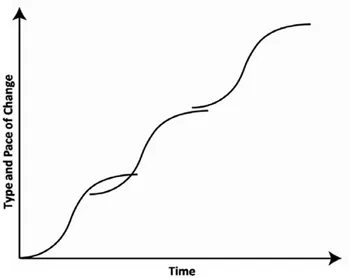
Figure 1.1 Step-phase changes
The aforementioned examples of game-changing forces and the incremental and operational initiatives taken by many airlines lead to three clear recommendations. First, executives in the airline industry and related businesses should not continue to believe that the future will be a continuation of the past, plus or minus small deviations. The game-changing forces, along with other trends discussed in the next chapter, will most likely produce “step-phase changes,” illustrated in a broad brush-form in Figure 1.1. While a number of senior executives, obviously, have the foresight of potential “step-phase changes,” they are struggling for insight into how to conceive new business models while simultaneously optimizing their current business models.
An example of a company that leveraged its foresight of and insight into “step-phase changes” would be IBM. It was that leverage that changed a declining manufacturing business into a services business, in fact into an e-business, a term that was certainly popularized by IBM, if not coined by them. Similarly, Nokia is an example of a company that has propelled its brand to be in the top half dozen global businesses by understanding the rising customer expectations and changing customer behavior by virtually living in its customers’ shoes. In the airline business, examples of leveraging “step-phase changes” would include Emirates (with the matriculated execution of its global expansion, capitalizing on its geographic location, ultra long-range aircraft, and the economic development of the region), Ryanair, with its business model of charging ultra low fares and making profit through ancillary revenue, and Virgin, with the unique business model of expanding its powerful brand globally and “creating” its very own strategic alliance that spans Europe, Africa, Australia, and the US.
If the need to prepare for the “step-phase changes” in the upcoming business environment is the first recommendation, then the second recommendation is that airlines must align their organizations, internally and externally, to revitalize their business models by integrating innovation and managing risk. It is interesting to note that one of Thomas Friedman’s world “flatteners” (number 3) relates to the application for all internal departments to become “interoperable,” enabling work to flow smoothly and effectively.5 Likewise, Harold Sirkin’s recommendation in “globality” is that incumbent businesses need “to organize for collaborative arrangements, partnerships, and acquisitions with challengers.”6
Now, look at the typical building blocks within airline organizations, shown in Figure 1.2. Think, for a moment, how integrated the airline business is in the creation of its product, and the associated irony. Regardless of whether you start with the brand or strategy (interchanging the top two blocks in Figure 1.2), there is need for integration. To begin with, in the airline business, network and brand are inextricably linked. However, at many airlines both brand and strategy seem to be missing. Look next at the two outside blocks. Customers are unhappy, at least in the US, and, as for distributors, many airlines are trying to distance themselves and go direct, as much as possible. Again, such a situation is ironical, given that in many regions, and for some segments, distributors can add lot of value (either brick-and-mortar, or online, or both types). While the airlines are working with the three pillars shown in the bottom row of Figure 1.2, most airlines are too often functioning in an isolated manner, and technology is dead on arrival. It is ironical that, whereas technology should be the dynamic linkage between these building blocks, instead, too often, it is a constraint for integrating strategies and breaking silos to introduce innovation. It is this lack of integration that has lead to, for example, (a) inconsistent customer experience (over time, during different phases of the trip, or within an alliance), and (b) the ineffectiveness of action to achieve consistent and across the board product profitability.
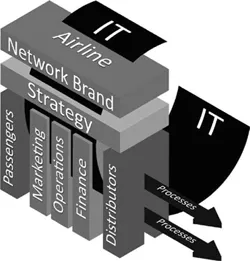
Figure 1.2 Misalignment within airline organizations
Moving to the third recommendation, if, as Sirkin says in “globality,” this means that everyone is competing from everywhere for everything, then the role of branding becomes even more important than ever before. At the beginning of 2008, in order to travel between Mumbai and San Francisco, a passenger had a choice of selecting a US airline, a European airline, or an Asian airline. In June 2008, a passenger could fly on an Indian airline, and in October 2008, on an airline based in the Gulf region of the Middle East. On top of that, as mentioned earlier, passengers are getting more demanding and more discerning. Let us also not forget that consumers from the developing economies are also rapidly beginning to care about differentiation and brand values. Consequently, the branding function, with the exception of a few airlines, has been initially done poorly, and must now be addressed much more seriously with a commitment from the top management and the involvement of all.
The aforementioned three recommendations reflect the general framework of this book. Noted futurists are envisioning a world that is radically different from the past, not just from the viewpoint of consumers and suppliers, but also from the viewpoint of societies in general. The emerging world, described by such words as “flattening” and “globality,” will bring both challenges and opportunities. In the case of airlines, those who are willing to adjust and adapt in line with the “step-phase changes” will finally earn sustainable margins that exceed their cost of capital. In the category of others, some will fail, some merge, some shrink, some will become more dependent on their governments, and some will become simply irrelevant.
Chapter 2 identifies some key trends that could change the way the airline business is conducted. Examples of these trends include “demanding” consumers worldwide, the emergence of “killer” competitors, and the emergence of “disruptive” technologies that are making customers “smart” and “demanding” on the one hand, and competitors increasingly powerful on the other hand. It is important to recognize that while each trend discussed is sufficiently significant by itself, it is the confluence of trends that leads to the potential emergence of “step-phase changes.” Such a confluence will be a challenge for most airlines, but an opportunity for few.
Chapter 3 focuses on the need to think through some thought-provoking scenarios—stories of futures relating to the global airline industry. There are two parts of these scenarios. First, a scenario can relate to the economic and business-related developments outside the airline industry, but have an impact within the airline industry, such as the developments in the Gulf region of the Middle East. The second part relates to the potential aviation-related developments within the aviation industry, such as the development of ultra long-range aircraft and the proliferation of the liberalization movement.
To deal with the challenges and opportunities resulting from the trends and scenarios discussed in Chapters 2 and 3, Chapter 4 deals with the need to transition from traditional management, based on functions, to integrative management, based on the creation of innovation and value, by integrating the end-to-end process. If the conventional business models, management thinking, and business-strategy levers are inadequate to deal with the future trends and scenarios, then how do we close the gap between the airline management practices/systems that we have and integrative airline management practices/systems that we need? This chapter sheds light on this question.
Since this book deals with emerging trends and one major emerging trend relates to social technology, Chapter 5 deals with the growth of the social networking phenomena. The social Web has evolved from people using search engines, to using blogs, to collaboration among users at various levels. Where is this phenomenon going, and what does it mean for airlines? This chapter provides a brief overview of the Web evolution and its implications for businesses, including airlines. The second part of the chapter provides a brief introduction to online communities, some examples of businesses that have used the power of communities to their own advantage, and a glimpse into how airlines can transform themselves by proactively riding the social technology wave.
The social networking phenomenon discussed in Chapter 5 is now becoming integrated into the broader marketing function. As a result, Chapter 6 begins with some observations on how the world of marketing has evolved from one in which the suppliers were in the driver’s seat to one in which customers now sit in the driver’s seat. Think seriously about the recommendation from A.G. Lafley, the Chairman and CEO of Procter & Gamble: “Make consumers and customers the boss, not the CEO or the management team.”7 Within the much larger sphere of marketing, this chapter focuses on just two areas that have significant impact on the global airline industry: branding and passenger loyalty. If the airline business has become a commodity, as many writers believe, then effective branding can help to differentiate services, enable the successful airlines to receive a premium for their services, and build sustainable loyalty.
The power of branding is substantiated in Chapter 7 where the reader is taken on a worldwide tour of an extremely broad array of 20 businesses that have developed successful brands: from Starbucks in the US, to BMW in Europe, to the Park Hotels in India, to Banyan Tree Hotels and Resorts in Singapore, to Samsung in Korea, to Shiseido in Japan, and to Cemex in Mexico. This chapter synthesizes not only insights from this extremely broad array of businesses based around the world, but also provides one or two key takeaways for airlines. Airlines may want to keep in mind that the same customers of these global brands may also shop for and buy airline services.
The final chapter deals with a question that was summarized from the comments of some readers of the draft contents of the first seven chapters. “O...
Table of contents
- Cover
- Half Title
- Title Page
- Copyright Page
- Dedication Page
- Table of Contents
- List of Figures
- List of Abbreviations
- Preface
- Foreword by Professor Israel (Izzy) Borovich, Chairman of the board, EL AL Israel Airlines
- Foreword by Russell Chew, President and Chief Operating Officer, JetBlue Airways
- Foreword by Tim Clark, President, Emirates Airline
- Foreword by Dr. Andres Conesa, Chairman and Chief Executive Officer, AeroMexico
- Foreword by Geoff Dixon, Chief Executive Officer, Qantas Airways
- Foreword by Mark Dunkerley, President and Chief Executive Officer, Hawaiian Airlines
- Foreword by Gary Kelly, Chairman, President, and Chief Executive Officer, Southwest Airlines
- Foreword by Dr. Temel Kotil, Chief Executive Officer, Turkish Airlines
- Foreword by Pham Ngoc Minh, President and Chief Executive Officer, Vietnam Airlines
- Foreword by Captain David Barioni Neto, Chief Executive Officer, TAM Airlines
- Foreword by Fernando Pinto, Chief Executive Officer, TAP Portugal
- Foreword by Steve Ridgway, Chief Executive, Virgin Atlantic Airways
- Foreword by Girma Wake, Chief Executive Officer, Ethiopian Airlines
- Acknowledgements
- 1 Introduction
- 2 Monitoring Über Trends
- 3 Game Changing: Potential Airline Scenarios
- 4 Are Airline Managements Prepared?
- 5 Social Networking Phenomena
- 6 Building Airline Brands and Developing Loyalty
- 7 Gaining Insights from Non-Airline Brands Around the World
- 8 Preparing for Tomorrow
- Index
- About the Author
Trusted by 375,005 students
Access to over 1.5 million titles for a fair monthly price.
Study more efficiently using our study tools.
Frequently asked questions
Yes, you can cancel anytime from the Subscription tab in your account settings on the Perlego website. Your subscription will stay active until the end of your current billing period. Learn how to cancel your subscription
No, books cannot be downloaded as external files, such as PDFs, for use outside of Perlego. However, you can download books within the Perlego app for offline reading on mobile or tablet. Learn how to download books offline
Perlego offers two plans: Essential and Complete
- Essential is ideal for learners and professionals who enjoy exploring a wide range of subjects. Access the Essential Library with 800,000+ trusted titles and best-sellers across business, personal growth, and the humanities. Includes unlimited reading time and Standard Read Aloud voice.
- Complete: Perfect for advanced learners and researchers needing full, unrestricted access. Unlock 1.5M+ books across hundreds of subjects, including academic and specialized titles. The Complete Plan also includes advanced features like Premium Read Aloud and Research Assistant.
We are an online textbook subscription service, where you can get access to an entire online library for less than the price of a single book per month. With over 1.5 million books across 990+ topics, we’ve got you covered! Learn about our mission
Look out for the read-aloud symbol on your next book to see if you can listen to it. The read-aloud tool reads text aloud for you, highlighting the text as it is being read. You can pause it, speed it up and slow it down. Learn more about Read Aloud
Yes! You can use the Perlego app on both iOS and Android devices to read anytime, anywhere — even offline. Perfect for commutes or when you’re on the go.
Please note we cannot support devices running on iOS 13 and Android 7 or earlier. Learn more about using the app
Please note we cannot support devices running on iOS 13 and Android 7 or earlier. Learn more about using the app
Yes, you can access Flying Ahead of the Airplane by Nawal K. Taneja in PDF and/or ePUB format, as well as other popular books in Business & Business General. We have over 1.5 million books available in our catalogue for you to explore.