eBook - ePub
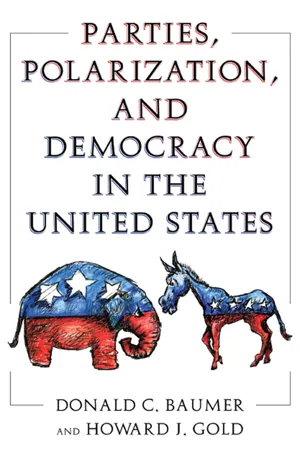
Parties, Polarization and Democracy in the United States
- 256 pages
- English
- ePUB (mobile friendly)
- Available on iOS & Android
eBook - ePub
Parties, Polarization and Democracy in the United States
About this book
As evidenced in the 2008 elections and the transition to a new era of Democratic governance, one of the most important developments in American politics in recent years has been the resurgence of political parties. Democrats and Republicans represent different world views and policies, citizens recognise these differences, and many of them use party labels to make sense of the political world. Parties, Polarisation and Democracy in the United States describes and analyses the place of political parties in American politics today - both among elites and citizens at large. Many scholars and pundits denounce political polarisation; they view it as a symptom of a broken political system that provides unappealing choices for voters and that is frequently mired in deadlock. Baumer and Gold make a different argument - that party polarisation offers the kind of choice and accountability to voters that was not always present in earlier periods of American political history.
Information
CHAPTER 1
Political Parties in the Twenty-First Century
Polarization, especially in the form of partisan polarization, has been the dominant theme of American politics over the last twenty years. It has been written about in numerous books and articles, and talked about extensively by politicians, media pundits, and ordinary citizens. Our most recent presidents, George W. Bush and Barack Obama, made frequent statements deploring the state of partisan relations, both as candidates and while in office. In the judgment of most scholars, Bush never fulfilled his promise to be a “uniter, not a divider,” and Obama’s early efforts at bipartisan policymaking were not particularly successful.1 In his first major legislative test, his economic stimulus proposal, Obama managed to get all of three Republican votes in the Senate and none in the House of Representatives.2
Numerous political observers have linked partisan polarization to deeper cultural divisions within American society. Sociologist James Davison Hunter was the first scholar to put forth the notion that America was riven by deeply rooted political and cultural differences:
The heart of the culture war argument was that American public culture was undergoing a realignment that, in turn, was generating significant tension and conflict. These antagonisms were playing out not just on the surface of social life (that is, in its cultural politics) but at the deepest and most profound levels, and not just at the level of ideology but in its public symbols, its myths, its discourse, and through the institutional structures that generate and sustain public culture.3
An especially memorable partisan expression of Hunter’s culture war thesis came in the form of a speech by Patrick Buchanan at the 1992 Republican convention, where he said, among other things:
The agenda Clinton and Clinton would impose on America—abortion on demand, a litmus test for the Supreme Court, homosexual rights, discrimination against religious schools, women in combat—that’s change, all right. But it is not the kind of change America wants. It is not the kind of change America needs. And it is not the kind of change we can tolerate in a nation that we still call God’s country …
My friends, this election is about much more than who gets what. It is about who we are. It is about what we believe. It is about what we stand for as Americans. There is a religious war going on in our country for the soul of America. It is a cultural war, as critical to the kind of nation we will one day be as was the Cold War itself. And in that struggle for the soul of America, Clinton & Clinton are on the other side, and George Bush is on our side. And so, we have to come home, and stand beside him.4
To be sure, not all analysts share the Hunter/Buchanan position that America is fundamentally divided over political and cultural issues. In their acclaimed book Culture War? The Myth of a Polarized America, political scientist Morris Fiorina and his colleagues accept the notion of a major divide between partisan elites, but they do not believe that this extends to the mass public.5 Most Americans, they believe, are somewhere in the middle on the leading political and cultural issues, which means that their true preferences are not reflected in the choices presented to them by partisan elites. In this book we will argue that American political parties represent sharply different values, policies, and constituencies, that the American public recognizes these sharp differences, and that this partisan polarization runs deeply into the electorate. We will also argue that there are many reasons to believe that the current state of party politics is healthy for the American republic.
Political parties exist to win elections; thus fierce competition between parties should be expected. Rival parties offering contrasting positions on vital issues of public policy is an essential element of a functioning democracy. Most voters need the kind of guidance that contending parties provide in order to make sense out of the choices they are offered in elections. Although citizens are turned off by public displays of personal animosity by politicians, they also want and expect elected officials to vote their consciences and to stand up for the political principles and policy positions they espoused during election campaigns.6 Whether they recognize it or not, people’s attitudes and beliefs about politics and politicians contribute to political conflict. Without conflict there is no meaningful democracy.
The logic of conflict expansion and its relationship to democracy is explained cogently and persuasively by political scientist E. E. Schattschneider.7 He argues that politics is much like a street fight: it attracts attention and draws people in. Soon the original combatants get lost, as those in the audience become participants. Conflict is contagious, and the outcome of political battles is ultimately determined by the size of the contending sides, or the “scope of conflict.” Thus most of politics is about trying to draw more people into the fray to change the balance between the winning and losing sides. If a political system is open, and thus democratic, conflicts should expand to the point that anyone who wants to participate will have a chance to do so. Often those with political power try to limit the scope of conflict to maintain their competitive advantage. For example, white Southerners prevented black Southerners from voting for many years as part of an effort to stop them from gaining the political power necessary to change their situation of oppression. A similar analysis can be used to explain most of the great political battles in American history, which basically involve some interests (usually powerful ones) trying to “privatize” conflict, while others (aspiring interests) try to “socialize” it. For Schattschneider, conflict expansion and democracy are synonymous, and political parties are the primary engines of conflict expansion.
If political conflict among major parties is essential to democracy, what does this say or imply about polarization? Using standard definitions of the two terms, polarization would appear to be an extreme form of conflict—one in which political actors congregate at opposite ends (or poles) of political or ideological spectrums.8 And, while the image of increasing congregation at the extremes does fit many aspects of contemporary politics, not every important political battle in American government is a reflection of a state of polarization. However, the thrust of our argument, which we support with copious amounts of data, is that the political differences among Americans are real and important, and the parties have captured (perhaps exploited) these differences in ways that are understandable to most citizens.
Political Parties and American Democracy
E. E. Schattschneider, who was perhaps the best known political science expert on political parties in his day, is often quoted as stating, “Political parties created democracy, and modern democracy is unthinkable save in terms of political parties.”9 What Schattschneider had in mind in making this assertion are the crucial functions parties perform in democratic political systems. These functions distinguish parties from all other political actors in fundamentally important ways.
First, political parties serve as integrative agents for the electorate. This means that they help citizens and groups to band together in broad coalitions to pursue their mutual interests. Since the days of Alexis de Tocqueville (circa 1830) Americans have been known for their propensity to form groups, or “associations,” to protect and/or advance specialized interests.10 The multiplicity of groups in this country tends to fragment, rather than integrate, the political community. Parties provide the most important and effective counterforce to the tendency toward fragmentation. For the contemporary Republican party, this means bringing together religious and socially conservative groups, who are primarily interested in issues such as abortion, gun control, and gay marriage, with big and small business interests for whom taxes and government regulatory policy are the most important concerns. For Democrats the integrative task involves linking blue collar workers/unions with certain professionals, especially teachers and lawyers, and with liberal cause groups, such as those interested in civil rights, women’s rights, and environmental protection. In Chapters 2 and 3 we examine the constituent parts of each party in some detail.
Second, and perhaps most fundamentally, parties serve as electors. This is the sine qua non of their existence; parties that cannot elect their own to public office soon disappear. National, state, and local party organizations try to identify promising candidates around the country to run for elected positions, and then try to help such candidates in a variety of ways. This help includes everything from supplying them with consultants, who conduct polls and develop media advertisements, to providing them with money, which can be given directly to candidates or spent indirectly on their behalf.11 Although the literature on American elections emphasizes the “candidate centered” nature of the electoral process and the limited control that party organizations have over who runs for office under their labels around the country, both major parties have developed elaborate machinery for helping their candidates win office (see Chapter 4). Much of this machinery is devoted to establishing a connection between voters and candidates. In recent elections, most Democratic and Republican candidates have staked out discernibly different positions on the key issues of the day, which has enabled large numbers of voters to make rational decisions about which candidate they prefer. Parties are by far the most important source of voting cues for the average voter. We will explore this connection in depth in Chapter 2.
Third, parties play a central role in the governing process. After the election results are tallied, and legislatures and chief executives set out to organize themselves to conduct business, the influence of party in these organizing decisions is pervasive. At the national level, the party organizations in the House and Senate are the backbones of their respective institutions. Voting on all matters of organization, such as who will be Speaker of the House and who will chair the legislative committees, goes strictly along party lines. The leaders of the majority party are the most powerful actors in each institution; and the different facets of the legislative process, from committee/subcommittee deliberations to floor voting, are heavily influenced by, if not controlled by, the majority party leadership (particularly in the House). In recent years, Republicans and Democrats have shown an increasing tendency to vote in unison, or near unison, on key policy matters. Much the same is true in many state legislatures.12 On the executive side, the nominations and appointments presidents and governors make to high-level positions in their administrations, and to the judiciary, go overwhelmingly to members of their party. Not surprisingly, the relationship between legislatures and chief executives is dominated by partisan considerations. The role of parties and partisanship in the governing process is analyzed in Chapter 5.
A Brief History of Political Parties in the United States
The history of political parties in the United Sates is usually told by identifying five (or six) different party systems that have held sway at different points in time.13 The first party system, which emerged during George Washington’s presidency (1789–1797) featured the debate over Alexander Hamilton’s (Secretary of Treasury under Washington) various initiatives for building up our new nation. Hamilton’s program consisted of instituting protective tariffs to protect America’s fledgling industry from British imports; an ambitious set of public works projects to facilitate trade, transportation, and western expansion; the development of a strong military for protection against hostile foreigners; and the establishment of a sound currency policy by instituting a National Bank and paying off Revolutionary War debts. These initiatives were opposed by southern and agricultural interests led by Thomas Jefferson and James Madison, who argued for limited government (laissez faire) and states’ rights. Washington’s and Hamilton’s group were known as the Federalists, Jefferson’s as the Republicans (or Democratic-Republicans).
By the early 1800s, Jefferson’s party dominated, although once in power (under presidents Jefferson, Madison and Monroe) they retained many of Hamilton’s programs. The Federalists faded out of existence by 1816, and the Democratic-Republicans enjoyed one-party rule until 1824. Modern-day Democrats trace their roots to Jefferson’s party, even though the party did not drop the “Republican” part of its name until the 1820s. Neither of these early parties had much of a grassroots base or public following; they were largely elite-level organizations.
The second party system ran from 1824 to just before the Civil War. The key figure in the early part of this period was Andrew Jackson, who is generally credited with opening up national politics to rank and file voters, especially those residing in states outside of the Atlantic seaboard. Jackson whipped up, and then rode, popular resentment against the “Eastern aristocrats” to the presidency in 1828. He then teamed with his vice president, Martin Van Buren, to build the first truly national political party in the country’s history. Their party-building efforts culminated in the staging of the first national political party convention, held in Baltimore in 1832 (to renominate Jackson for president). Another important manifestation of “Jacksonian democracy” was that more and more states opened up voting eligibility in presidential elections to white male citizens, thus creating a national electorate. (Prior to this, most states chose their Electoral College delegations by vote of the state legislature.) The percentage of the eligible electorate voting in presidential elections rose from around 20 percent in 1820 to more than 75 percent by 1840.14
The opposition to the Democrats, the Whigs, led originally by Henry Clay and Daniel Webster, succeeded in winning the presidency on two occasions: the elections of 1840 and 1848. The campaign of 1840 was quite colorful, with the Whigs promoting their candidate William Henry Harrison, the hero of the Battle of Tippecanoe, as a man of the people against incumbent President Martin Van Buren, whom they accused of rampant corruption. The public pageantry that accompanied this campaign was very elaborate.15 Harrison, of course, died shortly after taking office. In 1848, the Whigs nominated another war hero, Zachary Taylor, who beat Democrat Lewis Cass. (The ever persistent Martin Van Buren ran as the nominee of the newly created Free Soil Party, but received few votes.) The Whigs stood for many of the same policies as Hamilton, thus favoring northern commercial interests over southern agricultural interests. Neither party knew exactly what to do with the most important and explosive issue of the era: slavery.
The third party system was mainly about the emergence of the Republican Party as a dominant national political force. The Republicans began in 1854 as a party unified in opposition to the expansion of slavery outside of the South. This position was unacceptable to Southern Democrats, and when Abraham Lincoln was elected to the presidency in the 1860, the Civil War broke out. During and after the Civil War, the Republicans were able to consolidate and hold power over national government until 1876. In the famous election of 1876, Democrat Samuel Tilden won the popular vote over Republican Rutherford B. Hayes, but eventually lost the presidency when the Electoral College votes from several Southern states were disputed, and a specially appointed electoral commission voted for Hayes strictly along party lines. Democrats in Congress finally agreed to this outcome after they made a deal with Republicans to accept the Hayes presidency in exchange for a pledge to end Reconstruction by removing U.S. troops from the South.16 Perhaps the most significant outcome of this agreement was that white Southerners were able to deny Black Americans in the South the civil rights and voting rights they had supposedly been guaranteed by the Fourteenth and Fifteenth amendments, which Republicans had passed during their period of dominance following the war.
For most of the remainder of the nineteenth century the two major parties, Democrats and Republicans, were fairly evenly matched at the national level. Republicans won three of five presidential elections (Hayes in 1876, Garfield in 1880, and Benjamin Harrison in 1888) and controlled the Senate for eight of the ten Congresses (45th through 54th). Democrats had a majority in the House of Representatives in eight out of the ten Congresses, and elected Grover Cleveland to the presidency twice (in 1884 and 1892).
During the latter part of the nineteenth century, and continuing into the twentieth century, party politics revolved around the activities of organizations known as “party machines,” which existed in most large cities in the United States, including New York, Boston, Philadelphia, Pittsburgh, and St. Louis.17 The machines were built on the backs of newly arrived immigrants from Europe who welcomed the favors—in some cases even the employment—the machine politicians offered in exchange for political loyalty. Exploiting this loyalty, machine “bosses” could control elections in municipalities around the country, and then use their access to public officials to create even more benefits for their followers. The machines, and a group of super-rich industrialists called “Robber barons,” were two sources of extensive corruption that typified the politics of the late nineteenth-century America. Two new movements arose in reaction to this unchecked power and corruption: the Populist Movement and the Progressive Movement. The former included mostly farmers and had a strong...
Table of contents
- Cover
- Half Title
- Title Page
- Copyright Page
- Table of Contents
- List of Tables, Figures, and Appendices
- Acknowledgments
- 1 Political Parties in the Twenty-First Century
- 2 Parties and the Electorate I: Images of the Parties
- 3 Parties and the Electorate II: The Dynamics of Party Polarization
- 4 The Midterm Elections of 1994 and 2006
- 5 Parties in Power: Congress, Presidents, Partisanship, and Gridlock
- 6 Political Parties in Anglo-America
- 7 Looking Backward and Forward: The Election of 2008 and the Future of American Politics
- Notes
- Index
- About the Authors
Trusted by 375,005 students
Access to over 1.5 million titles for a fair monthly price.
Study more efficiently using our study tools.
Frequently asked questions
Yes, you can cancel anytime from the Subscription tab in your account settings on the Perlego website. Your subscription will stay active until the end of your current billing period. Learn how to cancel your subscription
No, books cannot be downloaded as external files, such as PDFs, for use outside of Perlego. However, you can download books within the Perlego app for offline reading on mobile or tablet. Learn how to download books offline
Perlego offers two plans: Essential and Complete
- Essential is ideal for learners and professionals who enjoy exploring a wide range of subjects. Access the Essential Library with 800,000+ trusted titles and best-sellers across business, personal growth, and the humanities. Includes unlimited reading time and Standard Read Aloud voice.
- Complete: Perfect for advanced learners and researchers needing full, unrestricted access. Unlock 1.5M+ books across hundreds of subjects, including academic and specialized titles. The Complete Plan also includes advanced features like Premium Read Aloud and Research Assistant.
We are an online textbook subscription service, where you can get access to an entire online library for less than the price of a single book per month. With over 1.5 million books across 990+ topics, we’ve got you covered! Learn about our mission
Look out for the read-aloud symbol on your next book to see if you can listen to it. The read-aloud tool reads text aloud for you, highlighting the text as it is being read. You can pause it, speed it up and slow it down. Learn more about Read Aloud
Yes! You can use the Perlego app on both iOS and Android devices to read anytime, anywhere — even offline. Perfect for commutes or when you’re on the go.
Please note we cannot support devices running on iOS 13 and Android 7 or earlier. Learn more about using the app
Please note we cannot support devices running on iOS 13 and Android 7 or earlier. Learn more about using the app
Yes, you can access Parties, Polarization and Democracy in the United States by Donald C. Baumer,Howard J. Gold in PDF and/or ePUB format, as well as other popular books in Politics & International Relations & American Government. We have over 1.5 million books available in our catalogue for you to explore.