The writers known as the English deists were not simply religious controversialists, but agents of reform who contributed to the emergence of modernity. This title claims that these writers advocated a failed ideology which itself declined after 1730. It argues for an evolution of their ideas into a more modern form.
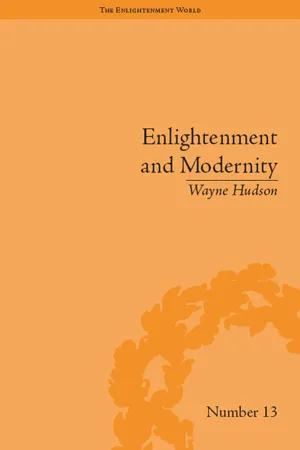
- 240 pages
- English
- ePUB (mobile friendly)
- Available on iOS & Android
eBook - ePub
About this book
1 Deism, Enlightenment and Modernity
DOI: 10.4324/9781315653433-1
Introduction
Contemporary debates about the Enlightenment have reawakened interest in early critics of Christianity and underground heterodoxy. In this context the writers known to historians as the English deists deserve to be read without the legacy of prejudice which nineteenth-century critics brought to their texts. Charles Blount (1654–93), John Toland (1670–1722), Anthony Collins (1679–1729), Matthew Tindal (1656–1733), Thomas Woolston (1669–1733), Conyers Middleton (1683–1750), Thomas Chubb (1679–1747), Thomas Morgan (d. 1743) and Peter Annet (1693–1769) were more complex and nuanced figures than much of the historiography suggests,1 and also significant agents of reform in a range of important areas.
These writers have proven more difficult to interpret than general works on the Enlightenment tend to imply. The term ‘the English deists’ itself is controversial, and is used here as a label for constellationally related writers whose historical significance depends on contextually related publications.2 This interpretation, which I introduced in my first volume, The English Deists: Studies in Early Enlightenment (2009), and further elaborate in the present volume, directs research away from the over-unified conceptions of the older historiography, which tended to assume that the English deists were the deists in England. More recently, revisionist historiography has tended to argue either that these writers were Protestant Christians, and so not perhaps deists in any substantive sense, or that some of them (Blount, Toland, Collins, Tindal) were more radical than the term ‘deist’ suggests.3 My work, in contrast, introduces a more contextual interpretation which emphasizes the multiple personae these writers exercised and the diversity of their contributions to the Enlightenment. This interpretation does not reduce either the lives or the publications of these writers to manifestations of ‘deism’. Nor do I claim to know what these writers privately believed. Instead, I emphasize the need for contextual readings of their texts.4
Many of these writers wrote texts with more than one level of meaning, and not, as historians have tended to assume, texts with a single ‘deist’ meaning. Further, all these writers were more complex contextual figures than polemical characterizations from the period suggest. In this first chapter I revisit and clarify further my revisionist approach to these writers, the evidence for which is provided in later chapters and in my previous volume, The English Deists.
Most of the older historiography dealing with ‘English deism’, ‘British deism’ and ‘the English deists’ deploys a hermeneutic framework which assumes that these writers were deists in an exclusive identitarian sense. This hermeneutic framework, which has shaped much of the historiography in all European languages, is organized around assertions which frequently go beyond what we know. My approach to these writers, in contrast, does not assume in advance that they were deists, infidels or atheists in an exclusive identity sense. I also qualify interpretations which play down the presence of deism, resort to purely rhetorical interpretations or imply that these writers were simply Christians.5 In many cases these writers wrote Protestant texts which opened Christianity to objection, or which exaggerated the sufficiency of natural religion, without any need of revelation. Their surface arguments, however, were often not deist but rational Protestant. Put simply, these writers implied more than they said, but what they implied was disputed because they did not set out their private views in their texts.
The pattern of interpretation which sees these writers as ‘Infidels’ trying to destroy Christianity has its origins in Christian polemic, which itself should warn us against taking it at face value. It owes much to John Leland’s View of the Principal Deistical Writers that have Appeared in England in the Last and Present Century (1754–6). In this work Leland dealt with writings ‘the manifest design of which was to set aside revealed religion’:
No man that is not utterly unacquainted with the state of things among us can be ignorant, that in the last, and especially in the present age, there have been many books published, the manifest design of which was, to set aside revealed religion. Never in any country where Christianity is professed, were there such repeated attempts to subvert its divine authority, carried on sometimes under various disguises, and at other times without any disguise at all.6
Leland assumed that the design of these works was evident to all, and then construed these writings as so many attempts to make objections to Christianity and to set up for natural religion in its place. Leland adopted an epistolary mode. Some authors were the subject of many letters (Bolingbroke and Hume), whereas others were treated in only one letter. He concentrated on objections to Christianity taken out of context, and drew attention to works by Christian authors which he alleged had successfully answered them. Despite his inordinate length (three volumes), he did not analyse any work in depth, or discuss all the writings of any author.7
The assumption that these writers held a single non-orthodox conception of God is harder to track, although it is implied in some apologetic works written against them,8 and came to be widely accepted, partly in the light of discussions in France. It is a form of Begriffgeschichte, written in the history of heresies mode, which posits organizing philosophical concepts behind the surfaces of texts. The notion that these writers were deists in a philosophic history sense needs to be treated with caution, however, because it easily builds orthodox Christian propaganda into the terms of analysis. There were deists in England, but, apart from Annet, the writers known as the English deists did not claim in print to have a special deistic conception of the nature of God. Further, the mutations of heterodox and unorthodox philosophical and religious thought cannot be understood in terms of a single pervasive ‘deism’. Seventeenth-century deism was multiple, although the fact that seventeenth-century deists had held a plurality of positions was subsequently forgotten, just as the polemic against Hobbes and Spinoza as deists in the sense of ‘improper theists’ was confused with the views of deists setting up for natural religion with a list of universally accepted doctrines.
In The English Deists I emphasized that these writers need to be read in the context of Protestant Enlightenment in England, and in terms of the wider constraints of Early Enlightenment.9 Early Enlightenment was more pluralist, exploratory and tentative than High Enlightenment, and occurred against a background of less developed political and social conditions. This means that in construing the works of these writers there is a need to avoid over-interpretations which reduce their message to only one of the strands in the texts they wrote. The writers known as the English deists, I argued, did not necessarily have exclusive single religious identities of the kind historians have attributed to them.
In this volume I continue to elaborate this interpretation, taking account of changes in regime and the politics of publication in the course of the eighteenth century. Protestant Enlightenment became more open to the public discussion of ideas as the century passed, including ideas which had once been clandestine, and the term ‘Early Enlightenment’ works less well for the period 1730–60. Nonetheless, it is crucial to take account of the contextual specificities of Protestant Enlightenment in England, while recognizing that the older notion of an ‘English Enlightenment’ requires some qualification. Many of these writers were aware of European heterodoxy and may have seen clandestine manuscripts, and their works were characterized by a degree of non-disclosure. To this extent, both ‘deist’ and ‘Christian’ readings of their writings tend to be insensitive to the textual politics of their lives, and to the limitations on publication which they took for granted. None of these writers should be read as if they set out their private thoughts in their books.
Multiple Personae
In the first volume of this work I attempted to undermine various myths about ‘English deism’. To do so, I discussed the genealogies of deism, and the need to achieve more multivalent readings of both Herbert of Cherbury and Charles Blount and his circle if we are to appreciate the role that multiple deisms, European heterodoxy and clandestine manuscripts played in some versions of seventeenth-century deism. I then used this seventeenth-century background to read Toland, Collins and Tindal as three writers operating in the context of Protestant Enlightenment and its theological debates, but against a background of multiple deisms, heterodoxy and both clandestine and scribal publication.
The writers known as the English deists were constellationally related controversialists, working with various publics for a range of purposes. Contextual and constellational considerations make them the writers known as the English deists, not the fact that they were ‘the deists in Britain’,10 which they were not. In the lived reality of their lives these writers enterained a range of personae in different social roles, and when addressing different audiences. Blount needs to be understood with reference to a tensional field of arguments and comportments and as the producer of multilayered dialectical texts. He was a man of the world, a philosopher, a religious radical, an Old Whig and a libertine who mixed in the highest circles and had different faces for different audiences. From an eminent country family, Blount was friendly with the poet and playwright John Dryden and may have known Archbishop Tillotson. In his political activities he was a Low Church Protestant. At a more private level he circulated classical texts and heterodox manuscripts among a circle interested in classical philosophical texts promoting esoteric materialism and Stoic pantheism. At yet another and more public level Blount published works full of insinuations against revealed religion. Nonetheless, although he was interested in multiple deisms and circulated at least two different deist systems, his activities were not reducible to deism. Blount modified Herbert of Cherbury’s arguments and made use of some of his materials in his attempts to cast doubt on revealed religion. In his writings he combined political Protestantism, classicism, multiple deisms and borrowings from English, French and Italian free thought. The heterodoxy Blount promoted was not the mild extension of religious liberalism which older historians associated with ‘English deism’, but to a significant degree classical, international and European. However, it was not his only focus of interest.
John Toland, Anthony Collins and Matthew Tindal continued this complex pattern. They were all Protestants, heavily immersed in contemporary theological debates. Specifically, they were radical Lockeans, who developed Locke’s Ideism in a reductionist direction. They were also Whigs, who sought to restrict the power of the Church and to promote political, religious and cultural change, where these were closely connected. Although they may have been more indebted than some of the literature suggests to the radical deisms of the seventeenth century, including the works of Blount and Gildon, and to European heterodoxy, their comportments varied with audience and context, and neither deism nor heterodoxy was their only concern or interest.
Toland was a superb strategic writer and, despite a considerable scholarly literature to the contrary, no one knows what he really believed. At one level he was a Low Churchman, respected in Remonstrant circles. As a Whig propagandist, he wrote as a Protestant, prepared if necessary to take the sacrament. Privately, he circulated scribal publications and clandestine manuscripts, but, as Justin Champion has shown,11 even in these texts he offered different faces to different audiences. There were related differences in how he presented to audiences in Europe ranging from eminent theologians to Quakers to collectors of anti-Christian materials.
Toland, the civil theologian, was genuinely committed to promoting a rational Christianity, just as he was privately interested in pantheism and probably atheist arguments.12 For speculative purposes, he may have accepted some transformation of classical theistic naturalism, but deism, in this classical sense, was only one of his concerns, and only pertinent in some of his identities and social roles. It was an undercurrent rather than the main purport of his writings. As a classically-educated historian, Toland pursued a range of critical inquiries designed to expose fables and myths. Like Blount and Gildon, he was steeped in European heterodoxy, esoteric materialism and Renaissance naturalism, and entertained radical ideas in many different areas.
Anthony Collins was an unbeliever, with no specific system to defend. He was involved with underground heterodoxy in Europe, collected clandestine materials and may have been interested in atheism, both as a speculative position and as a social possibility. In private, he argued on occasion against any form of revealed religion. Nonetheless, his works were more contextually aimed than this suggests, and were written dialectically at more than one level. For social purposes, Collins was a member of the Church of England who chose rational Christians as his close friends. As a Whig he was a Low Church Protestant, concerned to extend the right of free examination and impartial inquiry. As a civil philosopher, he was a ‘freethinker’ who relied on his own reason. As a speculative philosopher, he was a materialist who may have identified the infinite extended being within the universe, although this is uncertain.
Matthew Tindal was an outstanding civil lawyer and Senior Fellow of All Souls College, Oxford, forced to take holy orders. As a Whig pamphleteer concerned to defeat the High Church party and Jacobitism, he was a Low Church Christian, even if an anti-clerical one. As a lawyer, a civil philosopher and a political theorist, Tindal was immersed in liberal Protestant thought and comported himself as a Low Church Christian. He was also a leading advocate of Remonstrant ecclesiology in England, and adapted the Dutch concept of churches as voluntary associations to a country with an established national church. While it is possible that his interest in underground heterodoxy and free thought was more extensive than this suggests, he did not challenge orthodox Christianity directly until his last work, published when he was seventy-three. Even then he did not explicitly reject Christianity, but introduced ‘Christian Deism’ as a strategic position in the context of his controversy with Samuel Clarke. For most of his life, Tindal was an enemy of ‘priestcraft’, who encouraged his contemporaries to think freely about religion, natural philosophy and politics.
The less well-known writers in this group also defy simple compartmentalization. Thomas Woolston was a Cambridge divine and an expert on the Church Fathers, especially Origen. He became famous throughout Europe for his attack on Jesus’s miracles, but in England he was widely regarded as insane. Woolston insisted, however, on his rationality and sincerity in addresses to the Chief Justice, and in conversations with eminent contemporaries. He was a more serious theological thinker than the standard interpretations suggest, and may have had his own mystical theological scheme.
Conyers Middleton, who, like Herbert of Cherbury, belongs among these writers only at times for constellational reasons, was a Cambridge divine, sometime librarian of Cambridge University, first Professor of Geology at Cambridge, a distinguished classicist and a Whig as well as a ruthless religious controversialist. A champion of Protestantism whose loyalty came to be questioned, Middleton was an Erastian who never argued for deism as an alternative to Christianity as the public religion of England. As an academic in the classical sense, his views may have been less than orthodox, and he was full of contempt for popular religion and the orthodox divines who defended its superstitions. Middleton was always concerned to discover the truth, in contrast to ‘theorists’ wedded to their favourite ‘hypotheses’.
Finally, Thomas Chubb, Thomas Morgan and Peter Annet were popular writers of the period without influential political, legal or ecclesiastical roles. Chubb was a Low Church Protestant theologian with Arian or at least subordinationist views, a moral philosopher and a leading eighteenth-century political and social theorist. He attended his local Anglican parish church and was prominent in local debating societies. Morgan was a moral philosopher, a medical doctor, a Newtonian physico-theologian and a republican civil theologian as well as a bitter enemy of the law of Moses. Annet was a former clergyman, a school master, an educationist, a social reformer, an inventor and a poet, as well as the most notorious anti-Christian propagandist in England.
All of these writers wrote controversial texts on particular topics, but all of them were well established within their social worlds. They were not isolated ‘deists’, but regular members of the world of Protestant Enlightenment, and respected as such by their less prejudiced contemporaries. Moreover, they deployed their ...
Table of contents
- Cover Page
- Half-title Page
- Series Page
- Title Page
- Copyright Page
- Table Of Contents
- Acknowledgements
- 1 Deism, Enlightenment and Modernity
- Part I: Problematizing Revealed Religion
- Part II: Agents of Reform
- Appendix: Shaftesbury and Bolingbroke
- Notes
- Works Cited
- Index
Trusted by 375,005 students
Access to over 1.5 million titles for a fair monthly price.
Study more efficiently using our study tools.
Frequently asked questions
Yes, you can cancel anytime from the Subscription tab in your account settings on the Perlego website. Your subscription will stay active until the end of your current billing period. Learn how to cancel your subscription
No, books cannot be downloaded as external files, such as PDFs, for use outside of Perlego. However, you can download books within the Perlego app for offline reading on mobile or tablet. Learn how to download books offline
Perlego offers two plans: Essential and Complete
- Essential is ideal for learners and professionals who enjoy exploring a wide range of subjects. Access the Essential Library with 800,000+ trusted titles and best-sellers across business, personal growth, and the humanities. Includes unlimited reading time and Standard Read Aloud voice.
- Complete: Perfect for advanced learners and researchers needing full, unrestricted access. Unlock 1.5M+ books across hundreds of subjects, including academic and specialized titles. The Complete Plan also includes advanced features like Premium Read Aloud and Research Assistant.
We are an online textbook subscription service, where you can get access to an entire online library for less than the price of a single book per month. With over 1.5 million books across 990+ topics, we’ve got you covered! Learn about our mission
Look out for the read-aloud symbol on your next book to see if you can listen to it. The read-aloud tool reads text aloud for you, highlighting the text as it is being read. You can pause it, speed it up and slow it down. Learn more about Read Aloud
Yes! You can use the Perlego app on both iOS and Android devices to read anytime, anywhere — even offline. Perfect for commutes or when you’re on the go.
Please note we cannot support devices running on iOS 13 and Android 7 or earlier. Learn more about using the app
Please note we cannot support devices running on iOS 13 and Android 7 or earlier. Learn more about using the app
Yes, you can access Enlightenment and Modernity by Wayne Hudson in PDF and/or ePUB format, as well as other popular books in History & World History. We have over 1.5 million books available in our catalogue for you to explore.